

GIGGING
Team Spear It
THE GULF’S MOST DELICIOUS FISH MUST BE CAUGHT AT NIGHT
By Wes Ferguson
This story is part of “Night Shift,” a feature on nighttime adventures in Texas.
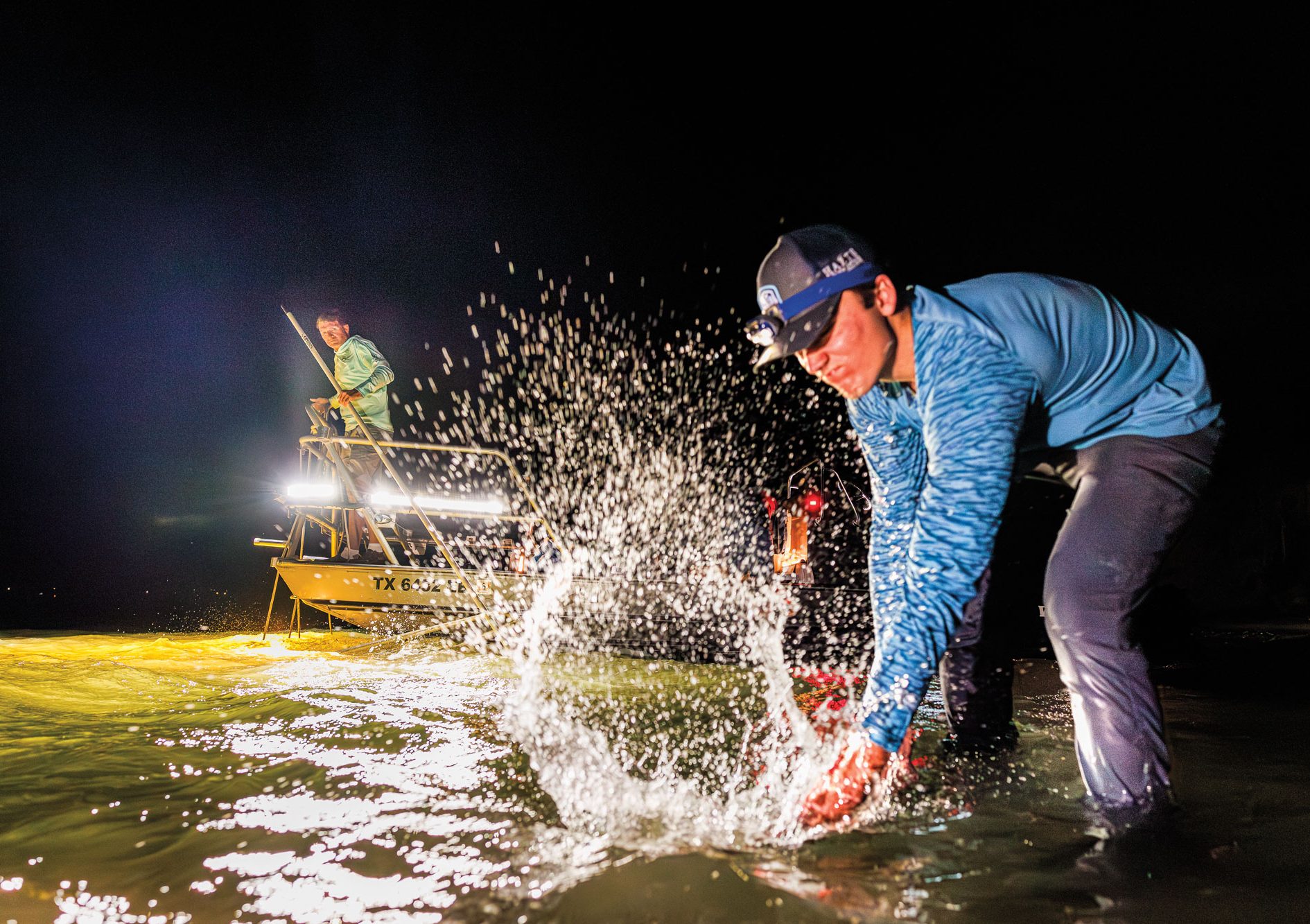
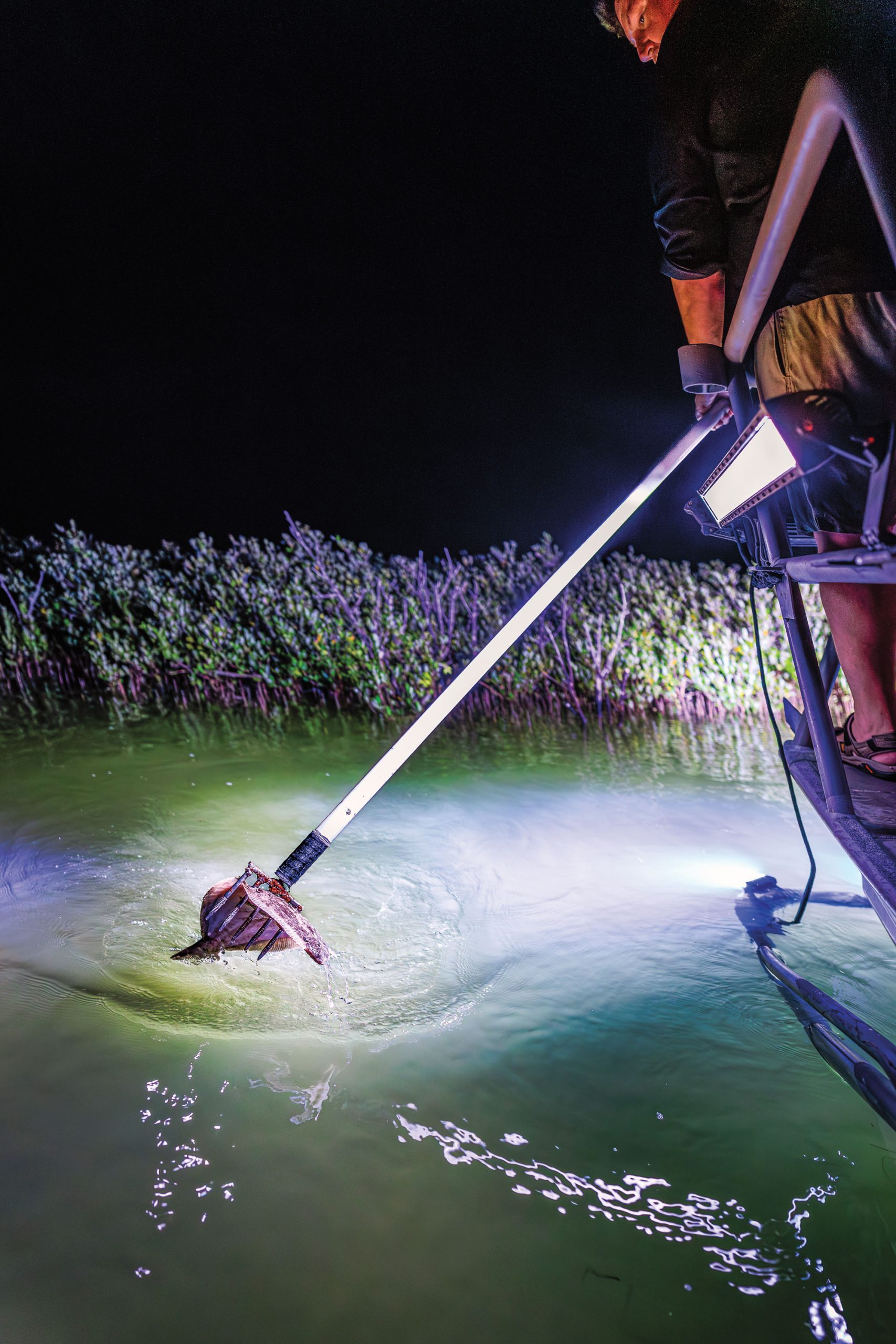
Tray Clark wasn’t trying to be such a backstabber. Not at first, anyway. It all started more than 30 years ago when some friends asked if he would take them flounder gigging in Port Aransas. Gigging is fishing using wooden poles of varying lengths, many of them exceeding 10 feet, with a row of sharp metal prongs mounted to the end.
Prowling the bays at night and jabbing fish with spears? Clark, formerly a commercial fisherman, was skeptical. “I was like, ‘I don’t know if that’s gonna happen or not,’” he recalls.
Clark was proven wrong within an hour when everybody in his group bagged their daily limit of southern flounder. The firm yet flaky fish has a delicate, slightly sweet flavor and is considered one of the Gulf’s most delicious. His friends went home and bragged to their friends. Clark’s phone has been ringing ever since.
“From there, it spread like wildfire. Nobody will let me stop doing it,” Clark says. Now the owner of gigging guide service Backstabber Charters, he’s never had to advertise his business.
One evening last October, a brilliant orange sunset is at Clark’s back as he captains his boat toward the flounder awaiting in Aransas Bay. Matt Streich, the Mark W. Ray CCA Texas endowed director of the Center for Sportfish Science and Conservation at Texas A&M University-Corpus Christi, rides with him.
“Flounder is an iconic species,” says Streich, who studies the fish and their fall migration from coastal bays to deeper water offshore. “With lights in the water, you’re seeing all kinds of species and habitat you don’t see during the day.”
Indeed, night is the only time to gig for flounder because they move into the shallows at dark, when their pancake-flat, mottled brown bodies are better camouflaged from birds and other predators—but not from humans wielding torches or lanterns.
Hundreds of years ago, the Karankawa stalked flounder around the Rockport area with cane poles sharpened into spears. Wading and gigging remains a time-honored tradition. In recent decades, though, gigging from the comfort of an airboat has exploded into a coastal craze, with professional guides running flounder along the entire Texas Gulf coast. The epicenter of the gigging economy is the mid-coast from Port O’Connor to Port Aransas, where clear water and abundant fish combine for the likeliest catch.
Clark speeds past the historical Lydia Ann Lighthouse, standing tall since the 1850s, and pulls his airboat along a grassy ridge where he expects flounder. They are easy to identify because they are the Gulf’s most common flatfish, though they don’t begin life that way. When they hatch, they swim upright like any other fish, with eyes on opposite sides of their heads. Once they grow to about half an inch long, however, their bodies compress, and one of their eyes begins a remarkable migration toward the other one. Once both eyes are positioned on top of their heads, they can lie flat on the ocean floor and keep watch on predators and prey swimming past, especially along the edges between shallow and deeper water.
“Flounder don’t chase fish,” Clark explains. “They put themselves in a position where fish will swim past. They’re opportunists, so they’ll sit for hours when they’re feeding.”
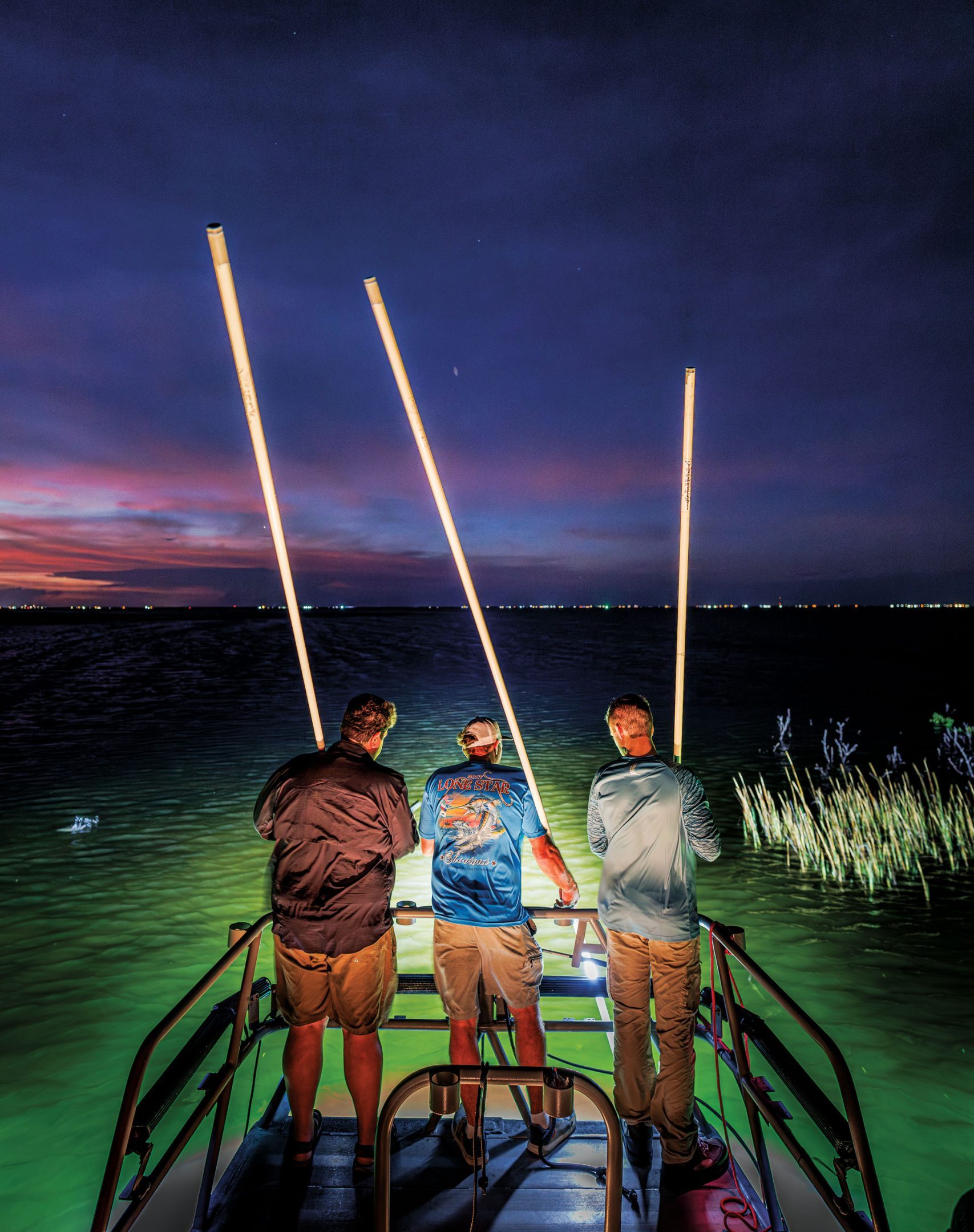
Clark follows the deepwater edge in his airboat, which can navigate water a mere 6 inches deep. Powerful, submerged LED lights illuminate a wild assortment of sea creatures including jellyfish, stingrays, blue crabs, mullet, and red drum.
“Don’t gig everything just because it swims,” Clark advises. “I’ll stop the boat when I see a flounder, and I’ll point at it.”
We stand at the prow, armed with our gigs.
“Use the gig like a pool stick,” Clark says, instructing us to grip the pole with our top hand and use our other hand to guide the gig toward the flounder. “Let it slide through your bottom hand. Go straight down and stab it.”
We are on the water that night before the first cold front of the fall, which triggers the flounder run. Unfortunately, flounder numbers have been decreasing since the 1970s, and the Texas Parks and Wildlife Department now closes the flounder season from Nov. 1-Dec. 14 to give them a fighting chance to reach deeper water, where they spawn. Streich and his team at the Sportfish Center are studying whether the season closes at the right time.
“Flounder get hammered pretty hard by the gigging boats, but there’s also a real concern about climate change,” Streich says. With cold fronts often coming later in the year, peak migration might not even start until after the flounder season opens back up on Dec. 15. If most of the flounder haven’t left the bays yet, they’re the fish equivalent of sitting ducks.
Warmer weather in the Gulf could be causing even more problems for reproduction because, bizarrely, flounder sex is determined by the water temperature when the fish is between 1.5 and 2.5 inches long. At 68 degrees, Streich explains, the odds are roughly 50-50 that a flounder will develop as a male or female. Colder water produces more females, while warmer water results in far more males.
Male flounder, like seahorses, are much smaller than their female counterparts—so small, in fact, that they almost never grow large enough to be legally harvested in Texas, where the minimum keeper size is 15 inches. As a result, 99% of the flounder taken in Texas each year are female.
“If the fishery is overwhelmingly harvesting females, there will be less spawning. And if the females are migrating later in the year to spawn, survival of their offspring will be reduced,” Streich says. “Taken together, this could have significant negative impacts on the success of recruitment—or offspring who survive until they settle into a nursery habitat.”
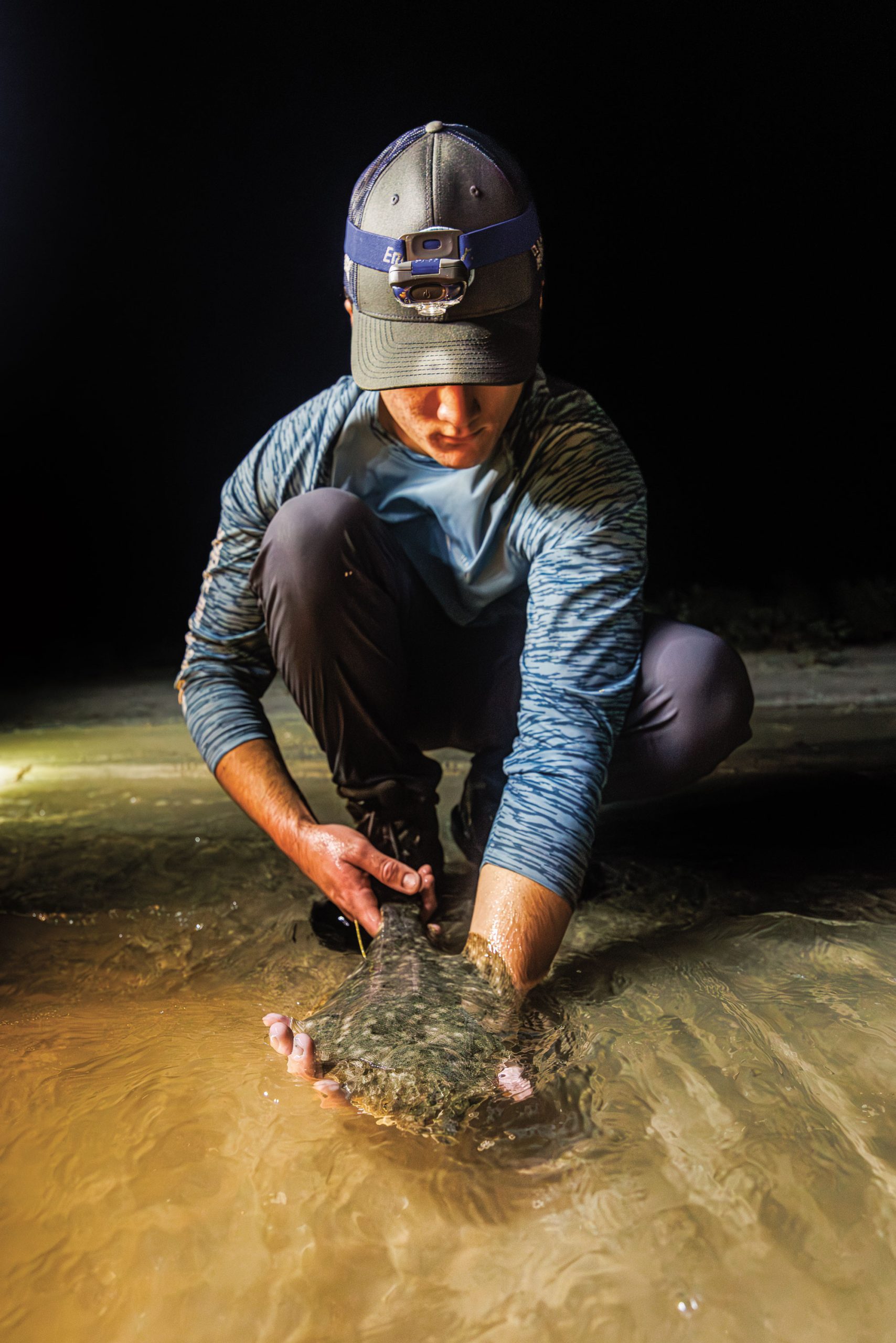
To keep a closer eye on migration patterns, Streich is working with Clark to capture flounder and tag them with a tracking device. By using acoustic transmitters and receivers, he can determine when the fish leave the bays during their fall run. Soon, Streich and Clark hope to have enough data to figure out a more ideal time to end the flounder season.
Back on Aransas Bay with Clark and Streich, recent torrential rains have clouded the water, and the gravitational pull of a harvest moon has caused the tide to rise extremely high. These conditions keep most of the flounder hidden. It doesn’t help that their guest (me) isn’t the most expert of marksmen. We see several, miss most, and successfully gig one flounder along with a few sheepshead—another tasty Gulf fish.
We keep up the search for a little more than six hours—past midnight, about twice as long as we expected—then navigate back toward Port Aransas. A pod of dolphins appears alongside our boat, marking a magical end to the night.
The next morning, our haul of flounder and sheepshead is cleaned and waiting at Fisherman’s Wharf, the island’s biggest marina. At lunchtime, my wife and I bring the fillets to our favorite seafood dive in the area, Black Diamond Oyster Bar, in operation since 1968, which offers a “you catch it, we cook it” special.
Flounder is versatile fare: You can bake it, broil it, fry it, grill it, or stuff it with crabmeat. The kitchen crew blackens ours with butter and spices, serving up fillets that are deliciously mild and flaky, amplified by a lemon squeeze and kick of cayenne. Our lunch is a welcome reward for a long, quiet night on the bay—always a good gig if you can get it.