
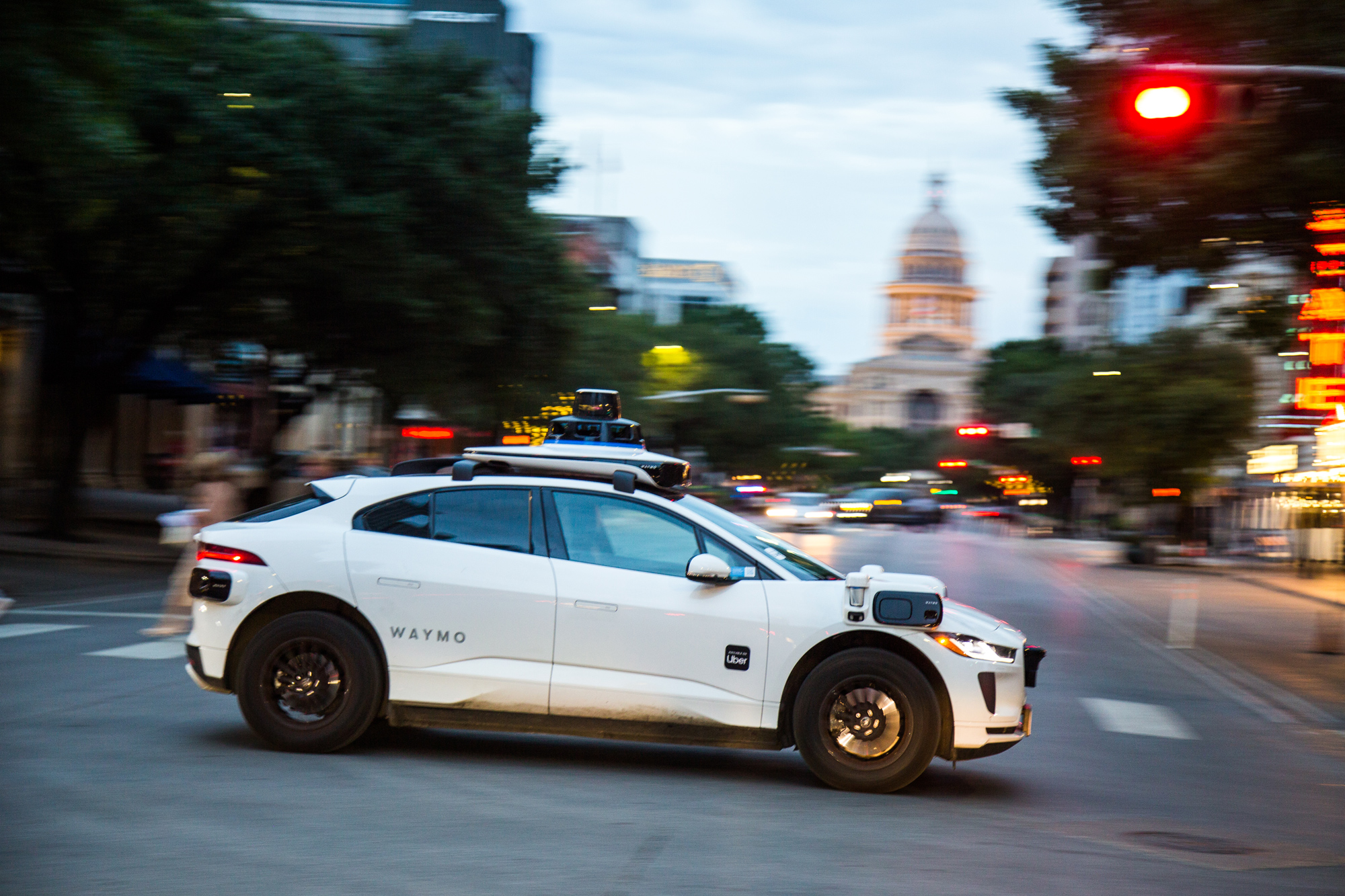
During a Friday night on Congress Avenue in Austin, three white Waymo cars bunch up at a red light like a herd of mild-mannered cattle. The first one idles for a passenger, who climbs into the back seat and disappears behind the black windows. A man on the corner feints jumping in front of the car, then steps back. His primal compulsion to taunt the robot vehicle is tempered by a flicker of apprehension, like he doesn’t quite trust it not to hit him. Driverless tech is still new, after all.
Thanks to an innovation-friendly environment and tech investment, Austin has become the country’s ground zero for self-driving cars, with General Motors, Tesla, Alphabet, Amazon, and Volkswagen all launching early programs here. The most visible are the svelte white Waymos, which navigate the capital city with lidar, a laser system that maps their surroundings in real time. Cars have been on an evolutionary journey toward increased automation since General Motors introduced an automatic transmission version of the Oldsmobile in 1940. Getting behind the wheel was just one more task technology could make easier. But, personally, I’ve always liked driving.

Despite cars following a long arc toward ease, not everyone wants the ride to be simpler. I learned to drive stick in a strip mall parking lot at 22, halting and jerking in a blue Subaru Impreza. I had purchased the car based on an instinctive sense that it would edify me—though I couldn’t actually drive it yet. I thought it would make me tougher, sexier, better in some vague way. It took my stepdad only a few minutes to explain the fundamental concept—clutch in, gas off, shift, clutch back out—but getting the feel for it was harder. So, like most people, I learned to drive stick in fits and starts over many months and even years. Driving solo across the country in that same blue car a few weeks later. Hauling trailers with a work truck in rural Utah. Teetering on steep hills during one brief year in San Francisco.
Later, when I upgraded to my current Toyota pickup in 2018, it took a few weeks just to locate one with a clutch. “Does it really need to be a manual?” my dad asked, watching me call yet another dealership. Yes, it does, I insisted, animated by a blend of vanity and restlessness. I like the feeling of competence I get. It’s like a party trick, as if I am playing traffic on hard mode because I am bored.
By the time I arrived in Austin from Seattle in 2021, I had learned to shift intuitively, listening to the sounds of the engine without consciously realizing it, rarely glancing down at the tachometer. Sometimes, when driving a friend’s automatic, I stomped the floor with my left foot, looking for the clutch pedal I didn’t need.
But even as I was clinging to the past, the traffic around me was rushing forward into the future. In 2017, state lawmakers passed a law banning local regulations on emerging self-driving car technology. The bill attracted developers to Austin.
General Motors’ self-driving Cruise cars appeared in Austin during a cold front in December 2022. The tiny orange-and-white cars rushed up and down the surface streets of my West Austin neighborhood. Alphabet’s Waymo followed in late 2024, and Tesla launched a beta version of its self-driving taxi service in mid-2025.
Today, autonomous vehicles are a fixture of the Austin cityscape, ubiquitous like Longhorns gear. A feeling of cowboy nostalgia permeates the city, where commuters drive to work in ranch-friendly pickups and two-stepping is the second-date gold standard. But self-driving cars’ increasing prevalence has solidified Austin’s identity as a growing tech hub. Here, the future-curious are willing, even eager, to try an unmanned car.
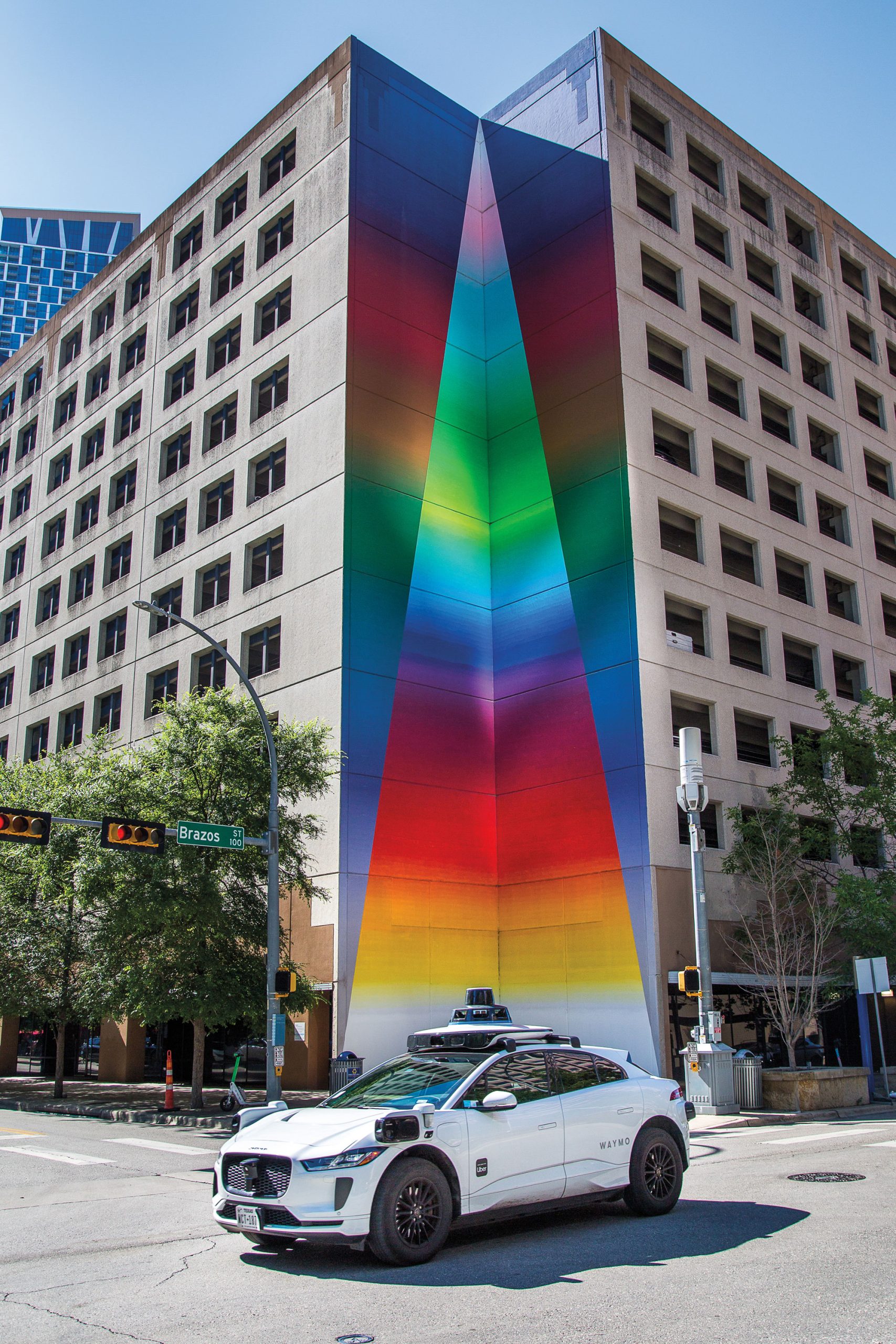
Waymos’ antics, in particular, have made for prodigious social media fodder, especially on forums like the r/Austin subreddit. With their distinctive white curves, Waymos have emerged as the de facto symbol of autonomous technology. Users have captured them idling in “No Drop Off” zones, traveling against traffic on one-way streets, and blocking emergency vehicles. “I have been impressed with how well they emulate human drivers,” riffs one Reddit user beneath a video of a driverless car blocking two lanes on South Congress Avenue in an oblivious attempt to turn. When a car in San Antonio drove into unsafe flood conditions in April, Waymo recalled its U.S. fleet of about 3,800 vehicles for a necessary software update.
Automated cars have made us humans into less present drivers for years now, long before Waymo and Tesla hit the streets. That may be the most compelling defense of manual transmission. The greater focus and presence required to operate a stick shift means drivers are more aware on the roads. These days, while idling at a stop sign, I glance at the cars around me and see most drivers looking down at screens—an observation that terrifies me, even though I’m also guilty of this.
In general, I feel present and alert in my truck. Downshifting up the incline of West Lake Hills or easing my truck into first gear at a stoplight, I am both engaged by the process of driving and free to notice the world around me. On the other side of my windshield, Austin has unfurled before me: a city of oak trees, single-family houses, and gravel-yard bars. Air that seems to glitter with bright pollen. The looming pink dome of the Capitol building. The purple afternoon sunlight glinting off the freshly constructed skyscrapers downtown. Driving, my mind is comfortably occupied and yet available to watch and wander. I think better when my daily life includes this time behind the wheel.
But the car market has only continued to shift away from the “standard transmission.” By 2025, fewer than 30 vehicle models with a manual transmission were available for purchase, and stick shifts represent about 1% of vehicle sales in the U.S. The only people left who bother to buy one perceive driving as a pleasure rather than a chore.
The joy is small and specific, like working the gearshift with a hand that is also clutching a P. Terry’s hamburger in its peeled-back paper. The euphoric lift from third gear to fourth. A thoughtless rev-matched merge onto MoPac. For a moment, a seamless connection with the machine itself.
Driving stick has evolved from a necessary life skill to an aesthetic choice. And, like most things analog, it’s easy to romanticize. On the 2014 song “Automatic,” Lindale product Miranda Lambert laments the transition: “God knows that shifting gears ain’t what it used to be/ I learned to drive that ’55 just like a queen, three on the tree.”
Over time, the car has advanced from mere transportation to luxury object to nuanced expression of identity. As Stefan Gössling explains in his 2017 book The Psychology of the Car, self-concept is expressed through consumer choices like car model, driving style, or even bumper stickers. In some ways, a manual transmission suggests competency and self-reliance, and a closer bond with the car—a symbol of freedom and independence.
And yet, tipsy on a weekend night south of Lady Bird Lake, I leave a neon-lit bar and slide into the soft black interior of a Waymo. Heading north, a line of taillights leads toward home. My estimated trip time flashes on a wide screen, and an automated voice begins to chatter. At a red light, the Waymo makes a bold right turn, more aggressive than I would have done, and I feel a stab of embarrassment for the robot. The wheel jerks back and forth symbolically. Outside the car, a woman on the curb pulls out her phone to record as my self-driving ride passes. I feel weird caught on a stranger’s camera, though I know the thickly tinted windows won’t show my face. It’s the same heavy coating that gives the world outside a uniform gray sheen. I look down at the bright screen of my phone.