
In the Face of Stars
INDIGENOUS ORIGIN STORIES TRACE THE GRAND DESIGN OF THE NIGHT SKY
Growing up in Texas, I learned the lyrics The stars at night are big and bright / Deep in the heart of Texas about the same time I learned Twinkle, twinkle, little star. By the time I turned 12, I’d fallen for Mexican boleros and rancheras, among them “Luna de Octubre,” made famous by the singer and actor Pedro Infante; and “Amanecí en Tus Brazos,” composed by the singer-songwriter José Alfredo Jiménez. Both songs focus on the moon. The first one declares the moons of October the most beautiful. The other has a gorgeous line about the singer watching the light of the moon illuminate their lover’s face. Few things linger in our memories quite like the wonderful nights we’ve lived under the stars, lit by the moon.
I recently traveled to Alaska for the first time. The trip took 15 hours and three planes. I marveled at the map showing how far I was from my San Antonio home. For the first time, I saw moose, bears, eagles, and sandhill cranes in the wild. But nothing showed me just how far I’d traveled the way the Alaskan night sky did. The familiar constellations were there—but not where or how I expected them. There was a whole stretch of night sky that I had no names or stories for.
Even in this age of information and social media, we can’t deny that we understand the world through stories. Stories connect us to the earth, to our histories, to our cultures, to other people. Most of us only know the stories we were taught in school that come from Greek myths. But there are many other stories from Indigenous peoples about the night sky, the stars, the moon, and even the sun—across the Americas as well as in what is now Texas and the United States.
I began researching some of these stories after I was asked to perform as a storyteller in the summer of 2023. I’d received a grant to visit schools, libraries, and nonprofits along the Texas-Oklahoma border. Over an 11-day period, I traveled to Clyde, Stephenville, Paducah, Anson, Vernon, and Crowell to conduct poetry readings and writing workshops for children and adults. The highlight was telling stories about the stars to a group of kids in Crowell at 3 Rivers Ranch, home of an astronomy campus for the Texas Tech University System.
For those of y’all who have never even heard of Crowell, it’s a tiny town near the Panhandle in the middle of vast fields, where GPS thinks that just because a roadway is labeled a “county road,” it’s paved and lit. It turns out GPS was wrong, and I killed an ungodly number of flying and jumping insects that became bright yellow and green splatters on my windshield. I went down roads that were nothing but one-lane red dirt lanes, tall cornfields on every side. A group of 50-75 kids of various ages and their parents were there to learn about the night sky.
It was a magical experience sharing stories with them as the sun set, sitting in a rocking chair on a huge porch without a microphone, only my voice and my hands to bring the stories to life. The kids cheered, groaned, laughed, and leaned forward during the suspenseful parts. After I was done, they clapped. Most of them then ran off to play until 9 p.m., when they were scheduled to take a closer look at the stars in the observatory.
I was touched by the immigrant parents who told me stories from their countries about the night sky. We were all one in our awe of the moon and the stars. Like the land, the night sky acknowledges and embraces us all. Taking time to look upward with reverence renders us small and infinite. In Mvskoke poet Joy Harjo’s words: “I can hear the sizzle of newborn stars … I am witness to flexible eternity, the evolving past, and I know we will live forever, as dust or breath in the face of stars, in the shifting pattern of winds.”
Here are four Indigenous myths I told in Crowell, two from the land now known as Texas and two from the land now known as Mexico.
The Morning Star/Evening Star
Mexico, Toltec
KNOWN SOMETIMES as the Morning Star and sometimes the Evening Star, this celestial body is the brightest in the sky after the sun and the moon. It’s most visible in the eastern sky before sunrise and in the western sky after sunset. In this story, the king of the Toltecs, Ce Acatl Topiltzin Quetzalcoatl, evolves into the Morning Star/Evening Star. Born in Tepoztlán to parents who were considered gods, he began taking on quests as a young man. He served his people as a warrior and a priest before he became their ruler. He was a peaceful and prosperous leader, much loved by his people. He wrought many changes in society, including putting an end to human sacrifices.
But this story concerns how Ce Acatl Topiltzin Quetzalcoatl died. Some accounts say he received a divine message; others say he was tricked into believing his time was coming to an end and he needed to travel to the East. He set off with his sister, Quetzalpetlatl, and some of his people. His journey lasted many years. Along the way, he mediated conflicts, built temples, and performed good deeds.
When he reached the eastern edge of the land, he stopped and wept. Then he strapped on his shield and his turquoise mask. What happened next is conveyed beautifully by David Bowles in his translation of the Florentine Codex, a 12-volume study of Mesoamerica compiled by the Franciscan friar Bernardino de Sahagún in the 16th century:
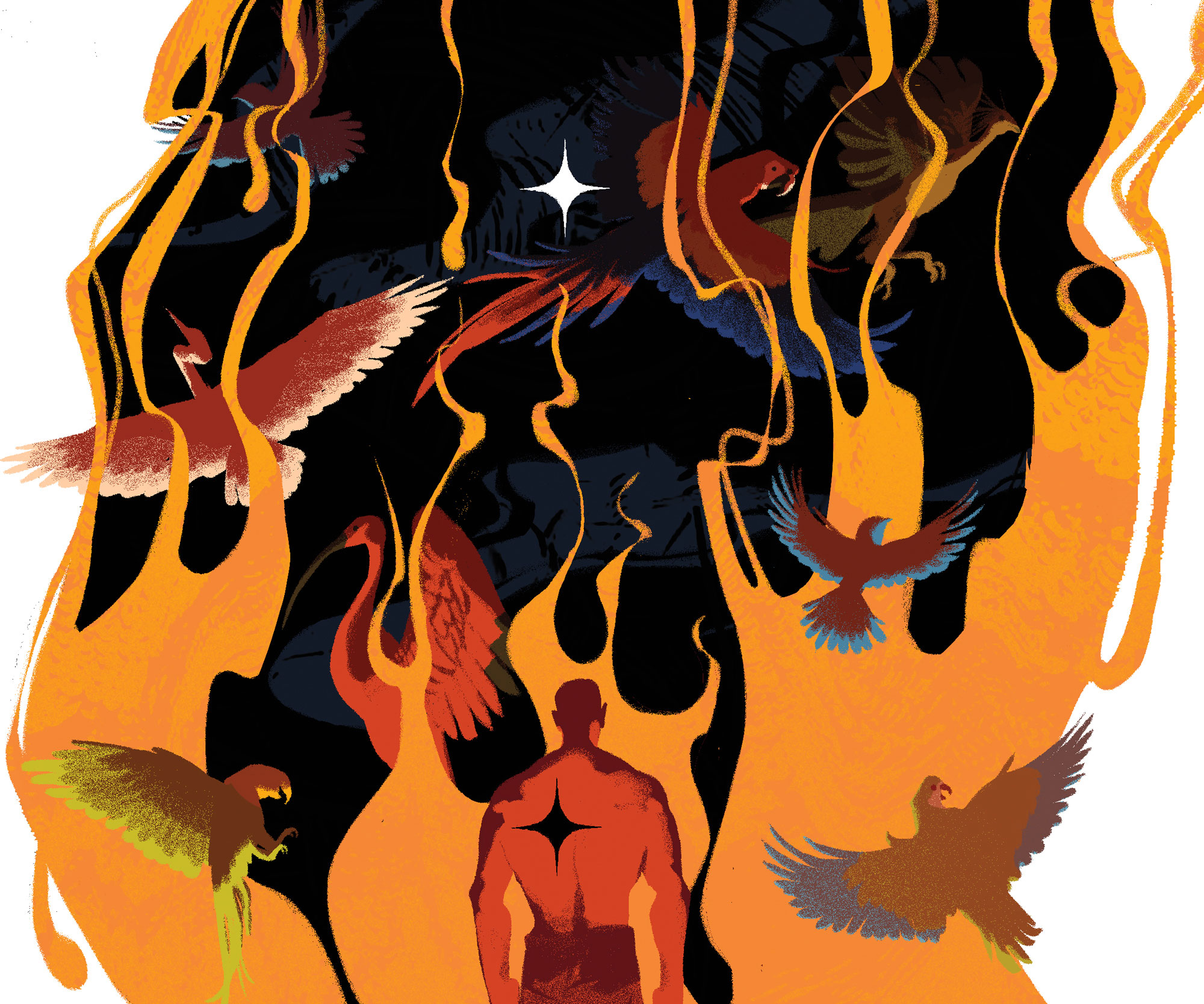
“Ce Acatl Topiltzin set himself ablaze and as his ashes rose into the sky, a multitude of birds appeared—fire-red ibises, blue cotingas, tzinizcans, great white herons, yellow-headed parakeets, scarlet macaws, and white-bellied parrots, among others. Ce Acatl Topiltzin’s heart rose up from the ground and arced into the sky, becoming the Morning Star. The elders called him Tlahuizcalpantecuhtli (Lord of the Dawn).”
The Evening Star & the Orphan Star
Texas, Caddo
There was once a poor orphan boy who lived with a family that didn’t want him. Many times, they tried to leave him behind. But because he had nowhere else to go, he would always find his way back to them. One day, they all set off to hunt for eggs on a small island in the middle of an immense lake. The boy worked hard all day, gathering eggs and loading them onto the boats. He wasn’t allowed to rest, not until very late that night when he fell into an exhausted sleep. The poor orphan boy was so tired that he didn’t hear everyone else gather their things, climb onto the boats, and row away.
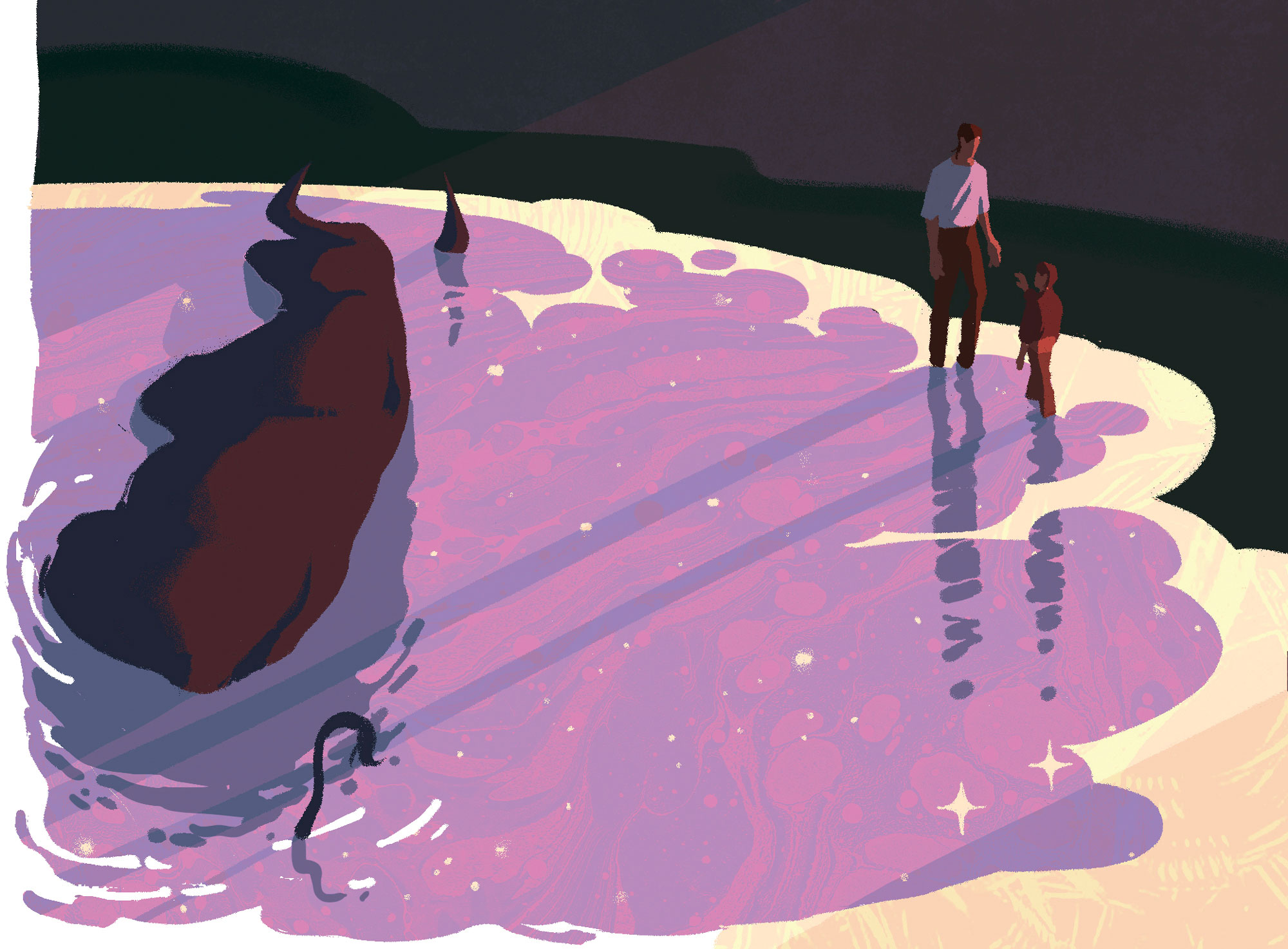
When he woke, everyone was long gone. They hadn’t left him any food. And since he’d helped gather all the eggs, he knew there were no more to be found on the island. Out of desperation, he tried to catch fish with his bare hands, but after hours spent by the water’s edge, he gave up empty-handed as night fell. The boy grew thinner and weaker. He was so diminished he couldn’t even run away when he saw a large monster with horns swimming toward him. He thought the monster had come to eat him, even as pitiful as he was. Instead, the monster spoke to him in a deep voice: “Poor orphan boy, I will rescue you. Climb on my back, and I will take you back to the land.” The boy was starving and had no choice but to overcome his fear and climb onto the monster’s back. “This is very important,” the monster said, “keep your eyes on the western sky. If you see a bright star, tell me at once.”
They hadn’t gone far when the boy pointed at the western sky and shouted, “I see a big star!” The monster looked up, saw the star, turned around, and swam back to the island. “Boy, we’ll have to try again tomorrow,” the monster said. One day, and then another and another after that, the monster came to the boy on the island and promised to rescue him. But every day, the boy would see the star in the western sky, and the monster would turn back to the island. Every day, the boy grew thinner and weaker. Every day, he felt more desperate. Finally, the boy decided he wouldn’t tell the monster anything, whether or not he saw the big star in the western sky. They set off, and when the boy saw the star, he said nothing, so the monster kept swimming. They were almost to the shore when a huge dark cloud rolled in front of the star and quickly approached the lake. The boy was frightened and slipped off the monster’s back.
That was all the warning the monster had. The boy was busy swimming to land and only heard a horrible sound. When he looked up, the monster was dead, and a young man was standing there, looking very pleased. “Thank you, boy. I have been trying to kill that monster for a long, long time, but he would always see me coming and swim out of my reach.” The young man, who was the Evening Star, offered to take the boy with him to the sky, where he morphed into the Orphan Star, always standing by his side.
The Moon and the 400 Gods of the Southern Stars
Mexico, Aztec
Huitzilopochtli was the patron god of the Mexica (known as Aztecs) and their capital city, Tenochtitlan (now Mexico City). He was also the god of war and the god of the sun. Huitzilopochtli’s mother, Coatlicue, was the powerful Mother Goddess of Life and Death. She wore a skirt made of writhing serpents and a necklace of hearts and severed hands. Her head had been replaced by two serpent heads, and she had powerful claws instead of hands and feet. One day while she was sweeping her temple at Coatepec, a town in the state of Veracruz, she was impregnated by a ball of hummingbird feathers that fell from the sky. Outraged, Coatlicue’s 400 sons, known collectively as the Centzonhuitznahua, and her daughter, Coyolxauhqui, conspired to kill their mother and the unborn child.
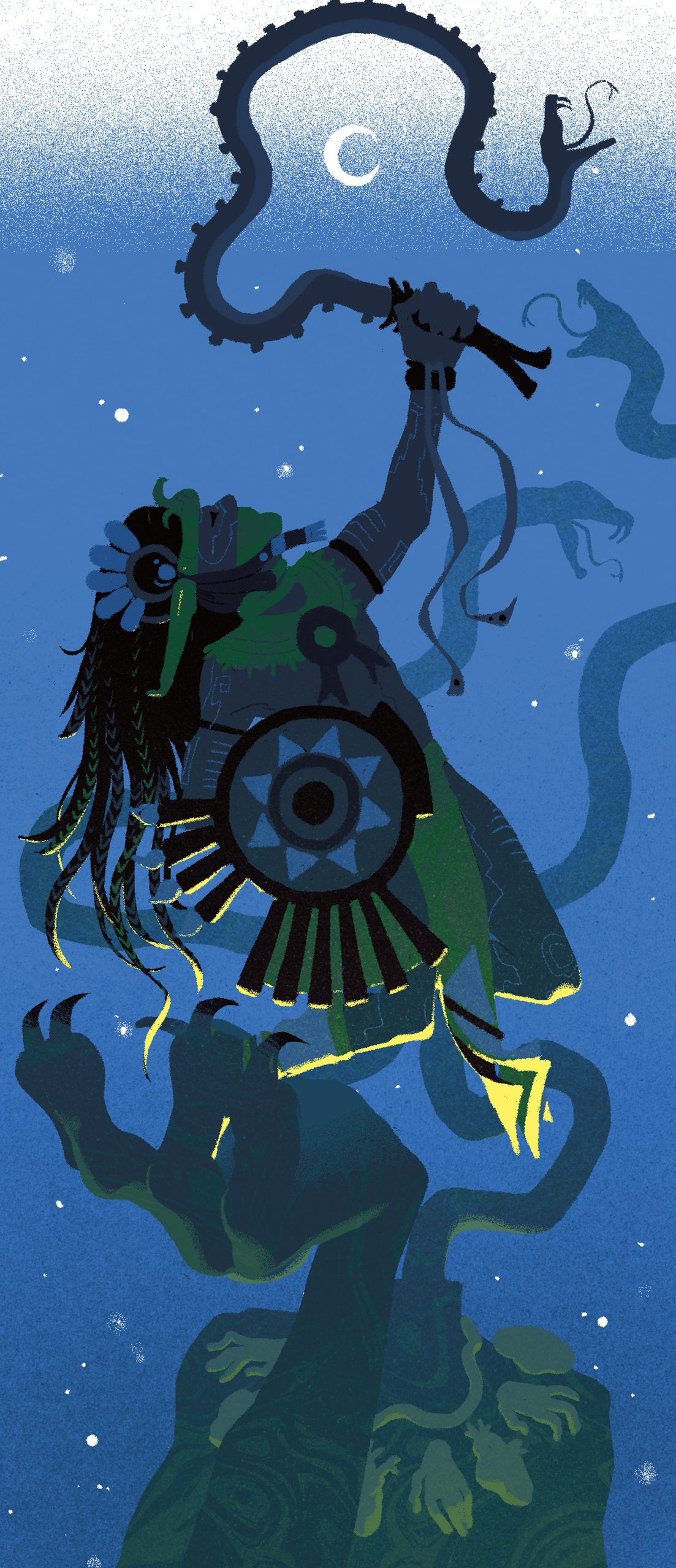
But their plan was foiled when Coatlicue suddenly gave birth to a fully grown and armed Huitzilopochtli. His helmet and armor were made of hummingbird feathers. His legs, arms, and the lower part of his face were blue, and the upper half of his face was black. He carried a round shield and a serpent-shaped weapon he called Xiuhcoatl. The battle between Huitzilopochtli and his siblings raged on at Coatepec until Huitzilopochtli defeated his sister by beheading her. He tossed her dismembered body from the mountaintop and flung her head into the heavens, where it became the moon. The Centzonhuitznahua fled from Huitzilopochtli and scattered across the southern sky, becoming the 400 Gods of the Southern Stars. This is why the sun constantly chases the moon and stars.
The Seven Brothers
Texas, Caddo
The Pleiades star cluster is more than 400 light-years from Earth and is comprised of more than 1,000 stars. Typically, only seven of those stars are visible to the naked eye—the Seven Sisters. According to Greek myth, they are seven nymphs born to Pleione and Atlas, the latter tasked to forever hold up the sky.
However, in the Caddo story, those seven visible stars are the Seven Brothers. The Caddo nation is currently located in Oklahoma. The Caddo Confederacy, composed of the Caddo, Hasinai, and Kadohadacho peoples, historically inhabited the confluence of Texas, Louisiana, Arkansas, and Oklahoma. There are other versions of the story of the Seven Brothers, particularly among the Pawnee and Wichita peoples.
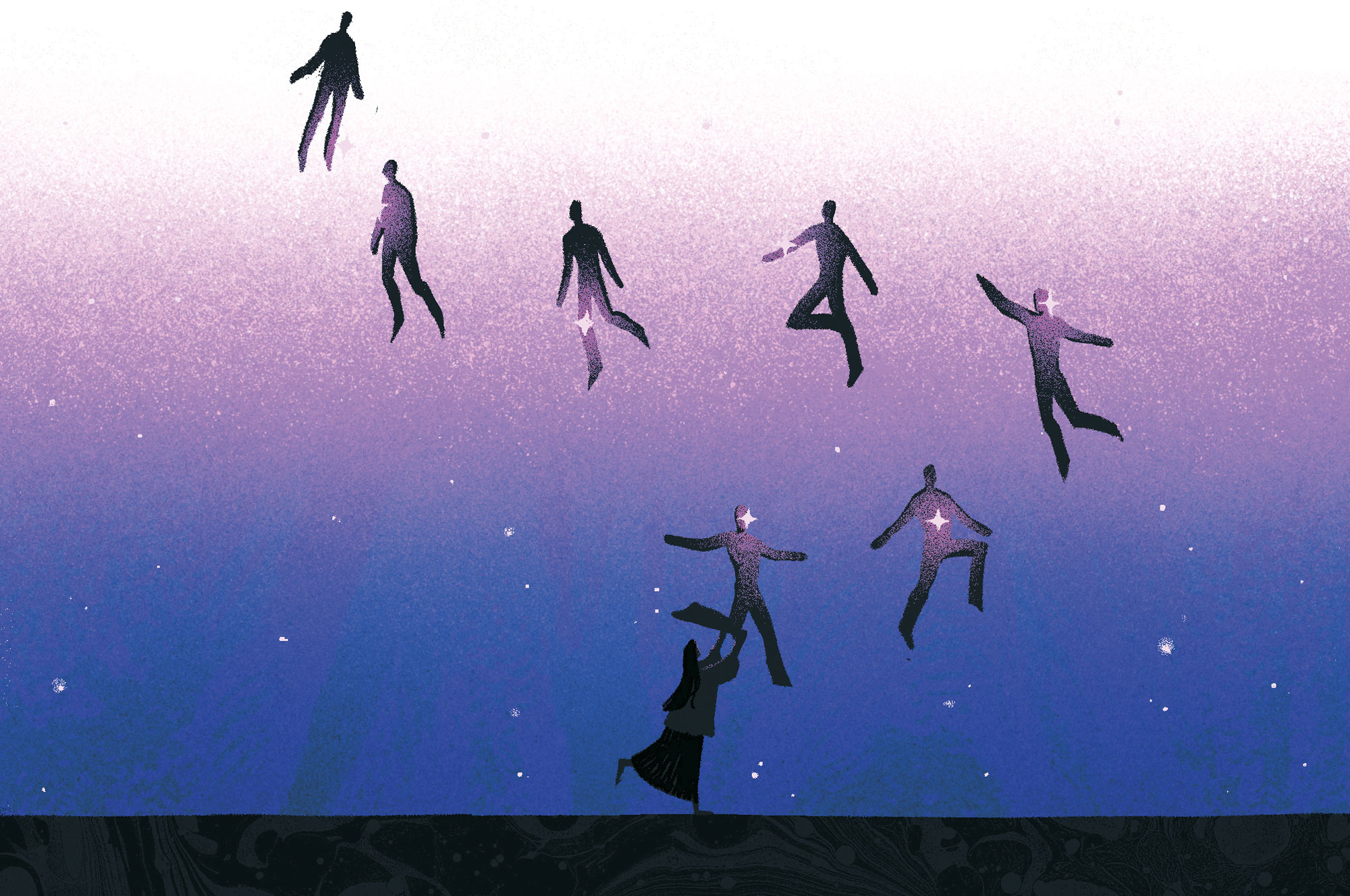
Once, a very long time ago, there was an old woman with seven very lazy boys who never wanted to work or do chores. All they wanted to do was play all day, every day. They didn’t even want to stop playing to come home and eat. They never helped their mother with anything—even though she’d chide them for being lazy. One night, they were so late for dinner that their mother sent them to bed without food. The next day before breakfast, the seven brothers decided to return to their play. They started to run circles around the house, calling to the spirits to take them away. The old woman heard their shouting and went to see what her children were doing. She cried out when she saw their feet were no longer touching the ground. She ran after them, trying to catch their feet. The seven brothers continued floating into the air. Before long, they were completely beyond her reach and then circling above the roof of their house. Higher and higher they went, until they were only glimmers in the sky.
Even as stars, they are still very lazy boys. That’s why they can only be seen during the winter months, when there is little or no work to be done—not during the spring months, when it’s time to start plowing the fields.