

Have Books, Will Travel
Mobile libraries are back on the road, bringing reading material, Wi-Fi, and more to small town Texas
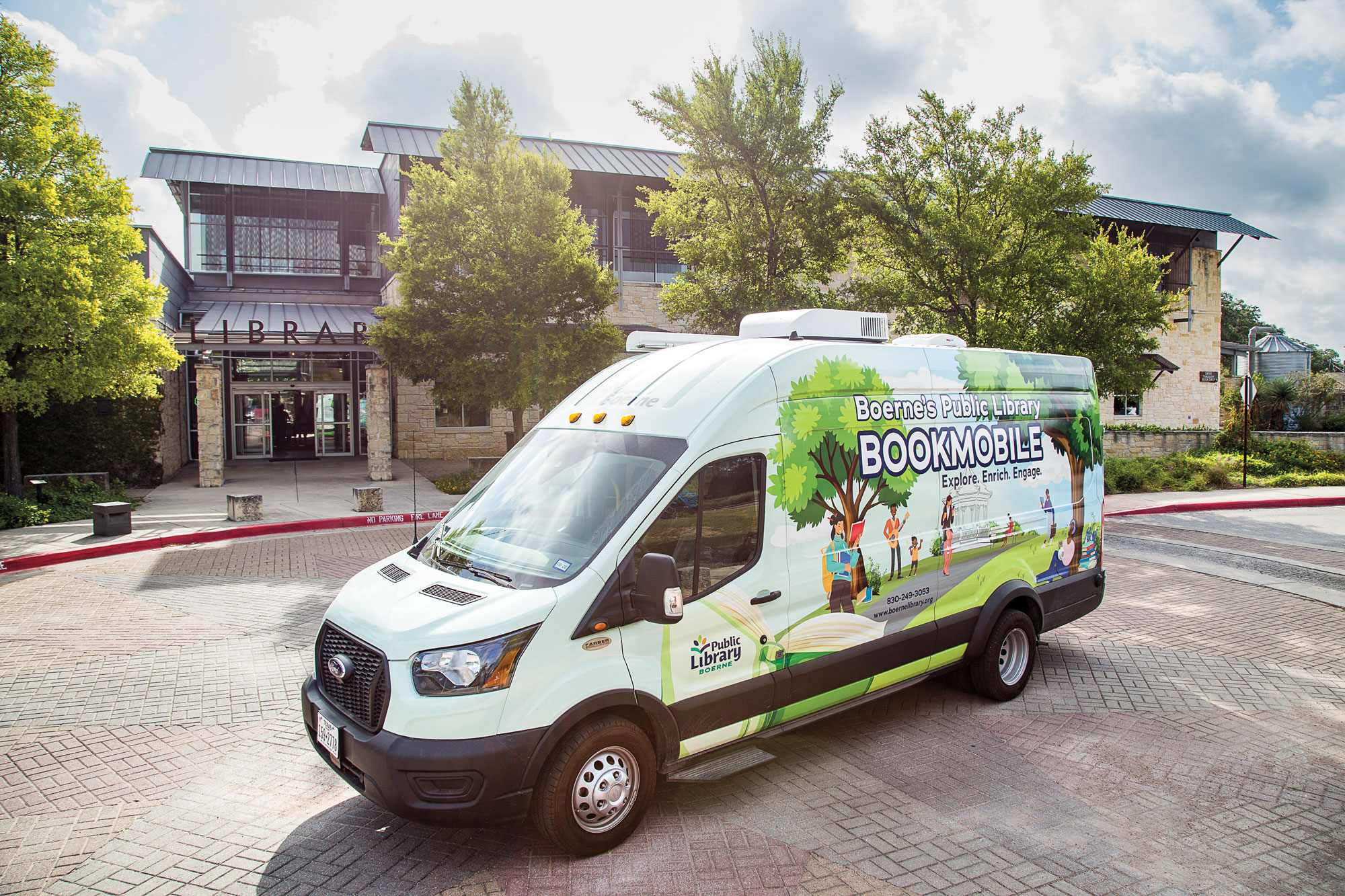
On a clear evening outside Boerne’s public library, Leah Mayo unplugs the charging cable from her Ford Transit van’s side port and swings open the driver-side door. The 32-year-old outreach services coordinator scales the running board and hops into the captain’s chair, turning the key in the ignition and sparking the Boerne Mobile Library’s engine. A hand on the gearshift, a foot on the accelerator. It’s a Friday night in Central Texas, and the bookmobile isn’t content to sit alone in a dark parking lot while the rest of the town kicks off the weekend with a rollicking good time.
Mayo wheels the vehicle through the library’s crowded lot and stops at the intersection of US 87 Business, the main drag running through this burg of 24,000 people. Her destination is Main StadtPlatz, a public plaza two short blocks away, home to a narrow stretch of open lawn ringed by mature pecan trees, live oaks, and an ornate gazebo. This spring evening, the city will screen The Good Dinosaur as part of its monthly Movies in the Park series. The seasonal event is a popular community gathering, and the Boerne Mobile Library is considered a guest of honor.
Today’s two-block jog is shorter than most of the bookmobile’s excursions across Kendall County, a rural-ish swath of hillocked creek land on the periphery of San Antonio. The mobile library crisscrosses the area day after day, hitting the highway to bring reading material to older adults, the homebound, folks without reliable transportation, and residents of fast-growing suburban communities orbiting Boerne.
Throughout Texas, cities are increasingly giving the green light to bookmobiles as a way of connecting residents with much-needed books, DVDs, tablets, and internet hot spots. According to the Texas State Library and Archives Commission, at least 27 mobile libraries are in operation around the state, several of which—such as those in Grapevine, New Braunfels, and Odessa—are newer additions to those libraries’ repertoires. This renewed demand follows a decade-long dip in bookmobile operation and comes at a time when literacy rates are at their lowest level since 1992. Library advocates say bookmobiles can help buck the trend, rekindling interest by meeting would-be readers outside of a brick-and-mortar establishment.
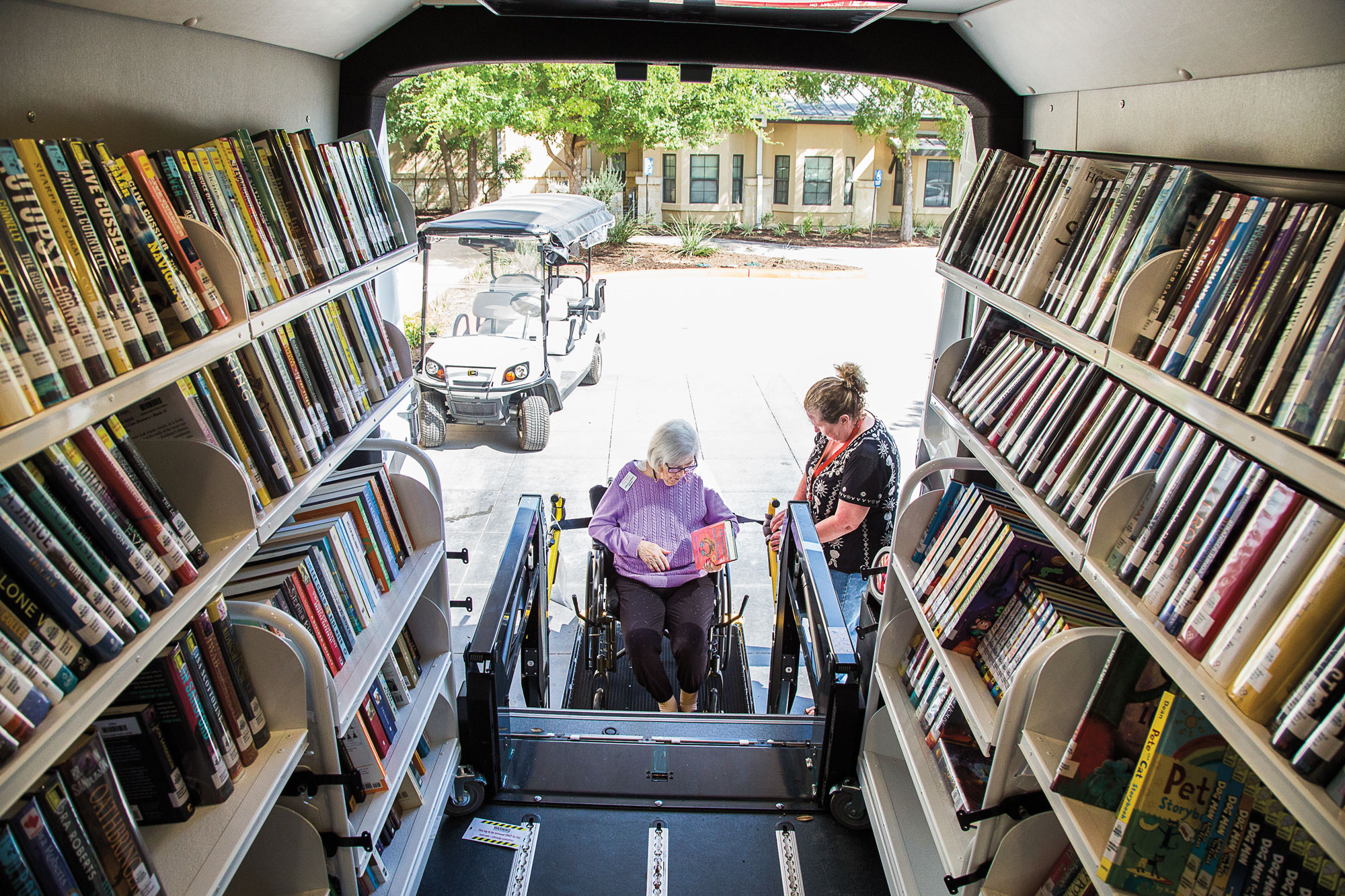
The Boerne Mobile Library van was acquired late last year from the Ohio-based fabricator Farber Specialty Vehicles and debuted at Boerne’s annual Weihnachts parade in December. The nighttime procession features 100 floats, several marching bands, and now, one bookmobile. Since then, the operation has cast a wider net than a bookmobile’s standard route of schools, nursing homes, and after-school centers. The library partners with the city’s animal care division to hand out books on Tuesdays and invite kids to read to shelter dogs and cats. In April, during Día de los Niños, the bookmobile gave out dozens of bilingual books and served paletas. Mayo also travels to the Roy Maas Youth Alternatives school, visiting with students and offering some respite via literature and even rabbits to pet.
“Our community has been growing steadily for the past six years,” Mayo says. “There are a lot of people who don’t know that the library offers so much more than books.”
At the screening of The Good Dinosaur, Mayo circles the plaza until she finds a low curb that allows her to pop up from the street and onto the lawn. Once all four tires touch grass, she navigates the vehicle carefully past a tangle of low-hanging branches that might otherwise gouge the 11-foot-tall, custom-wrapped van. It’s a task Mayo approaches with some trepidation—“It’s pretty low clearance,” she says, turning the wheel left and right. “I
drive a tiny little Chevy Spark as my personal vehicle.”
In the back of the van, a smattering of books jostle on floor-mounted racks. The folded legs of a plastic table jangle. Dozens of popcorn bags for tonight’s event crinkle in their neatly tied plastic packages. Mayo finally clears the arboreal obstacle course and putters to the opposite side of the lawn, parking the mobile library in the shade of slightly higher tree branches. She kills the engine, jumps out of the vehicle, and gets ready for the big show.
Mobile libraries have gone by many names in the century or so since their creation—traveling libraries, book wagons, libraries on wheels. Whatever the label, they have always had the same chief purpose: to bring books to people who are unable or unwilling to go to the library. This could be due to a lack of mobility, free time, or transportation—or just unfamiliarity with the library system, says Sheri Miklaski, Georgetown Public Library’s community outreach librarian. “We’re trying to meet people where they are,” she says. “Not everyone can make it to the library; for some, we’re the only way of getting services. We’re their connection to the library.”
The genesis of the mobile library can be traced to early-20th-century Maryland, when an enterprising library booster sent horse-drawn wagons to deliver boxes of books to post offices and general stores. Around the same time, Waco-based activist Kate Rotan—the first president of the Texas Federation of Women’s Clubs—became one of the earliest advocates for bookmobiles in the Lone Star State. The Great Depression saw packsaddle librarians charting courses through remote Appalachia, carrying books on horses, mules, and donkeys until the advent of Henry Ford’s Model T enabled librarians to relinquish their hooved mounts and take the reins of gas-powered automobiles. One decade later, wearied GIs on World War II’s European front received reading material courtesy of converted Willys Jeeps.
“As vehicles changed, bookmobiles kept up with the industry and how they delivered reading material,” says Cathy Zimmerman, executive director of the Association of Bookmobile and Outreach Services, an international consortium that trains library staff in the art of book delivery. ABOS is the fastest-growing library association in the country, claiming over 1,200 members and chapters in Canada, Croatia, Australia, and Japan—proof that mobile libraries are a longstanding, international phenomenon adapted to local conditions. In Thailand, for example, books are delivered via elephants. In Kenya and Ethiopia, camels bear the brunt of transporting literature. Floating aquatic libraries in Norway service that country’s western expanses.
Due to a suspension of domestic automobile manufacturing during World War II, there was a brief lull in bookmobile production, Zimmerman says. But the 1950s saw a revival of the practice in the U.S. School buses were converted into mobile libraries, offering ample space for a wide selection of books and plenty of legroom for patrons to search the stacks. Fast forward to the present, and the methods for bringing cultural materials to the masses have evolved to include nearly every form of conveyance imaginable: package trucks, Sprinter vans, motor homes, coach buses, bicycles, trollies, trams, boats, and even drones.
Miklaski, who is the treasurer of ABOS, has spent years piloting Georgetown’s 32-foot bookmobile, which is about the size of a UPS parcel delivery truck and can hold 2,500 books. In June, its odometer clicked over the 50,000-mile mark, the culmination of thousands of individual stops. Miklaski took a photo for posterity—after safely pulling over in a park, of course.
Business is expected to get even brisker in coming years, she says, as a growing population increases demand for mobile services. Lately, the bookmobile has been spread thin; whereas the vehicle used to return to the same stops every 14 days, a swelling list of clients has strained resources. “All of a sudden, we had a waitlist of nine stops that we could not fit into our schedule. So, we had to switch to every four weeks, which is a bummer for those who are used to us being there more frequently,” Miklaski says. In Boerne, despite the infancy of its bookmobile initiative, requests for home deliveries of books have tripled in just a few short months.
Mayo, the Boerne library’s outreach services coordinator, sees this as an encouraging sign—and evidence that the town’s bookmobile should be even more involved in local happenings. One idea currently percolating is parking the mobile library in the heart of the town’s monthly car show and hot rod run. “I think it’d be funny to get our van in there, play music and things like that,” Mayo says. “Going to community events and getting the library’s name out there, that’s a big positive impact we’re seeing with the van.”
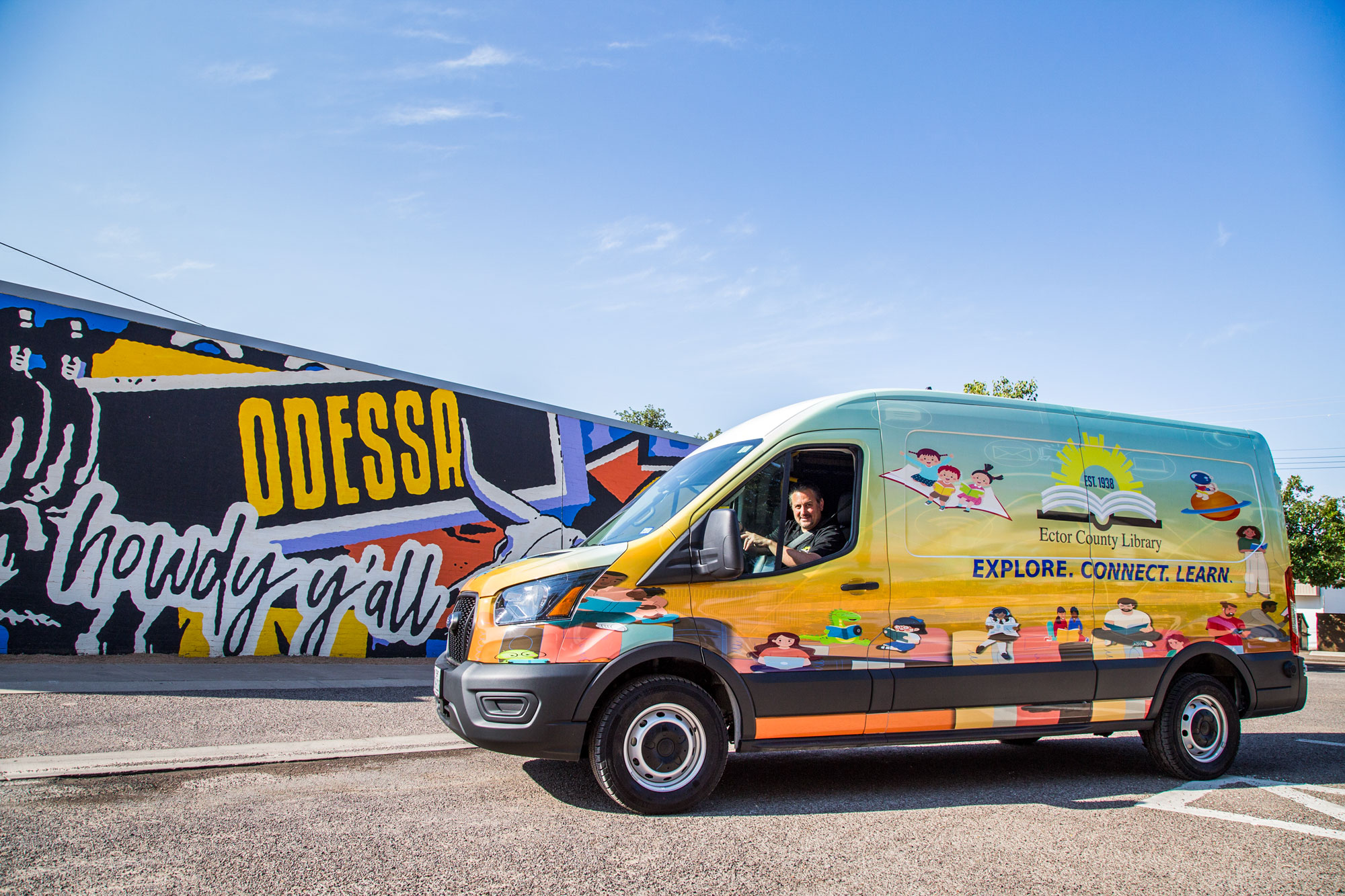
This brings up an important but secondary function bookmobiles serve—to promote the public library and spur community engagement. “We’re like a driving billboard for the library—for the city—in many ways,” Miklaski says. “You can put a really fun wrap on it, and when people see it, they’re like, ‘Whoa!’” Both Boerne and Georgetown are brimming with newcomers who may be less aware of municipal services than residents of tighter-knit towns. Bookmobiles are a reminder of all that these libraries offer their communities.
To that end, the Boerne Mobile Library serves strictly in a support capacity during the city’s The Good Dinosaur screening. After the folding tables, popcorn, freebie bookmarks, and flyers promoting the library’s upcoming summer program are unloaded from its cargo bay, the van waits in the wings as other, more eye-catching attractions take center stage. Chief among them is a 25-foot-tall inflatable slide featuring, at one end, the towering likeness of King Kong, and at the other, a Tyrannosaurus rex with slavering jaws. A winding churn of children climb the plastic stairs to the summit and make shrieking descents, narrowly escaping the King of the Apes and King of the Lizards along their exit path. They could be forgiven for missing the modest bookmobile altogether. (Even Mayo and her coworker, Cassidy Herrera, take a turn on the slide—“We’ve gotta make sure it’s safe for the kids,” they laugh.)
Still, the mobile library doesn’t evade the gaze of a few sharp-eyed observers that night. Shelby Young, a 33-year-old Boerne resident who works in public relations, sees the vehicle as a boon for marketing the library and increasing brand awareness. “I think it’s awesome,” she says. “Meeting people where they’re at, which seems to be what they’re doing, is very important.” Young is new in town, with a 3-year-old son who loves to read and hasn’t visited the library yet. Now she looks forward to stopping by.
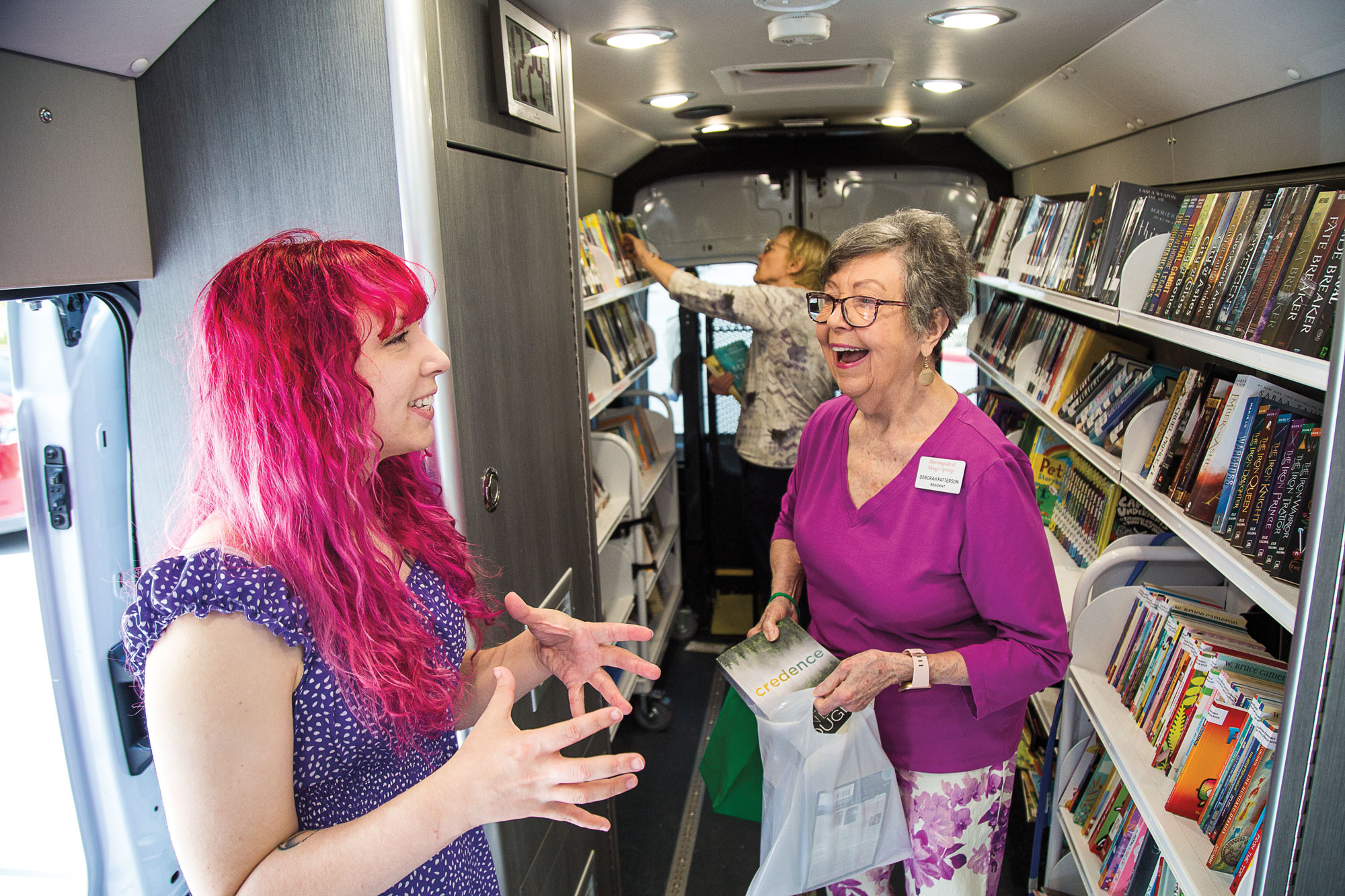
A person’s first encounter with a bookmobile tends to be memorable. At Boerne nursing homes, octogenarians wax nostalgic about the mobile libraries of their youth and the indelible impressions they made. “They’ll tell us how they remember when they were a kid and the library bus would come to their neighborhood,” Mayo says. “They would get so excited. It was like the ice cream truck.”
Today’s rolling libraries are outfitted with far more bells and whistles than the bookmobiles of yore: Wheelchair lifts, onboard Wi-Fi, electric generators, solar panels, roof-mounted air conditioning units, and retractable awnings. But these technological advancements can both help and hinder—for example, Georgetown’s bookmobile no longer carries its original AC unit, which was shorn from the roof by a low-hanging portico. Lifts break down and generators fail. And, of course, these amenities come at an additional, sometimes steep cost.
To ease the financial strain, the Texas State Library and Archives Commission has awarded grants to local libraries to assist with the purchase and operation of bookmobiles. In Georgetown, the commission paid the salary of a mobile librarian for three years, and the city picked up the tab after that. TSLAC also bought a new bookmobile for Ector County, a West Texas community in the Permian Basin, in 2023. “It’s a decent chunk of change,” says Howard Marks, director of the Ector County Library. Without the cash infusion, buying a bookmobile would have been a mere pipe dream. “We didn’t have an extra $75,000 lying around,” he says.
This year, Marks and his staff have made their Words on Wheels [WoW!] van the centerpiece of their outreach efforts, demonstrating the wisdom of the investment. The bookmobile runs regular routes two to four times a week throughout Odessa, a city whose economy is predicated on the boom-and-bust cycles of the oil industry. The modified Ford cargo van targets its catchment area’s most vulnerable residents—typically the youngest and the oldest members of the community. “We’ll take it all over the county just so it gets out there, so it’s exposed to people who normally may not get those services,” Marks says. “There are a lot of people who don’t have access, so it’s meeting people in all parts of Ector County.”
In April, WoW! camps out at Compass Charter School, where a smattering of fourth and fifth graders peruse two rolling carts stacked with books, homing in on titles like Westfallen and Hannah Sharpe, Cartoon Detective. The bookmobile is a welcome visitor to the campus since it has no library. At its next stop, the Boys & Girls Club, kids browse while waiting for a ride home. A precocious first grader named Emilina Carrasco is tickled by Mo Willems’ illustrated book, There Is a Bird on Your Head!, in which an elephant is dismayed to find two birds nesting on his cranium. His friend, a pig, is decidedly nonchalant about the dilemma. Carrasco breezes through the story and can’t help but spoil the ending. “Look!” she says, pointing to the last page. The birds have vacated the elephant and are now lighting upon the pig.
The Ector County Library is still fine-tuning its bookmobile system. How many stops should it visit each day? Which locations bring the largest audience? How do they best curate book selections for specific sites? “Nobody was born knowing how to do this, so yeah, it’s been a lot of trial and error,” says J’Nevelyn White, Ector County’s managing librarian. When the county initially received the bookmobile, White figured folks in local retirement homes would be most interested in books about genealogy, gardening, and other more practical subjects. What they actually requested were racy Harlequin romances, aka “bodice-rippers.” “People still have their own opinions and don’t necessarily fall into your idea of what they’re gonna want,” she says.
At least the county’s library staff didn’t have to start their bookmobile program from scratch: In the 1950s, a refurbished school bus served as a mobile library here before being replaced by more modern iterations in later decades. Their last mobile library was decommissioned in 1987 for lack of funding, a likely result of a dwindling rural population around Odessa. Now that Ector County’s initiative has been pulled from the shelf and dusted off, “some of the momentum has gone away,” White says, “but if we get some more years in it, we have the potential to be a big deal again.”
That sentiment rings true statewide. Even though mobile libraries are gaining traction, it may take some time for them to climb out of the rearview and accelerate into the passing lane. But just as the present rolls ever forward meeting the rubber of the future’s road, so do the wheels on these vans, trucks, bikes, and buses that circumnavigate Texas every day, bringing the library to you. Wherever you may be.