

The Mysterious Cereus
This West Texas cactus blooms only one day out of the year—at night, in the middle of nowhere—if at all
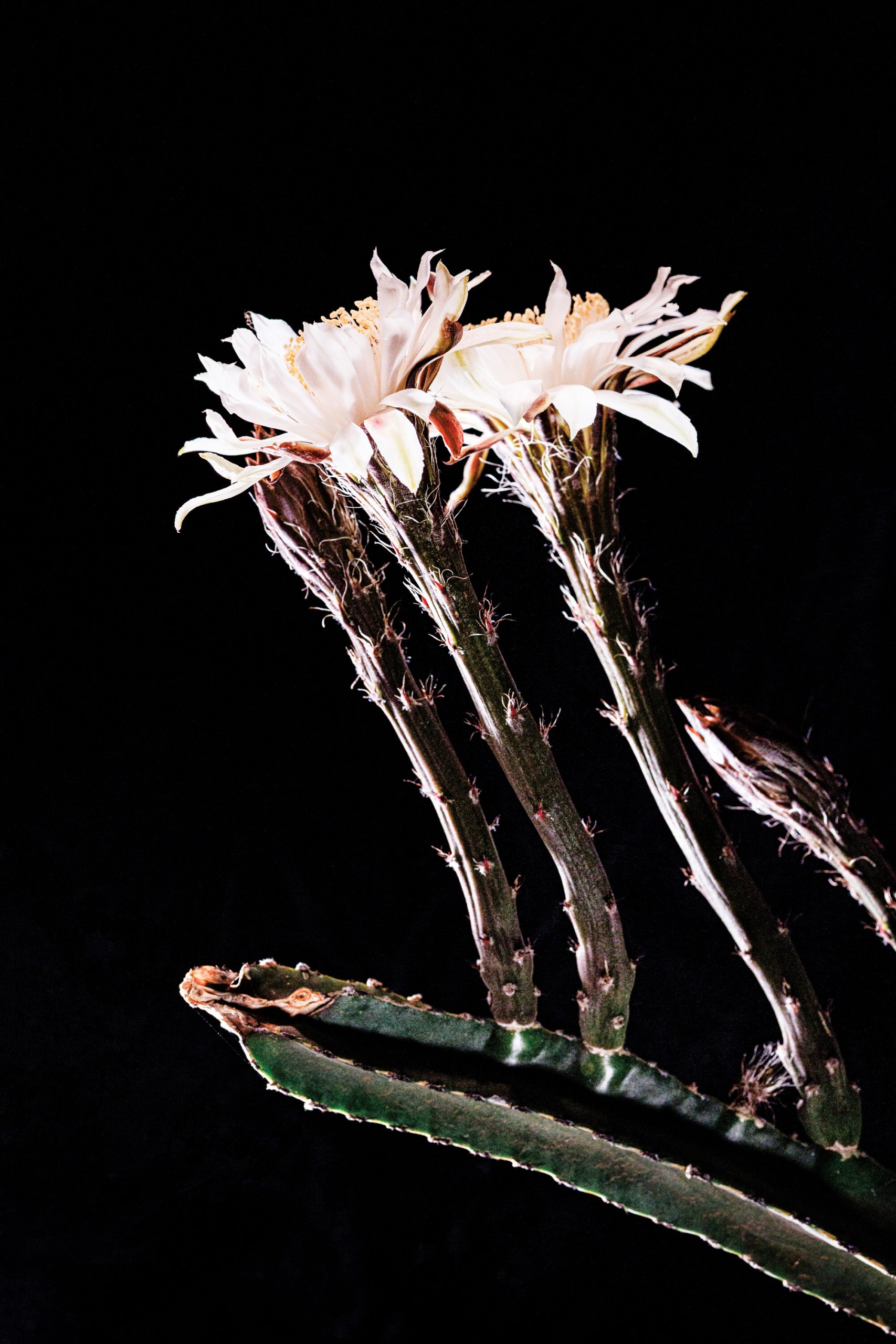
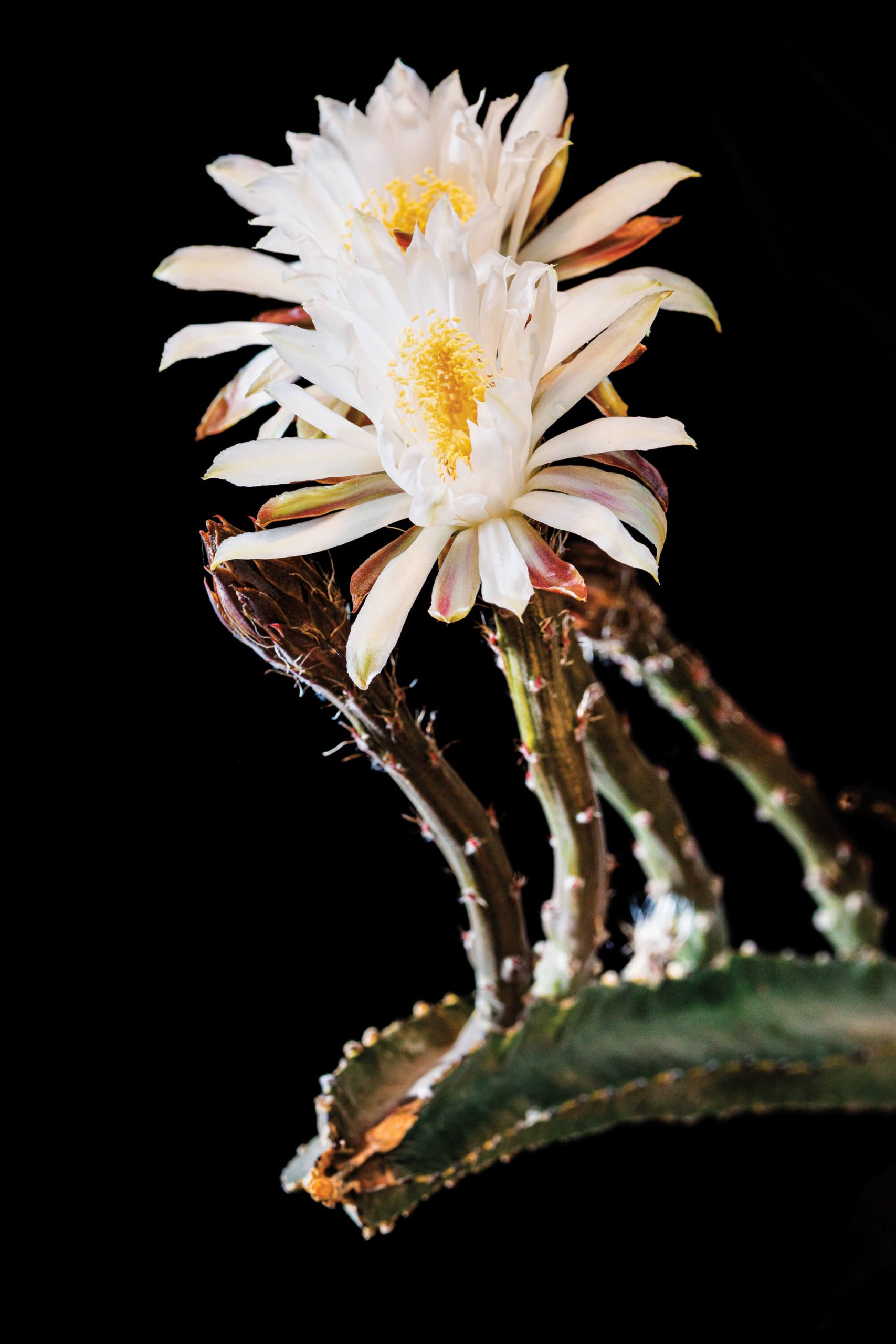
It’s not so much astounding that she still exists somewhere out there, blooming only once a year, for one night only. What’s most amazing to me about the night-blooming cereus, or “queen of the night,” is how extraordinarily white the blossom is in total darkness. Almost phosphorescent. Amazing, too, is the enormity of her blossom—that pent-up desire, the yearning for beauty. Her brief intoxicating fragrance, which rivals magnolia and gardenia, suggests vanilla and the sassy power of citrus. She is worth dreaming about, even searching for and seeing if you know where to look.
The human tendency is to pinpoint the rarity, to map the miraculous. The cactus I seek is a wild thing, though living for now in the backyard of a small town in far West Texas. The people who caretake her are understandably protective—there is a long and strange history of rogue plant collectors rustling rare species. Midwifing the bloom’s arrival is Kelsey Wogan, a scientist with the San Antonio Botanical Garden.
Some years, the meteorological conditions are terrible, and yet she appears; other years, everything seems just right, and yet she stays hidden, dormant, waiting for a better year, finicky. It’s an extreme and flamboyant Hail Mary way of life that occurs in deserts and subtropics around the world. In Chinese folklore, night-blooming cereus blossoms represent unfulfilled love. Others believe the blossoms bring good fortune and grant wishes.
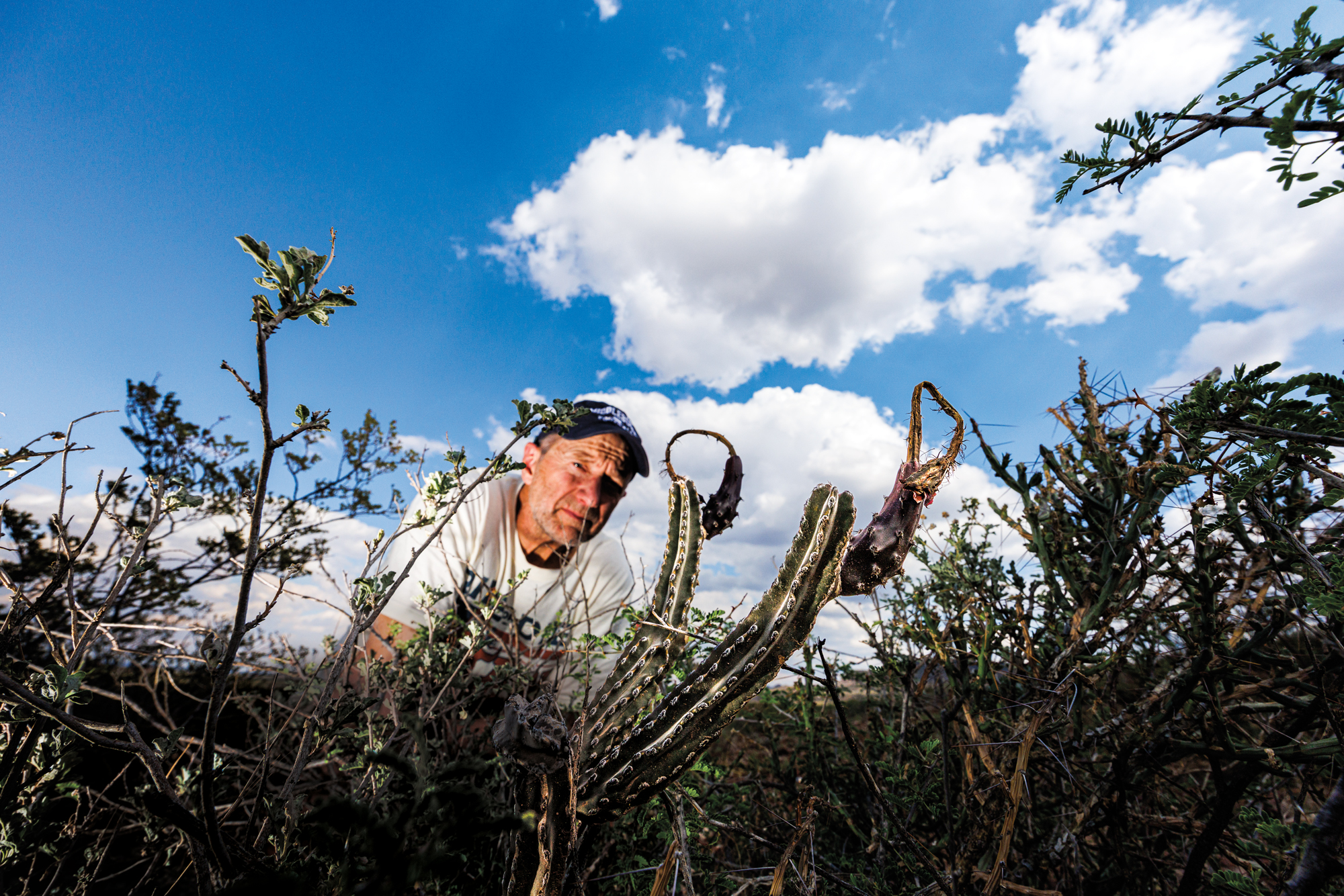
The queen I’m suiting, Penio-cereus greggii, typically blossoms around Mother’s Day. It’s a maddeningly inexact estimation. I’ve missed seeing her the past two years. My hope is this third time she will grant me my most fervent wish: to witness a mysterious and elusive natural phenomenon. I believe it’s important to celebrate that there are still things we do not know or understand. To remember that we, too, are a fragile species, exceptional in our own way and highly dependent upon a great many factors.
There is always further calibration of the world to which we are not privy. Perhaps miracles are blooming all around us, in all hours and all seasons, but pass by unseen, unheard, untouched, their flashbulb existence supremely calibrated to a complex world. It is as if we don’t know a miracle until someone points it out to us.
A tall wooden fence guards the garden in which our cereus is housed. There’s a chain and padlock on the gate, but tonight the lock is open and the gate’s ajar. I knock anyway. The gate widens just a crack, and then, after Wogan assesses security, opens. Once I pass through, a new world presents itself. The nighttime garden is deeply ordered, curated, cultivated. Here, one species stands linked branch in branch with another among a gurgling fountain and moist yet arid conditions.
The night-blooming cereus in its non-blossoming state has been described as “a half-dead vine.” When the support of other plants is available, the cactus can grow straight toward the moon, reaching up through the lattice of the stronger nurse plants’ outstretched arms. The little silver hairs—remnant spines—can reach out and hold on to, rather than repel, their surroundings. I marvel at the secret contract between the cereus’ green blood and the austere landscape in which she exists. In the desert, existence is prosperity.
Out here, a common host plant for the cereus is the creosote bush. But just you try spotting this half-dead viny stick of a cactus nestled inside a shrub, camouflaged, hiding her beauty in broad daylight. “They’re so cryptic,” Wogan says, “that even if you looked right at one, you might not see it.”
Giant turnip-shaped tubers that can balloon to 50 pounds retain starches that allow the cereus to quench her thirst in the harsh conditions of the desert. All that she ever will be resides underground. “There’s so much energy down there,” Wogan says.
In the blazing environment in which the cereus has evolved, where else to hide the treasure but below, in the relatively cool vault beneath the flames?
This 365-day preparation requires the delicate calibration of temperature, sunlight, aridity, geochemical sustenance, host-plant support, and 10,000 other trembling variables we can neither see nor know. The wind might be the biggest wild card. The cereus’ great planning and precise timing can be for naught if, on the eve of her offering, a breeze kicks up—much less a desert wind. “The pollinators won’t fly if it’s too windy,” Wogan says. “They’ll just hole up and wait. It’s not worth it for them.” Too much energy expenditure; too elevated a risk of being preyed upon.
Hawk moths are a common nighttime pollinator, but so are other insects, even bats. Despite her persnicketiness, the queen is not choosy about pollinators. “The nighttime blooms,” JoAnna Klein wrote in a 2017 New York Times article on night-blooming cereuses, “reduce competition for pollinators by other plants, allowing the cactuses to bear more fruit.”
The cereus times her debut, launching her luminous self, completely open and vulnerable, into the night. Wogan has watched hawk moths drain the nectar from the big blossoms at night, the year’s masterpiece diminished in real time. The moths sip from the blossom until it’s completely drained, and then they fly on, radiating an aura, leaving the empty, defeated blossom.
Sometimes if the blossom hasn’t been successfully pollinated, Wogan says, it will stay open a little past dawn and into the new day, as if holding on for as long as possible, in search of a miracle. “Maybe we’ll hang around till morning and get some daytime butterflies,” Wogan says, speaking for the cereus.
But if no one arrives, her blossom is bathed only by the gentle wind that keeps her suitors away, and by dawn she is dwindled, her year of reserves and yearning spent. Is there recrimination in the defeat of the unpollinated blossom? Is there an evolutionary second-guessing going on in the roots: a silent conversation about how greater attention could have been paid to barometric pressure and phase-of-moon? Should we have waited one more night?
“Cereuses can die completely above ground,” Wogan says, “or can be completely trampled above. But they can still have all the resources below that are required for a resurrection.”
All the queen has to do is lie low and wait, secure in the knowledge that she was made for this hard world, and that this hard world was made for her.
What is rare is usually valuable, and what is fragile, even more so. There are so few secrets left in the world that our brute kind can be drawn to this, too, craving mystery. The Chihuahuan Desert is home to roughly a quarter of some 1,500 known cactus species, and about 30% of those species are threatened, mainly by illegal trade. The night-blooming cereus, found in deserts throughout Texas, New Mexico, Arizona, and Mexico, is prime for the taking.
“Like many cacti, Peniocereus greggii is coveted by collectors due to its unique appearance,” says Zack Leibovitch, a horticulturist who manages the Enid A. Haupt Conservatory at the New York Botanical Garden, which is home to a variety of night-blooming cacti. Incidentally, Peniocereus greggii was placed into its current genus in 1909 by NYBG founder Nathaniel Lord Britton. “All cacti, including the queen of the night, are protected by the Convention on International Trade in Endangered Species of Wild Fauna and Flora,” Leibovitch adds. “These species are not necessarily threatened yet, but the trade of these organisms is controlled to prevent them from getting to that point.”
Closer to home, the San Antonio Botanical Garden hosts cereuses in captivity for Texans unable to track them down in nature. Michael Eason, vice president of conservation and collections, also keeps seeds as a doomsday cache. “It’s impossible to know how many individuals are out there,” he says, “but based on collection records and observations, we do know they are rare compared to other species.”
Nature is bloody with tooth and claw in cactus world. Yet, somehow, the queen of the night resides a mysterious distance away from the fray, with a stalk no thicker than a pencil and a smattering of silver spines so chaste as to seem more like individual hairs. She exists not with ostentatious military overspending but instead with silence, exile, cunning. She situates herself, often literally, between a rock and a hard place, appearing no more delicious than a dried-out twig waiting patiently while the world broils and bakes. All her dreams reside in the cool red dirt below, tucked away in one crevice or another that we above neither see nor imagine, even as we pass by, directly above the dream.
Sometimes the dream sleeps. But usually, I think, the cereus is waiting, attentively. And perhaps a year for a cereus is but a few seconds, or even a minute, to you or me.
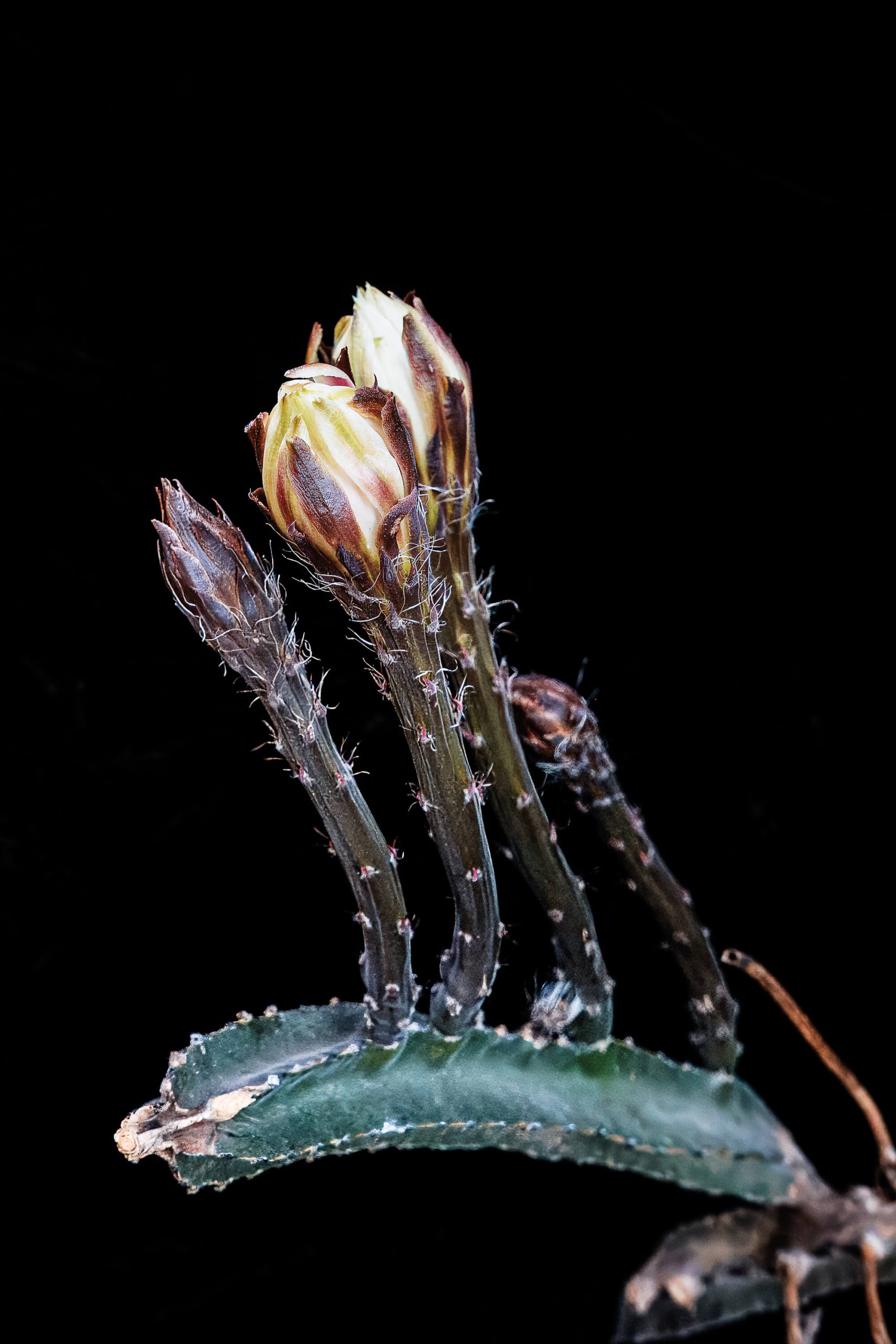
It’s almost 8 p.m. and the blossoms are not here yet. There are two buds: one on the front side of the cactus and another hidden on the back side, shy. They remind me of pumpkin seeds, though they’re sheathed in olive green, the color of a jeep or a tank. Where the protective green casing is starting to split—as a chrysalis does—we can see the moist, tantalizing lines of white. The blossom within, still making up its mind, is so close.
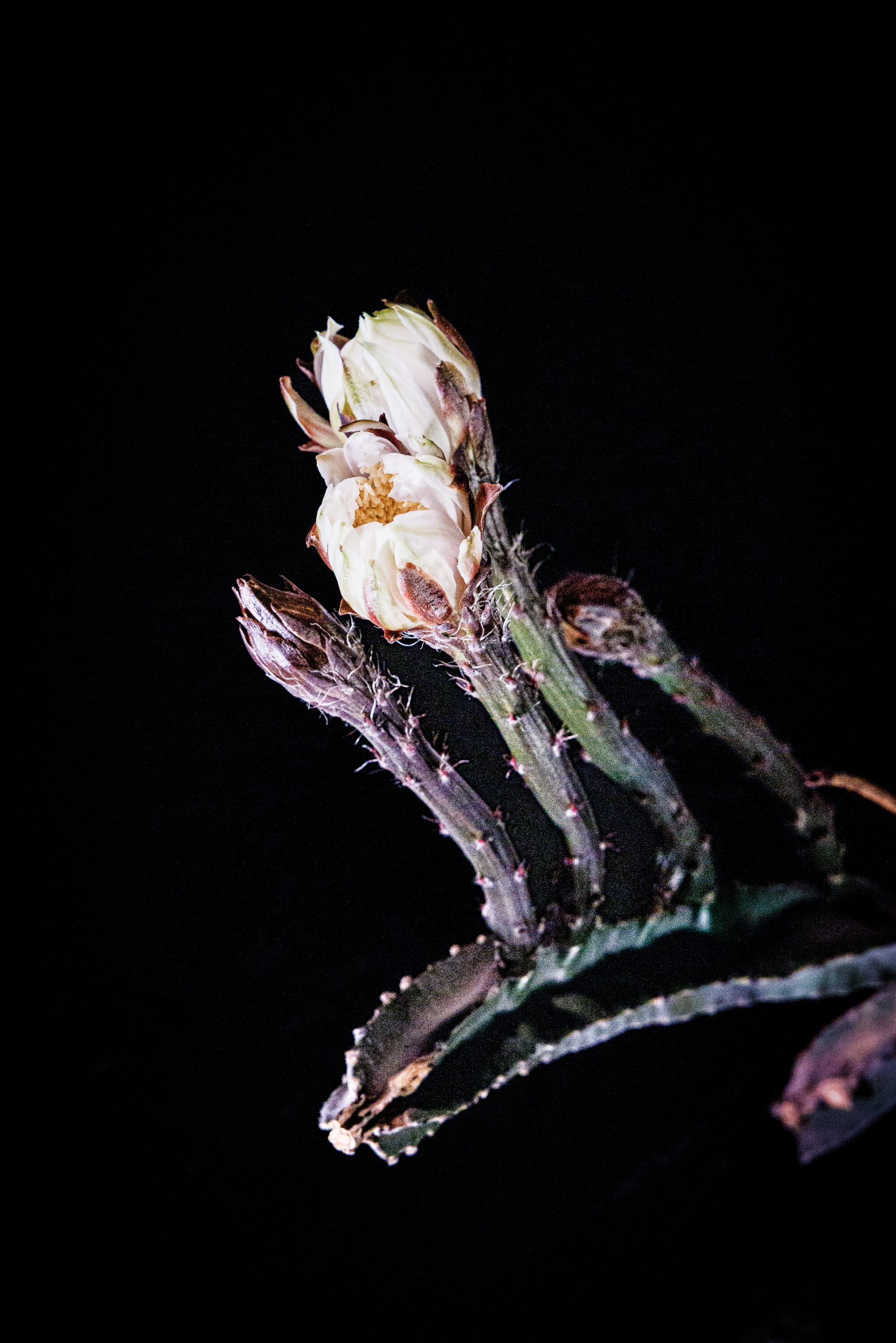
Once the decision is made, there can be no turning back. The seam of creamy white is skinnier than the smallest fingernail paring, tinier than the thinnest of crescent moons. But the blossom is in there, being born into the world. After waiting a full year or longer, the flower is now entering a relationship with time that more closely approximates our own. Living on human time now, living on the clock. Living on borrowed time, in the sliver of darkness that exists between today and tomorrow.
Wogan looks at the buds and says, “They’re about to blow.”
This is a different kind of waiting. There is no precise moment for when the bud will open, no clockwork commitment or predestination, only the random choice available to the cactus in each next living moment. But we wait, and watch, and are rewarded.
At first, it’s hard to believe. What will soon enough complete the metamorphosis into absolute beauty presents first as a fraying. The green husks slowly spread wider as the pristine white hatchling within pushes them aside. It’s as if the husks had sealed tight the opening to a cave from which the blossom is emerging: ragged and misshapen at first, like a butterfly with wetted wings.
After all asymmetry falls away, we gather closer and admire the spreading blossoms. The radial white brilliance washes out the memory of imperfection.
“How does this lush, succulent thing, with everything wanting to eat you and no ability to move around, survive in the desert?” Wogan asks the cactus. “How would you make it in such a world?” Wogan asks me.
There’s a cricket chirping in the bushes. Sean Fitzgerald, the photographer accompanying me, arranges his tripod, putters with his screen, and measures readings from his artificial lights. Will the moths see his flashbulb poppings and be drawn from afar? Perhaps the flashes of camera light register as lightning—dry lightning, heat lightning—to the outstretched, twisted arms of the cereus, open to the breeze above and the stars farther out. No longer waiting but asking. Believing. Summoning.
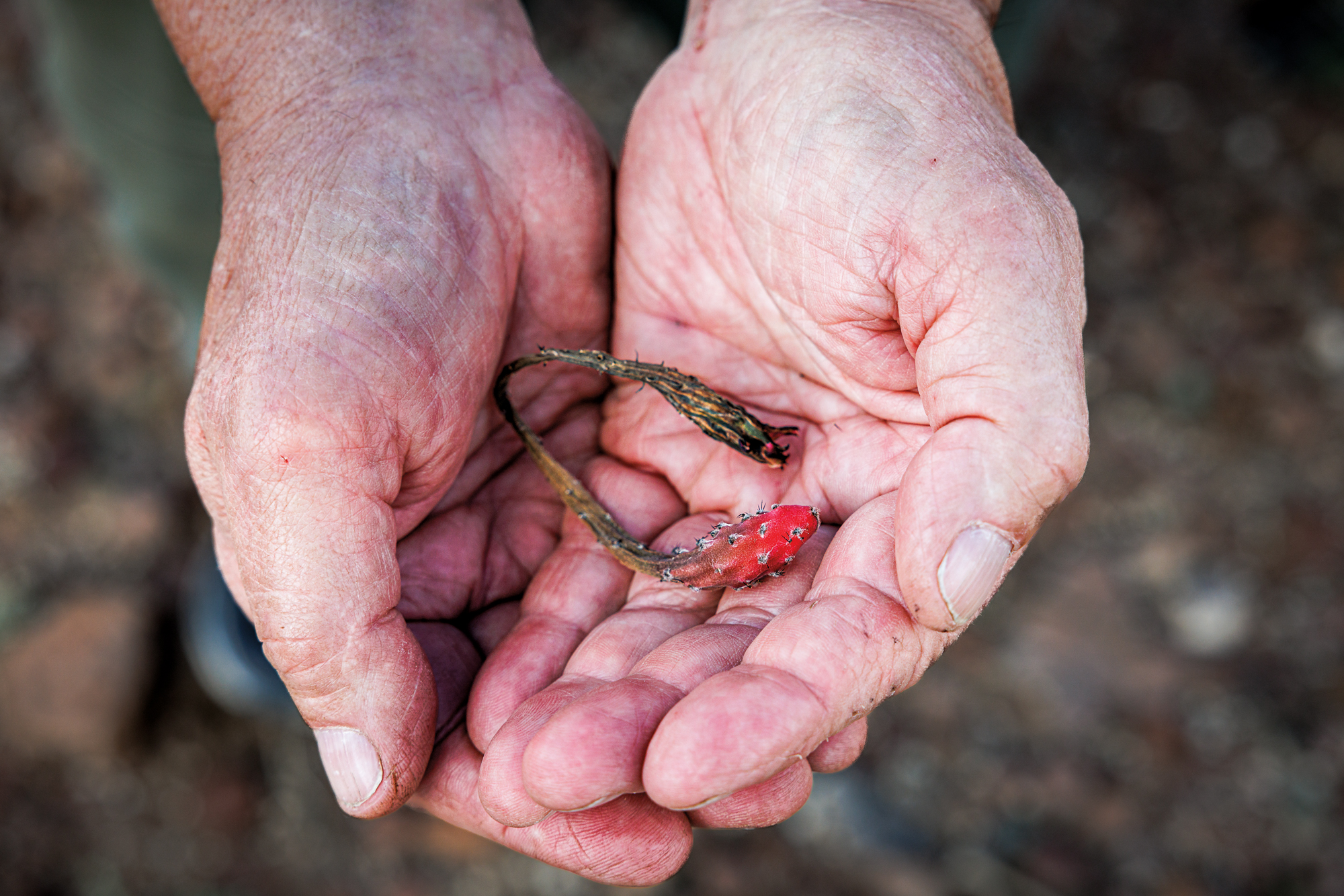
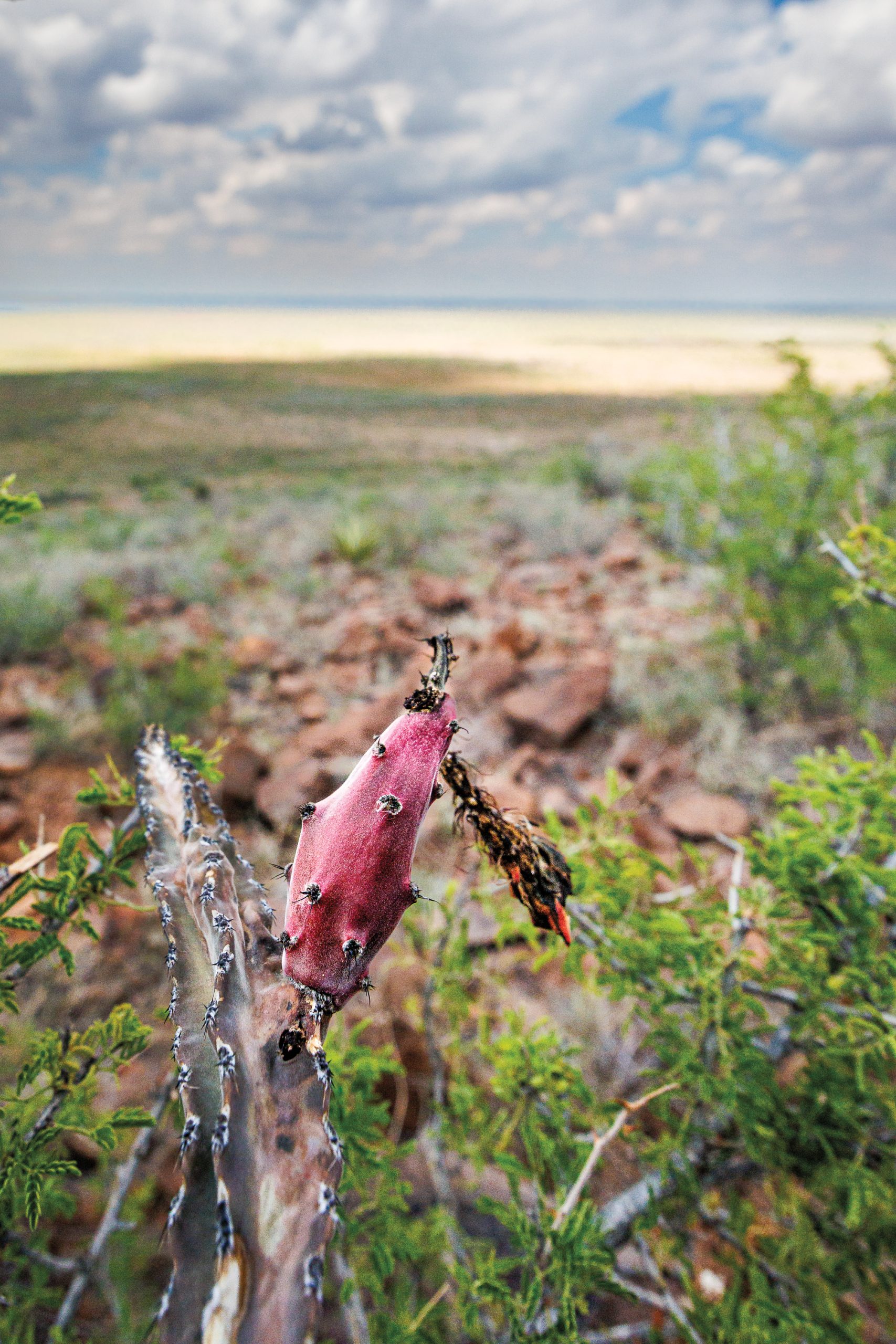
The fruit, not the blossom, is the thing, of course, with its shimmering, lighthouse-in-the-night quality. The swollen, nectar-coated anther points the way toward the future via the imperative of procreation. This fruit is red, as are the fruits of many cacti—choose me, choose me—and round like a golf ball.
“It’s like, ‘I have all these beautiful spangly bits in my blossom, all these delicious sticky bits,’” Wogan says, channeling the cereus. “And after pollination, it’s like, ‘I’m gonna keep all this to myself, to take care of it. Here are my flowers, and here are my fruits.’”
Extreme environments create extreme adaptations. The blue-collar, bring-your-lunchbox-to-work ethic of the beautiful blossom—you’ve got one night, make it count—is turned upside down once the fruit is made. Many seeds fall to the rocky ground, where other species may or may not find them and carry them on. Cactus wrens, desert box turtles, coyotes, foxes. Chance, now, rather than exquisite design. Incredibly fragile and longshot odds of being transported to a new site and establishing roots and rootedness, strength and meaning, in a hard country. And yet, the yearning of the cereus persists.
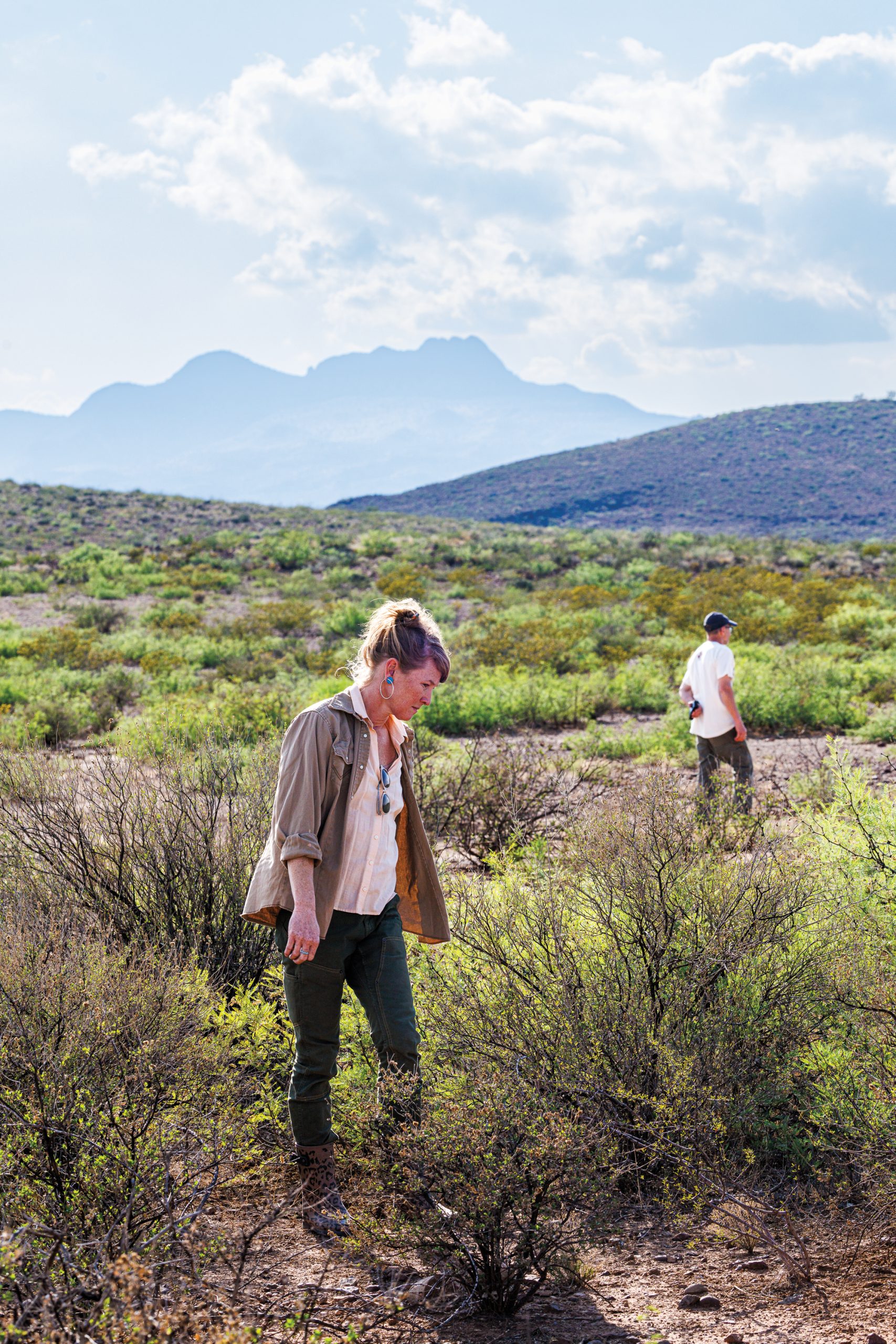
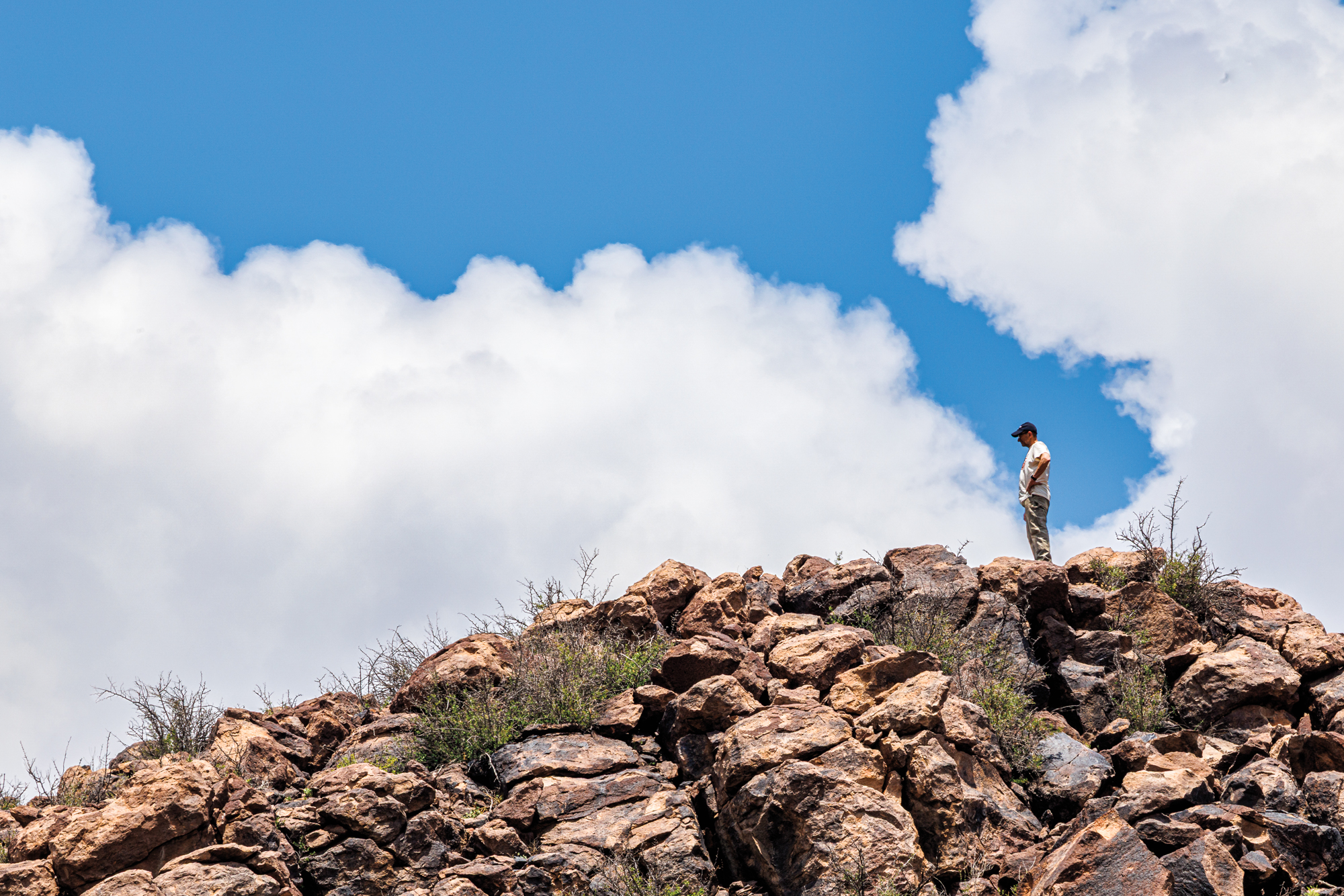
The next day, Sean and I travel to a ranch to see if we might, against all odds, locate a cereus—blooming or not—in the wild wild. We walk through the knee-high creosote with our heads tipped down, the heat and silence lulling us into believing we are in surf.
What can grow here? Creosote and cactus and, higher on the slopes of the hills, acacia. Such a terrible, thorny, broiling landscape. Remember, I tell myself, it is not coincidence that one of the most beautiful blossoms on the continent arises only and specifically from such mayhem and geological trauma.
We start side-hilling uphill, slowly in the heat, heads still tipped down. We’re not yet sure of the search image, the shape and substance of the thing we’re looking for, but we trust we might know it when we see it. A tiny, twisted, withered stick of grace. Like something that might easily be tossed into a fire.
I follow a rocky contour up the hill, weaving between rocks. There are a few grasses and the sun-dried pellets of scat from aoudad and mule deer.
I’ve been watching the ground, only occasionally looking up to check in on the upper world, and when I look back down, there it is, in all the absence of glory: a withered cereus, its lone stem no taller than a cigar and no thicker than a crayon, standing upright, cradled within a nest of acacia.
This cereus looks like it’s masquerading as a dead dry stick. Hiding its inner beauty in bold bright sight. Unable to grow taller without the latticed support of the random twisting little branches of the acacia, which will stabilize it.
My first response, upon finding something that’s working so hard to remain hidden, is to hold in confidence the secret upon which I’ve stumbled instead of calling out in joy to Sean on the other flank of the hill.
I crouch and marvel. I study the tiny sepals in her gunmetal green sides—places that could, if circumstances were perfect, allow for the emergence of a bud, a blossom, a fruit.
This cereus looks deader than driftwood. But the refiner’s white fire of beauty is powerful within. It has vanished, for at least a year, but is no less mighty for the waiting.
To mark the location so I can bring Sean back to it later, I stack a small cairn of basalt and continue on, with the world changed for me now. I’ve dared to believe, and my faith is rewarded. In these fractured times, where truth has become so devalued, it’s a welcome surge of reinvigoration to discover that a thing one wants desperately to be true actually is. The residue of chronic disbelief burns away. One sees.