

STARGAZING
Dark Matter
Gaze upon and learn about the stars of Texas
By Antonio Ruiz-Camacho
This story is part of “Night Shift,” a feature on nighttime adventures in Texas.
The nocturnal spectacle begins when you hit the road as the sun slides from the sky, turning the horizon shades of pink and rich orange. It’s past 8 p.m. when my wife and I leave our house in Northwest Austin and take State Highway 290, delving deeper into the Texas Hill Country as daylight fades.
By the time we cross through Dripping Springs and turn right on Ranch Road 3232 to reach the entrance to Pedernales Falls State Park, it’s fully dark. The entrance booth is eerily empty, the park’s headquarters and gift store closed, the penumbra only disrupted by glowing ticket dispensers where you can purchase permits after-hours.
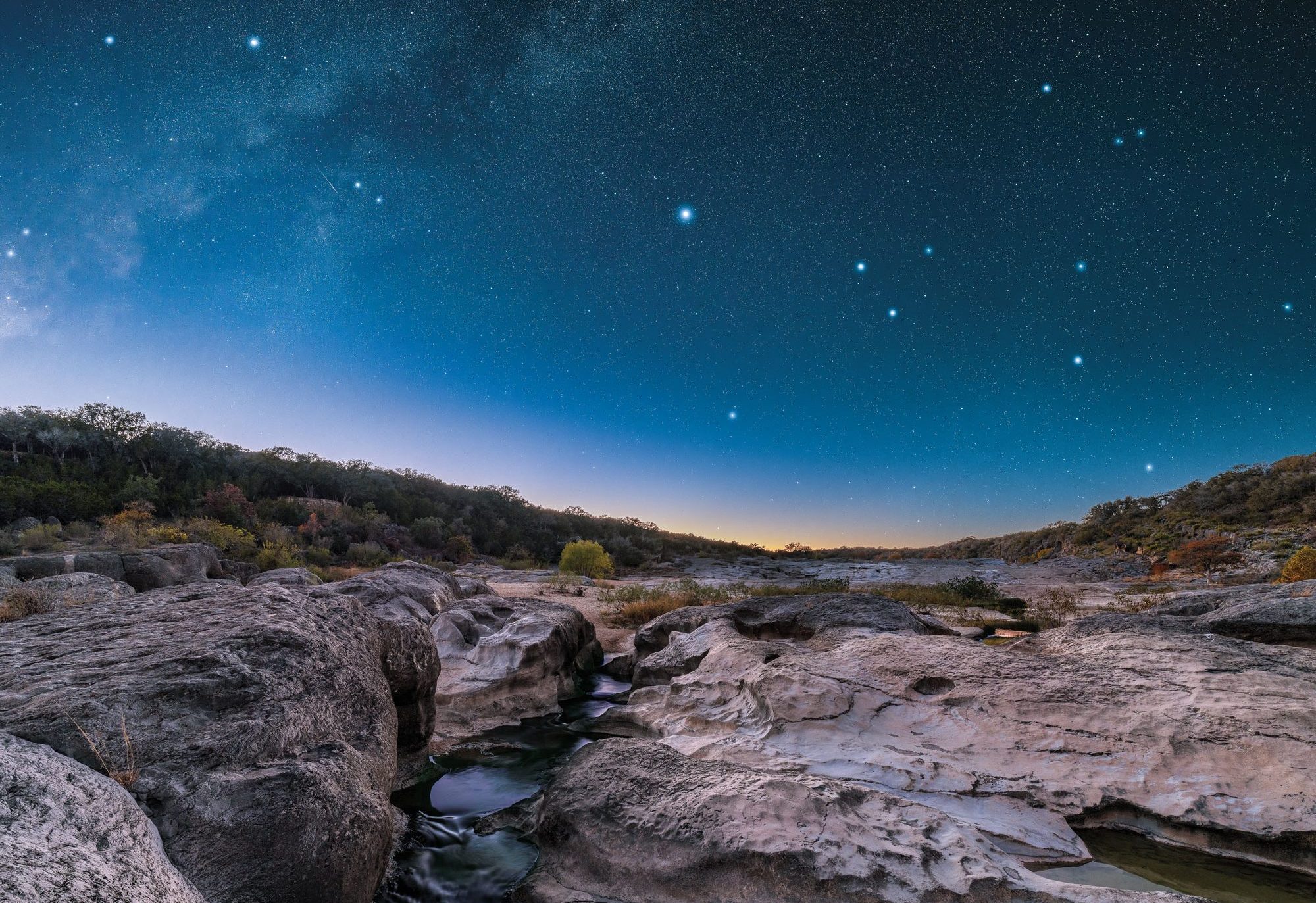
We retrieve our passes and enter the park in total darkness, winding down the road until we reach the Pedernales Falls Trailhead parking lot at the end. At the top of the trailhead, a group of about 60 stargazing enthusiasts gathers around Stephen Garmon. The park interpreter and ranger is our host for tonight’s Hiking to the Stars, one of roughly 50 events the park organizes every year to illuminate the wonders of the night sky.
Following his lead, we hike down for three-quarters of a mile to Pedernales Falls, red flashlights in hand to help the group stay adjusted to the dark and find a spot to lie down on the riverbed’s massive slabs of exposed limestone. For the next 40 minutes, Garmon uses a green laser pointer to highlight the constellations above us formed by the cacophony of distant stars blanketing the night sky, sharing ancient stories about the origin of these celestial bodies.
Garmon begins with one of his favorite tales: A group of spirits is hoarding the sun in their tent, and a pack of animals decides to try to steal it so everyone can enjoy it. Sly and sneaky, the gray fox tries first. He successfully slinks past the spirit guardians into the tent, where he grabs the bright, scorching sun with his mouth and begins to run. But the fox soon realizes the sun is just way too hot to hold in his mouth—it begins to burn him, so he must drop it. The fox goes back to the rest of the animals, “tells everyone what happened, and everyone can see that his mouth is badly burned,” Garmon recounts. “And to this day, all gray foxes have black fur around their mouths.”
For the rest of the evening, Garmon shares the origin stories of other popular stars and constellations gracing the clear sky—Greek and Native American myths about the Big Dipper, Scorpius, Antares, the Milky Way, Cassiopeia, the Northern Cross.
Our guide peppers his stories with mind-blowing facts about these space celebrities: “Deneb is somewhere around 2,000 to 3,000 light-years away,” Garmon explains, pointing to a bright supergiant star that belongs to a constellation called Cygnus, the Swan. “The light we’re looking at right now left that star in about 1,000 or 500 B.C.” It only adds to the sense of smallness I feel about our place in the universe as I gawk at the firmament.
I’ve always struggled to make out the shapes of those mythological animals and other figures that populate the sky, and tonight is no exception. But I’ve been fascinated with starry nights since I was a child. A sense of calm and awe washes over me. I am overwhelmed by the improbable spectacle curated by the sky tonight, a sight increasingly elusive, especially living in a big city.
I can hear the symphony of the cricket frogs, whose hypnotizing calls the park ranger poetically describes as the sound of two rocks being rubbed against each other. I could stay here all night, in silence, just gazing at the stars.
I’m not the only one who feels that way. At the end of his presentation, Garmon encourages visitors to stay for as long as they want and about 10 people take him up on the offer. He leads the rest of the group back to the parking lot, where the light radiating off the lampposts feels too much, too bright.
Pedernales Falls State Park hosts two to three stargazing events every month. During the winter, it gets darker earlier, while August, July, and September offer the brightest Milky Way sightings. Garmon has hosted these events since 2018 and still hasn’t gotten his fill of the spectacle above. “The sky changes every single night,” he says. All events are free, but entrance fees are required to access the park and reservations are encouraged. tpwd.texas.gov/calendar/pedernales-falls/hiking-to-the-stars