

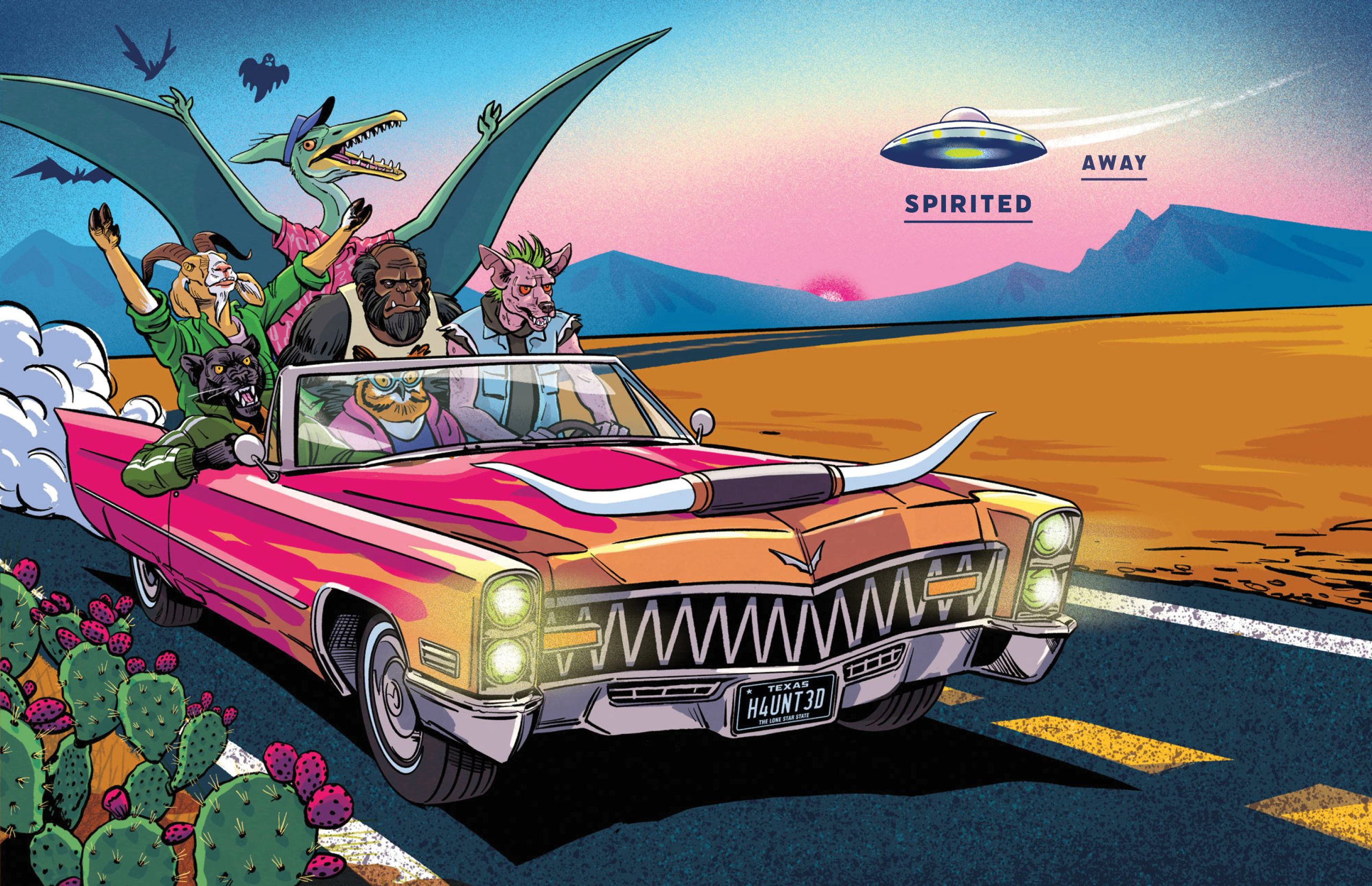
Take a trip through the spookier side of the state on cursed ships, in haunted hotels, and at sites of alleged paranormal activity
By Asher Elbein
Illustrations by Brandon Loving
To love history is to try and cross the veil that separates the dead from the living. It’s no wonder, then, that wherever remnants of the past are found, paranormal legends—and the people entranced by them—are seldom far behind. This is the world of dark tourism, luring visitors eager to engage with all things mystifying and macabre.
“Dark tourism is not a new concept,” says Karli Stansbury, museum educator for the Beaumont Heritage Society, “but it has only been studied academically since as recently as the 1990s. The category has just become more widespread in recent years, in part due to Gen Z and social media contributing to its popularity.”
Today, the dark tourism category has grown into a booming industry that now generates $32 billion globally and roughly $575 million in Texas. While that figure may only amount to a fraction of the state’s robust economy, some of the money helps fund museums, historical buildings, and other sites in need of support. “When approached thoughtfully,” Stansbury says, “it helps cultural institutions spark meaningful conversations, broaden their audience, and foster deeper connections to the past.”
In graveyards and old red-light districts, across cities scarred by assassinations and cryptid-packed landscapes, Texas has plenty of past to be haunted by. What’s the real story behind the lore? Oftentimes, the trip to discovery is even more rewarding than the truth.
TROUBLED
WATERS
SET SAIL ON THE STATE’S MOST
TERRIFYING SHIP
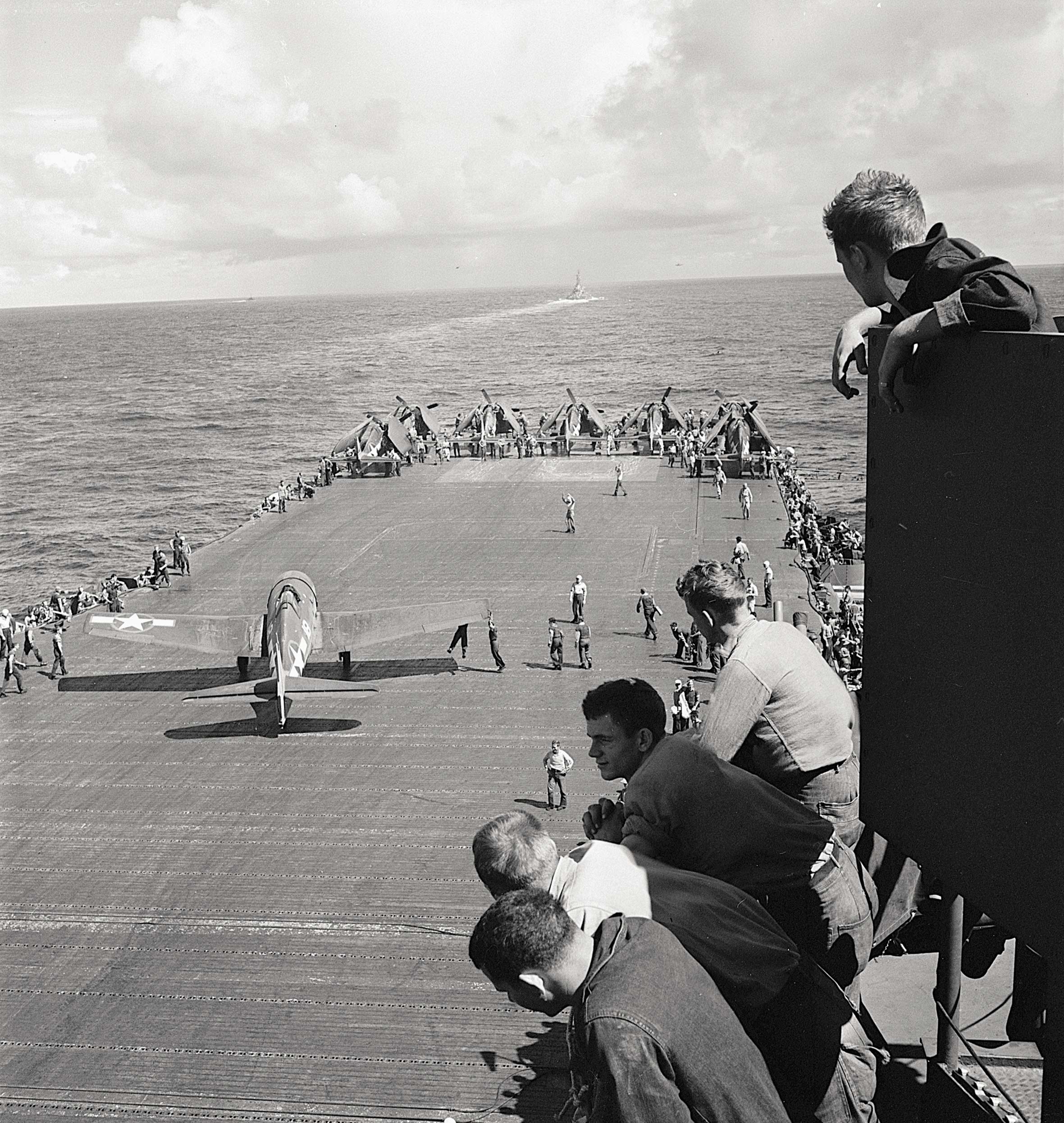
After serving in the fires of the Pacific Theater of World War II, the USS Lexington found its final resting place in Corpus Christi. While it’s largely a floating history museum, this aircraft carrier doubles as a haunted house: A resident ghost, Charlie, is said to walk the narrow corridors. Reportedly killed in a Japanese attack in 1944, he’s a well-mannered apparition, dressed in an old-fashioned sailor’s uniform. And he’s not alone: Visitors and staff have both reported hearing the sounds of ghostly chains, experiencing elevators acting on their own, and glimpsing shadowy figures in the hangar bays. You can try your luck with a ghost tour ($50/person) or an overnight investigation ($75/person), which will give you after-hours access to the black, echoing interior of the ship. usslexington.com
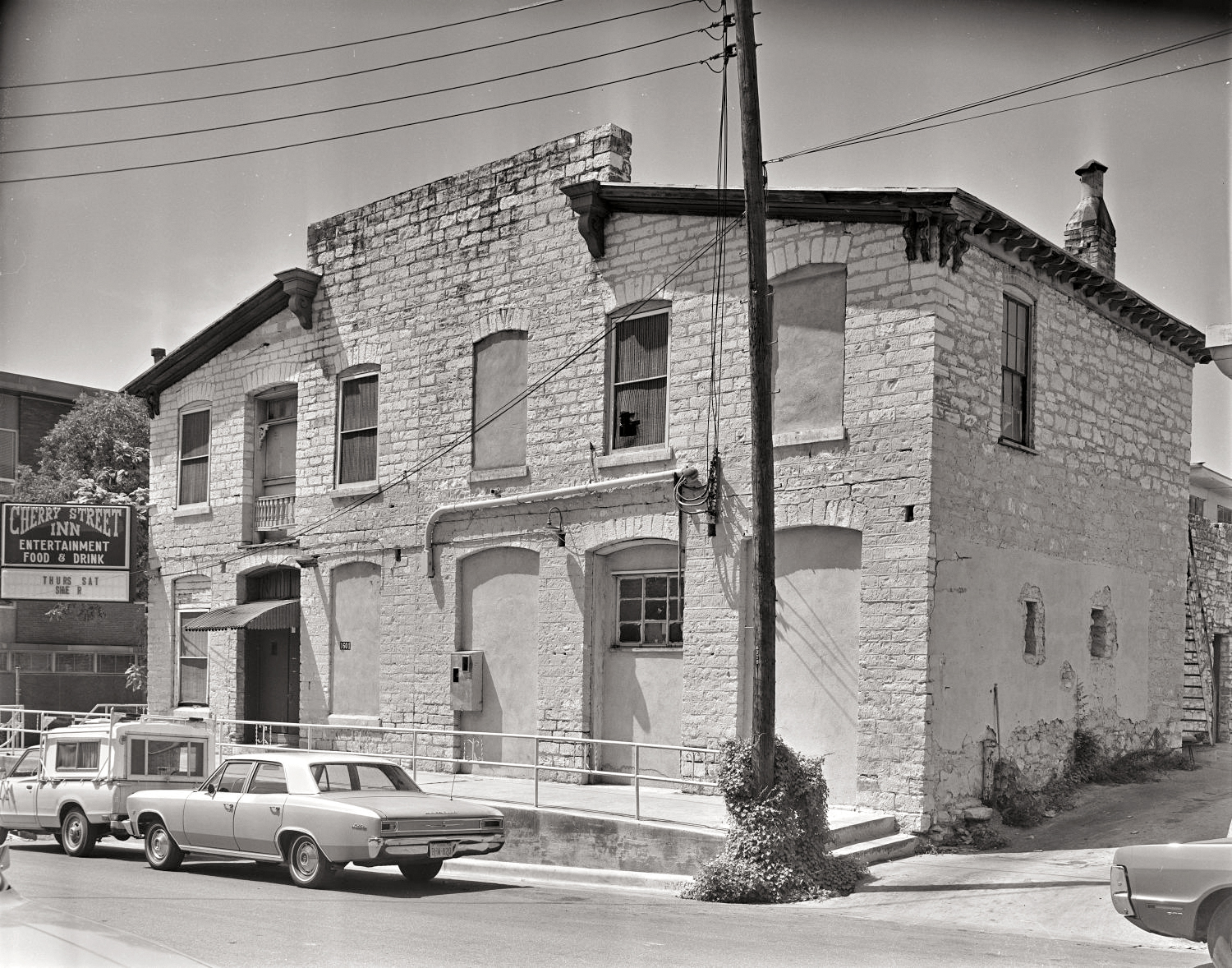

Ghosts often appear as a result of a violent or uncomfortable past, digested by time, and, possibly, sensationalized by opportunistic entrepreneurs. Take Austin, for example. Between 1870 and 1913, Austin’s First Ward—10 square blocks of businesses in the modern downtown—served as the city’s unofficial red-light district. Sometimes referred to as Guy Town, these historical buildings once housed dens of gambling, drinking, dancing, and vice, says Jeanine Plumer, owner of Haunted Texas Corporation and author of Haunted Austin. Echoes of that seedy past can still be heard—sometimes literally—at certain buildings surrounding the Capitol.
DuMont’s Down Low
214 W. Fourth St., Suite B
Today, it’s a low-key speakeasy in the modern Warehouse District. But in the late 1800s, brothel owner Blanche Dumont ran an establishment in the area before her young daughter died of typhus. Dumont followed in her wake not long after. Yet something of her establishment lingers. “[The owners] called us because they were having things happen,” Plumer says. “Glasses falling off shelves, lights that would turn off or on, voices. All of these disembodied sounds of humans who weren’t there.”
The Tavern
922 W. 12th St.
A bustling sports bar since 1933, the Tavern also embraces an allegedly haunted history. Despite rumors that the building was an illicit bar and casino during Prohibition—and that it was the site of the grisly murder of a madame’s daughter, suggested by the discovery of a pair of shoes in a third-floor crawlspace—Plumer says that it was, in fact, a grocery store in an upscale early suburb. That doesn’t mean it isn’t haunted, though: When the building was vacant in the ’80s, Plumer collected an eyewitness account of a strange woman in the window. “The people who work there now report stuff all the time, like the movement of objects and sounds that aren’t there,” she says. “It’s almost always when you’re closing up or opening—that’s when it’s magnified.”
Bertram Building (Clay Pit)
1601 Guadalupe St.
Another structure often associated with Guy Town, the Bertram Building was also a general grocer, serving the German American enclave in downtown Austin. While legends of a “scarlet lady” ghost have no historical basis, Plumer says the building was in an area marked by other tragedies: namely, a child who accidentally burned to death across the street. “It’s 100% extremely haunted,” Plumer says. During the 1991 renovation, the building’s owners invited her up to the second floor. “We collectively heard things falling and hitting the ground, and the sound of footsteps. And there was nothing there,” she says.

OTHER HAUNTED
HANGOUTS
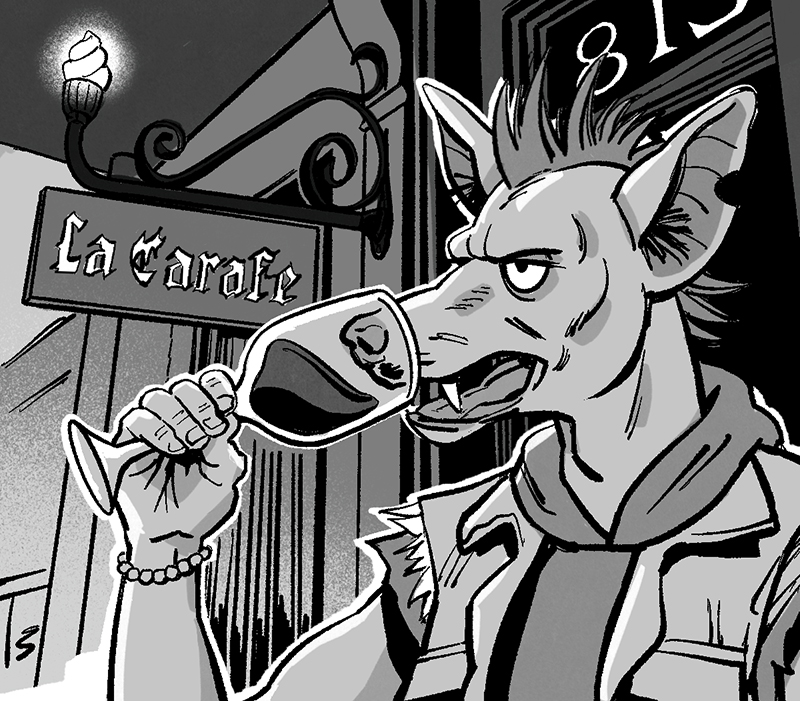
In 1902, Charlie and Dell Wunsche built a hotel and roadhouse, the Wunsche Bros. Cafe and Saloon in Spring, to cater to railroad workers. Their spirits are alleged to have stayed on to mind the property. Ghosts are also celebrated at La Carafe in Houston, a wine bar that originally opened as a bakery in 1860. This is the oldest commercial property in the city under continuous use—despite its late manager’s tendency to drop by for return visits. Meanwhile, Wimberley’s Devil’s Backbone Tavern is the epicenter of a whole region’s worth of spooky Hill Country stories, including the specters of a woman and child crying out for their missing husband and father.

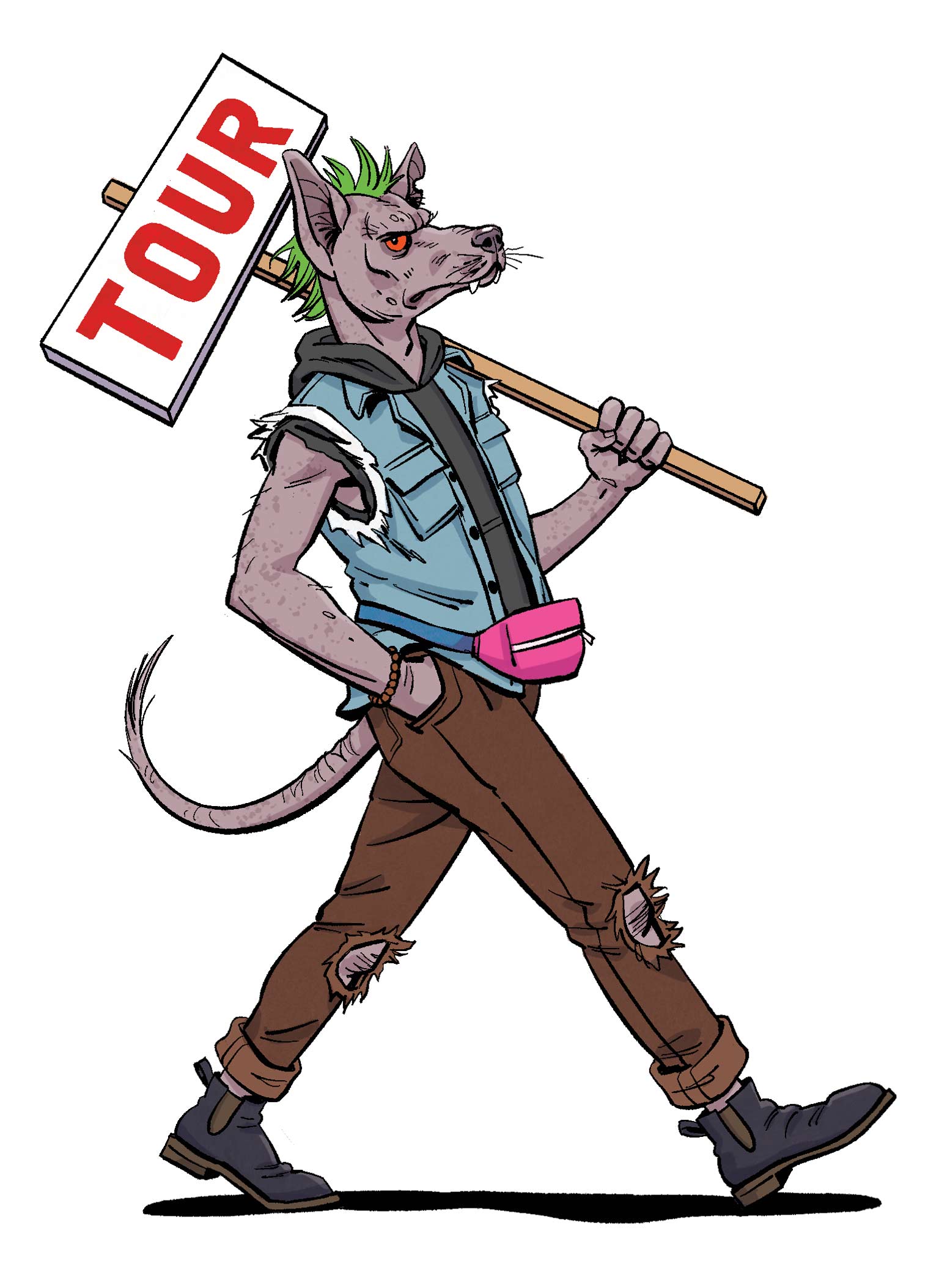
From its rural backroads to urban alleys, Texas abounds with legends of strange beasts. These monsters—also known as cryptids, or animals unrecognized by formal zoology—are a fixture of Lone Star State folklore. “People think that every inch of Texas has been explored and cataloged, and it’s just not true,” says Michael Mayes, a Killeen-based cryptozoologist who has authored several books on the subject. The best cryptid hunters, he explains, report on what people see and keep an open mind while maintaining a degree of healthy skepticism. “I think it’s interesting to try and discern what, if any, small grain of truth might have sent things snowballing down the hill that morphed into a story.” Here are seven of the state’s most mysterious creatures spotted over the last several decades.

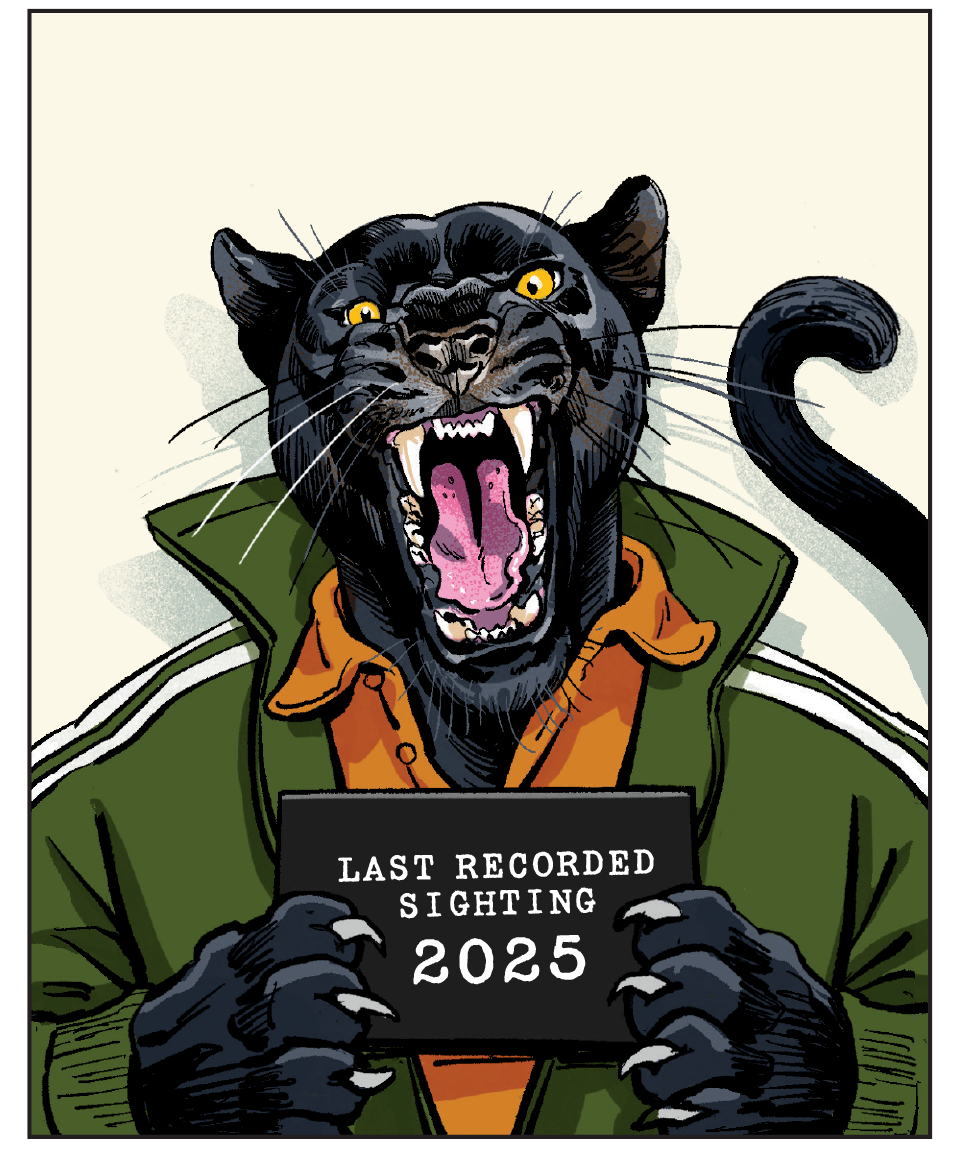
Physical description
Big cat with black fur, yellow eyes, and a long tail
LOCATION
Forested land east of Interstate 35
*HISTORY*
It’s not uncommon to see a black cat wandering down a backroad. It’s very uncommon to see one the size of a jaguar, with an unusually long tail. But there have been hundreds of sightings of these mysterious big cats in Texas, usually east of I-35, in areas that receive regular rain and retain forest cover, like the Big Thicket. But what are they? Mountain lions do not have dark coats, and bobcats don’t have long tails. One possibility is the modern jaguar, a species that roamed East Texas as recently as the 1940s. Occasionally sporting dark coats, this ancient predator has recently been caught on trail cameras in Arizona and New Mexico. The Texas panther, meanwhile, sticks mostly to the shadows, however much we may hope it steps into the light.

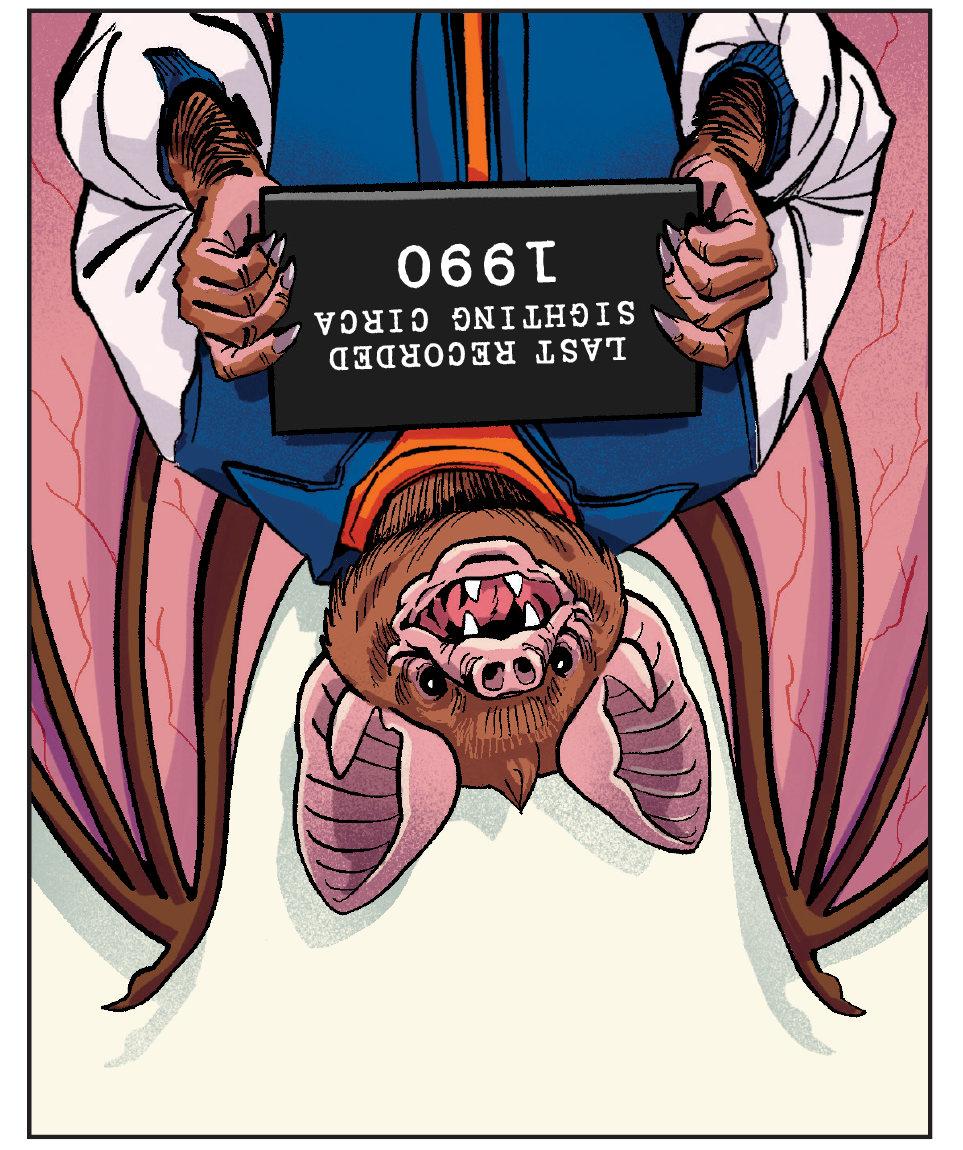
Physical description
Glowing humanoid figure with batlike wings folded against its back
LOCATION
Houston
*HISTORY*
In 1953, a trio of Houstonians sitting on their porch saw an enormous shadow leap into the top of a pecan tree. The Batman (no relation to Bruce Wayne) was visible for 30 seconds before it vanished. It next appeared in the ’90s, according to a report collected by cryptozoologist Ken Gerhard, when employees of the Bellaire Theater spotted a gigantic helmeted man crouching on a rooftop. This weird figure of the night remains a beloved urban legend from Space City, so keep an eye out between trips to NASA and the zoo—you never know what might be soaring above you on leather wings.


Physical description
Large, goat-faced beast that runs on two legs
LOCATION
Fort Worth
*HISTORY*
Some monsters appear only for a season before vanishing without a trace. In July 1969, a 7-foot-tall goat man, covered in both fur and scales, jumped onto the hood of a car parked by the lake, terrifying its occupants. For the remainder of the summer, reports of the Lake Worth Monster ran rampant. Gawkers and monster hunters flocked to the lakeshore and reported hearing terrible screams and seeing blazing red eyes peering from the dark. With the start of the school year, the goat man disappeared for good. But it’s not forgotten: The Fort Worth Nature Center still hosts a biannual event in its honor. The next Lake Worth Monster Bash will take place in fall 2026.

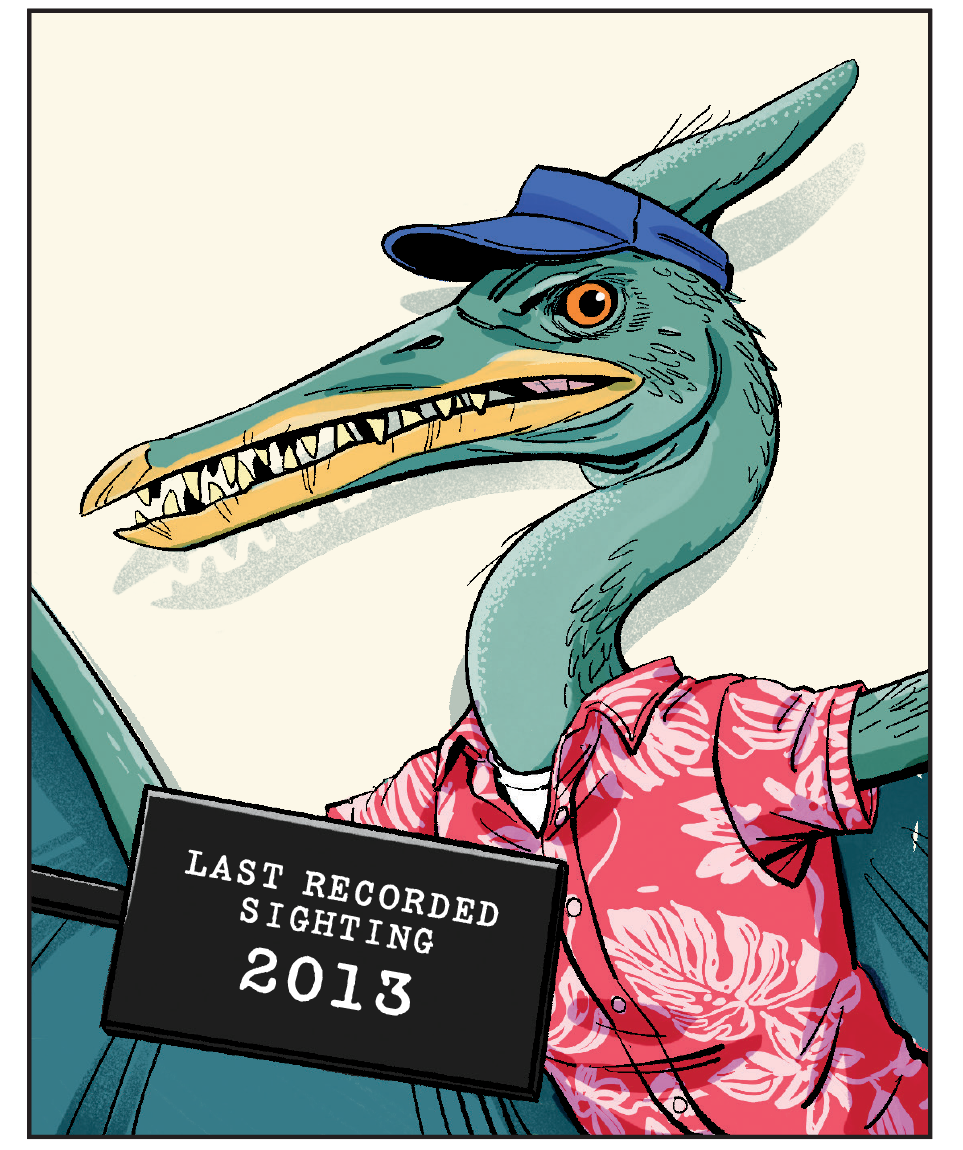
Physical description
Giant flying beast resembling an enormous bird or skin-winged pterosaurs
LOCATION
San Antonio and the Rio Grande Valley
*HISTORY*
Fossils of the extinct, Cessna-sized pterosaur Quetzalcoatlus were discovered in Big Bend in 1971. Five years later, a pair of San Antonio school teachers reported seeing enormous, pterosaur-like animals flapping over a desolate road. More witnesses disclosed similar sightings in Harlingen and the Rio Grande Valley. In the years since, there have been occasional reports of enormous flying animals, often referred to as “thunderbirds” after Lakota and Dakota folklore. Some have suggested the sightings are of an unknown species of large bird that nests somewhere remote, like the Mexican Sierra Madre, and occasionally blows into Texas airspace. Others have hinted that Quetzalcoatlus has returned to haunt this side of the border.

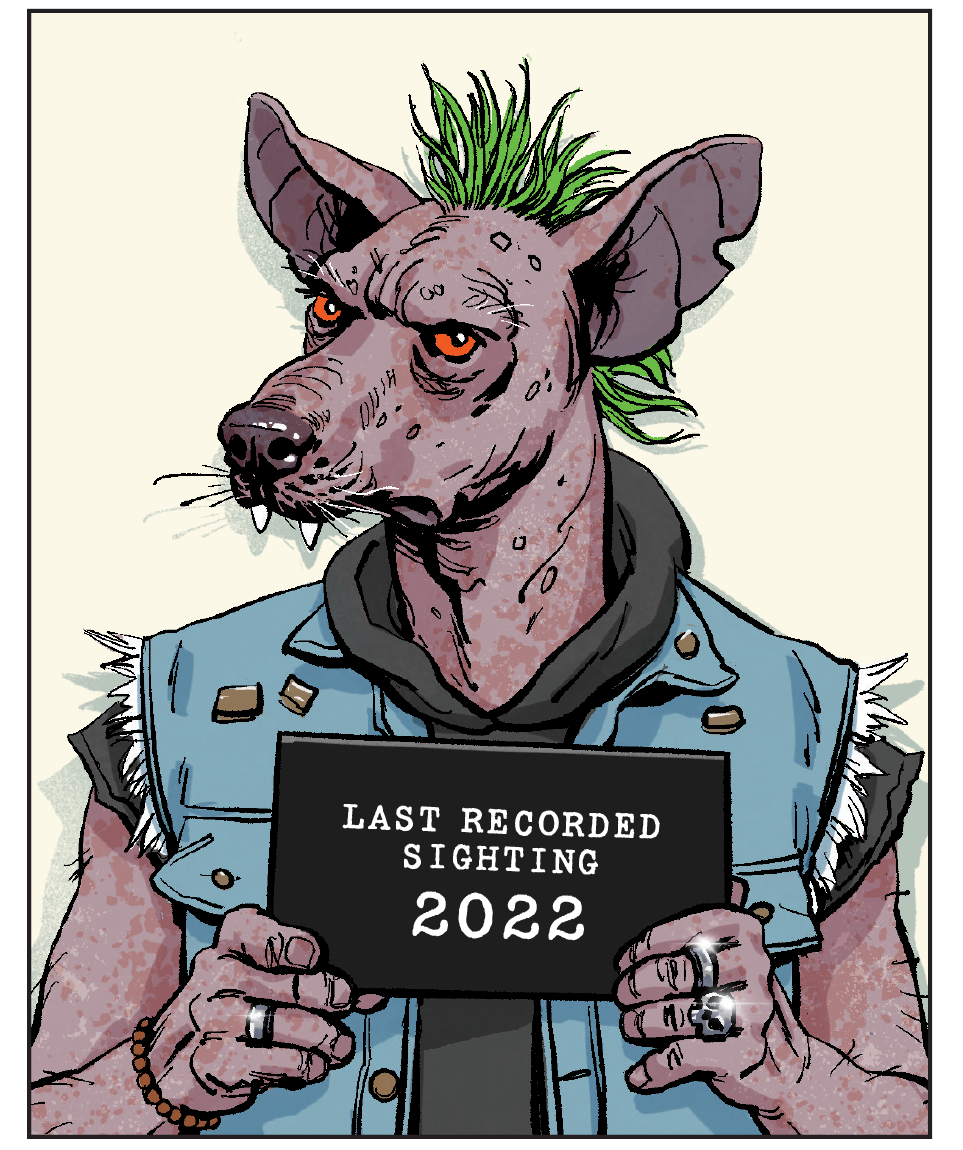
Physical description
Skinny, hairless mammal with wrinkled skin and long fangs
LOCATION
Backroads around Cuero, San Antonio, and Amarillo
*HISTORY *
First reported in Puerto Rico in 1995, the chupacabra—or “goat-sucker”—is a vampiric critter that feasts on the bodily fluids of livestock. Originally considered to be a reptilian-looking alien, stories of the chupacabra eventually spread to Texas, where they took on a new shape: strange, hairless dogs with a hunger for cows and goats. A number of chupacabra bodies have popped up in Central Texas, most famously around Cuero in 2007. Each has turned out to be a coyote or racoon suffering from a vampiric infestation of their own: mites that cause their hair to fall out and may make the sick animals more prone to attack larger prey. Take heart, cryptid hunters: Where coyotes are common in Texas, chupacabras are never far behind.


Physical description
A 2-foot- to 7-foot-tall owl with a human face
LOCATION
South Texas, particularly around Corpus Christi
*HISTORY *
This shape-shifting bird woman is a fixture of northern Mexican and South Texan folklore. Legend tells of a woman falsely accused of witchcraft who returned as an owl after her execution to target misbehaving men. In 1975, a series of sightings of “El Pajaro Gigante,” an enormous owl with a human face, were reported around a small community outside Corpus Christi. The resulting flap became a cultural touchstone for local Chicano culture, with appearances in music, magazines, and comics. Sightings of La Lechuza have been scarce for decades, but the quickest way to attract its attention—and its ire—is to stay out too late and drunkenly stagger down the wrong backroad.

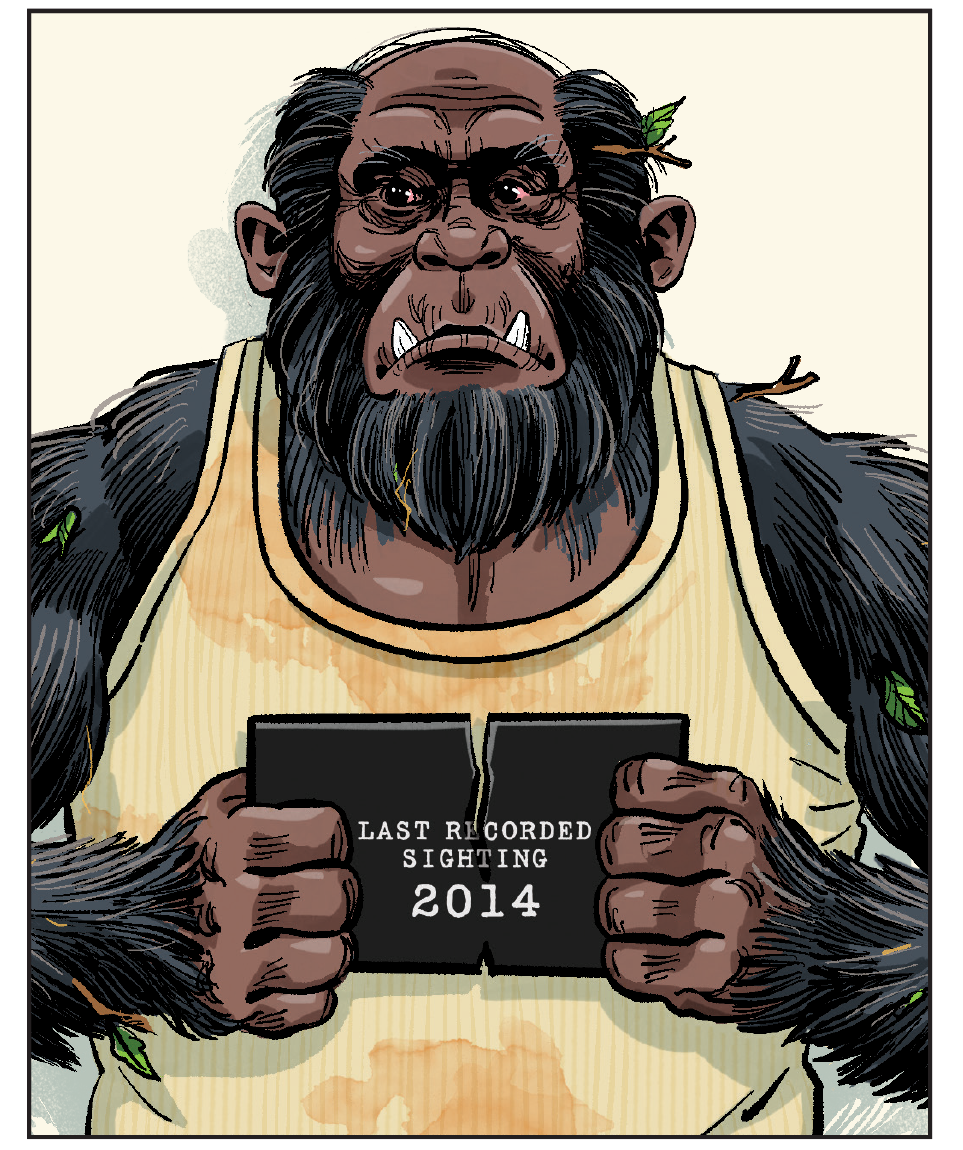
Physical description
Shaggy ape-man with black or gray fur, reaching heights between 4 and 8 feet
LOCATION
Palmetto State Park in Gonzales
*HISTORY *
The Ottine Swamp is an anomaly in the southern Hill Country—a landscape of palmetto-choked swampland and Spanish moss above the muddy course of the San Marcos River. The jungle-like landscape comes complete with tales of Texas’ own homegrown Bigfoot. First reported in the 1970s, the swamp ape haunts the oaks and supposedly throws rocks and shakes car bumpers. The beast is particularly famous for its ability to quickly disappear and remain invisible even in short brush. But it doesn’t need to be seen to maintain a presence. The Swamp Thing has been a fixture of local lore for decades, to the point that Palmetto State Park’s gift shop makes a killing selling swamp monster T-shirts.

A San Antonio hotel offers
room service with a spectral smile
By Rachel Monroe
Some people are unlucky in love; I consider myself unlucky in ghosts because I’ve never seen one. When campfire conversations turn to ghost stories, I have nothing to contribute. I spent months living in what was widely considered one of the most haunted houses in Marfa, where my roommates reported multiple uncanny encounters with spectral children. I saw nothing out of the ordinary.
At a certain point, being this unhaunted starts to feel like a personal failing. So, I have high hopes for my visit to San Antonio’s Emily Morgan Hotel, the third-most-haunted hotel in the world, according to USA Today. My pre-visit research revealed stories of souls trapped in the pool, and elevators with minds of their own.
“You hear things and see things out of the corner of your eye. A few months ago, I was checking a room, and I thought a maintenance guy came in behind me. But no one was there,” the concierge checking me in at the front desk reports. “Oh, and another freaky thing—sometimes you’ll be walking down the hallways, and you’ll feel a spot that’s cold for no reason.”
On the way up to my room, I share the elevator with an older woman who suddenly gets an apprehensive look in her eyes. Was she seeing something I wasn’t? “You know,” she tells me, “I used to go to the dentist here.”
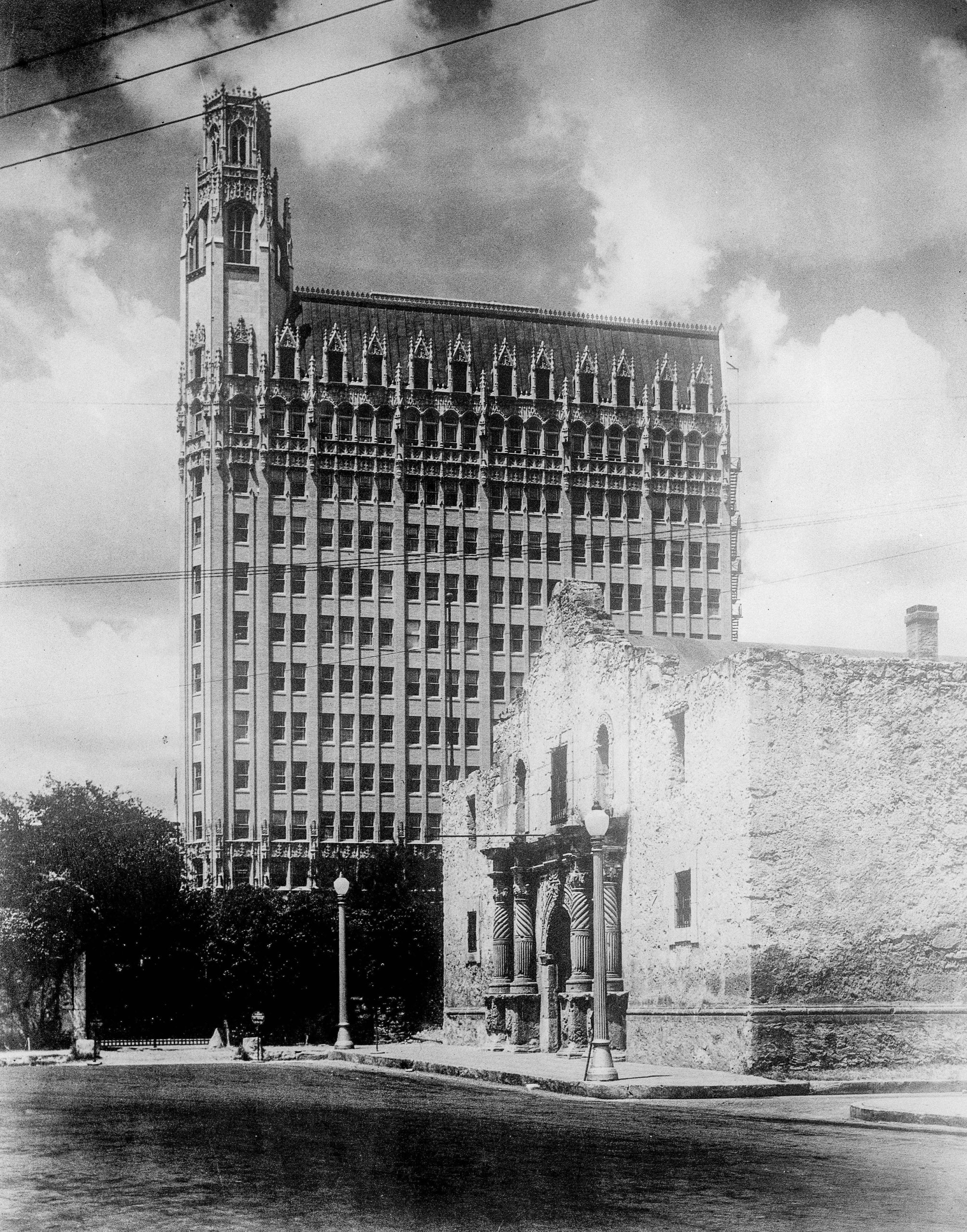
She wasn’t kidding: The wedge-shaped building’s history as a hotel is relatively recent. Until the 1970s, it housed medical offices and even, at one point, a working hospital. The Gothic Revival building, which began construction in 1924, was for a time the tallest in San Antonio. Spires jutting around its exterior are guarded by looming terra cotta gargoyles that display an assortment of medical ailments. One’s leering grin reveals a mouthful of broken teeth, while another clutches its belly in pain.
Some haunted hotels are inhabited by ghosts with detailed backstories: a mournful bride, say, or a murder victim bent on vengeance. The Emily Morgan’s reputation isn’t based on any specific spirits but rather a general spooky ambiance. The hotel’s namesake, a free woman of color who played a key role in the Texas Revolution, is not rumored to be one of the ghosts.
Kole Siefken, the Emily Morgan’s general manager, meets me in the hotel restaurant, where he expresses some gentle skepticism of his workplace’s reputation. “Most of the stories have to do with the hospital, but a lot of soldiers were slaughtered on this land at the Battle of the Alamo. It’s funny that that rarely comes into the mix.”
He’s heard plenty of stories of hovering orbs and flitting shadows—some of them from the paranormal YouTubers and TikTokers who flock to the hotel to make content—but he hasn’t had any otherworldly experiences himself. And there are a few online rumors he wants to dispel: No, the hospital gurneys were not melted down and used to line the pool; no, employees are not terrified to enter the basement break room. “I can’t get them out of the break room!” he jokes.
Managing a haunted hotel requires walking a fine line, indulging the people who come hoping to confront the spirit world while not alienating more trepidatious guests. Once a week, the hotel hosts a haunted dinner, and on Halloween, the bartenders dress up as spooky pharmacists. “We try to keep it lighthearted,” Siefken says. “We don’t want to come off as scary.”
Perhaps bolstered by Siefken’s rational, soothing presence, I spend a peaceful, thoroughly ghost-free night at the Emily Morgan. In the morning, I walk through the hallways, hoping for one last opportunity to experience the uncanny. I take the elevator up to the 14th floor—actually the building’s 13th story renumbered for superstitious reasons—reportedly one of the most paranormally active spots in the hotel. As soon as the elevator doors open, I sense it: an unusual antiseptic smell, faint but unmistakably reminiscent of hospital gloves. Later, Siefken admits to me that he’s heard this before, and he can’t explain it; the housekeeping staff uses the same cleaning products and procedures as elsewhere in the building.
I wouldn’t say the Emily Morgan gave me a ghost story, exactly—at least not one that’s fit for the campfire. But I did have an experience I can’t quite explain. And maybe that’s what we really mean when we talk about hauntings: not a wailing spirit but rather a strange frisson, the thrill of a moment when the present brushes up against the palpable past.
HIDE AND SHRIEK
Want to doze among the departed? These hotels offer the fright of your life.
The Grand Galvez in Galveston notes ghosts of children, a nun who died in the great hurricane of 1900, and the lovelorn suicidal bride of Room 501. If you’re brave enough, you can stay in her room overnight—though someone might snuggle up with you in bed. Rooms start at $220/night. grandgalvez
.com
The Menger Hotel in San Antonio is the place to go if you want to commune with the rough-and-tumble spirits of Teddy Roosevelt (who recruited for his Rough Riders there in 1898) and Richard King of the King Ranch, who is said to linger in Room 2052, his former suite. Rooms start at $219/night. mengerhotel.com
The Magnolia Hotel offers paying guests both a restored second-floor suite and free access to unrestored, historical parts of the Seguin hotel. Thirteen different ghosts have been reported on the premises—though the owners make no guarantees of meeting them. Rooms start at $249/night. hauntedmagnoliahotel.com
The Adolphus Hotel was once one of the tallest buildings in Dallas. Several accidental deaths allegedly occurred near the building’s elevator shaft, and ghosts are still said to cluster around the lift that claimed their lives, warning visitors to watch their step. Rooms start at $374/night. adolphus.com
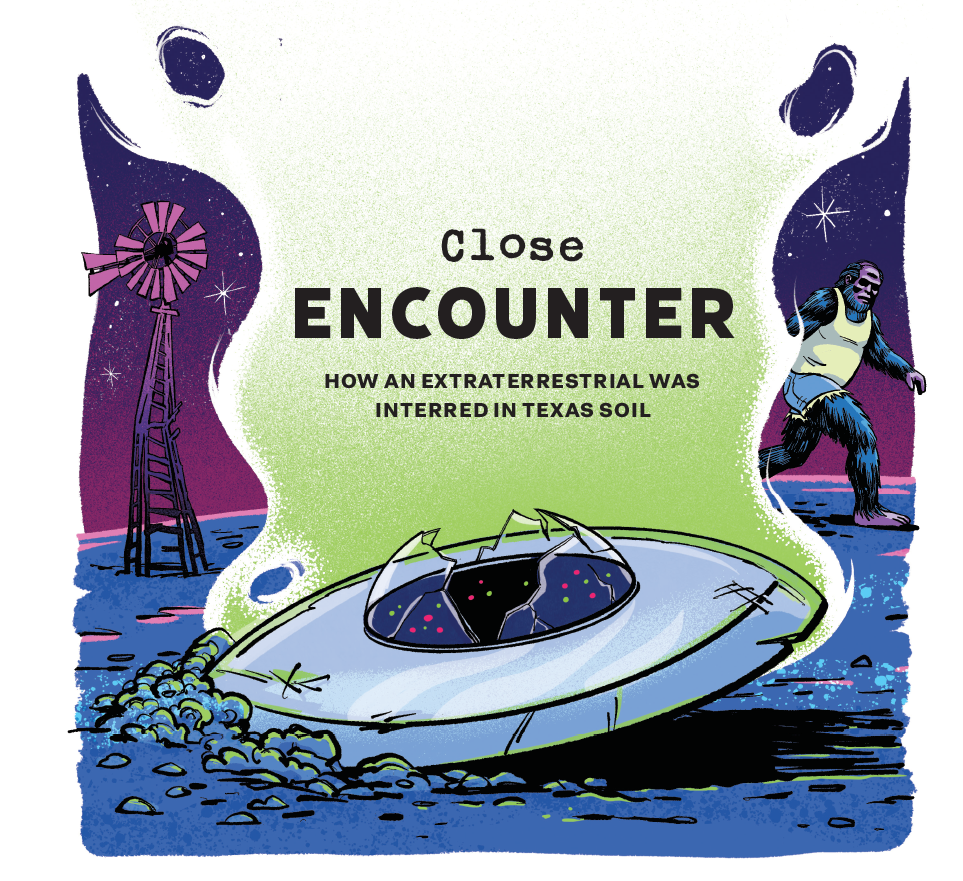
A cigar-shaped spacecraft careened out of the sky over Aurora on April 17, 1897, and obliterated a judge’s windmill. According to an account by local correspondent S.E. Haydon, published in the Dallas Morning News, the alien pilot did not survive the crash. “The pilot of the ship is supposed to have been the only one onboard, and while his remains are badly disfigured, enough of the original has been picked up to show he was not an inhabitant of this world,” he reported. Arriving 50 years before the more famous Roswell incident in New Mexico, the story still made quite the impression. While no government agents arrived to whisk away the body, it was rumored that the people of Aurora took charge of the situation themselves. The result: a town with an extraterrestrial buried in a cemetery—the only place in Texas that can make such a bold claim.
It’s certainly a fun story. But is it true? In 1979, Time magazine interviewed Aurora resident Etta Pegues, who scoffed at the tale. According to the 86-year-old, it was a hoax perpetrated by Haydon to bring some interest to a dying town. When author and paranormal investigator Jerry Drake looked into the matter, he noted the locals likewise dismissed it as a joke. The alleged burial site is no longer marked with a headstone, and it’s not even clear whether there was ever any windmill for an alien spacecraft to strike. “Haydon got his wish,” Drake says. “The Martian has created interest in the town. It just took 130 years to do it.”
Why not simply dig up the alleged grave spot near an old, twisted tree and check? Texas law states you have to notify a next of kin before exhuming a body, leaving Aurora officials with an ironclad alibi. With no set headstone, any visitors hoping to commune with Haydon’s interred extraterrestrial will have to make do with a Texas Historical Commission marker commemorating the legend.
HALLOWED GROUNDS
journey through several notable cemeteries Home to Texas’ bygone stars
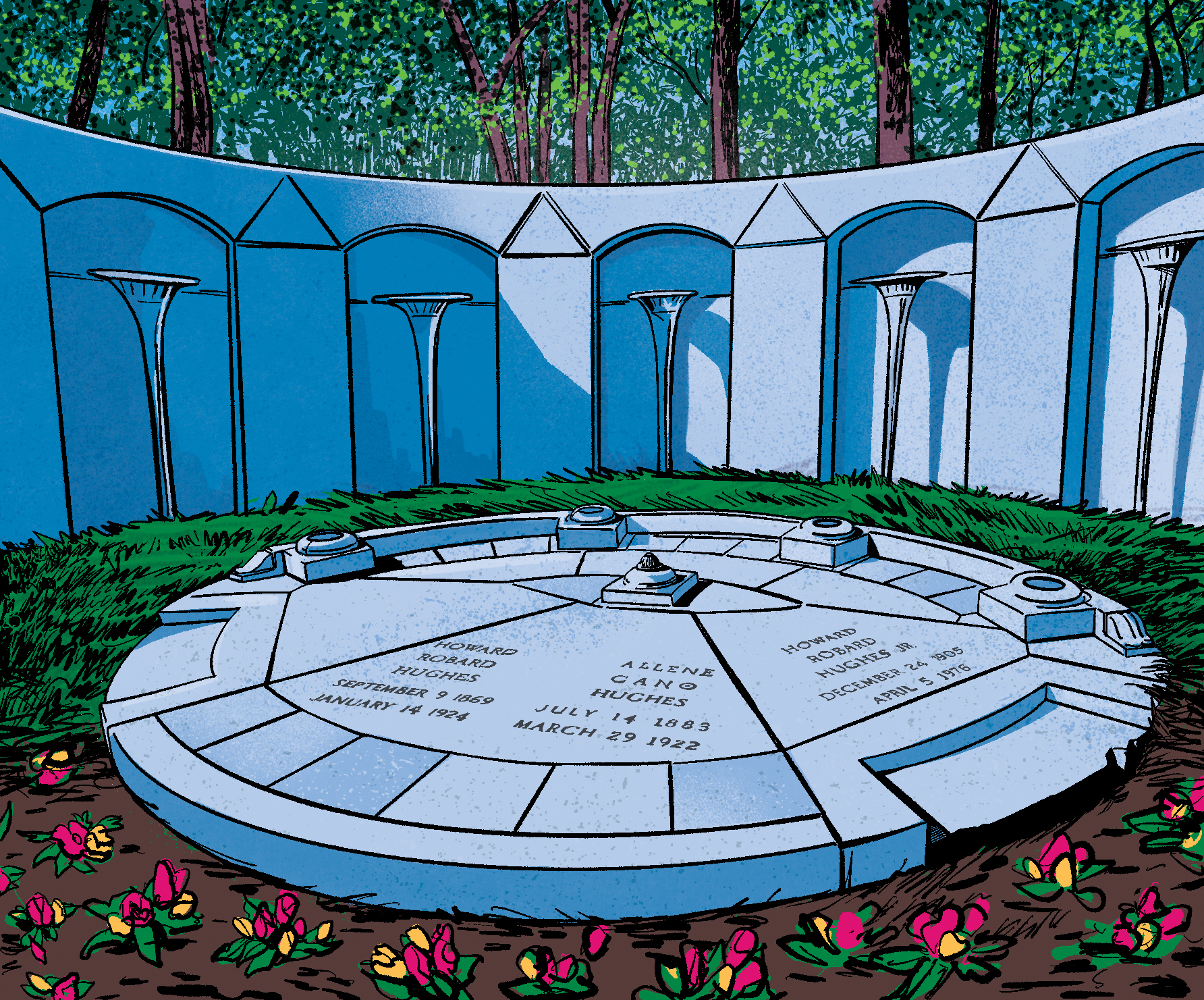
Howard Hughes
Glenwood Cemetery, Houston
Founded in 1871, Glenwood Cemetery hosts some of Houston’s most illustrious dead within its lush 88 acres. Examples include Sarah Emma Edmundson, a woman who dressed as a man to serve in the Civil War; Houston Astros impresario Roy Hofheinz; and the famously wealthy and eccentric Howard Hughes. The Hollywood magnate-turned-recluse is buried in a monumental crypt, lending gravitas to the cemetery’s reputation as one of Texas’ most haunted spots.
Abraham Zapruder
Emanu-El Cemetery, Dallas
The second-oldest Jewish burial ground in Dallas, Emanu-El Cemetery, holds the remains of Abraham Zapruder, the Ukrainian American clothing manufacturer who sought to commemorate John F. Kennedy’s 1963 visit to Dallas—and instead captured 26 seconds of the most famous footage ever recorded.
Bonnie Elizabeth Parker
Crown Hill Memorial Park, Dallas
One half of the infamous lovebird criminals known as Bonnie and Clyde, Parker died in 1934 at the hands of the FBI in Louisiana after committing a string of murders and robberies. Her mortal remains ended up at the then-recently established Crown Hill. Her paramour, Clyde Barrow, rests 10 miles away at Western Heights Cemetery on Fort Worth Avenue.
Buddy Holly
City of Lubbock Cemetery
Established in the late 1800s, Lubbock’s cemetery is the third largest in Texas, with over 60,000 graves backing up to an old railway trestle dubbed “Hell’s Gate” by locals. Disembodied whispers, feelings of bleak unease, and faint guitar music are sometimes reported around the grave of iconic rock musician Buddy Holly, who died in an airplane crash in 1959.
Sam Houston
Oakwood Cemetery, Huntsville
After Sam Houston’s eventful life, the hero of the Texas Revolution went to rest in the shady green at Huntsville, established in 1846. The great general’s ghost is joined by a rather intimidating statue of Jesus, whose hands are reputed to flip positions at night and whose tarnished bronze surface has stubbornly resisted any efforts at cleaning.
Selena Quintanilla-Pérez
Seaside Memorial Park, Corpus Christi
Few ghost stories inhabit this cemetery, established in 1936. But it does hold a star: Selena Quintanilla-Pérez, the beloved singer who was struck down by the former manager of her boutique store chain. Her tomb is protected by a fence and haunted now only by those who come to pay their respects to the queen of Tejano music.
END OF CAMELOT
Few events in American history attract as much interest and mythmaking as the assassination of President John F. Kennedy. The tragic events of Nov. 22, 1963, are etched across the landscape of Dallas. But while the most famous sites exist downtown, those fascinated can follow the threads across the city, visiting multiple locations that played a role in one of the most shocking afternoons in the country’s history.
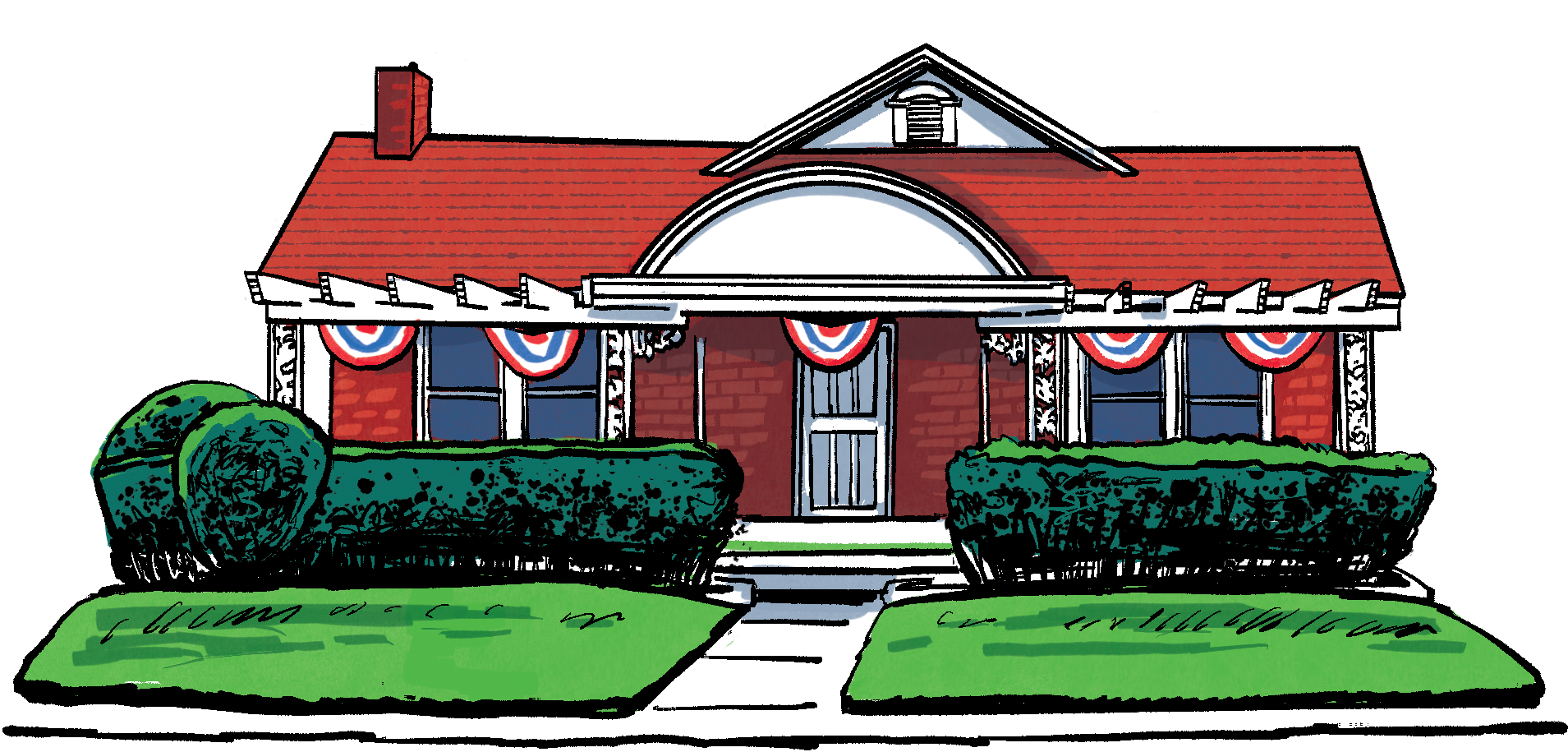
Oswald Rooming House
This Oak Cliff home-turned-museum preserves the boardinghouse where Lee Harvey Oswald resided in the month leading up to the assassination. Inside, you’ll find his room left largely as it was, including the same bedframe and wardrobe, which holds a replica of Oswald’s gray jacket. Paid tours are available and led by the house’s owner, Patricia Hall, who met Oswald briefly when she was a girl.
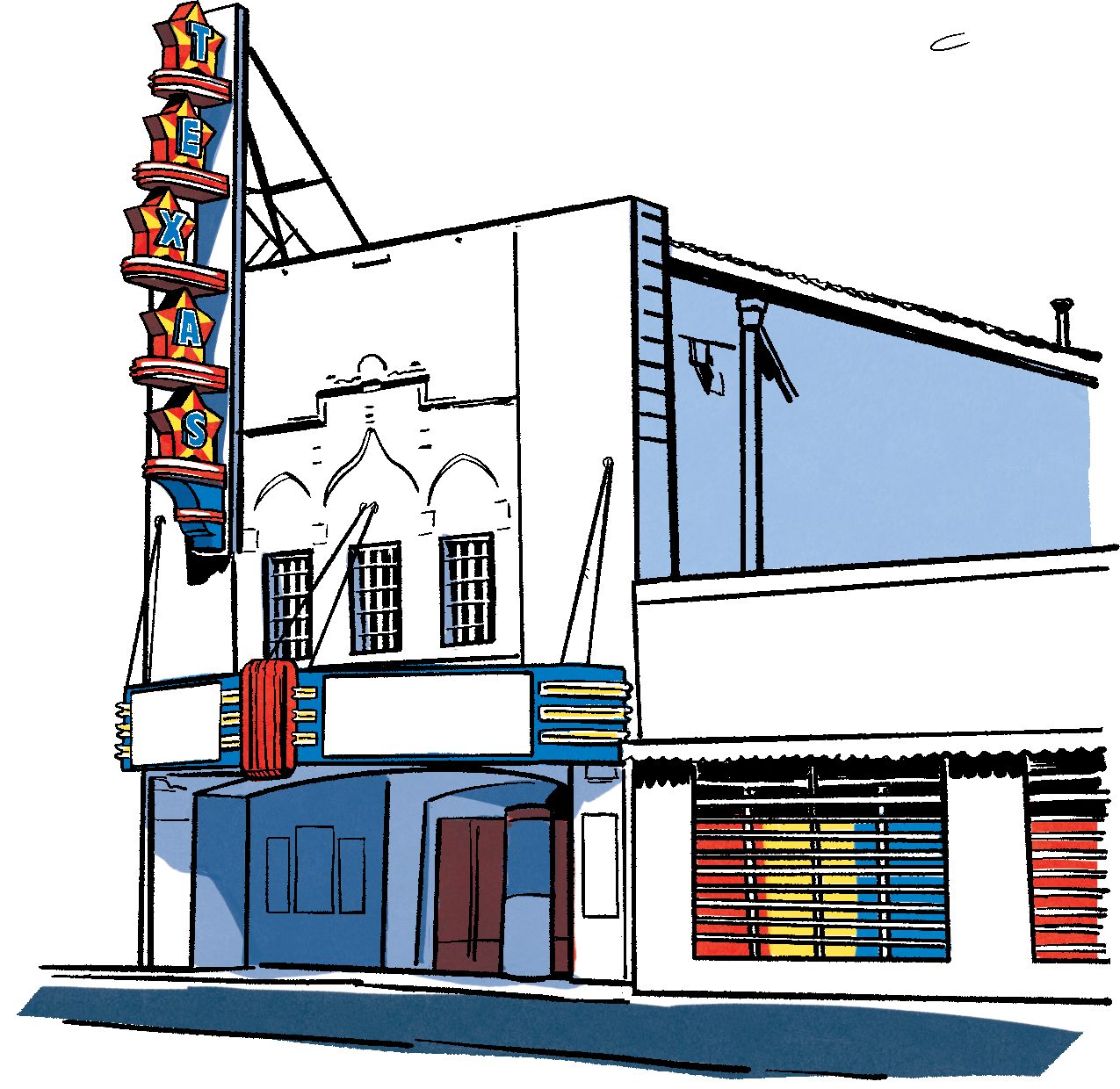
Texas Theatre
After assassinating Kennedy, Oswald was eventually arrested at this movie house for the murder of both the president and a police officer he’d shot earlier the same day. He was caught at a venue widely reported to host its own share of specters, including shadowy figures, unexplained whistling, and an overall eerie atmosphere.
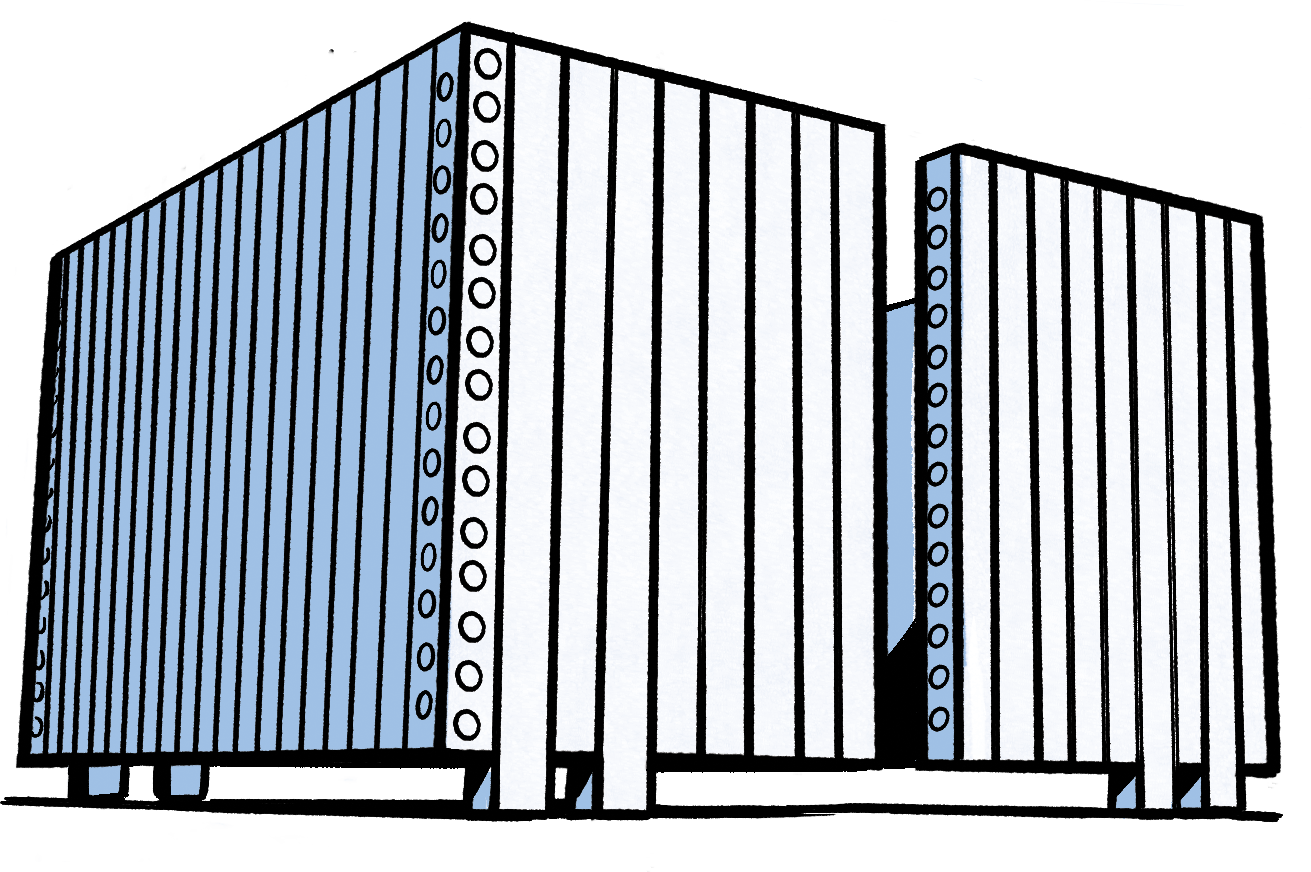
JFK Memorial
Located just one discrete block away from Dealey Plaza are the concrete walls of this cenotaph erected in 1970 to commemorate the president’s death. The bare walls and open roof of the cenotaph split the difference between empty tomb and monument, which befits a historical event that changes shape depending on who’s looking at it.
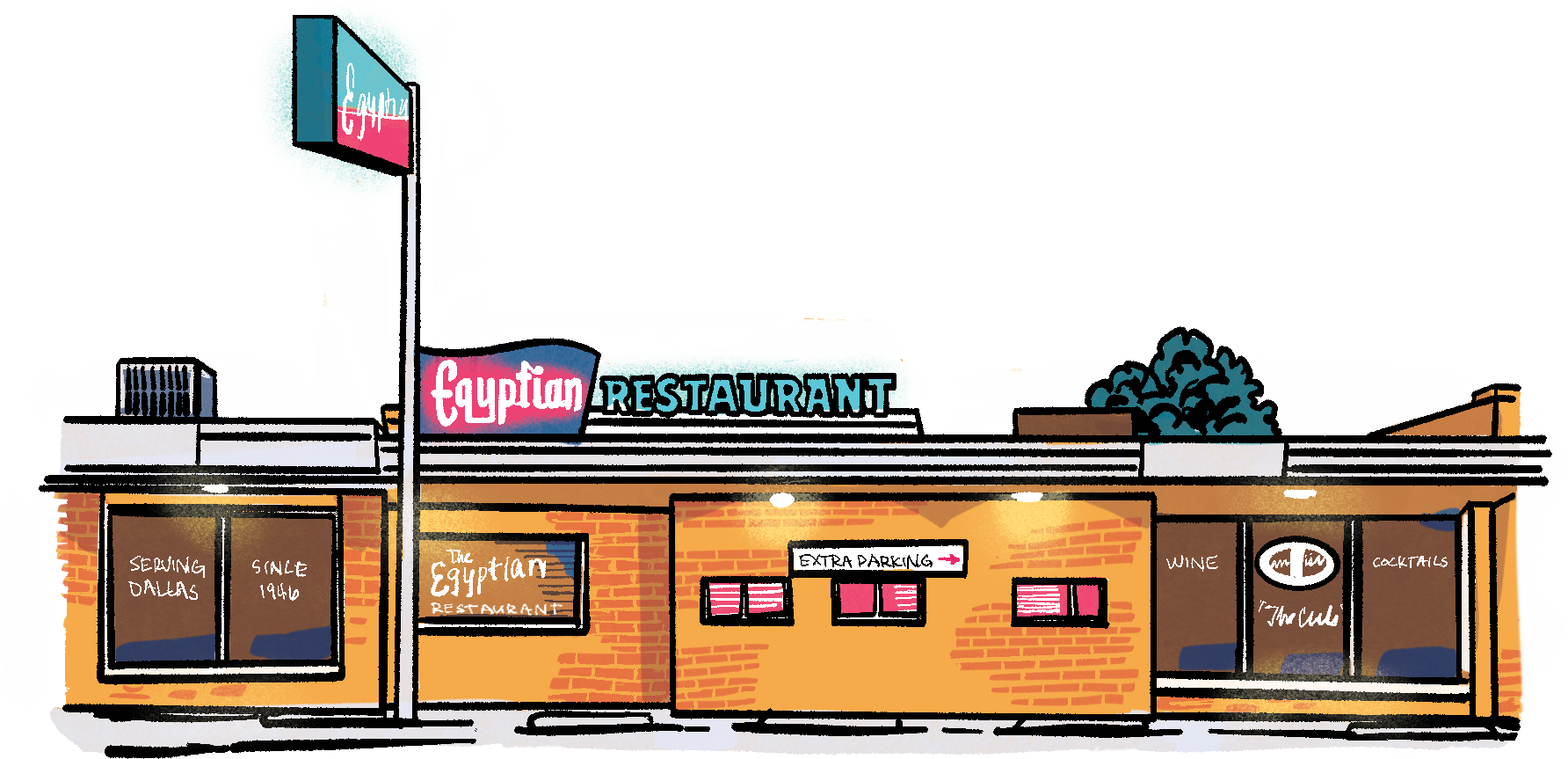
Sixth Floor Museum
Located at the site of the former Texas Book Depository, this downtown museum traces the course of Nov. 22, and the days leading up to it, through historical artifacts and photographs. It also allows visitors to stand in the room Oswald fired from and contains a significant section exploring the many conspiracy theories about the event.
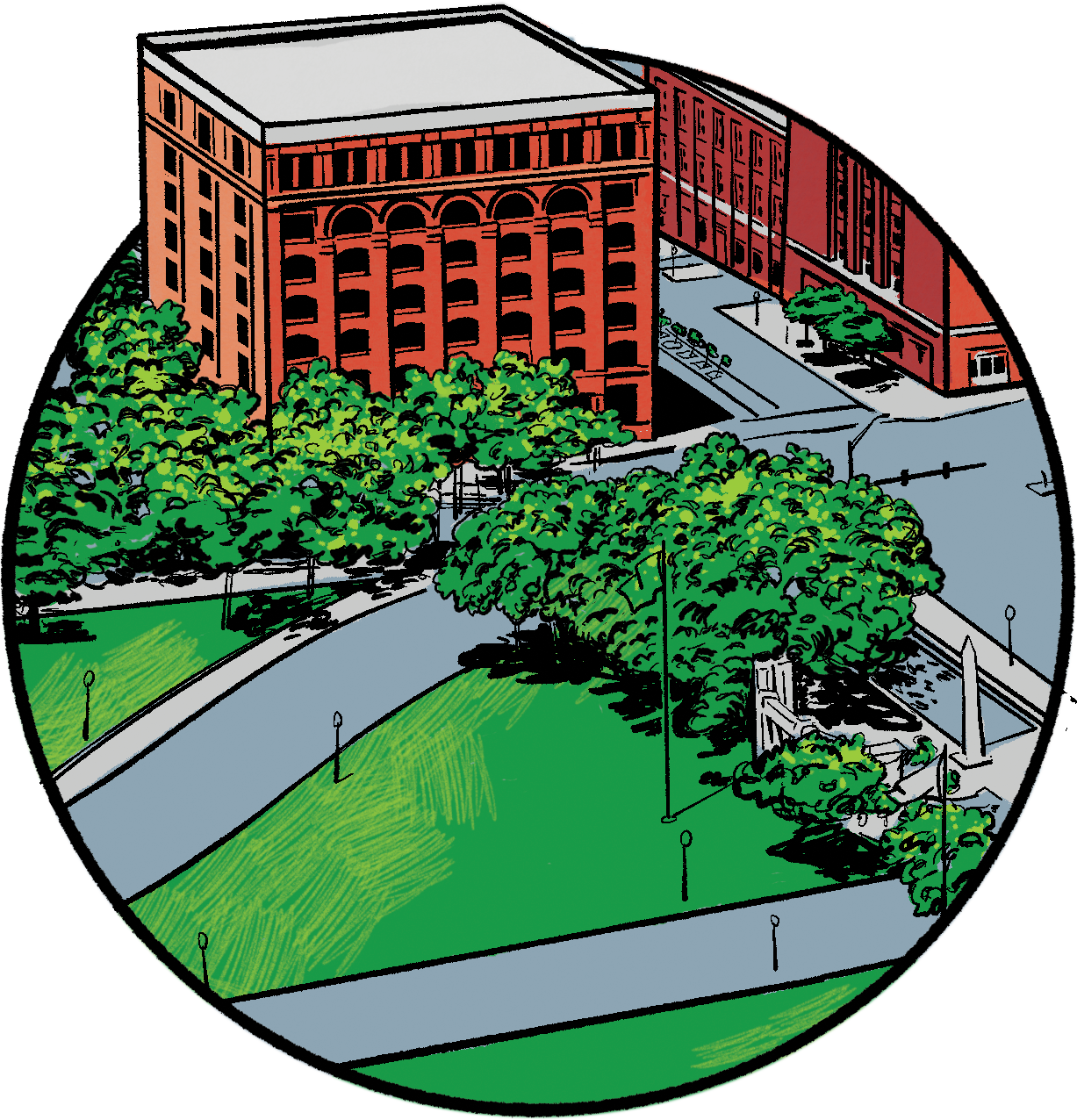
Dealey Plaza
This is the easiest site to visit, as many drive right through it coming into downtown. The curve of road where Kennedy was shot remains an epicenter of both conspiracy theories—Who was the phantom figure some reported seeing on the grassy knoll?—and ghost lore, with some claiming to sense feelings of overwhelming grief and gloom at the spot.