

The Disappearing Art of Deep-Sea Oil Rig Fishing
For decades, dropping a line below a deep-sea oil rig has proven a bucket-list, high-octane fishing challenge. But now the rigs are disappearing from the Texas Gulf.
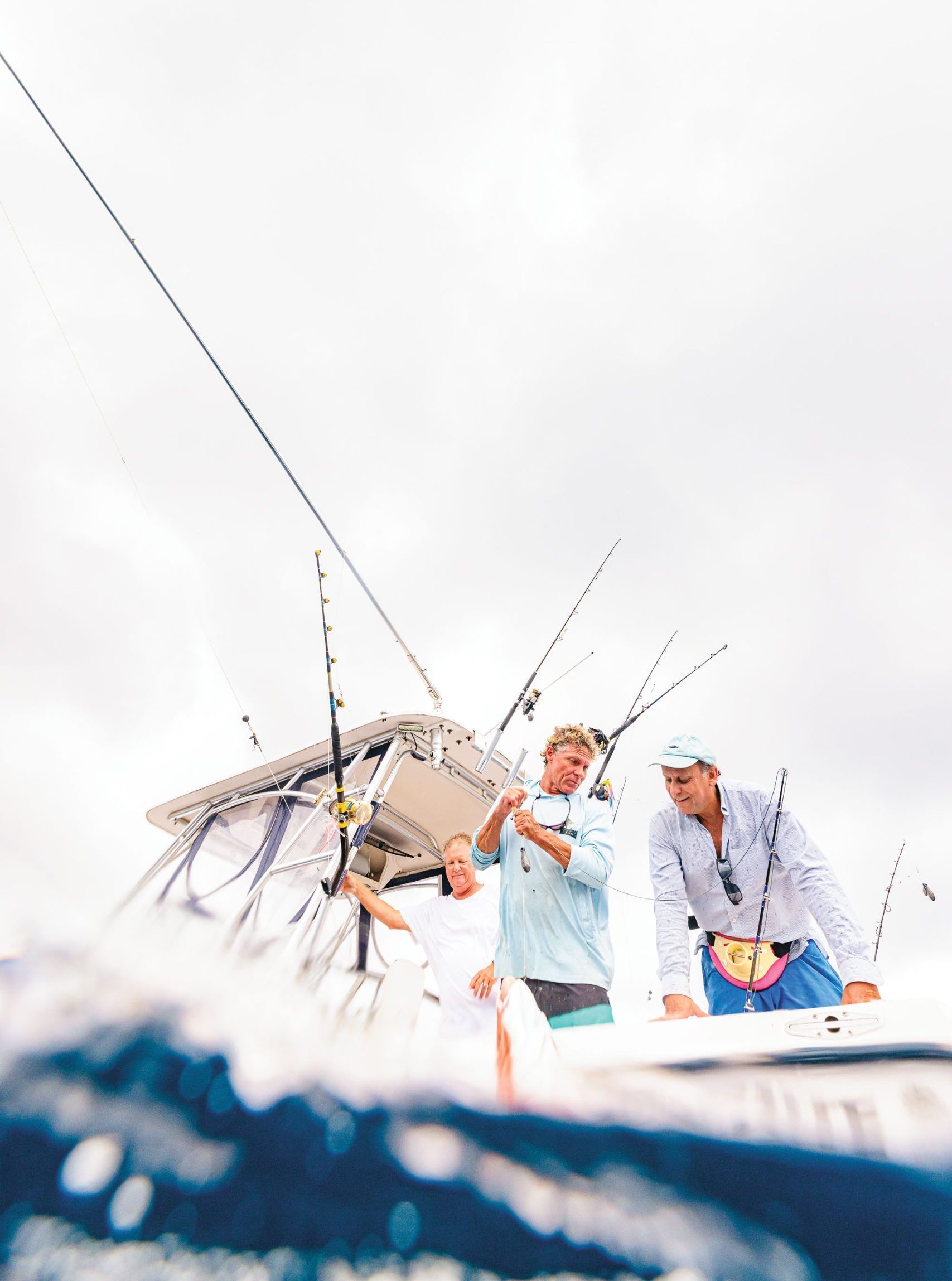
The giant red snapper I’ve just caught and released in the shadow of an offshore oil platform is trying to get back down to the bottom of the Texas Gulf. Mac Elliott, our photographer, has jumped into the water to film the catch-and-release endeavor. Except for the massive yellow Erector set of a rig, we’re all alone out here in a 26-foot Grady-White boat, bobbing around in a blue, churning autumn chop, about 50 miles from the coast. But there’s just been a new arrival.
“Darling,” our captain, Wes Belcher, calls out to the photographer, “you’re about to become part of the food chain.” A fin has appeared behind Elliott, and though she’s an experienced diver and even has a shark-
repelling super magnet strapped to her ankle, I wince in horror. Because if she ends up getting bitten, it’ll be all my fault—the result of my desire to put one more exotic fishing trip in my cooler.
All committed sport anglers (read: obsessed delinquents) have trips they dream of taking before they become too feeble to reel in the big one. In my case, that list was often stocked by the legendary 20th-century outdoor writer and Field & Stream fishing editor A.J. McClane. His books and articles, which I tore through in the ’70s, were compendiums of such adventures: Atlantic salmon in Iceland, golden dorado in Paraguay, Chinooks on the Yukon. And, to my surprise, by the time I’d hit the midcentury mark of life, I’d crossed nearly all of A.J.’s trips off my list. True, I’d gotten skunked when I tried to emulate Hemingway on an endless, fishless marlin endeavor out of Hawaii. But generally, I racked up major A.J. points around the globe on various magazine assignments. This includes nearly every species of salmon, a host of river monsters from Amazonia, and even sea-run brown trout from the Falkland Islands—a place, if research serves me correctly, A.J. never set foot.
But still, one pivotal trip remained.
In one of his early books, A.J. hit the oil rigs of the Gulf. What captured my tween mind at the time was that oil rigs were known locally as one-stop shops. Dropping a structure in a structureless void turns out to draw in all kinds of life. So, a day near the rigs can produce pretty much every species the Gulf has to offer, lined up by depth like steaks, chops, and chicken breasts in the meat aisle of a supermarket. Snapper and grouper on the bottom, amberjack and cobia as mid-tier catch, and mahi-mahi and marlin up top.
I very much wanted to patronize this particular meat market. But I was thwarted time and time again. During multiple trips to the Gulf to cover the aftermath of the Deepwater Horizon oil spill in 2010 for my book American Catch, I’d almost gotten out to the rigs only to be deferred by wind and circumstance. Now, it’s finally happening.
The problem is, four decades after first hearing about rig fishing, things have changed profoundly in the Gulf. Some species have been overfished, regulations have turned things on their heads for others, and most recently the rigs themselves are being ripped out, toppled over, or blown up by the very people who had put them there in the first place.
It was clear that if I wanted to have my A.J. moment I’d have to have it quickly, before the bad weather settled in and the oil companies, for a variety of complicated economic and regulatory reasons, decided to permanently shutter the meat market.
Seven hours earlier, before the encounter with the shark and the red snapper, we start out from the inland waterway near Corpus Christi in ominous conditions. “It got sporty overnight,” the mate, Wes Welsh, says as we round the inlet at Port Aransas in darkness and head due south into a heaving open ocean. Captain Wes concurs: “When the National Oceanic and Atmospheric Association calls for waves of 3 to 4 feet, we just add ’em together and make it seven.” Soon, it gets too rough to chat with Captain Wes and Mate Wes, and they stick Elliott and me on adjacent bean bags wedged against the stern. The boat tosses us up and slams us down. The constellation Orion hangs in the air off starboard. Venus rises off port. I feel a tightening in my throat and push back an upchuck. Elliott gets on her knees, pulls back her hair, demurely vomits, and then continues to prep her camera kit for the shoot ahead.
This all would continue for hours and hours.
Back in the A.J. days, such a long grind to the rigs wouldn’t have been necessary. In the heyday of the ’70s and ’80s, oil and rigs were everywhere. The first freestanding platform, built in 1938 by Pure Oil and Superior Oil Company near Creole, Louisiana, sat in just 14 feet of water. Salt domes had been predictive indicators of petroleum on land, so it made sense when the technology arrived to look under those same domes at sea and locate “gas and grease.” Oil begets more oil hunting, and so prospectors went further. In 1947, energy company Kerr-McGee made history when it drilled the Kermac No. 16 Well 10 miles off the coast of Louisiana, entirely out of sight of land. This marked the true beginning of modern offshore oil drilling. Eventually, word got out that the Gulf was the perfect setting for petroleum plunder with its abundant salt domes, a shallow continental shelf, and ports of call protected by barrier islands.
Sometime at the peak of the oil boom in 1972, someone started dropping a line off those rigs and was surprised to haul in all kinds of fish. And the reason for this is simple ecology. “I can’t tell you exactly what’s in a fish’s mind when it sees one of these things,” says Callum Roberts, the renowned British ecologist and author of Reef Life: An Underwater Memoir. “The hypothesis behind it is that a structure will accumulate a whole food chain of animals around it because there are smaller animals like fish larvae or baitfish that are trying to hide. They’re attracted to the structures because there’s something to hide behind, as opposed to being completely out in the open. And the bigger animals then can move in and start hunting.”
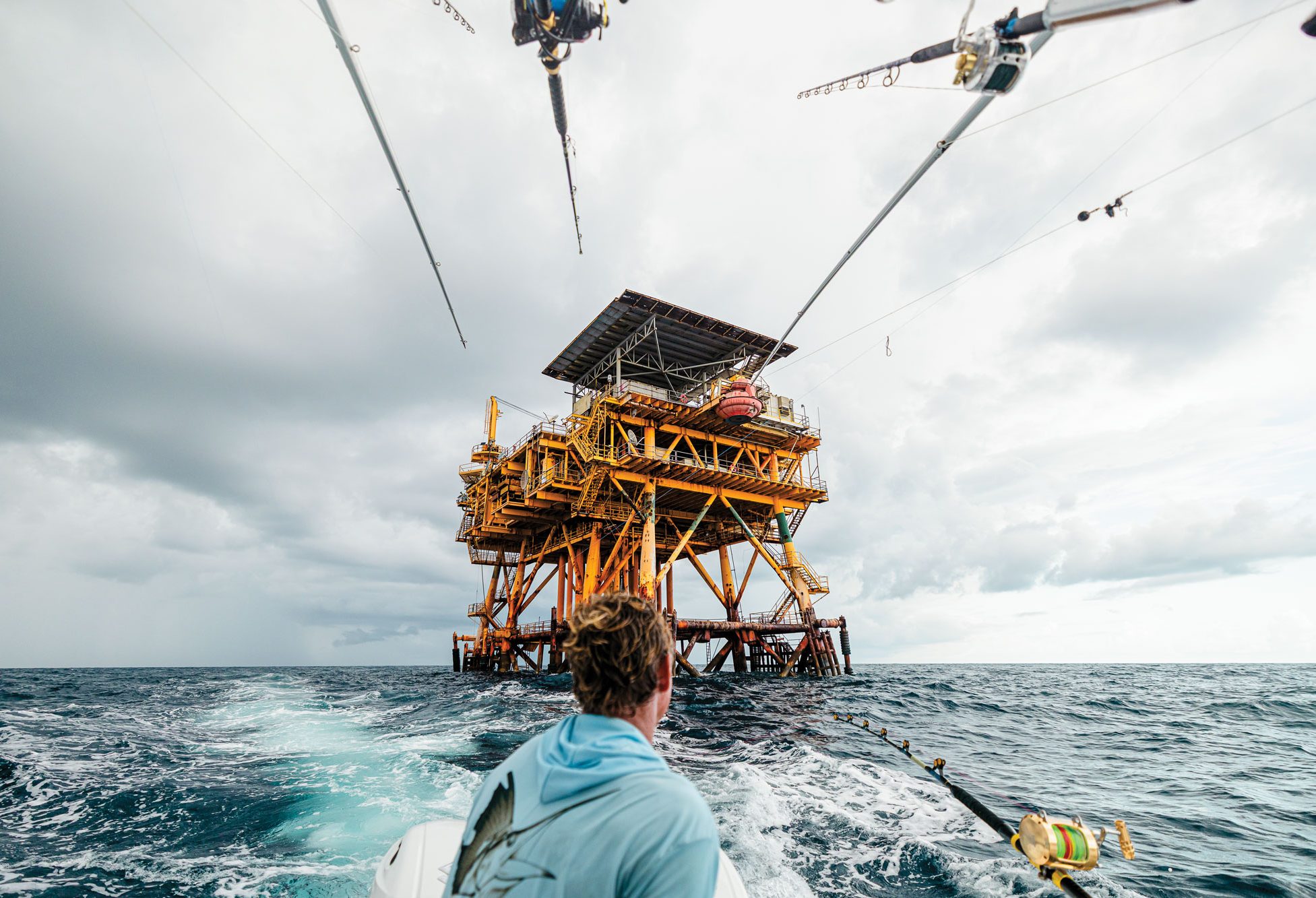
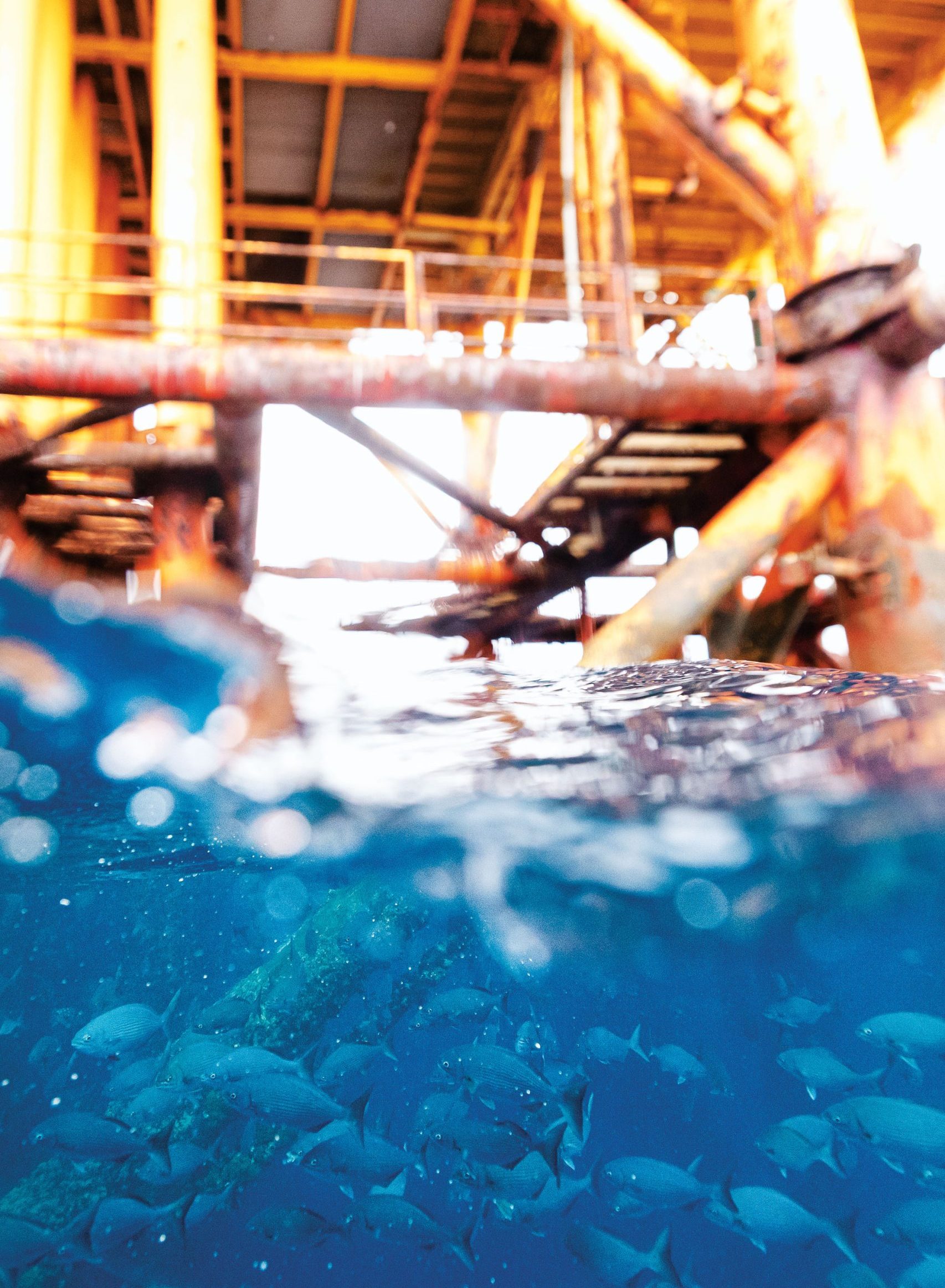
All of this eventually attracted the ultimate big animal: humans. In Texas, what started out as an adventurous few has expanded to hundreds of professional charter fishing boats as well as a handful of 60-plus passenger “head boats” that work the rigs out from Port Aransas to Galveston and points in between. With operations like Galveston Sea Ventures or Oilfield Outkasts out of Freeport, these trips range from half-day to multiday adventures that can set you back thousands of dollars. But while rig fishing has clearly evolved into a sport of its own, it’s not entirely clear if it’s sporting for the fish. “There are some who argue that the rigs are just accumulators,” Roberts points out, making the argument that if you draw all the fish to one spot, you’re creating the proverbial barrel in which to shoot said fish. That concentrated overfishing made Captain Wes have to take me much farther out to sea, all the way to the Mustang Island A-85 North Baker Rig 50 miles offshore.
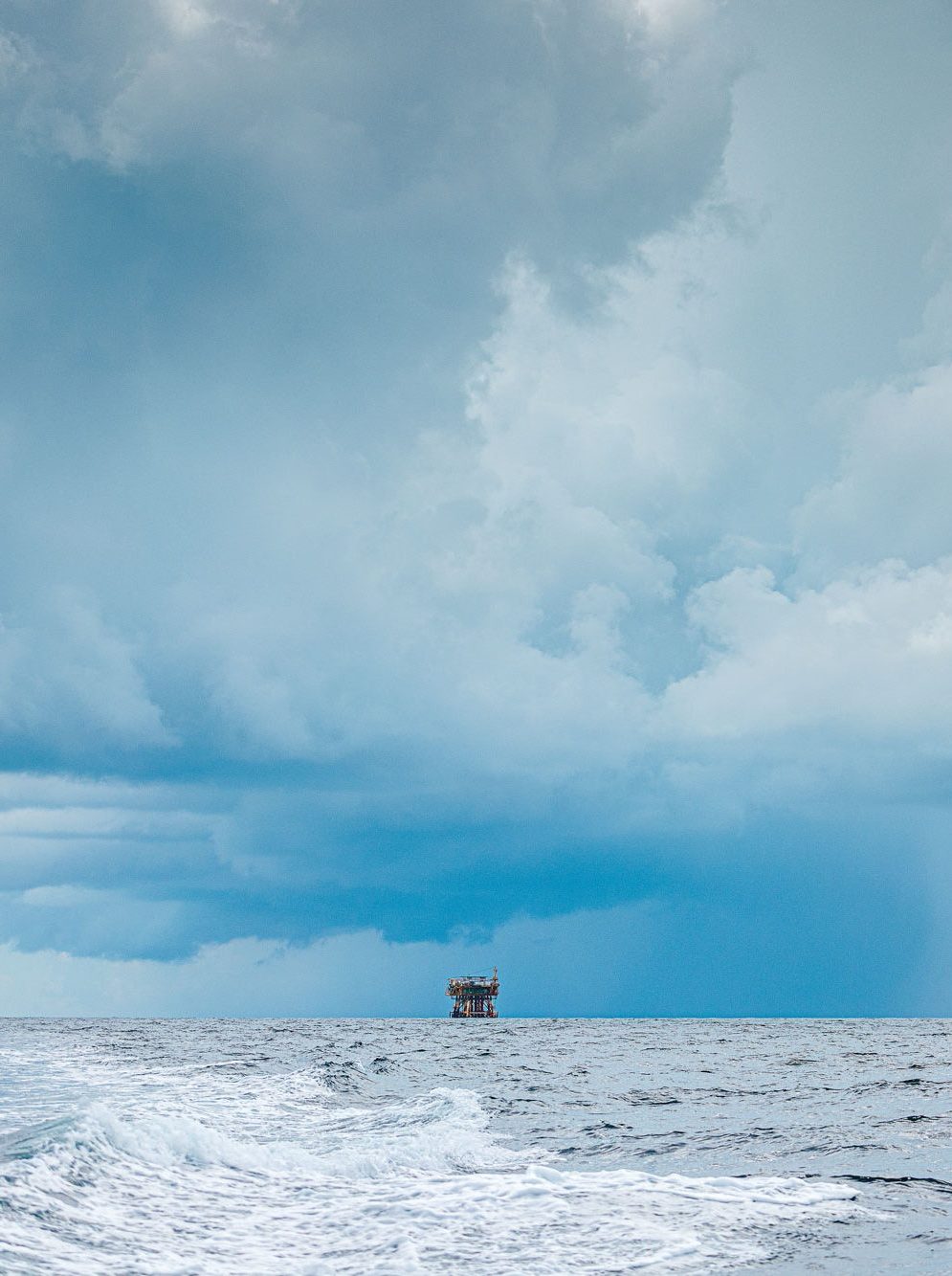
“We used to have four rigs in this spot,” Captain Wes tells me as we sidle up to the 100-foot-tall tangle of metal while the mate baits up my hook with an 8-inch-long live sand trout. “Now there’s just this rig.” Once, some 4,000 rigs stretched from Florida to just west of Corpus Christi. But today, there are fewer than 1,300, and dozens are yanked out every year, mainly due to insurance liability.
Frankly, at the moment, I don’t care. I’m in a churning sea that’s getting choppier with each passing moment, and there’s a big thunderhead gathering off to the south. The only thing that shakes me from my seasick reverie is when line starts peeling off the reel and a deep bend sets into the pole.
My A.J. moment has arrived.
There’s a reason people who fish the Gulf have taken to nicknaming the greater amberjack a “sea donkey.” Streamlined silver-and-gold torpedoes, amberjacks can grow bigger than a German shepherd. With all that bulk, they are stubborn and hard to move. But you could just as easily call the amberjack an “ocean running back,” because when the fish switches out of donkey mode, it’s able to make quick, extreme turns, accelerate to up to 50 miles per hour, and then turn on a dime. Add to that the amberjack’s skill at making use of oil platforms’ submerged metal lattices, and you’ve got a situation where you either manage your fish or it manages you right into the rig.
Thanks to Mate Wes’ direction, I am able to budge my sea donkey and get it to shoot off toward open water. Raising my pole up and then dropping it down to make up slack, I keep the fish’s head up so it can’t turn again toward the steel. Slowly, I make progress. But there are times when it bears down again and just seems to say, “Nope.” Finally, after about 10 minutes, the swivel indicates I’ve reached the last few yards of effort; a quick pull from Captain Wes toward the gaff and a big lift upward and 50 pounds of angry amberjack are in the boat.
“Nice AJ,” Captain Wes says.
That’s the amberjack’s other nickname: AJ. How appropriate.
The only thing an angler likes more than catching a fish is showing it off after it’s caught. So, not long after capturing what I think is a really humongous amberjack, I text a picture of my catch to another rig fisherman in east Lousiana. As soon as Paul Cozic receives my photo, he zaps me back his own pic of an AJ nearly three times the size. But whereas I’ve caught mine on what Cozic calls “an idiot stick,” he shot his with a spear and wrestled it to the surface. Yes, another type of predator oil rigs attract these days are spearfishermen, the most elite of which belong to Cozic’s club the Hell Divers.
Founded by a dozen mailmen in neighboring Louisiana, where the rigs are more plentiful than in Texas, the Hell Divers prefer to fish with spearguns. The origins of this decision are as murky as the “muck layer” club members must dive beneath the platforms to get to good, clear shooting water. Somehow, a cluster of danger junkies figured out that you can descend 80 or so feet beneath a decommissioned rig, hang out, and choose which fish you want to kill. Some, like cobia, can even be called with a grunting sound, which Cozic eloquently demonstrates for me on a Zoom call three days later. He then picks up his spear and shows me how the rest of the work gets done.
“What you want to do,” he says, brandishing a 6-foot-long gun, “is to try to get a head shot.” His fellow Louisiana-based Hell Diver Robbie Schmidt, who is also on the call, chimes in: “Then what you gotta do is hold on and hopefully get to the rig, get a line over the rig, and let the fish fight.”
As one might imagine, all kinds of bad situations can arise from men with spearguns in deep water. You can make a side shot instead of a kill shot and piss off a fish way out of your league and get dragged to unreturnable depths. You can get tangled up in somebody else’s fish as it heads for the rig, wrapping you tightly against the steel. Since things have gotten decidedly “sharkier” since shark finning was banned in the Gulf, you could get bit or have your catch stolen. There’s also a chance you never even spear anything if you mess up the angle of your dive, miss the rig entirely, and drift off into the open ocean where some spearfishermen have been scooped up by shrimp trawlers. Hell Divers don’t use the buddy system. It’s an every-man-for-himself scenario. In fact, when Cozic shot the giant amberjack that dwarfed mine, he was inches from getting shot by a competing spearfisherman behind him. And sometimes things happen that are shrouded in deathly mystery. “Rock, the former head of our club, had a young man who came out, and he desperately wanted to be a Hell Diver,” Cozic told me. “He went down, and we don’t know what happened, but he floated back up. He was embolized.”
Every few years, divers who don’t know what they’re doing never make it to the surface again. The Hell Divers try to recover the bodies since insurance won’t pay out until seven years after a disappearance. But they don’t always succeed in finding the wet-suited corpses. This seems to put zero drag on the enthusiasm for the sport, which according to the NOAA accounts for more than 80,000 dive trips per year and more YouTube videos than you can shake an idiot stick at.
Back on the surface, with my amberjack now in the ice chest, we go out searching for another item in the rig supermarket aisle, ideally a grouper. Possibly because of the turbulent weather, and almost assuredly due to the fact that there are more Texas anglers hitting fewer rigs, we have trouble getting back on the meat. “After COVID,” Captain Wes explains, “everyone bought a boat.”
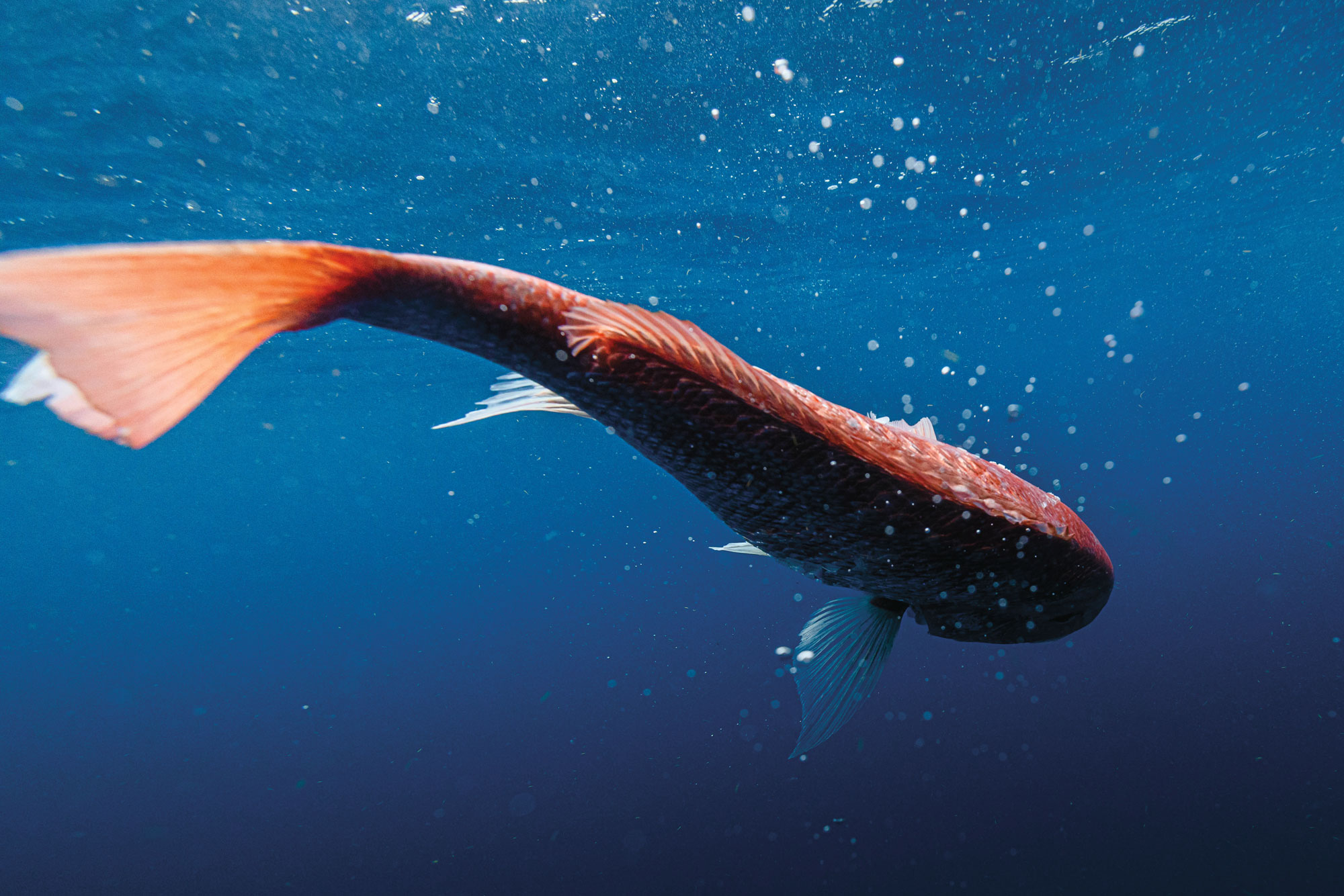
Adding to that problem, the fish we could catch are up against the same embolization that an unlucky Hell Diver may experience. Shortly after we park over a patch of bottom just north of the Baker rig, a bang bang bang hits the live sand trout I’d let to the bottom. Rearing back, I think for a moment I have another amberjack. But at a certain point, when the fish was perhaps 30 feet below the surface, it just, in a very un-amberjacklike way, quit. Soon I see why. As the 20-pound out-of-season red snapper surfaces, I can see its eyes bulging out of its head and its stomach sticking like a balloon out of its mouth.
Since before deep-water rig fishing became a thing, snapper have been a prime target of anglers. Thirty years ago they were assessed as critically overfished and headed toward commercial extinction. But both state and federal governments stepped in at a key moment in 2005 and instituted a “rebuilding plan,” which shortened the red snapper season sometimes to a matter of days, raised the minimum size length, and lowered the take-home limit. Populations stabilized by the late 2010s and started growing again. The problem is, when the red snapper season’s closed, they’ll still take a bait meant for an in-season species. Out-of-season snapper can end up dying because of a phenomenon called
barotrauma.
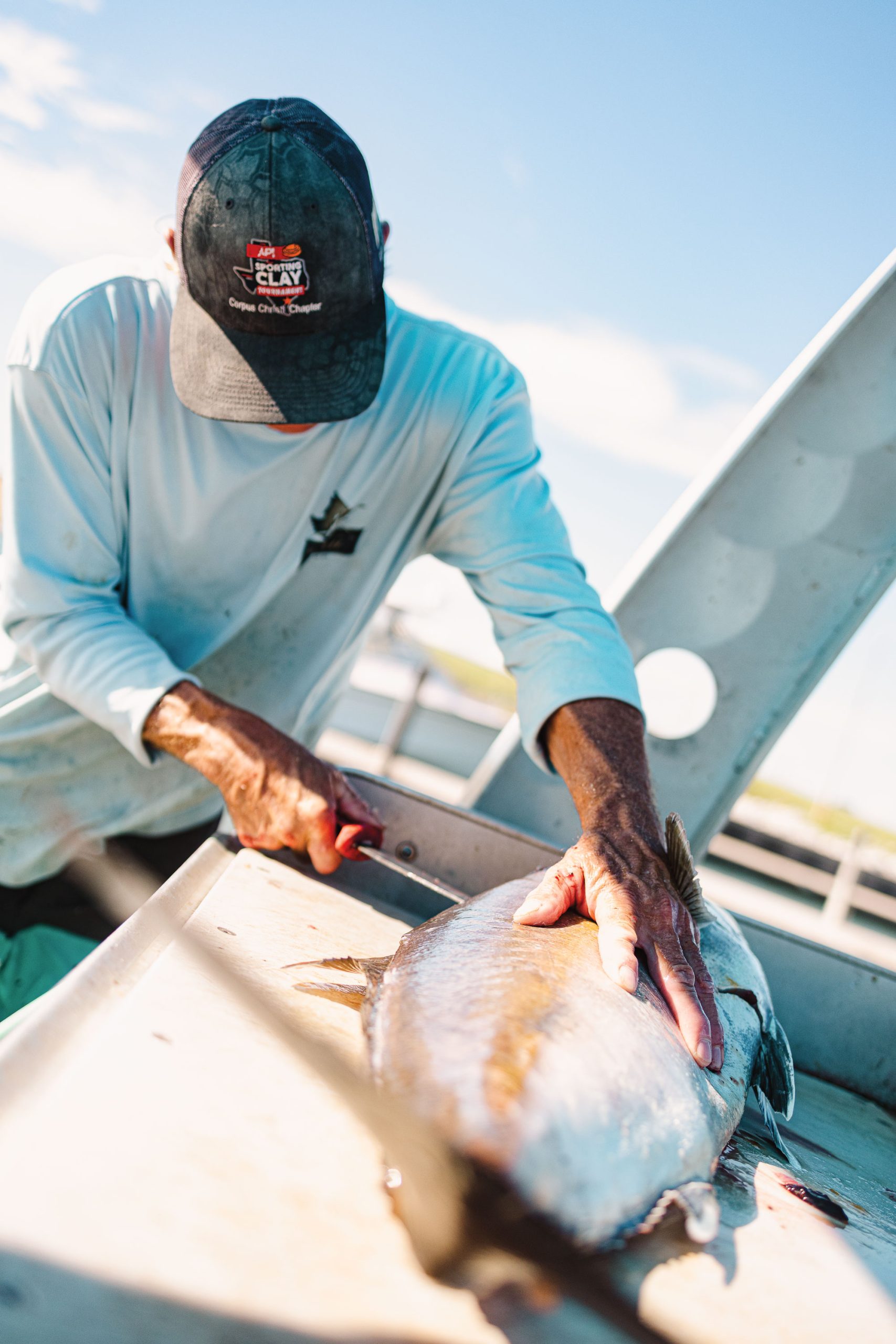
When reef fish are brought up too quickly from depth, their swim bladders expand, leaving them unable to swim back down. As Matt Streich, director for the Center for Sportfish Science and Conservation at the Harte Research Institute in Corpus Christi, explains, “If you release them on the surface, the mortality’s gonna be, like, 100%.”
There is, however, a way to fix this. Taking out a long metal venting needle, Captain Wes shows me the most primitive method. He shoves the needle straight through the fish’s flank. A sssssss sound escapes from within, indicating the fish’s swim bladder has been “vented.” Though gruesome, this method has been proven to substantially reduce fish death, and the wound will often heal afterward.
Sadly, this is not the fate of my red snapper. Even though our photographer tries to help it by sliding it back and forth in the water to get oxygen flowing across its gills, Captain Wes has to call it when a blacktip shark fin appears. The shark has no doubt been drawn to the scene by the vibrations of the struggling fish, and now both snapper and photographer risk becoming bait.
The 2020 DESCEND Federal Act now requires anglers pursuing reef fish in the Gulf to carry either a venting tool or a descending device such as a SeaQualizer. But to this day, only about 70% of reef anglers are even aware of venting, and just 32% are familiar with fish descending devices. This makes for a lot of ugliness. A typical low-cost “head boat,” which looks like a sleeker version of a ferry, can host more than 50 paying customers on any given day. Each one of those anglers lined up against the rails and bouncing bait on the bottom of the rigs hopes to latch on to a “keeper” to take home for the skillet. But only a fraction of the fish caught by these day trippers are in-season or the right size, so they often are released. Captain Wes reports that he’s seen many a head boat fishing over a rig, trailed by plumes of dying snapper that have not been properly let go. It’s a significant hit to the sustainability of the fishery. For every two fish that go home in a cooler, another three get thrown back and don’t survive.
In short, if people want to keep fishing the rigs, they’ll need to fish a lot smarter.
Whither the rigs? Or wither the rigs! That was the question in my mind when the thunderheads finally let loose. The two Weses closed up shop, Elliott and I assume our positions on our bouncy bean bags, and we all hold back vomit for the pounding hours it takes us to return to port. The question of the future of the rigs continues to rise and fall in my head while I feel the ghost of the sea swell in my stomach watching Mate Wes portion out my sea donkey into rib-eye-size steaks. The question stays with me as I drive from Corpus to Houston, crossing a broad swath of petrochemical Texas. The region has been the beneficiary of an industry that has brought untold wealth—but also has been victim to that same industry. All those refineries, canals, and roadwork I blew by have helped destroy millions of acres of the South’s great fish-rearing marshlands—a trend that, if unchecked, will continue to weigh on the productivity of the Gulf’s marine wildlife.
That the rigs represent awesome fishing opportunities is clear. Any idiot-stick angler blessed with good weather will tell you that. That they even serve as bases for sportfish reproduction has been supported by research from scientists like Streich. But in the present situation, where rigs are yanked out at a rate of 200 per year and anglers are congregating over fewer and fewer rigs, the net depletion may ultimately be a bad thing for fish-kind.
That is, unless an alternate strategy is cooked up.
One person actively thinking about how to keep the rigs out there is a former Shell engineer turned rig repurposing advocate named Kent Saterlee. When I ask him why so many rigs are coming out, he doesn’t blame environmentalists but rather plain economics. “The issue is bonding and balance sheets,” Saterlee explains. “Oil companies have to carry bonding insurance, which gives some protection for the government if the companies walk away from a platform and don’t remove it.” Also, he continues, when a company owns a lot of defunct rigs, they appear as liabilities on their balance sheets. The quickest way for an oil company to remove that liability is to get rid of it.
Saterlee, now the executive director for the nonprofit Gulf Offshore Research Institute, sees all kinds of possibilities for these dead rigs. In addition to the life-giving structure they provide wild fish, they could be platforms for offshore aquaculture; stations for collecting renewable wave, wind, and solar energy; even distillers of rare earth minerals from seawater to make still more renewable energy technology. All that and they could continue to be “towers of life” for the dozens of fish that now use them for shelter, reproduction, and hunting.
The first grant proposals for such rig repurposing were going out just as I arrive at George Bush International Airport in Houston and plop the 30-odd pounds of sea donkey steaks in my cold bag onto the TSA screening belt. The security officer snags the bag and pulls it aside for a closer look.
“We have the meats!” he exclaims, parroting the Arby’s fast food slogan.
Yes, we do, I think. But for how much longer?