

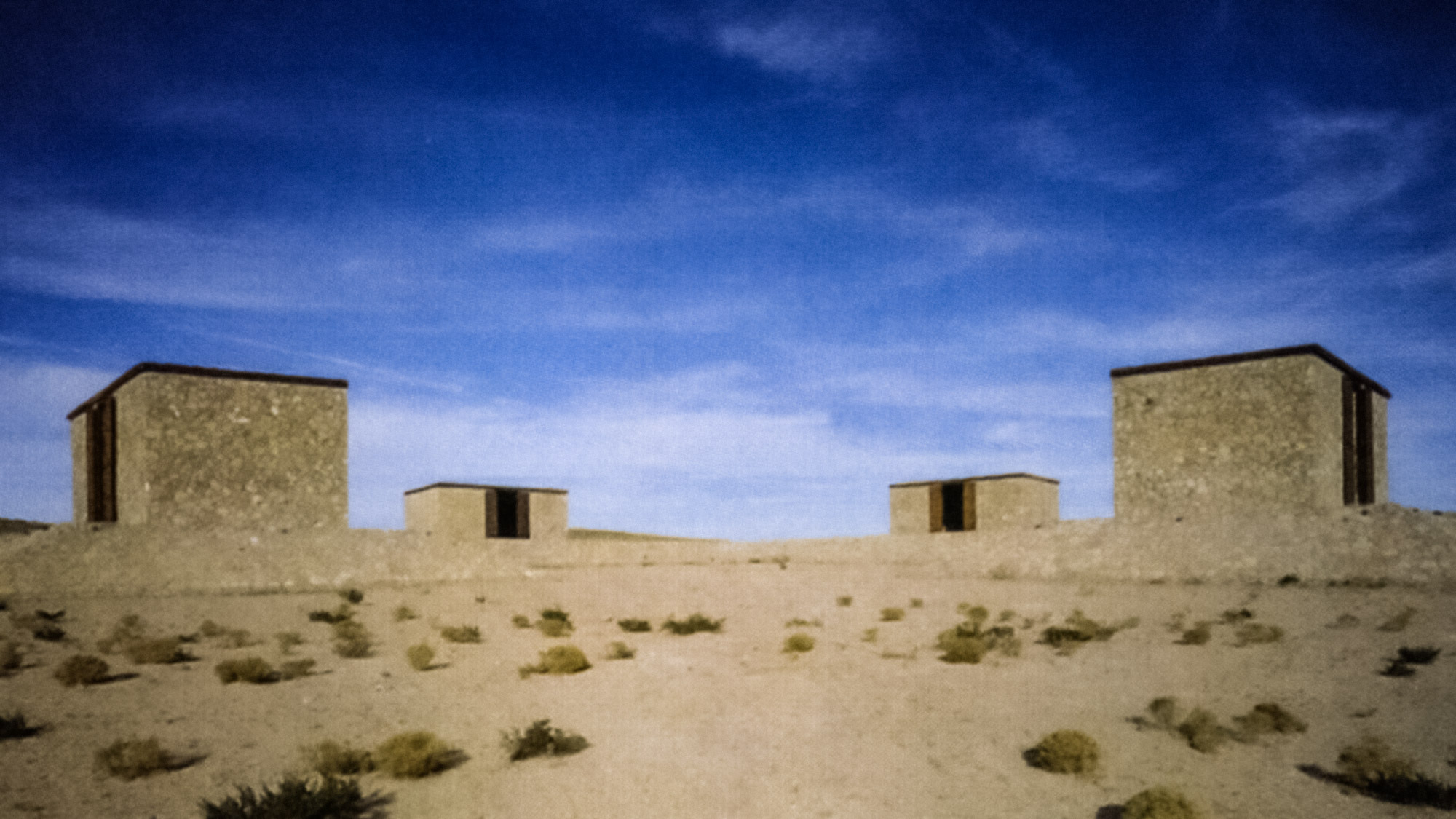
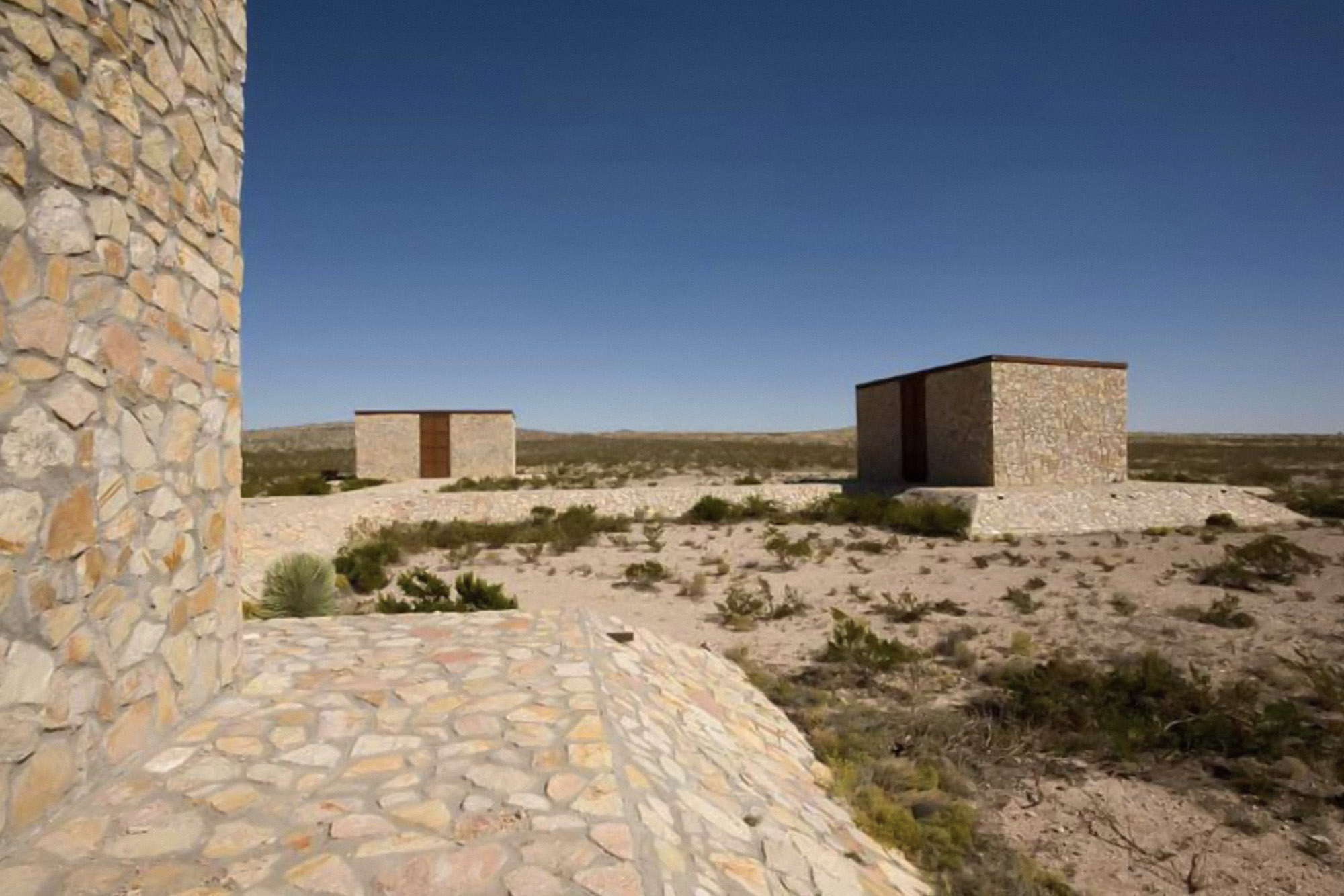
About 70 miles east of El Paso, the Chihuahuan Desert runs flat and pale before giving way to the magmatic peaks of the Cornudas Mountains, where four stone buildings stand in the shape of a cross.
“You can start to see it from the highway, but you really don’t get a sense of what it is,” says Chris Cummings, chair of the Cornudas Mountain Foundation. “It just looks like a little bit of a hill with maybe a building on it.”
This is The Hill, the life’s work of James Magee. Each building is 40 feet long and stands 17 feet tall, built of rough-hewn shale. Visitors enter through iron gateways Magee engineered himself. Wide walkways run between the buildings, and a ring of gabion columns rises and falls to follow the horizon. Inside three of the buildings, steel altarpieces open like wings onto sculptures of unlikely ingredients: oil and scrap metal, old tires and ball bearings, dried hibiscus flowers and spices. In one building, participants must work together to pull chains that raise a section of the floor, revealing the work beneath.
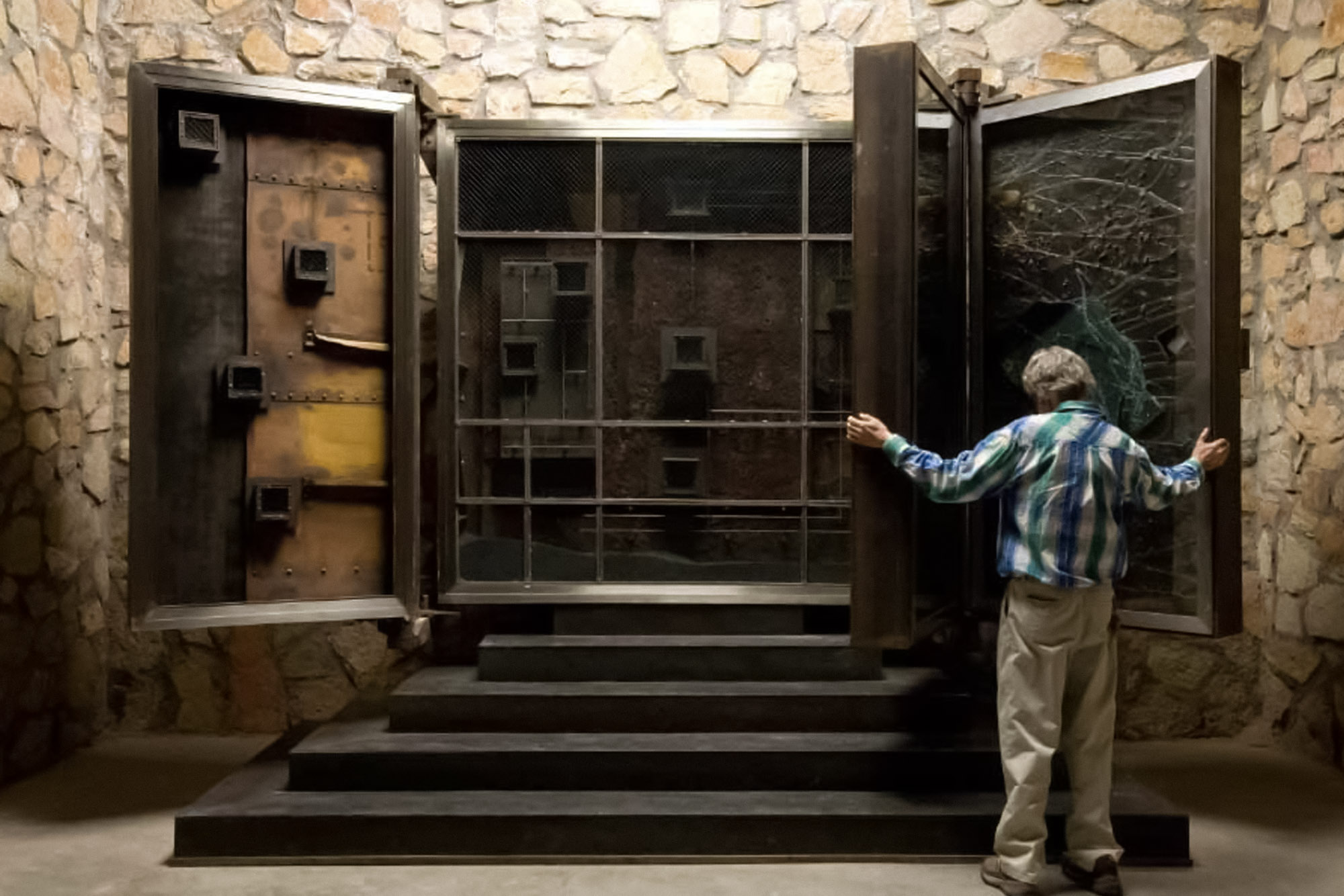
Magee built nearly all of it by hand for over 40 years, pacing out the cross with a string, without a blueprint. By the time he died in 2024, at 79, only about 200 people had made the pilgrimage.

Those few tend to describe the visit the same way. The late art critic Rick Brettell wrote that people can divide their lives into two parts: before The Hill and after.
“And it’s true,” says Jed Morse, chief curator of the Nasher Sculpture Center in Dallas. “There is really no experience quite like it.” Morse, who sits on the foundation’s board, calls the buildings “industrial reliquaries,” hushed and almost monastic. “The Hill is monumental,” he says, “but incredibly intimate at the same time.”
Since Magee’s death, the Cornudas Mountain Foundation—an El Paso nonprofit the artist and his family created to steward the site—has strived to welcome more people to The Hill and carry his work forward. A private visit runs a few hundred dollars per person, covering crew and upkeep.
For his works on The Hill, Magee wrote long prose poems. He called them “titles,” and would occasionally intone one aloud while a visitor stood facing the piece.
He would instruct the viewer to look at the artwork while slipping behind them, recalls Eric Pearson, president of the El Paso Community Foundation, who also sits on the board. “And if you look back, he would be upset,” he says. “So you had to keep looking at the pieces.”
Magee said that El Paso saved his life. A Michigan transplant living in New York, he first passed through El Paso in 1977 after his train to Mexico City derailed north of Los Mochis. He arrived on foot amid a sandstorm and planned to stay one night; fascinated, he stayed for three. From the bus window returning northeast, he realized the desert was where his work belonged, and soon bought the Cornudas land that became The Hill.
Out on The Hill, working alone under an unobstructed sky since 1981, he answered to no one. Asked whether an artist needs an audience, he shook his head. “His audience was the almighty,” says Adair Margo, the El Paso gallerist who championed his work and now serves on the foundation’s board.
In El Paso, he found room to work and people who took him as he was.
“They were not curators or writers trying to help him climb the ladder,” Margo says. “They were people who knew how to deal with hinges, or how to lay foundations, or deal with steel.”
For all the solitude of The Hill, Magee was no hermit. He worked the phone for hours, and when his friends gathered to remember him in the fall of 2024, they compared notes.
“There were hundreds of people who felt like they were the one special person being called by Magee,” Cummings says.
Magee’s work is scattered across El Paso, and the easiest to find is free to visit. In the lobby of University Medical Center, the county hospital, a small chapel holds flower paintings by Annabel Livermore. A fountain trickles beneath them, and fresh flowers are always set out. Livermore was supposedly a retired Midwestern librarian. In truth, she was one of Magee’s invented selves, along with a man he called Horace Mayfield. “Instead of stations of the cross, as you go toward the high altar, there are flower paintings,” Margo says. “It’s embedded in life. It’s not set apart in a museum.”
Word of Livermore’s flowers traveled beyond El Paso. Former first lady Laura Bush collected her paintings and once made the trip to The Hill. Livermore has her own museum, Museo Livermore, in an unassuming neighborhood building.
“Here’s this house that looks just like any other, and inside there’s a million dollars’ worth of artwork, but the outside walls are cracking,” Cummings says. More of Magee’s work keeps surfacing. “Nobody really knows how much is out there,” he says.
Magee stipulated that work on The Hill should stop when he did, and he kept building to the end. In his last years, a double amputee, he still made his way across the walkways. “A month before he left us, he was out on The Hill working on some aspect of it,” Pearson says.
Magee never set out to make El Paso famous, and his friends were long content to keep it to themselves. Some have since come around. “El Paso is a secretly wonderful place,” Cummings says. “Now I don’t want to keep the secret, because I want everyone to know about The Hill.”
Pearson believes Magee saw something in the Chihuahuan Desert that El Pasoans have trouble seeing themselves. “Magee was a beautiful soul who found a home here, coming to what can seem like a harsh desert and recognizing its stark beauty,” Pearson says.
Magee recorded the titles before he died. It is undetermined how The Hill will present them. But one day, visitors may stand facing the work, as he once asked, and hear his voice behind them still.