A Booklover’s Guide to Texas
More on the state’s indie bookstores, storytelling champions, and literary destinations turning the page
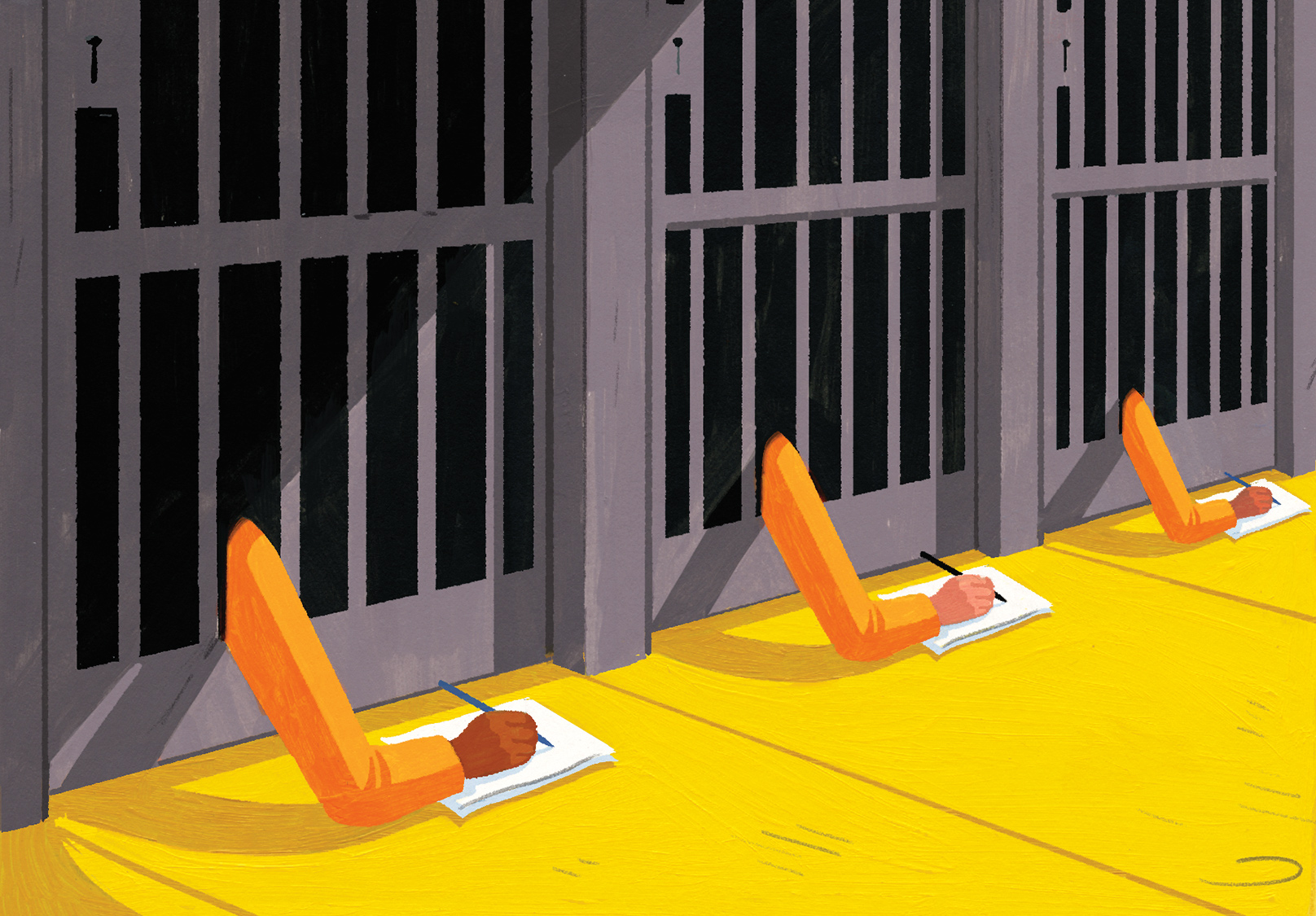
In a cafeteria-like room at the Harris County Jail in downtown Houston, 75 people who are incarcerated fill numerous metal tables and chairs bolted to the sealed concrete floor. Overhead, tubes of fluorescent lights bounce off the hard surfaces. A cacophony of voices volley throughout the space. Here, last fall, writer and educator Fernando Villagómez led the group in a 10-week creative writing workshop as a part of the community programming of Inprint, considered Houston’s largest literary nonprofit. “It is a space where they can be themselves, where they don’t have to be contrite,” Villagómez says. “Instead, they can explore their humorous selves, their dark selves, their mischievous selves.”
Texas ranks near the top in terms of incarceration rates in the U.S., according to the nonprofit Prison Policy Initiative. This has spurred groups to bring opportunities for expression to those who have been deprived. In 2015, Deb Olin Unferth, a novelist and professor of creative writing at the University of Texas at Austin, formed the Pen City Writers at the John B. Connally Unit, a penitentiary in Kenedy. Building on Pen City’s success, Unferth later expanded the program so participants could receive college credit through UT Austin Extension. “Once the writers find their footing and do a lot of reading, they blossom and do a lot of great writing,” Unferth says. “They all feel strongly about expressing their voices.”
Some of the most popular books made available to the writers include The Beautiful Struggle by Ta-Nehisi Coates and The Sellout by Paul Beatty, as well as classics by Alex Haley, Toni Morrison, and others. Carlos Flores, a longtime participant in Pen City, says of The Beautiful Struggle: “The work showed me what was possible. It showed me how art could be made by exploring experience and that, through literature, there is a place to share perspective and create empathy.” Flores now teaches the beginner class. “Pen City has been everything that prison is not,” adds Flores, who has been incarcerated for 27 years. “Respect among all participants, learning, artistic and creative self-expression, achievement, value for my efforts and actions.”
In 2017, Unferth established The Insider Prize in partnership with the Austin literary magazine American Short Fiction. Each year, writers who are incarcerated in penitentiaries across the state are invited to submit stories and essays. “It shows how stories can really change people’s lives,” says Sergio Muro, director of the program. “They are teaching us what story is about and how it can liberate.” Ten finalists are selected by a panel of readers, and then the winners are chosen by a judge—this year, award-winning short story writer Elizabeth McCracken.
Inside Books Project is another program that supports literacy by sending around 1,000 books a month to people incarcerated in Texas. Established in 1998, the Austin nonprofit is one of the largest prison book projects in the country and is always looking for volunteers and donations. Among the most requested works are the dictionary and genre fiction by authors such as Stephen King and John Grisham. Recently, the organization began sending Spanish-language books to Spanish speakers. “A lot of the prison libraries are undependable and have limited access,” says program coordinator Scott Odierno, “so it’s important we get free books into the hands of prisoners.”
The impact of these programs is immeasurable. Patrick Jeffries, who spent four years in the Pen City program before he was released from Connally after an 18-year sentence, is currently working on an associate’s degree in psychology at San Antonio College. “Growing up, I had a negative relationship to education,” Jeffries says. “The creative writing program gave me a lot of confidence to try higher education. It gave me the ability to explore a new side of myself that I never knew—this person who likes learning.”