

Return to the River
Nearly a year after the devastating July 4 floods, Hill Country communities are still grieving and rebuilding, while hoping to welcome visitors back to the Guadalupe
“A big flood is coming,” Scott Towery told the 911 dispatcher from the Kerr County Sheriff’s office at 2:52 a.m. on July 4, 2025. The electronic rain gauge in the River Inn Resort and Conference Center apartment where Towery lives with his wife, Connie, read 5 1/2 inches. He walked out on the deck and saw water 4 feet over the dam. He spoke plainly, “I just wanted to alert y’all.”
Towery, the manager of the inn located about 7 miles upstream of Hunt, continued updating the operator—“The water is coming up really quick,” he said—as he and Connie began banging on the doors of the roughly 130 people staying at the inn. They roused sleeping families and tied bed sheets together, pulling guests onto the property’s long roof. Looking down from the top of the two-story building, the guests watched as the water rose and rose, almost completely submerging the inn’s first floor.
Downstream, sheer limestone walls funneled millions of gallons of rushing water down the narrow Guadalupe River valley with the force of a runaway freight train. Centuries-old cypress trees snapped like toothpicks. Homes came apart and floated away. The flood gauge in Hunt rose from 8 feet to 38 feet—then broke. At Camp Mystic, the first of four youth camps heading down the South Fork of the Guadalupe, the river climbed to a confirmed high-water mark of 37.5 feet.
State officials attributed the deaths of 119 people to the flood, including 25 8- and 9-year-old Mystic campers and two teenage counselors. The owner and director of Camp Mystic, Dick Eastland, died while trying to save campers. Two flood victims, Mystic camper Cile Steward, 8, and Jeff Ramsey, 63, who was vacationing with his wife and dog in their airstream trailer at the HTR RV park in Ingram, remain missing.
As the floodwaters began to recede on July 5, a daunting recovery process began. The severe physical damage you could see. The immense emotional toll and the economic cost of the flood would become evident in the passing hours, days, and months.
The restoration process started almost immediately. All along the ravaged river, heavy equipment operators gradually scraped the banks clean, transforming the Guadalupe into a blank slate. Flooded homes have been rebuilt and new homes erected, rehousing more than 300 flood survivors to date.
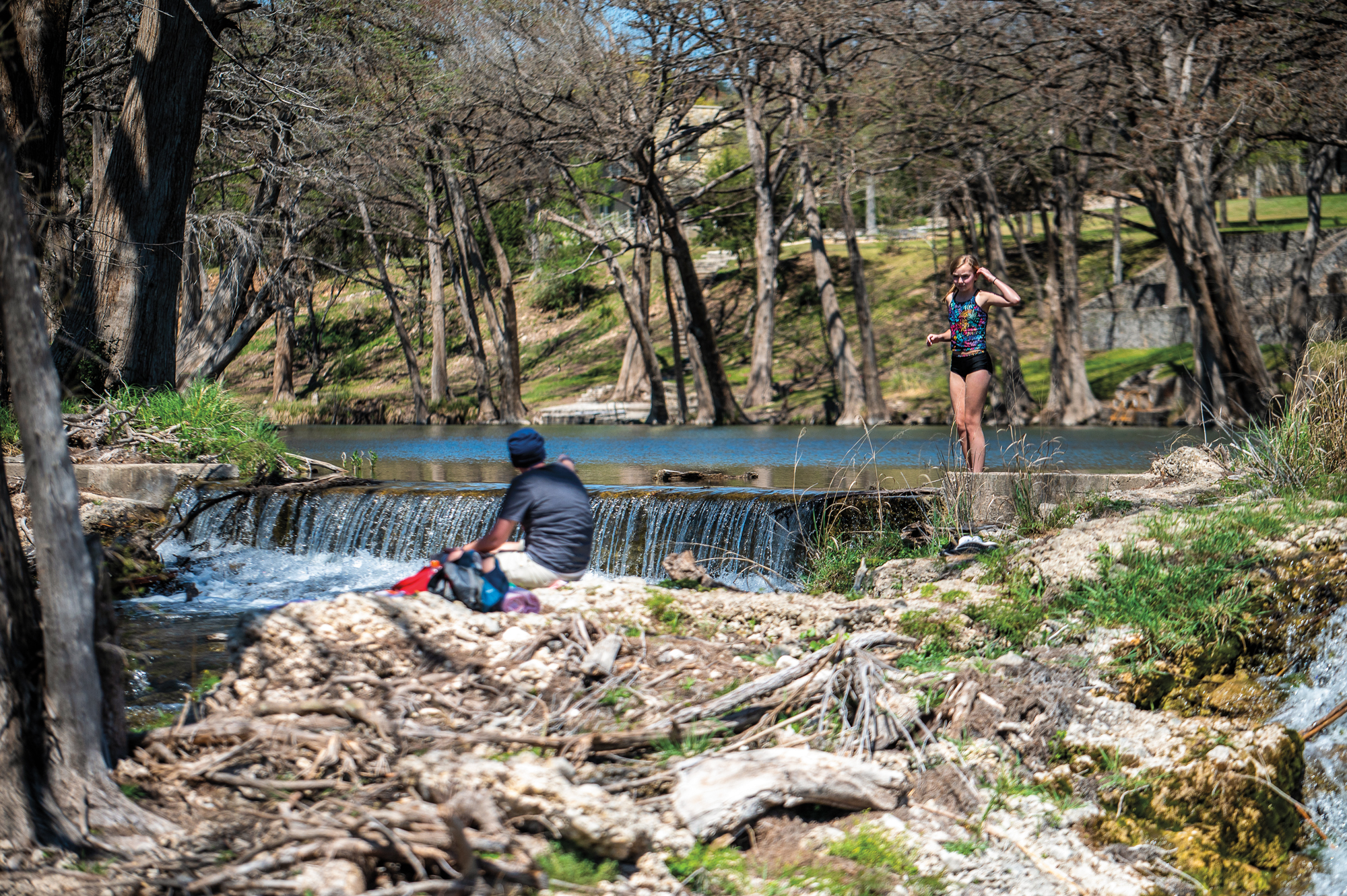
The mental and emotional recovery of the community continues. Throughout Kerr County, pop-up counseling centers provide space for people to congregate and talk. For many, this work will never end.
The financial loss looms as a remaining hurdle for area residents, who depend on the river for their livelihood. The Upper Guadalupe River, the portion of the river above Comfort, is among the most popular recreation destinations in the state, and tourism is Kerr County’s second-largest economic driver after healthcare. The Kerr County Relief Fund, launched by the nonprofit Community Foundation of the Hill Country, raised over $100 million to support rebuilding and recovery efforts. But the nonprofit is limited in how it can directly support the private businesses that buoy Kerr County tourism.
In March, the Kerr Together long-term recovery group released the preliminary results of an economic impact study that surveyed over 200 local business. The report stated that “2026 would need to be incredibly strong to make up for lost revenue in the late summer and fall of 2025.”
The area’s camps, vacation rentals, restaurants, local grocers, and retailers need visitors to survive. But how do you return to a place built around a river after the worst imaginable tragedy?
Thousands of Texans, including myself, know the Upper Guadalupe as a formative place. It’s where we’ve come to play, to pray, to form lasting friendships, to reconnect with our family and ourselves. Returning to the river requires holding on to and building upon the memories of our past—and understanding how the July 4 flood affects the present.
In the weeks after the flood, I came to the river from my home in Austin and followed search and recovery workers as they waded through towering piles of debris, trying to find the remaining victims. Throughout the fall and winter, I kept coming back. During the day, I talked to local business owners, flood relief volunteers, city officials, and politicians. At night, I would pitch a tent at Kerrville-Schreiner Park and stare at a campfire, letting my thoughts drift between intrusive images and the flickering flames.
As winter turned to spring, I started planning a trip down the Guadalupe River, by boat and bike, from just below the river’s headwaters, through Hunt and Ingram, into downtown Kerrville. I wanted to see what the water saw that day. But I needed a guide for this journey, so I recruited a local, former camp worker Camden Jones, 37, who’d been coordinating equipment with search and rescue teams and working with nonprofit Rampart Vigilance to restore the river since the flood.
As we discussed the trip, Jones showed me an aerial video of a demolished dam near where the heaviest rain fell on July 4. “How’d you end up on a helicopter?” I asked. “I don’t know,” he shrugged. “The same way I ended up with a satellite phone from Homeland Security.” When the river rose, he showed up and tried to help. Jones suggested we put in at the first publicly accessible business downstream from the headwaters, River Inn Resort.
As we gather our gear at the River Inn crossing on State Highway 39, the road that traces the river, he points to his skid steer bucket, sitting in the grass outside River Inn Resort. Reconstruction on the damaged first floor units and riverfront amenities will begin this fall. Just as we’re sliding our boats into the water, a local in a red SUV stops us. Looking a little envious that we’re getting out on such a sunny afternoon, he asks, “Where y’all headed?” After learning I’m a journalist, he tells us that the night of the flood, neighbors filled their homes with shaken survivors. “I had 30 people on the floor at my house still in their pajamas,” he says.
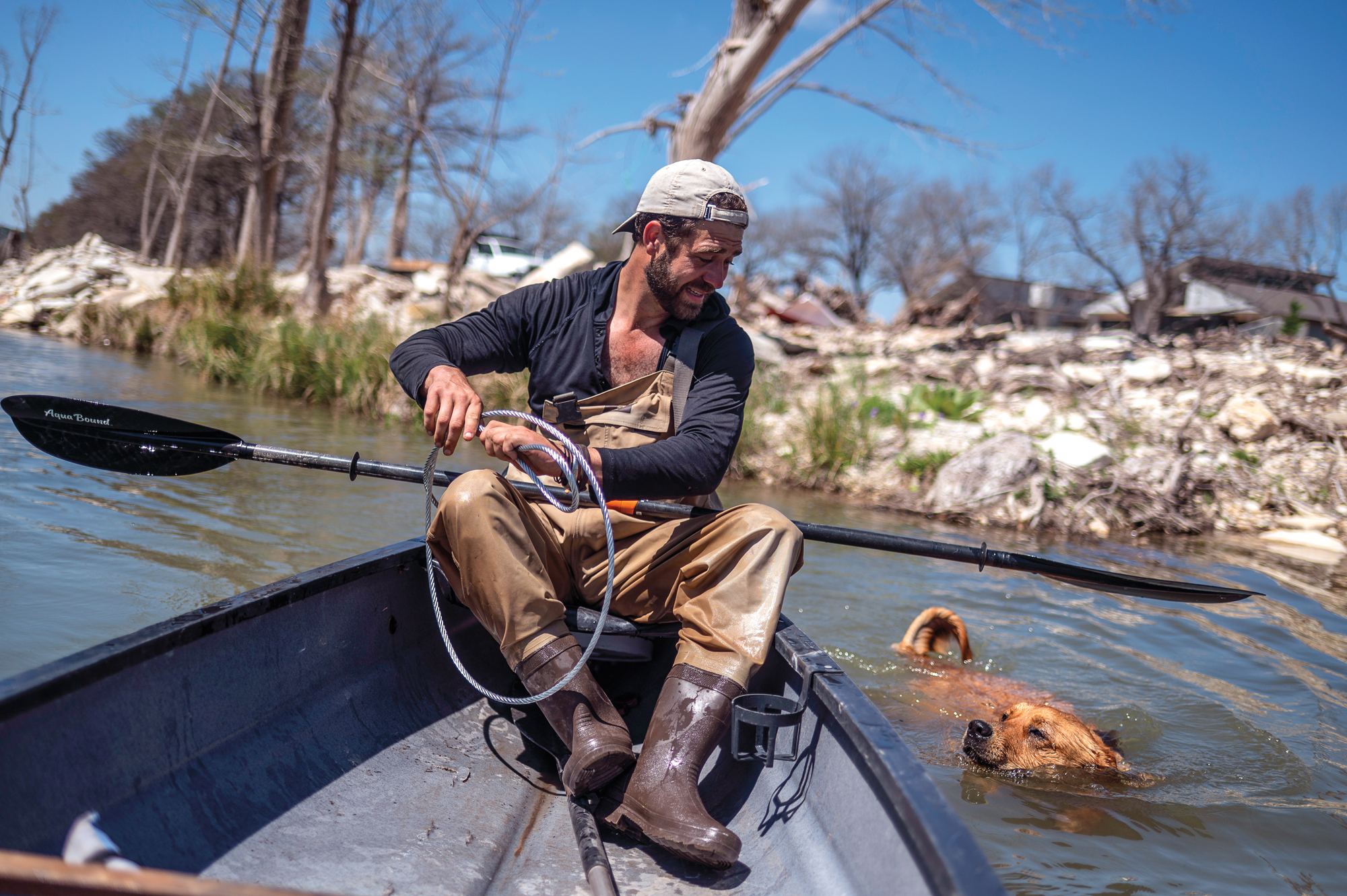
All these months later, some of the local kids haven’t been back to the river. “They’re still traumatized,” he says. But “for all the tragedy that occurred, there were 10 times as many miracles.” Then he bangs the side of his truck—“Y’all have a good day”—and drives off before I can get his name.
Along the post-flood Guadalupe River, Jones explains, you need to make space for people who want to talk. “Those moments of synchronicity, those are the moments that have consistently gotten me through,” he says. “As soon as I stop approaching situations with an open heart and soft eyes, I’ll know that I’m at my breaking point.”
We reach a gently flowing portion of the river, and I sit listless in my boat, admiring the various rock formations carved by millennia of moving water. The water appears light green in spots, blue in others, and clear to the bottom. The Upper Guadalupe River Authority advises caution when recreating in the river, as some portions still contain submerged debris. We toss the debris we spot into our boats. Jones is more ambitious than me, pulling an orange construction cone from the river. “I should have brought a barge,” he jokes.
We exchange waves with the occasional pickup truck driver who passes by. The flood stripped away much of the lush foliage that previously hid the Guadalupe from view. Now, it seems, you can see right into the soul of the river.
Certain sections of the Guadalupe River are easier to navigate and more accessible than others. The historic rains came and went with such speed, the Edwards Aquifer that feeds the Guadalupe River barely filled. Drought conditions persist, and the river flow is low. Some dams remain unplugged, while others need repair. At intermittent points where the water flattens into a thin trickle, we tie ropes around our waists and pull our boats down the rocky riverbed.
Upon reaching the Mystic Crossing, Jones and I slide our boats beneath SH 39 and quietly paddle into the sadness of this section. As a navigable waterway, public access to canoe or kayak the Guadalupe River is protected by state law, but a part of me still feels like an interloper. The scene remains surreal, even with the Mystic grounds mostly cleaned up. At the base of the rugged hills, you can see the Twins and Bubble Inn cabins where girls were lost; the diving boards hanging over the river, somehow still anchored to a dock; the hall where campers gathered for shared meals; and the open field for camp games. Twenty-seven freshly planted memorial cypress saplings line the riverbank in front of Camp Mystic.
Not far upstream, homes about 100 feet from the river appear hardly affected. But the hydrology here, the confluence of Cypress Creek and the way the water gained force as it came through Mystic, all contributed to the flood’s largest loss of life. “It doesn’t make sense,” Jones says. “It just doesn’t make any sense.”
Only two camps remain in operation on the South Fork of the Guadalupe River, La Junta and Mystic. Heart of the Hills, a girls camp and conference center, was between sessions during the July 4 flood and has since relocated to a property on the North Fork of the Guadalupe River.
In the legislative session following the catastrophe, lawmakers passed two bills aimed at improving camp safety and allocated $50 million toward flood warning systems across Texas. The camp safety bills were pushed forward by the Heaven’s 27 Foundation, a coalition formed by the grieving parents of Mystic campers. Along the Guadalupe, many businesses and summer camps, including Mystic, have installed River Sentry flood sensors. Stationed below homes and cabins along the river, the towers issue ear-ringing alerts when they detect rising water levels.
In September 2025, the Eastland family sent a letter to families announcing their intent to reopen a separate facility a half-mile up the hill from the Guadalupe River, Camp Mystic Cypress Lake, pending state licensing. Ruling on an injunction filed by the parents of Cile Steward, Will and CiCi, a Travis County judge mandated the flood-damaged buildings at Camp Mystic must remain closed as investigators gather potential evidence pertaining to multiple civil lawsuits.
We keep paddling. Below Mystic, the river is full and peaceful and numerous sections remain canopied by tall, swaying cypress trees. To our right, the land rises into the sky.
Before long, we’re passing Crider’s Rodeo and Dancehall, the last remaining of five outdoor dance venues that existed along the Upper Guadalupe River in the 1950s. Since July 4, 1925, Crider’s has hosted a dance and rodeo almost every Saturday night, from Memorial Day through Labor Day. (The day of the flood was the venue’s 100-year anniversary.) After the flood, most of the buildings still stood, even Crider’s iconic neon sign, written in a lasso script. But the owner, Megan Bruinsma, had lost a family member. Her cousin’s daughter, 8-year-old Renee “Nay Nay” Smajstria, known for mutton bustin’ at the Crider’s rodeo, was among the Camp Mystic victims.
Though plans to resume operation remain in the works for 2026, on the Labor Day following the July 4 flood, Crider’s opened its gates for a community dance with no admission fee and live music by local country artist John Christopher Way. Austinite Chris McQuilkin, 40, drove down for the dance. “I make a point of coming back once a year,” he says. McQuilkin worked at a Hill Country dude ranch in his 20s and spent his Saturdays off at Crider’s “buying beers for the rodeo riders, twirling girls around the dance floor, and learning how to dance from the older women.”
He came back for the Labor Day dance, he tells me, because he believes in “the importance of keeping those memories alive.”
By the time Jones and I reach Hunt, an arrowhead-shaped piece of land where the North and South forks of the Guadalupe River come together, we’ve missed the group of locals that hold daily “office hours.” Prior to the flood, the group would gather from 3 to 5 p.m. on the back patio at the Hunt Store, which also hosted a morning coffee crew, a bible study group, the mahjong ladies, and students who would walk down from the school to do their homework.
On the day of the flood, Joe Vorhes, 75, who moved to Hunt in 1979 to work at the store, called his friend Don Cottonware, who lives just across the South Fork of the Guadalupe River. “If you’re planning on coming to the store, don’t bother,” he said. “It ain’t here no more.” By the following afternoon, the group was sitting in a semicircle of folding chairs in front of the wrecked Hunt Store. Today, just the stone chimney and wraparound front porch remain. The store’s sign has been rearranged to read HUNT STRONG.
Over the decades, Vorhes witnessed the store pass between a few different owners, before Haley Lehrmann took over in March of 2024. “I feel like I’m best described as a steward of the store,” says Lehrmann, who ran her real estate business from an office at the store prior to the flood. The first store in Hunt proper opened in 1911, a small wooden building operated by Lizzie Joy on land to which Joy owned the title, a rare accomplishment in Texas at a time when women couldn’t yet vote. “It’s a big responsibility to keep the store going,” Lehrmann says.
While final plans to rebuild the Hunt Store have been drawn up, the funding remains in question. As an intermediary, Lehrmann began construction on a new, more compact store in Hunt, selling essentials like milk, eggs, and gas. “It’s gonna be mini but mighty,” she says. “So many people have told me, ‘We just can’t wait to see everybody and have a place to gather again.’”
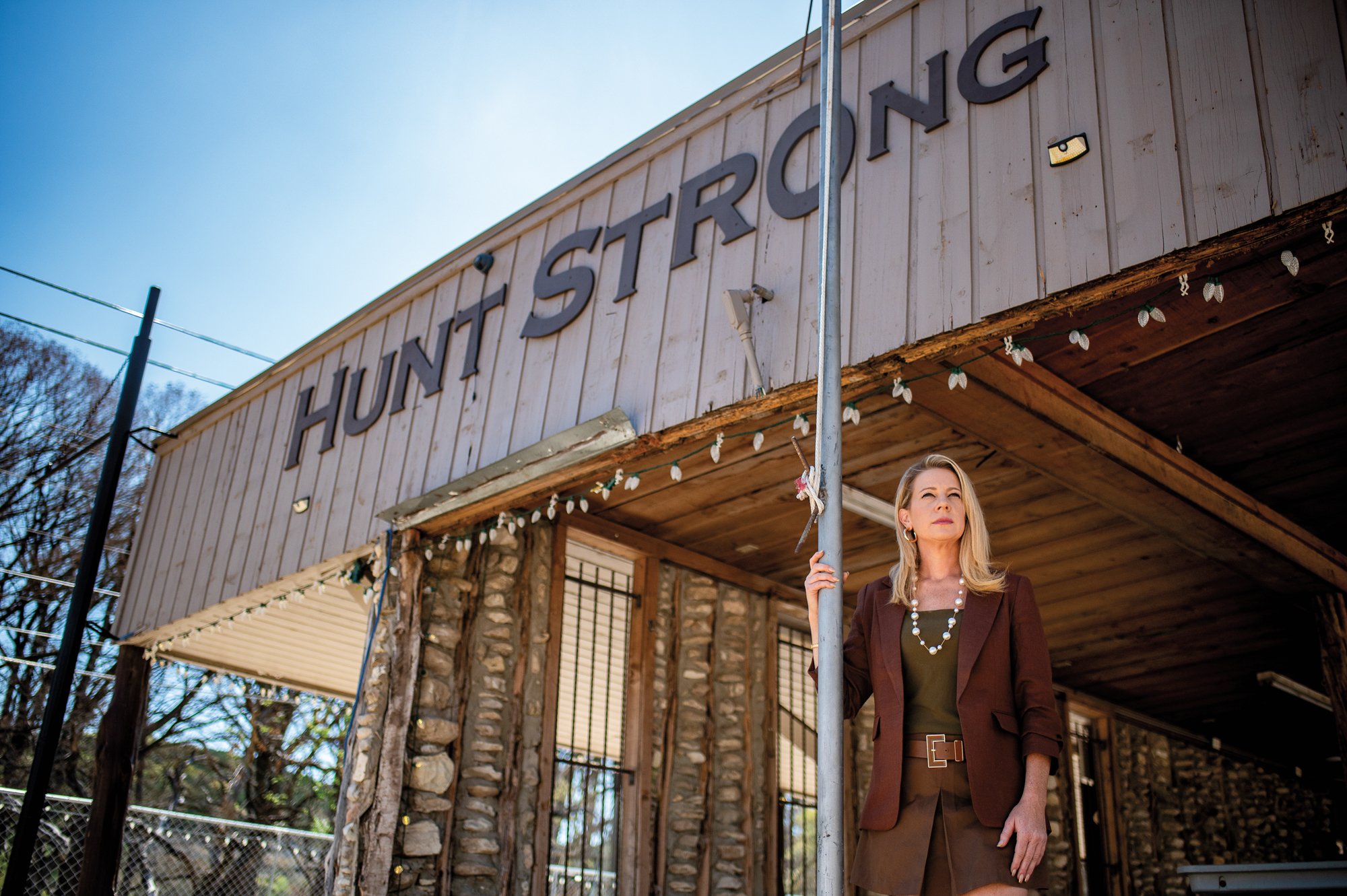
Lehrmann is among those who remain deeply shaken by the flood: “I still wake up every day and say, is this reality?” At 4:30 on the morning of the flood, she received a call from her general manager, Courtney Garrison, who lived with her 10-year-old daughter in an apartment above the Hunt Store. “Haley, there’s water in my apartment,” Garrison told Lehrmann. In the store below her, Garrison could hear furniture and merchandise banging into the beams.
“I told her to climb out the apartment’s window onto the roof of the store,” Lehrmann says. Then the call dropped, and Lehrmann’s heart sank. When they reconnected, Lehrmann learned what happened: “The apartment collapsed onto the back of the store.” But Garrison and her daughter survived on the roof and ultimately climbed down a ladder to safety.
Behind what’s left of the Hunt Store, Lehrmann says, St. Peter’s Episcopal Church in Kerrville placed a pair of mobile homes, staffed with counselors available for anyone in need of support and as a temporary office for her.
“There’s room for grief, and there’s also room for hope,” Lehrmann says. “We want people to come back. If they’ve never been to Hunt before, they’ll see how strong our community is.”
Downstream from Hunt, the Guadalupe flows over the iconic Hunt Dam and beneath Schumacher crossing, an old low water bridge and popular swimming hole. The Guadalupe is mostly wide and deep below Hunt and bordered by several vacation rental properties.
After our day paddling the river, I spend the night at Casa Blanca, an 11-acre spread with a Spanish Colonial main house and nine other lodging areas. On July 4, property manager Eddie Mathews got a call from the family of a neighboring property. “They hadn’t heard from their brother, Patrick, who was staying in one of the cabins,” Mathews says. “So I drove out to check on him.”
Navigating uncleared flood debris along SH 39, it was nearly 10 p.m. by the time Mathews reached the property. Flashlight in hand, Mathews walked toward the neighboring cabins, which sat awkwardly, carried away from their foundations. He called into the darkness, “Hello?” And heard a reply. Mathews found Patrick, 53, disoriented and dehydrated but physically fine.
In the weeks after the flood, Mathews opened Casa Blanca to first responders, providing complimentary lodging. He spent much of his own time processing canceled reservations, wondering how he and the other short-term rental businesses would survive. Since reopening to the public last August, his revenue remains down 60%. “Nearly every guest who called to cancel their reservation asked, ‘Eddie, what can we do to help?’” he says. He gave each person a simple response: “Next summer, please come visit.”
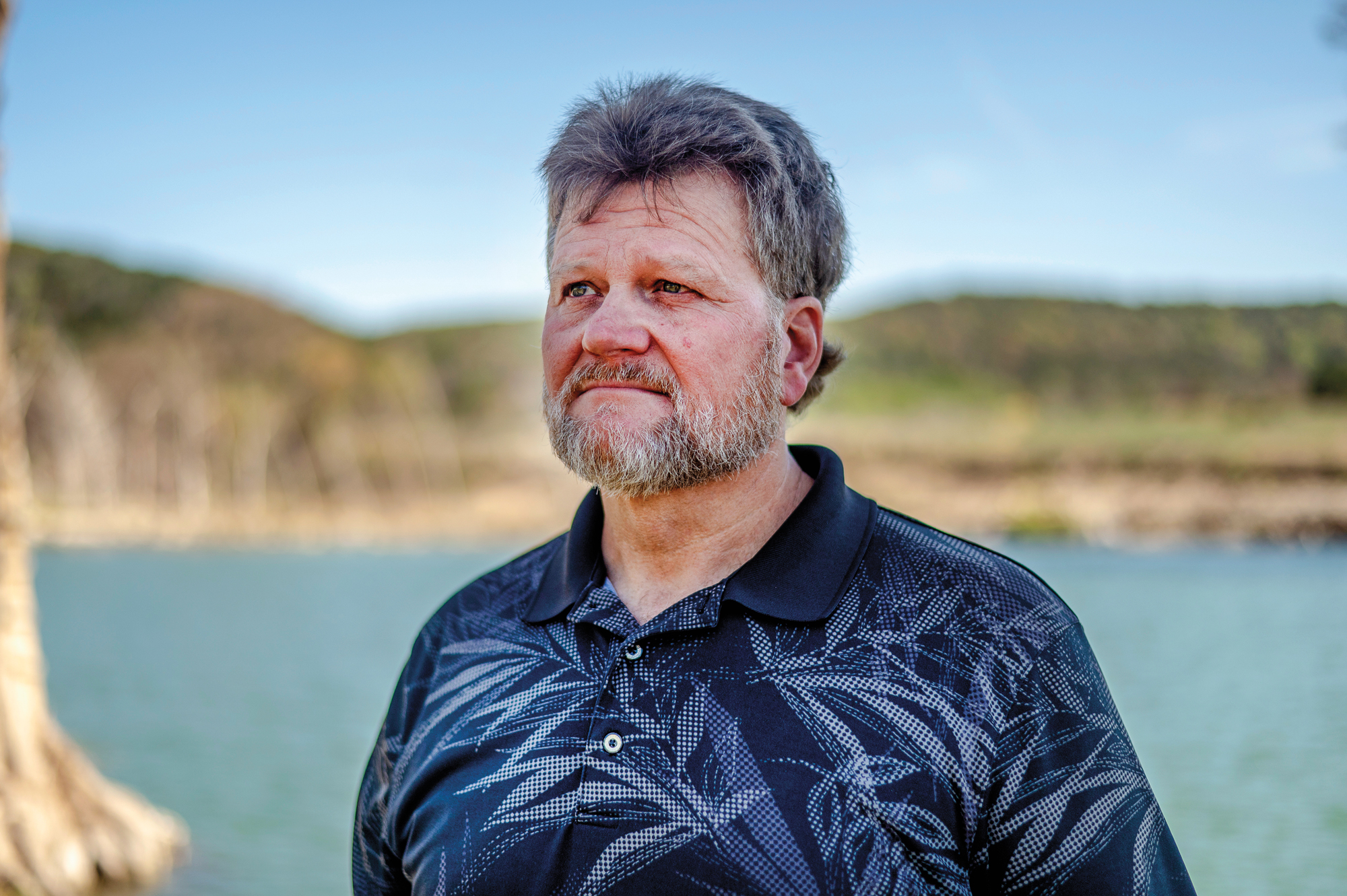
The next day, Jones and I paddle through Ingram. Below Lake Ingram, workers repair the Hill Country Arts Foundation, a community hub and tourist destination featuring a nearly life-size replica of Stonehenge and a 520-seat outdoor amphitheater with the Guadalupe River as its backdrop. HCAF Executive Director Sarah Tacey told a local news crew that the building, built in 1959, performed as it was intentionally designed to: “For the walls to blow out during a flood, so that water wouldn’t carry the whole building down the river.” Next to the arts foundation, at Ingram’s Little League ballpark, the flood washed away three primary fields and two practice fields, along with 8,000 feet of fencing, batting cages, and a concession stand. Donations from baseball organizations across the U.S., including $2.5 million from the Houston Astros Foundation, helped restore the entire facility.
The Guadalupe River splits in two just below Johnson Creek, encompassing a human-made island circled with walking trails. Jones guides his boat down a topaz-tinted chute, past a concrete footbridge that connects the island with Howdy’s Restaurant, Bar & Chill and a gravel lot where the Blue Oak RV Park existed before the flood.
When Lorena Guillen and her husband, Bob Canales, purchased the 7-acre property in 2022, they imagined retiring here at the end of Riverview Road, living in the two-story house right next to Howdy’s. Of the 54 available RV hookups at Blue Oak, 28 were used that night, with 21 rented there permanently. “They were our neighbors, our friends,” Guillen says. When the previous owners of the restaurant ended their lease, Guillen wouldn’t let the place sit empty. “I wasn’t experienced in commercial cooking,” she says, “but I love to cook for my family.” She developed a menu and began serving meals at Howdy’s as a bonus for people staying on-site.
On the evening of July 3, the Cactus Country Band was playing on the Howdy’s patio, overlooking the river and island. It was cool and cloudy. “We were packed,” Guillen says. “Little kids, big kids, everybody dancing. It was one of our best days since opening.” After closing, Guillen got an emergency alert at 1:14 a.m., warning of possible flooding. She called the county sheriff’s office, but the dispatcher didn’t have any additional information. Before going to bed at around 3 a.m., Guillen drove down to the island, where a family was camping. The river appeared calm.
An hour-and-a-half later, she woke to the flashing lights of emergency vehicles. The river was rising. Guillen and Canales banged on the doors of the RVs at Blue Oak, urging their tenants to evacuate. Canales waded toward the island as waves overwhelmed him. He tried to guide the family, who had a 1-year-old and a 3-year-old, through the water. “Throw me the baby,” Canales yelled. Then the family was gone. The following day, Guillen learned one of her employees had also died, saving his own family.
In our boats, a bit downstream from Howdy’s, Jones shows me a place where the river reconnects. The water flows from the shadows of a forest, spilling over little falls formed by mulched cypress. We drift in the swirling stream, soothed by the white noise of the rumbling river. Jones eyes the opposing bank. “I think those are my excavator tracks over there,” he says. In the days after the flood, he was among the hundreds of volunteers who helped clear the area.
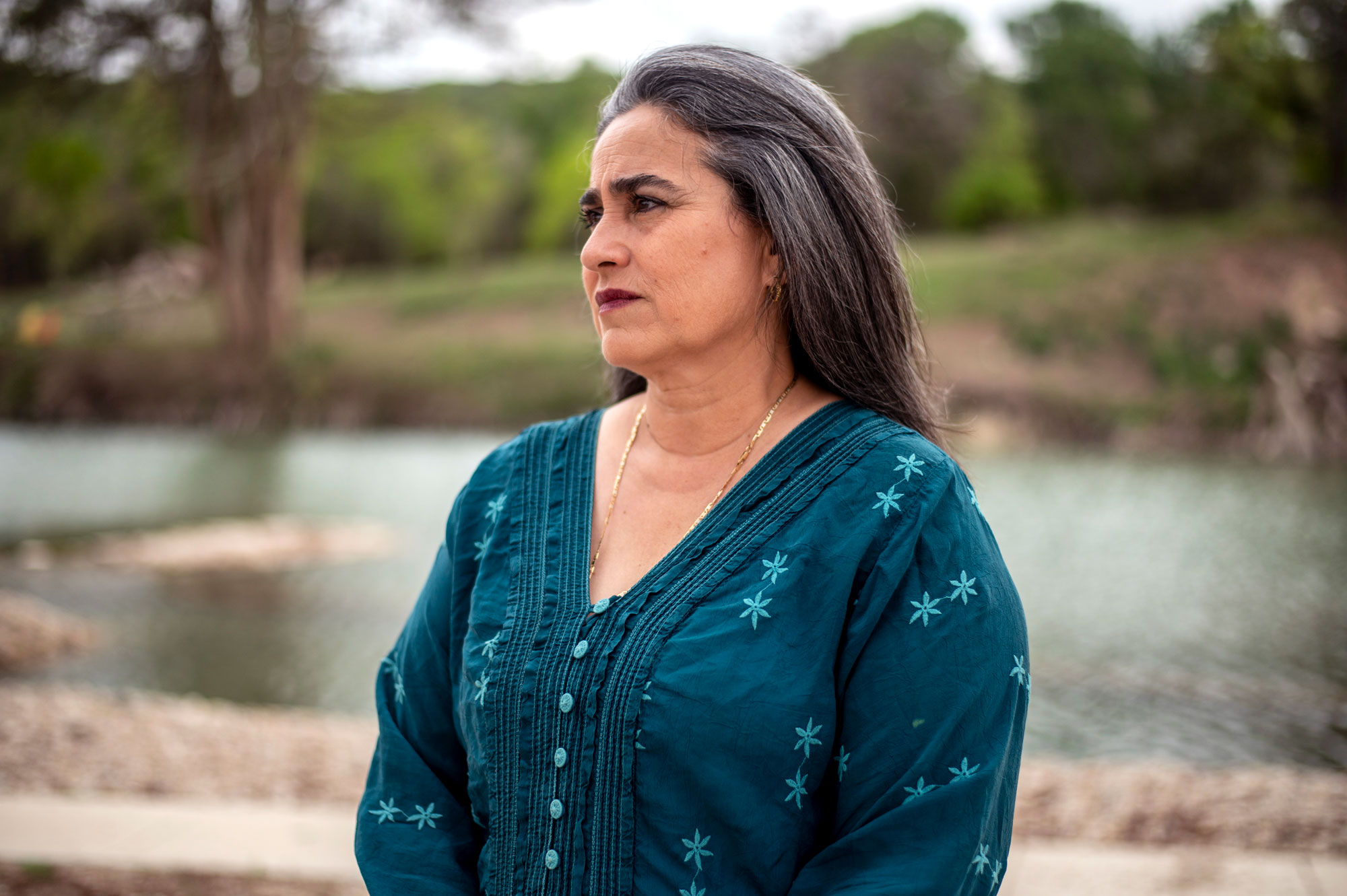
“It was weird. The restaurant never really closed,” Guillen recalls of those foggy hours on July 4. She kept the doors open to dry out the restaurant and soon volunteers and state workers started wandering in to use the bathroom and clean up. Before long, people were dropping off supplies, like Gatorade, gloves, and socks. Fredericksburg’s Hill Country Propane got the kitchen going. “The volunteers would come eat with us,” she says. “And at the end of their shift, I would tell them, have a beer from the coolers; it’s just going to go bad.” The search and recovery workers shared stories. “There was a lot of hugging, a lot of crying,”
Guillen remembers.
The Blue Oak RV park won’t reopen. Guillen and Canales lost $2 million dollars of underground infrastructure and the revenue from hosting guests. “Plus, we still have a mortgage to pay,” Guillen says. She envisions transforming the island into a day-use park where families can fish and kayak. “If I have somebody staying down there, I don’t think I’ll ever be able to sleep again.”
Before I leave Kerrville, I go on a bike ride along the River Trail. The paved path first opened in 2012 and now extends 6 miles along the Guadalupe River, winding past downtown Kerrville’s 100-year-old Arcadia Live theater and the Museum of Western Art, and currently ending at Kerrville-Schreiner Park. Various spurs provide access to points of interest, like the Riverside Nature Center, the Butt-Holdsworth Library, and Schreiner University’s Trailhead Beer Garden.
Within central Kerrville, public parkland occupies most of the Guadalupe River flood plain, and the parks system serves as a big draw. The River Trail survived the flood with only minor damage and became an emergency roadway for crews working along the river. Once the monthslong process of debris removal subsided, residents came to the river and swept the trail clear. The announcement of the trail’s reopening, Kerrville’s former communications director Crystal Stutes says, “was our most viewed post of the year. More than the posts about the flood.”
I pedal across a narrow bridge onto Tranquility Island, where a tunnel of cypress trees shades a green lawn, with the river calmly flowing down either side. I think about everyone I’ve met along the Guadalupe River, a chain of people linked by trauma, holding each other arm in arm, from the headwaters to Hunt, Ingram to Kerrville, and well beyond. I think about our attraction to water, as humans; it’s where we find life. And I think about death, both preventable and inevitable.
Much of the work that remains along the Upper Guadalupe River, we can’t see. But we can still support the Texans who live here. When we’re ready, we can return to the river.