

Everything
Big,
Bigger,
And
Biggest
In Texas, natural landmarks, appetites, and even hairstyles have one thing in common:
They’re big. Very big. Fitting for a place whose personality and lore are larger
than life.


there was Texas as far as the eye could see. Only at the edges could you glimpse anywhere else. And why would you want to? The view was so much better looking inward at this new dominion, oft conquered but never controlled. Before there was money, oil, barbecue, or the Dallas Cowboys, there was more space than anyone had ever imagined. The sheer scale of it has defined the people who decided to fill it ever since.
Before “everything was bigger in Texas,” it was simply big. Since 1883, the “everything” has been applied to newspapers, budget deficits, failures, storms, and jackrabbit ears. One senses a mocking tone in the historical record. What was intended as boosterism in Texas must have seemed slightly ridiculous beyond our borders.
Texans never got the joke. Well into the 1900s, big had become bigger, and the attempts at mockery took on a strained and unintentionally revealing mien. In 1913, Miss Marvel Rainey of Nez Perce, Idaho, traveled east to arrange a tour of the Liberty Bell in Philadelphia, Pennsylvania. Along the way, she unfavorably compared the men of New York to those of, well, everywhere else. A writer for the New York Tribune decided that he’d had enough.

“We have heard criticisms similar to this before, as it happens. Texan maidens are always particularly scornful on the point of size. Unless a man has a chest as broad as a sugar barrel, they cannot think of draping their fair heads upon him. Everything is bigger in Texas than anywhere else, it seems, so naturally New Yorkers are quite out of scale,” he sniffed. “A dwarfed and inferior race we plainly must be.”
Far be it for us to comment on another man’s insecurity, but outsiders who take the “everything is bigger in Texas” mantra as a comparison overestimate how much we think about them at all.
(We don’t.)
But to be fair, even the Bullock Texas State History Museum in Austin seems a tiny bit sensitive that we “rank … just behind Alaska in terms of size.”
Stephen Harrigan, author of Big Wonderful Thing: A History of Texas, recalls watching President Eisenhower’s proclamation admitting Alaska—more than twice the size of Texas—into the Union in 1959 with a vague sense of panic. “They had to change the lyrics of our state song from ‘largest and grandest’ to ‘boldest and grandest,’” he says. “But ultimately the fact that we were no longer the biggest state didn’t make that much of a dent in our self-regard. We could still feel in our hearts that we were the ‘grandest,’ and we could back that claim up with our epic, tumultuous, and literally world-changing history.”
Bigness matters to Texans because that is what Texas makes possible. The phrase contains an unstated assumption that everything is also better in Texas than it could be elsewhere. People have always come to Texas not just as a challenge to New York or California sensibilities, but for what Texas has to offer: the opportunities for bigger houses, bigger families, bigger fortunes, and bigger lives. Let the outsiders have their fun. From the very beginning, big has always been the point of Texas.—Jason Stanford

JUMP TO: STATE SPIRIT | STYLE | THE OUTDOORS | LANDMARKS | CRAVINGS | SPORTS | BEAUTY
TEXAS BY THE NUMBERS
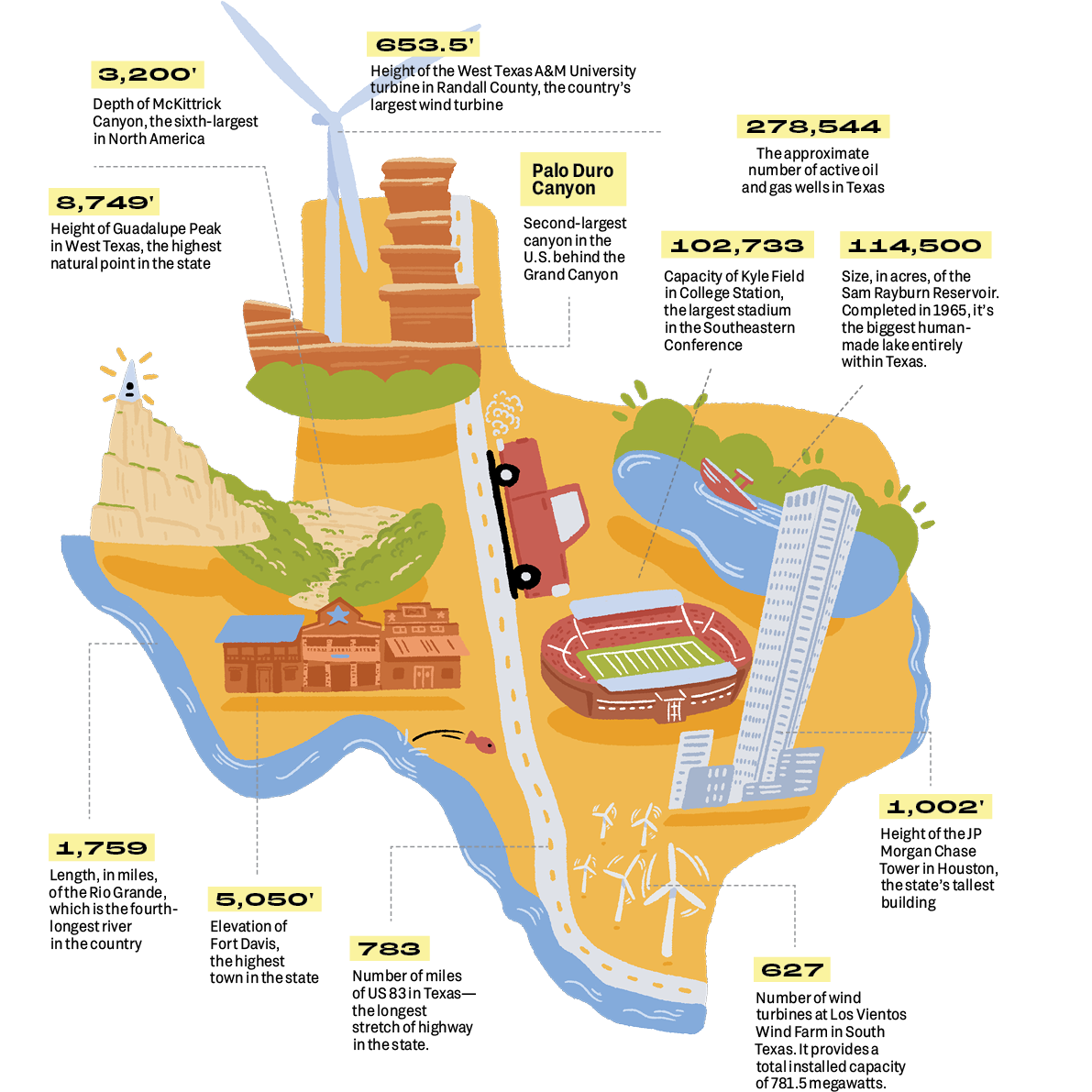
Illustration by James Yates

31+ MILLION residents in the state, second only to California
773 MILES
EAST-WEST DISTANCE from the Sabine River in Newton Country to the Rio Grande in El Paso
268,820
TOTAL SQUARE MILES, only behind Alaska in size

773 MILES
EAST-WEST DISTANCE from the Sabine River in Newton Country to the Rio Grande in El Paso

268,820
TOTAL SQUARE MILES, only behind Alaska in size

ROUND THE BEND
BY JASON STANFORD
It’s possible to live a long and fulfilling life in Texas and never know its beauty. One could grow up against the backdrop of refineries, strip malls, and highways and accept the cover story that nature exists in Texas only to offer people something to pave over, drill under, or build upon—often at the same time.
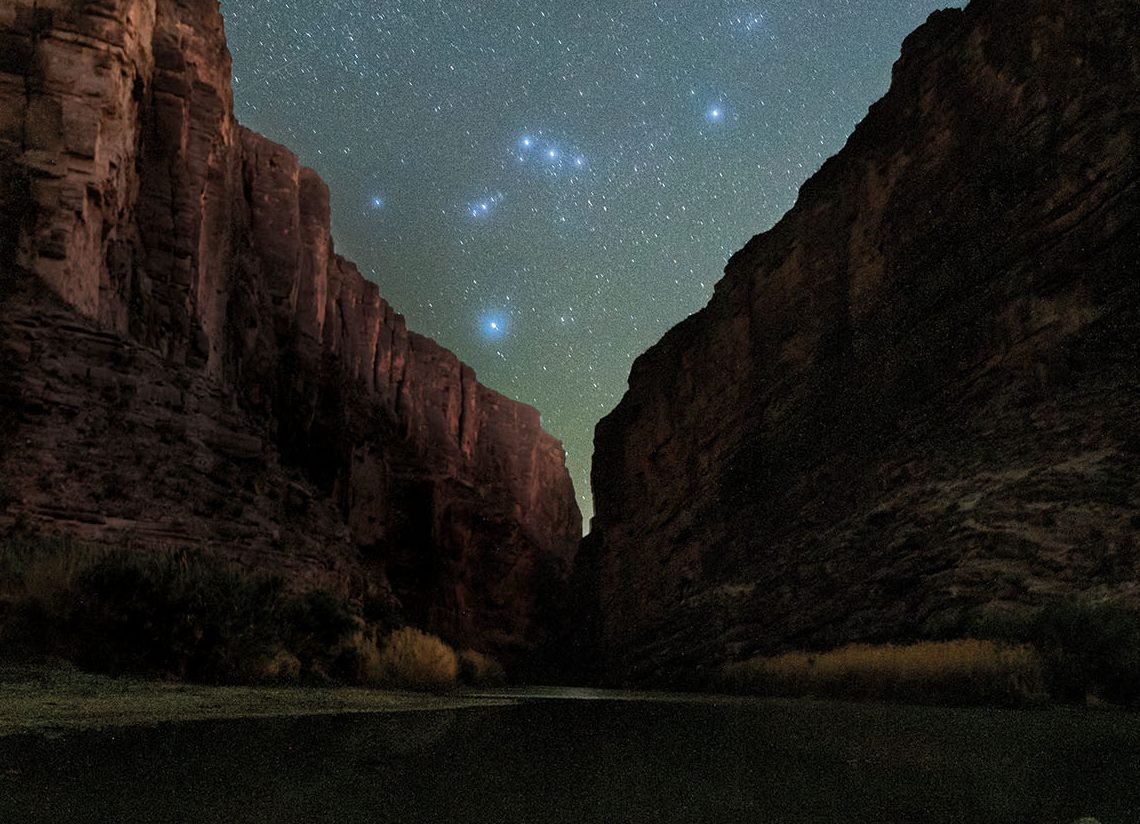
That impression does not survive a visit to Big Bend Ranch State Park, where Texas takes off its glasses, shakes out its hair, and dazzles you. The region spans more than a million acres on the southwestern tip of Texas, and only a small part of that, 300,000 acres or so, makes up the park. After a life in the city, it’s like finding out you’ve been set up with an heiress who has brains and impeccable style.
There’s also Big Bend National Park, the Black Gap Wildlife Management Area, and the Chinati Mountains State Natural Area. Another 1.9 million acres are preserved on the Mexican side as well. Literally as far as you can see, it’s all you can see.
Big Bend is too vast for most to understand on an initial visit, so it has to be broken down into its component parts: the feral burros, the roadrunners and jackrabbits, and the Rio Grande. Look up, and one is dazzled by the immense sky and starry nights. When the sun rises you notice the geological chaos and diverse plant life farther up the mountains.
Standing on the desert bottom, looking up at the top, you see that you’re on an ocean floor. Around 100 million years ago, sharks, mosasaurs, and other marine reptiles that would thrill schoolchildren swam where you’re hiking. When the Western Interior Seaway finished carving up all the formations, the Cretaceous Period began. Plants flowered. Insects pollinated. Continental plates shoved together and made mountains. Dinosaurs roamed where Texans now hike. Big Bend can take hours to get to, but once you get there you’ve traveled tens of millions of years, and there is nothing bigger than time. But yeah, it’s also real beautiful.
BIG DATA
450+
Number of bird species
that have been reported in
Big Bend National Park
1,200
Number of plant species
inside the park. This
includes
60 types of cacti.
1933
Year a bill was passed in
the Texas Legislature establishing
Texas Canyons State Park in Big Bend
560,000+
Visitors per year
that have been reported in
Big Bend National Park
1,200
Number of plant species
inside the park. This
includes
60 types of cacti.
1933
Year a bill was passed in
the Texas Legislature establishing
Texas Canyons State Park in Big Bend
560,000+
Visitors per year
the Texas Legislature establishing
Texas Canyons State Park in Big Bend

560,000+
Visitors per year
CAPITOL GAINS
The actual bigness of the Texas Capitol isn’t measured just by height. True, it surpasses the U.S. Capitol, but it is only the sixth tallest among other state capitols and, at 303 feet tall, is far shorter than the 450-foot-tall edifice next door in Louisiana. Our capitol building does capture the square footage crown at 360,000 square feet, but find me a Texan who feels like bragging about floor space, and I’ll show you someone who needs a hobby.
What is undeniably big about the Texas version is the sheer achievement of its construction. The first cornerstone was laid on Texas Independence Day in 1885, and the building was eventually opened to the public on San Jacinto Day in 1888. It’s almost a miracle that the Italian Renaissance Revival structure overlooking Austin was even erected in the first place; there are not enough people now with the skills necessary to build another one.
The construction of the capitol has more in common with Egyptian pyramids than with the frame-first model: A special rail line was built from the quarry to Austin, where 88 Scottish granite cutters hand-cut giant blocks into massive “Sunset Red” puzzle pieces. More than 1,000 incarcerated and migrant workers turned those hunks of pink granite into the monument to representative democracy that stands today.
“You would have to spend years training all trades involved in how to construct these buildings,” says Tom Marsden, an Austin-based architect. “We have no craftsmen left who build like this. Very few architects who could draw the details properly. Very few engineers who could calculate this type of construction.”
And that’s kind of a big deal.
BIG DATA
14.64′
Height difference between the Texas (302.64 feet)
and U.S. (288 feet) capitol buildings
and U.S. (288 feet) capitol buildings

CAPTURE THE BRAG
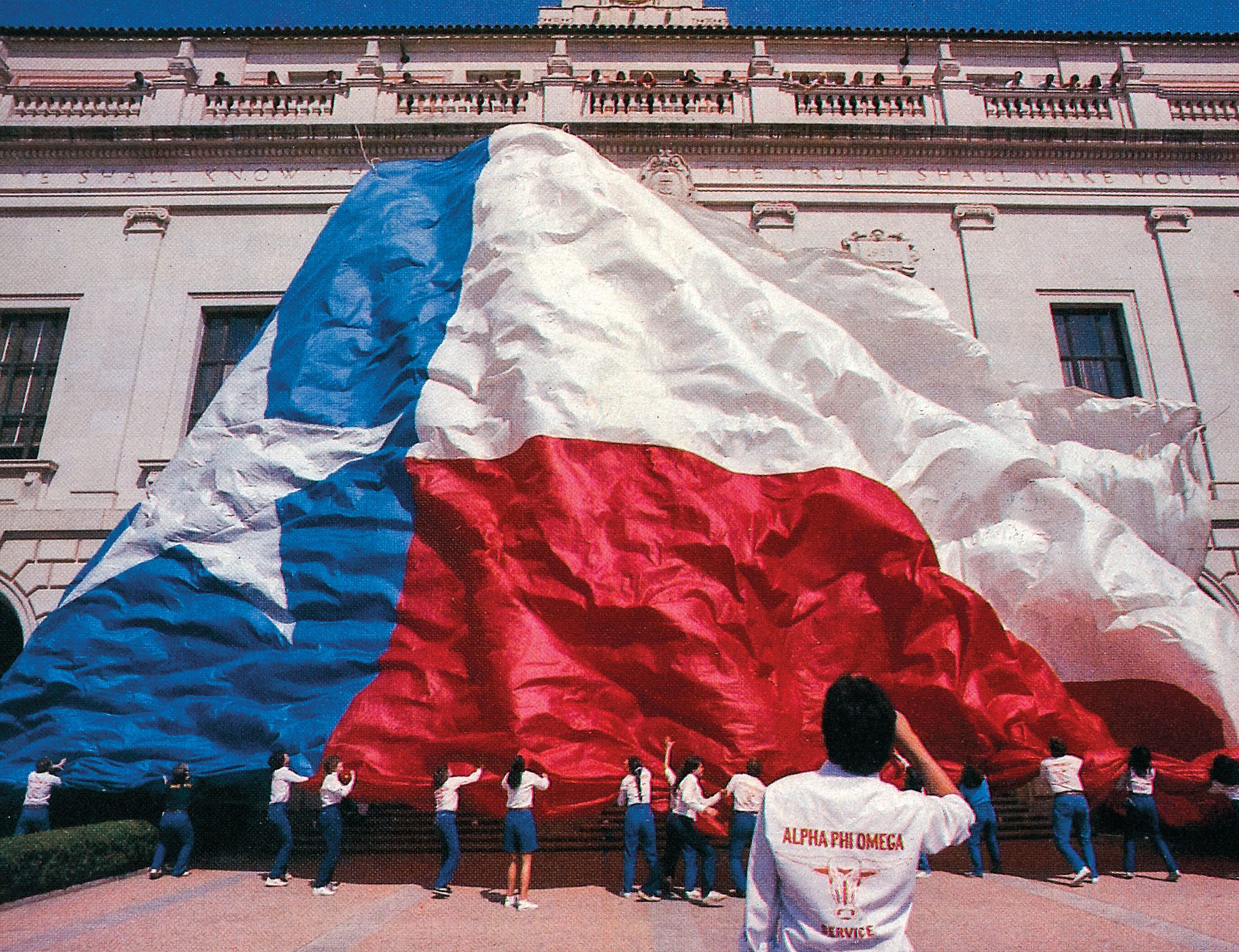
The story goes that Mississippi Gov. Ross Barnett gave Texas Gov. Price Daniel the biggest Texas flag in the world as a token of southern hospitality during the 1962 Cotton Bowl—a grand gesture considering the Longhorns held on to beat Ole Miss 12-7.
First given to the Longhorn Band, it was subsequently surrendered to the men’s athletic department. The following football season, the Alpha Phi Omega co-ed fraternity was asked to “run the flag” at the 1962 Thanksgiving game against Texas A&M. Since then, APO has displayed the flag at halftime at home games and the Red River Shootout, pregame “flag runs,” and pep rallies. In 1977, APO even brought it out during halftime at Kyle Field, instigating a brawl.
The flag that covers Oklahoma’s end zone in Dallas is far from the original flag Burnett gifted in the ’60s. APO has owned eight Texas flags that have grown, like a tall tale, successively more outlandish until reaching its current 100-by-150-foot dimensions. Stored at Darrell K Royal Texas Memorial Stadium, the biggest Texas flag in the world weighs 450 pounds, far more than Justin Blalock, who, at 330 pounds, was one of the heaviest UT football players of all time. Blalock was an All-American lineman on the 2005 team who played in the Rose Bowl. APO showed off the flag at halftime there, too. (UT won, 41-38.)

BALL GAME
BY CAT CARDENAS
It might be hard to imagine now, but it wasn’t that long ago that a quinceañera was a small, intimate affair—a simple family gathering meant to commemorate a young Latina’s transition into womanhood when she turned 15. Though the tradition dates to pre-Columbian times and is celebrated in various ways across Latin America, the modern-day quince in the U.S. first rose to popularity along the Texas-Mexico borderlands in the 1930s and ’40s.
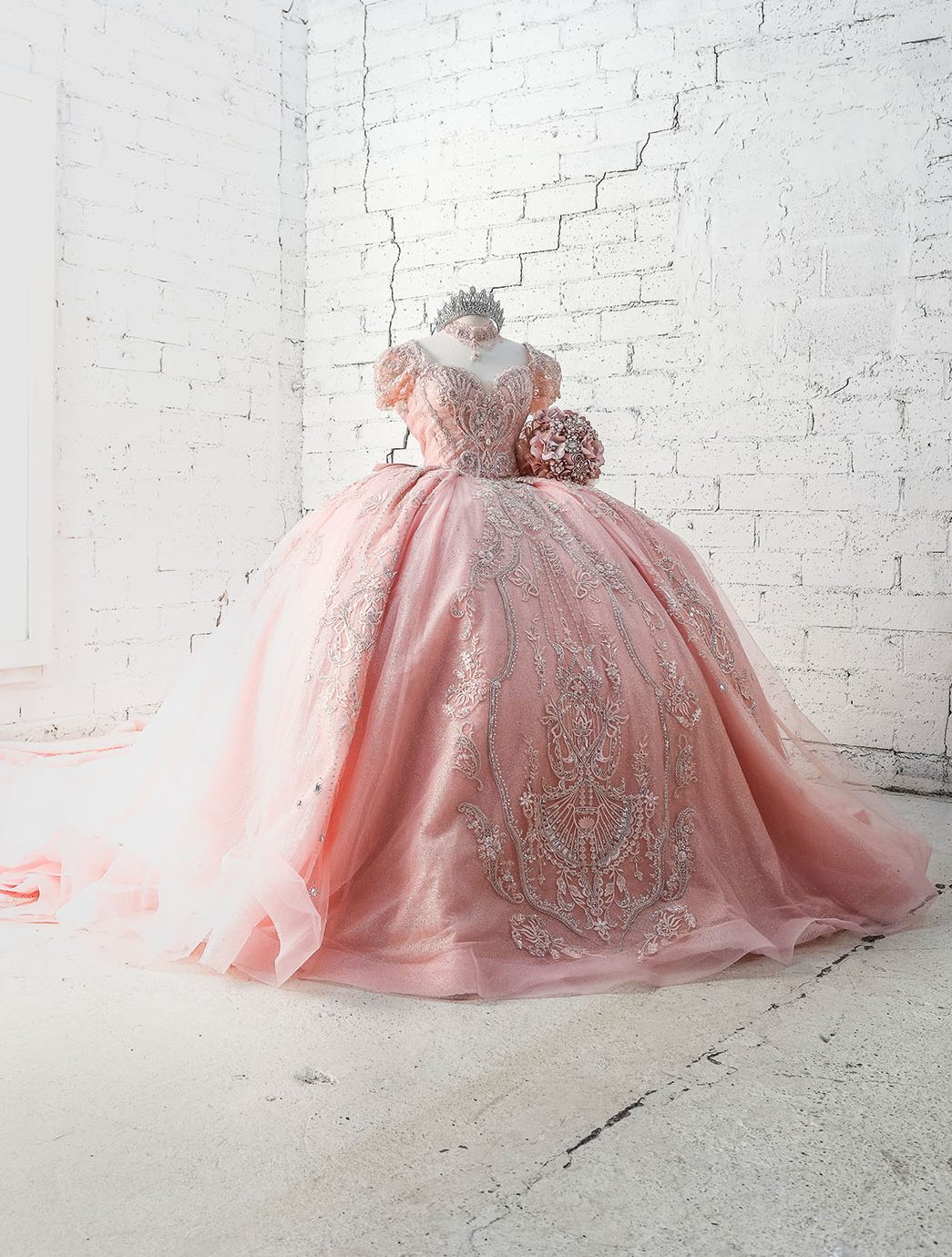
Many quinceañeras have become something closer to a wedding—an over-the-top affair that often includes a theme, hundreds of guests, a court of honor, professional dancers, party buses, photo booths, balloon arches, and live performers—altogether averaging around $20,000, according to a 2019 study by Quinceañera Report. Everything about the event has ballooned in size and cost, including one of the night’s most important elements: the dress.
In the 1940s and ’50s, these dresses were typically pink or white. And while their upper-class counterparts in Latin America opted for more elaborate gowns in the style of Spanish debutantes, Mexican-Americans wore simple, modest designs with minimal accoutrements. Over the following decades, the dresses, like the quinceañera itself, evolved and blended with American culture, reflected in the pastels and puffed sleeves of the ’80s and ’90s.


20-25 YARDS
Amount of fabric necessary for a large skirt

6-8 MONTHS
Amount of time it can take to create a custom dress
More recently, the trend has swung back in the other direction. No longer influenced by prom dresses or evening gowns, quince dresses are something all their own—bigger, bolder, louder exclamations of a young girl’s Hispanic heritage. Today’s dress designers create ball gowns with voluminous crinoline petticoats, glittery tulle skirts, bedazzled bodices, and matching tiaras.
“There’s so much variety now,” says Annette Morales of Ana’s Pro Gowns in Lewisville, about 30 miles north of Dallas. “The simple versions still exist, but in general, the girls who come in are looking for long trains, big skirts, and corset bodices.” Their store carries major designers but also offers fully custom designs. Along with the dresses come packages that include all the necessary accessories: crowns, guest books, Bibles, bouquets, and matching dolls or bears for the traditional gift of the “last doll.” “When girls come in looking for a dress, they want something that feels personal,” Morales says. “The parties have turned into little weddings, so every detail counts.” anasquinceaneragowns.com
TREASURE CHEST
BY DINA GACHMAN
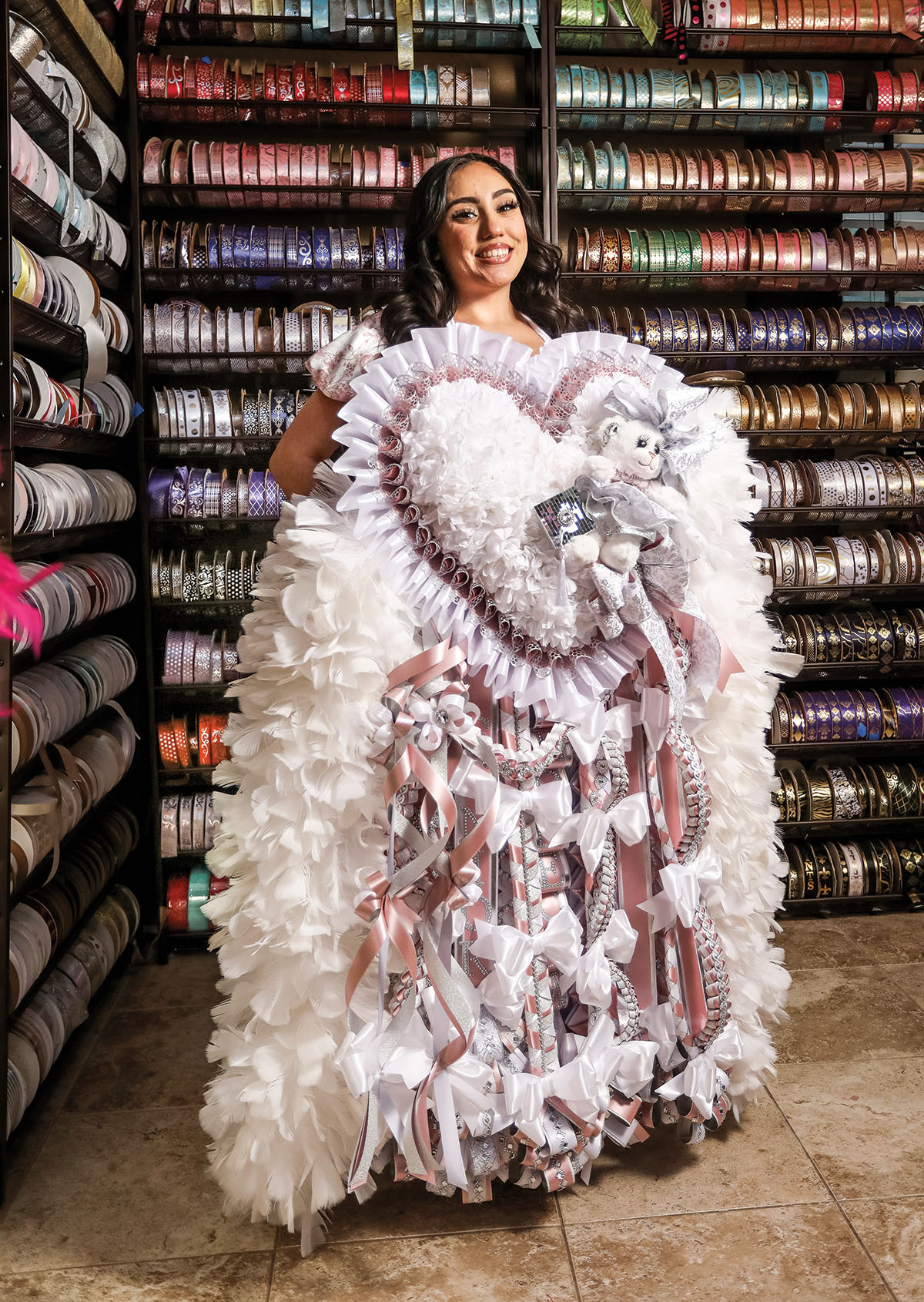
“I’m quite a legend, as I’ve been told,” says Spring-based maker Elizabeth “The Mum Queen” Cleaver. If a high schooler wants a mega mum made with 75 yards of ribbon, diamond dust, boas, and bells, Cleaver will deliver—assuming you place your order ahead of time. Like many mum craftspeople in Texas, Cleaver starts booking up in January for the following fall’s homecoming, making as many as 500 custom mums each year.
“It’s a Texas tradition, and people really believe in it,” she says.
That tradition might’ve started in Missouri in 1911, but it’s since been usurped by Texans, who often “do go overboard,” according to Cleaver. At her studio, a mom once tasked her with creating an extravagant $2,000 version.
“Unless you put actual diamonds on it, that’s hard to do,” she says. The result: a mum so huge that, when the mother carried it out, the only thing visible on her five-foot-four-inch frame was her sandaled feet.
Mums made their Texas debut at the Baylor University homecoming celebration in 1936. Almost nine decades later, our love for these bedazzled mega accessories festooned with teddy bears, glitter, bows, and bling is still the pinned standard of the fall season. themumqueen.com

37.5′
Length of the world record-holding mum created by students at Lewisville High School in 2023
BASIC PRICE RANGE OF A MUM TODAY
$250-$400

CROWN JEWEL
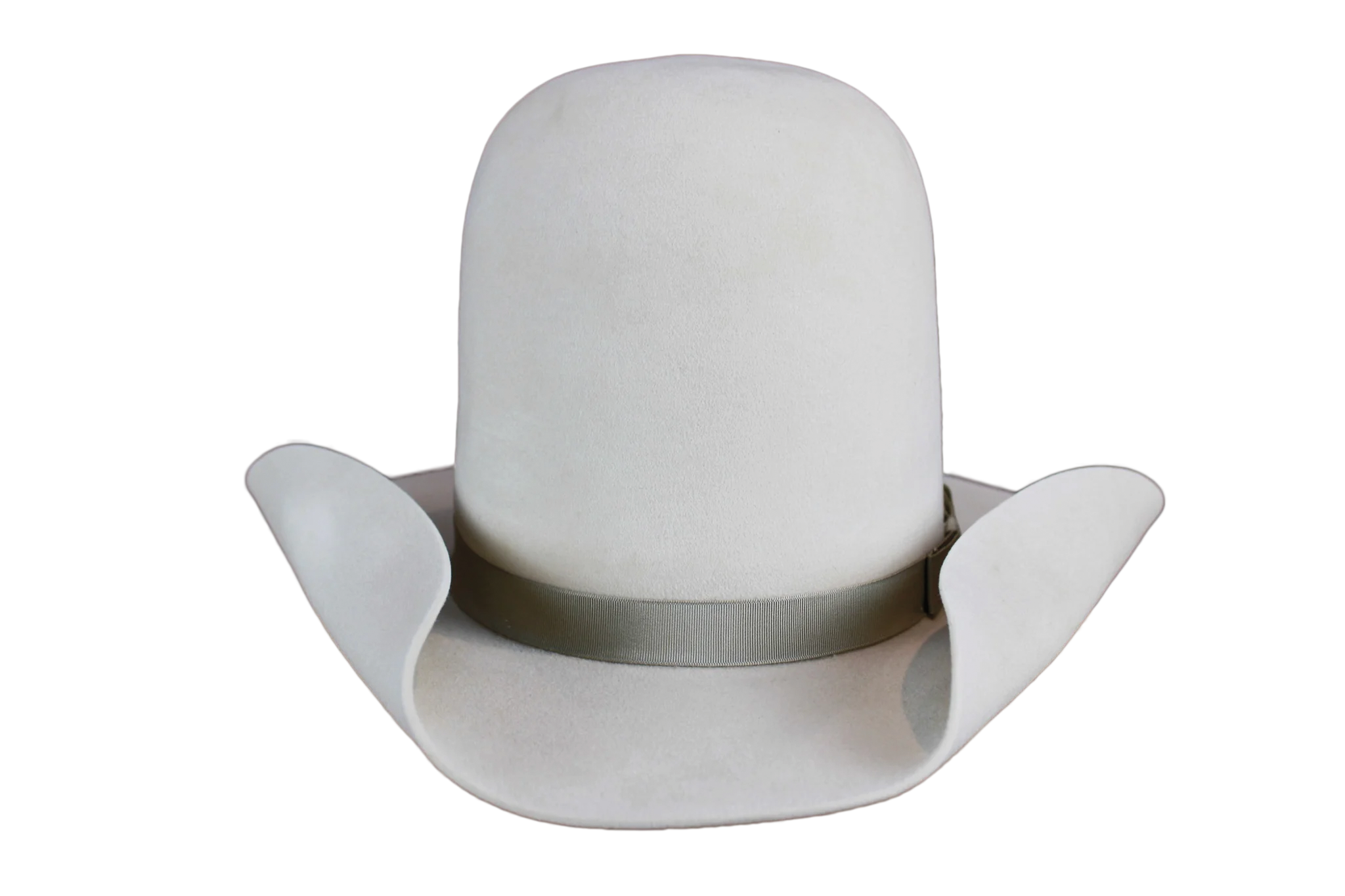
The iconic wide brim and tall crown of the 10-gallon hat can be found everywhere from cattle ranches to dance halls to the neon brown-and-yellow Arby’s sign. Although it’s long been associated with Texas, the hat was created by John B. Stetson in Colorado in 1849. Some say its moniker came from the fact that cowboys would fill their hat with water from creeks to hydrate their horses, but it’s more likely a mispronunciation of the Spanish word “galón,” referring to the braided bands on sombreros worn by vaqueros. It could also come from the phrase “tan galán,” aka “very handsome.”
HOLD UP
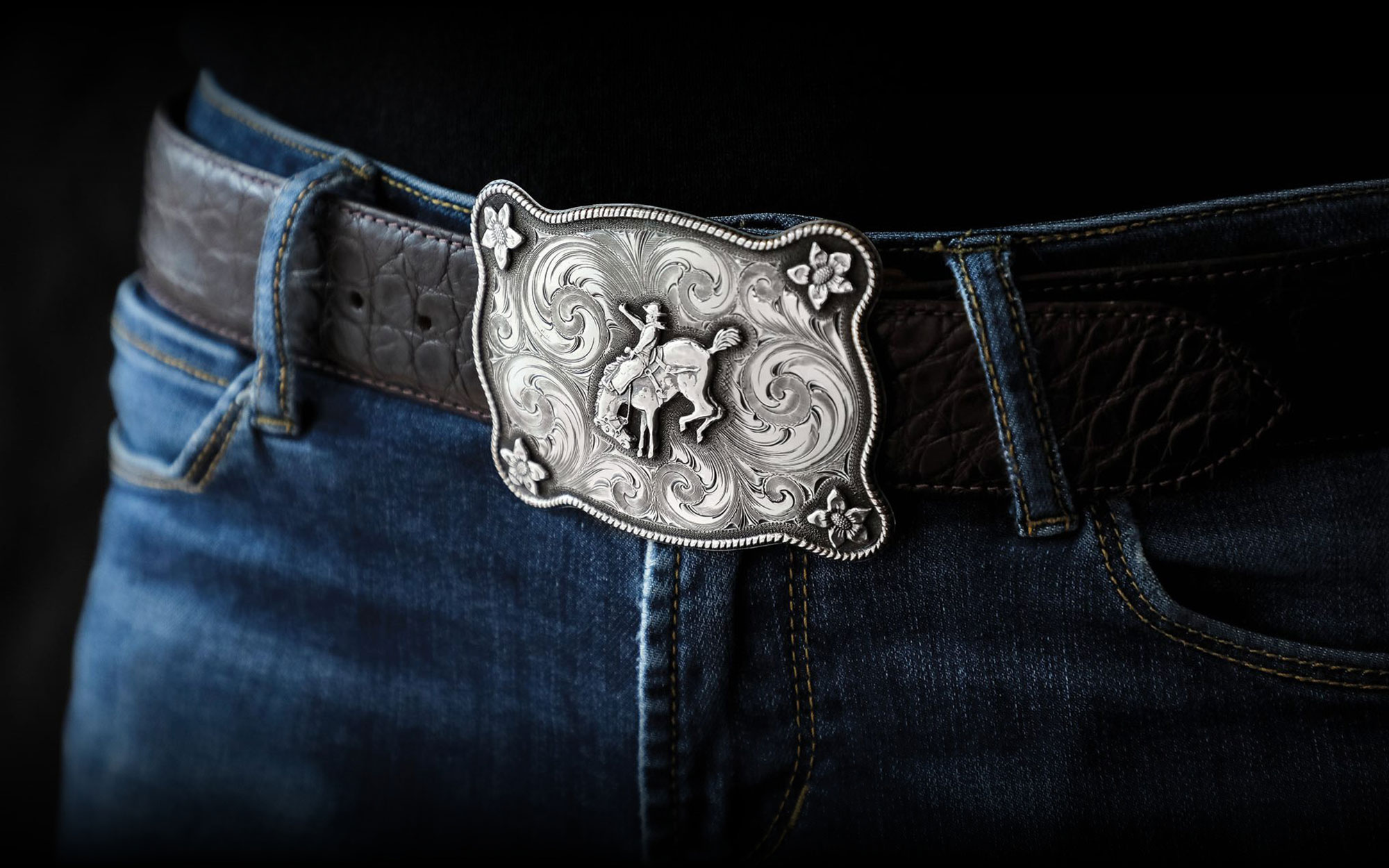
Long before Beyoncé was spotted wearing a bedazzled buffalo belt buckle at the 2024 Christmas Day NFL Halftime Show, these imposing accessories were the pride of vaqueros, Texas Rangers, and rodeo champions across the state. “You used to be able to tell where a man came from by the shape of his hat, and that can go for buckles too,” says Jason Maida, owner of Houston-based Maida’s Belts and Buckles. A fifth-generation leatherworker and antique buckle collector, Maida traces the designs of these pieces back to the engraved armor and swords used by Spanish conquistadors in Texas in the 16th century.
Whether a dream piece is engraved with a family crest or serves as a gleaming barrel racing trophy, one thing’s for certain: Texas buckles are not known for their subtlety. “There’s nobody walking around Texas who says they want their belt buckle to be too small,” says Lance Neirby, CEO of Montana Silversmiths. Neirby’s company might not be local, but it’s beloved by Lone Star residents, mainly because of its custom designs for Taylor Sheridan’s television phenomenon Yellowstone.
Maida says younger generations might think of the traditional buckle as “a big old dinner plate.” The look worked for Western stars like John Wayne, but fashions change. Still, the silversmith loves it when younger customers come into his shop looking for an elaborate buckle like those worn on the big screen or even by their grandparents. “Movies and TV series definitely plug the item back into the charger,” Maida says. “But the buckle will always be part of Texas history. maidasbelts.com

1,000 LBS.
Weight of the Guinness World Record holder crafted by Montana Silversmiths. The engraved 14-foot-wide behemoth was displayed in Dallas in 2021.

HOOK ’EM
BY CHRISTOPHER COLLINS
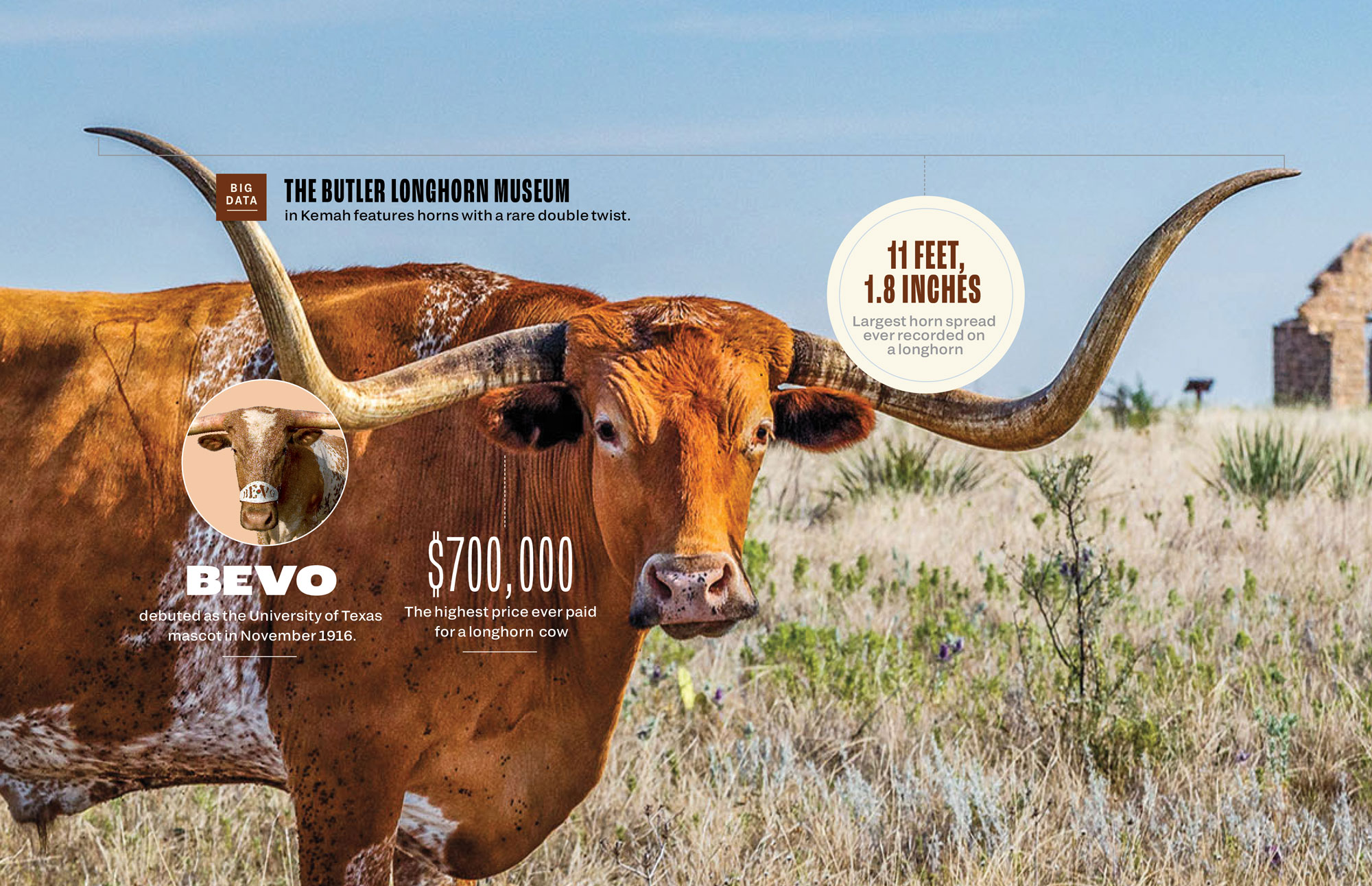
Eight feet long and 10 feet wide. Those are the physics-defying dimensions of a Texas longhorn. This epic gentle giant has been an ambling emblem of independence and stick-to-itiveness since colonial times, long before the Texas Legislature designated it the state’s official large mammal in 1995. The ancestors of today’s longhorns were brought to the state from Spain by explorers and missionaries. Some of the cattle escaped captivity and took to living off the land, roaming wild for decades and becoming better suited for life in Texas. “They had to contend with predatory animals and crazy weather and rugged terrain. And they survived,” says Deborah Davis, the president of Cattlemen’s Texas Longhorn Conservancy. “That long evolution they went through made them smarter and better adapted.”
Despite their hardiness, longhorns were almost wiped out on multiple occasions. Today, only 4,500 head remain. The breed’s first brush with extinction came just after the Civil War, when they were rounded up by the thousands and driven to slaughterhouses in the Midwest. In the late 1800s, livestock breeders began mixing longhorn genetics with other varieties of cattle, such as Angus and Charolais, to create new coat colors and stockier builds.
However, this crossbreeding “dilutes” longhorn DNA to a dangerous degree, Davis says. She commends the work being done at Fort Griffin State Historic Site, where the state’s official herd of 250 Texas Longhorns is kept, preserving genetic purity. They make for a popular tourist attraction as well and even have a role in Albany’s annual Fort Griffin Fandangle stage production.
If you’re wondering why Texans are so enamored with the extraordinary animals, Davis says it’s pretty obvious: “We just love really big, cool horns. When we see them, we stop and gawk. I don’t know why, but we just do.”
FANG TIME
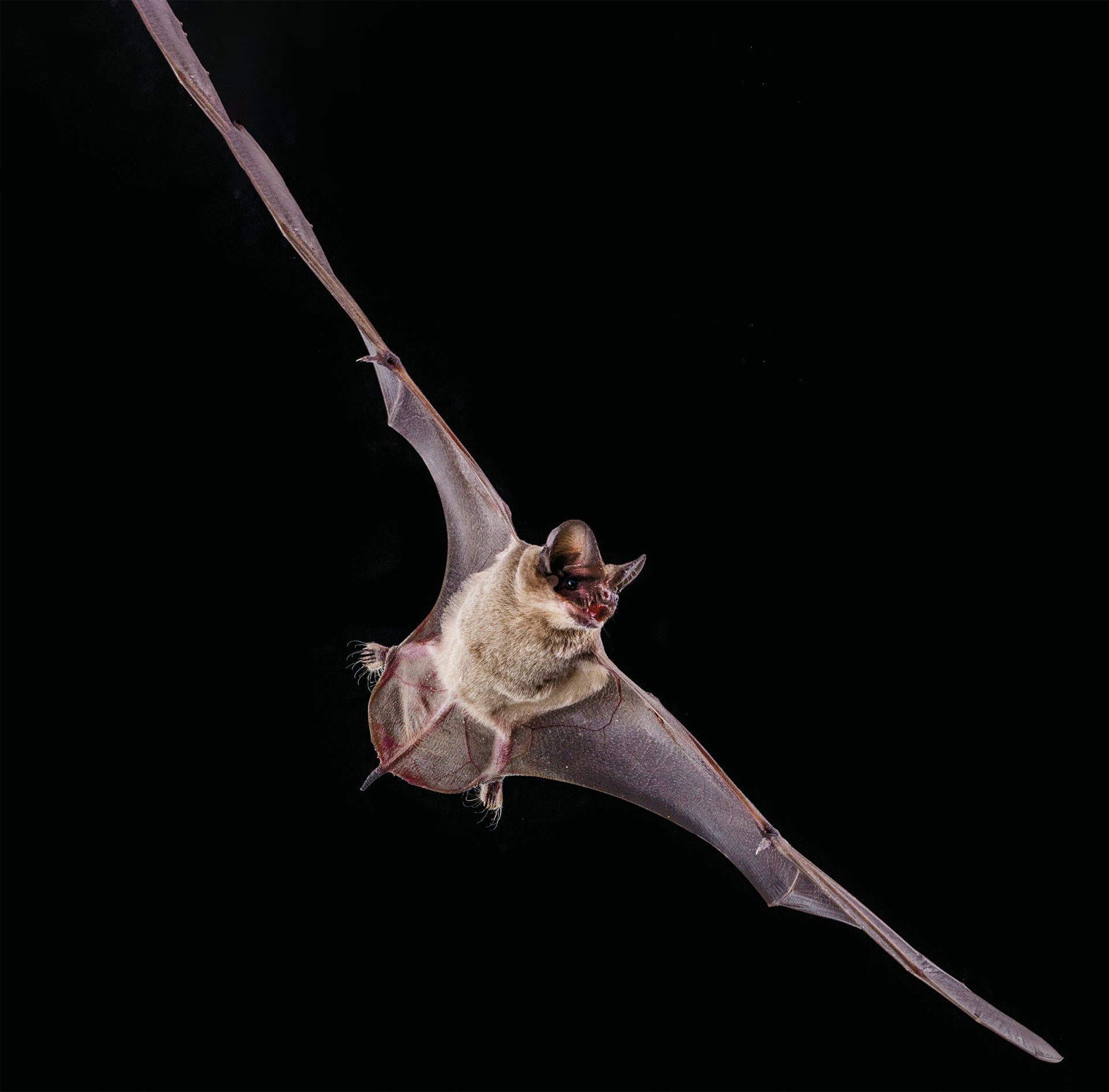
Just north of San Antonio in Comal County, Bracken Cave is home to 15 million Mexican free-tailed bats, making it the site of the world’s biggest bat colony. From May through September, visitors flock to the area to see the nightly emergence of the nocturnal mammals, who fly up to 100 miles away for food. “Around 7:30, you’ll see this swirling vortex—we call it a ‘batnado,’” says Fran Hutchins, director of the Bracken Cave Preserve. “Once they get to treetop level, they start streaming away and it sounds like rain falling.” Of the 32 species of bats that can be found in Texas, the Mexican free-tailed is the most common, spending its winters caving in Mexico and flooding into the Lone Star State come February. Due to its high humidity levels and consistent temperatures—perfect for giving birth and rearing young pups—Bracken Cave has served as a maternity colony for 10,000 years. The five-fingered fliers are a wonder when viewed from afar or from a nearby farm field. The cave, along with the former ranchland that surrounds it, has been owned by Bat Conservation International since 1992. The area was once the proposed site of a 3,500-home subdivision, but a coalition of environmentalists came together to save it from development. Today, what could have been suburbia now offers sublime nature-watching and provides habitat to a host of other critters, including the endangered golden-cheeked warbler. To see the bats take wing on summer nights, become a member of Bat Conservation International for $45. batcon.org
BIG DATA
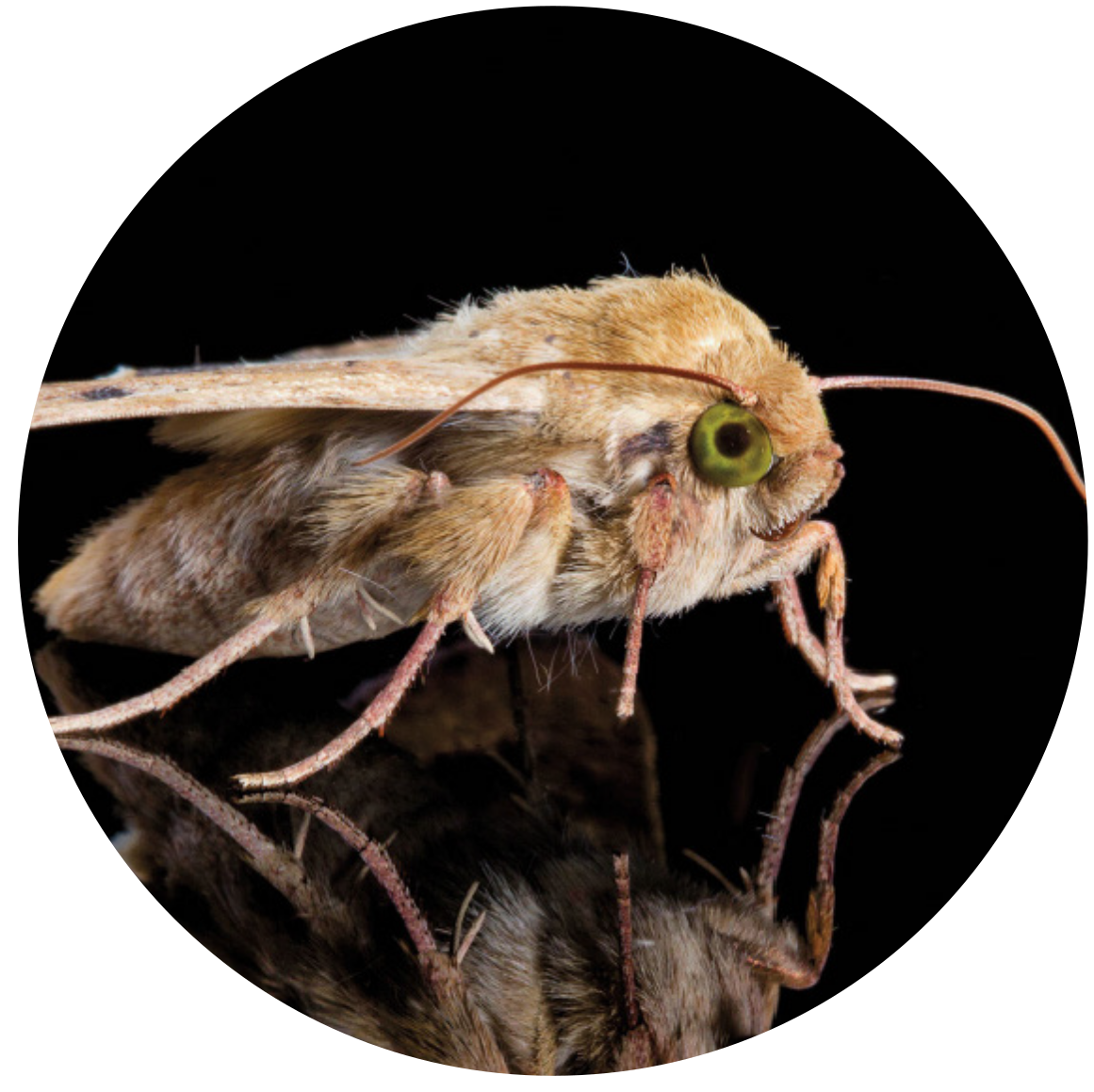
150 TONS
Volume of corn earworm moths, a crop pest, that Bracken’s resident colony consumes each summer night
4
Number of
weeks after birth that baby bats, also called pups, are able to fly
The bats’ emergence from Bracken Cave is dense enough to view by radar.
CHIROTOPHOBIA
The intense fear of bats

The bats’ emergence from Bracken Cave is dense enough to view by radar.
CHIROTOPHOBIA
The intense fear of bats

FOR THE GRAM
AT THE SAN ANTONIO ZOO, even the smallest of animals can make a splash on social media. Virtual zoo visitors can’t seem to get enough of the critters’ slithering, scampering, and sleeping: The charismatic creatures have racked up 9 billion online impressions and helped the zoo amass 6.2 million followers—only 5% of whom live in the greater San Antonio region. The internet sensations can thank Jacob Downing, the zoo’s social media coordinator, for their superstardom. He has a knack for using his camera to capture special moments with a wide spectrum of species; the critters are in turn ambassadors for their brethren in the wild that may face extinction or other conservation concerns. “We have fans from India, all over Europe, Australia,” Downing says. “At the end of the day, it’s cute animals on the internet. Who doesn’t love that?”
Here are just a few of the zoo’s four-legged luminaries.
TIMOTHY: This 10-year-old hippo enjoys cracking watermelons and pumpkins with his powerful jaws almost as much as he loves naps. He shares his enclosure with his best friend, Kevin, a wild duck who is more than happy to clean up any food scraps the hippo leaves behind.
WILSON: You can frequently find this three-banded armadillo on his exercise wheel, where he burns off excess calories from hoovering up heaps of mealworms. The “tactical assault possum,” as one Reddit user referred to Wilson, is so adorable that a video of him sleeping has garnered hundreds of millions of views.
BRUNO: Unlike the infamous Encanto character, San Antonio zoo-goers talk a lot about Bruno. But this one is a 450-pound Aldabra tortoise that crunches cacti and seeks out head-pats like a puppy. His mate Edie, who is estimated to be close to 150 years old, is too old to produce viable eggs. But the recently acquired Agnes, 8, may have more success in yielding a clutch of baby Brunos someday.
BRANCH OUT
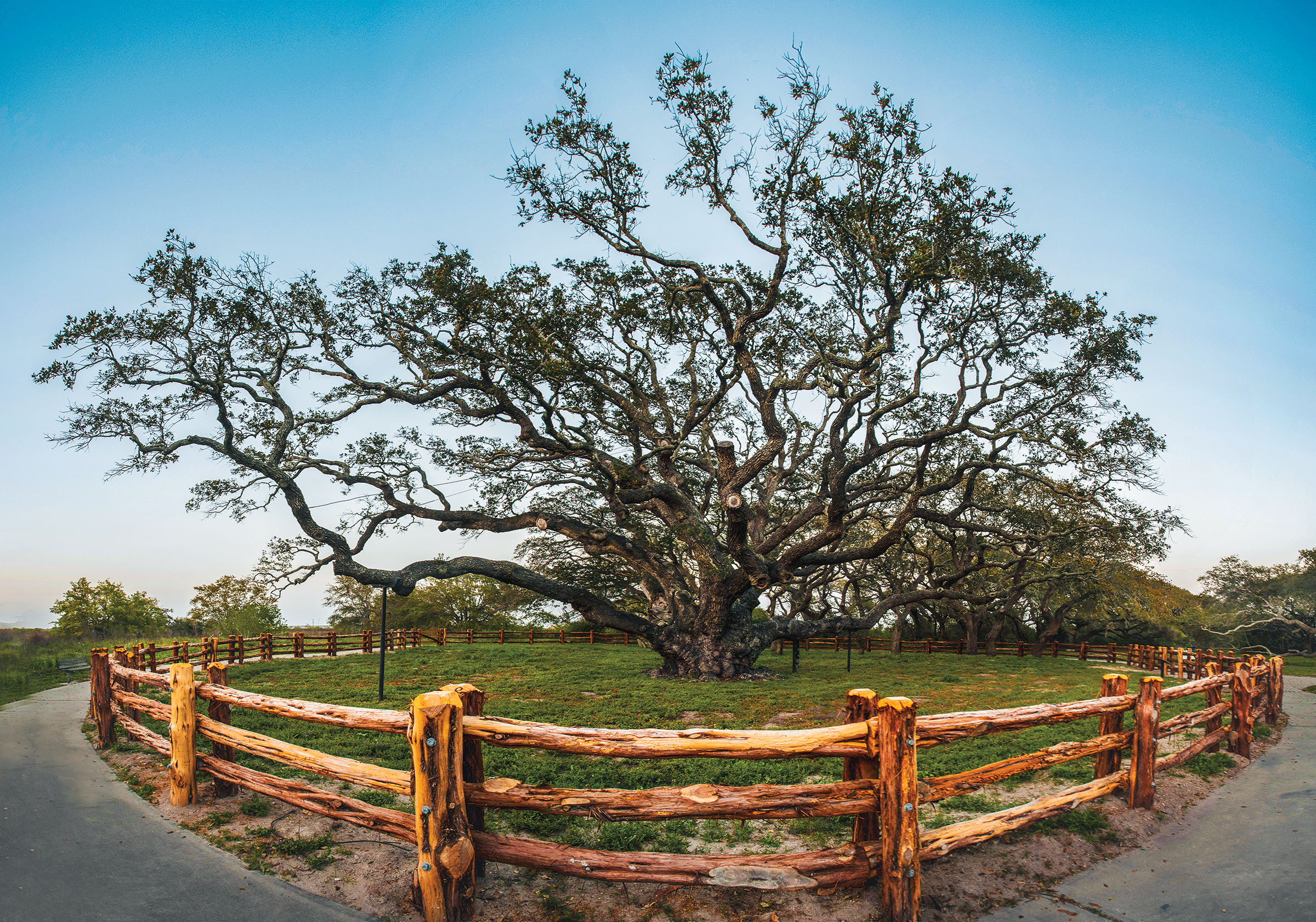
One of the oldest live oaks in the world can be found at Goose Island State Park near Rockport. Known simply as The Big Tree, the arboreal specimen wears a crown of corkscrewing branches that makes for the perfect photo-op backdrop.
Estimated to be more than 1,000 years old, the tree stands 44 feet tall and has a trunk measuring 35 feet around. Speaking to Texas’ penchant for superlatives, The Big Tree isn’t even the largest live oak in the state—that distinction belongs to a tree discovered in Brazoria County in 2003—but it’s a survivor.
The tree has endured between 40 and 50 major hurricanes from its station on the Texas Gulf, not to mention a shelling by the Union Navy during the Civil War: When the smoke cleared, the only things left standing in the town of Lamar were a few houses, a chapel, and The Big Tree.
Today, park officials are doing what they can to keep the specimen thriving for another millennia, including fertilization, chemical applications to shield it from leaf-eating insects, and erecting a cedar fence around the perimeter to safeguard it from vehicular collisions. “Part of our mission is to protect the natural and cultural resources for future generations,” says T.J. Hinojosa, assistant superintendent of Goose Island State Park. “There’s a sense of legacy and wonder in something that’s been able to travel through time and still be a resource today.”

COWBOY UP
BY CHRISTOPHER COLLINS
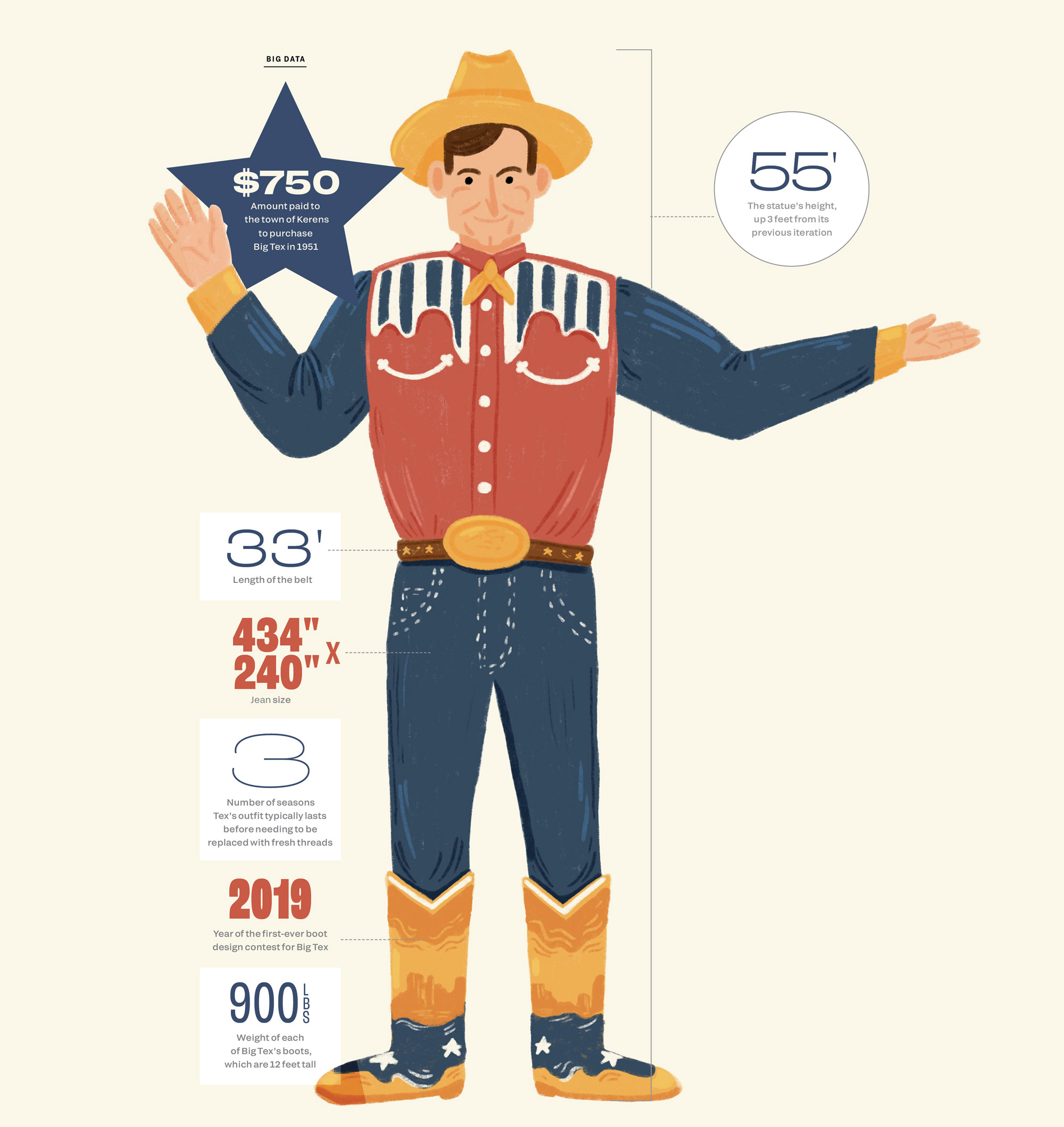
Sure, it may seem glamorous donning a white ascot and Shiner belt buckle and saying “Howdy” to every soul you see. But like the Willie Nelson tune goes: “Mommas, don’t let your babies grow up to be 55-foot-tall animatronic cowboys.” Because heavy is the head that wears the 95-gallon hat. Just ask Big Tex, the timeless face of the State Fair of Texas, who must diligently watch over his flock—for 24 consecutive days in September and October—weathering the elements as folks graze on fried delicacies he’ll never taste. Everyone looks up to this cowboy, yet how many are brave enough to stand in his size-96 Lucchese boots and wave at two-minute intervals with a smile on their face? Few know that Tex took up cowboying as a second career in the 1950s, after working a stint as a giant Santa Claus in East Texas, where he helped drum up sales for local businesses. Tex found new digs in Dallas’ Fair Park in 1952, and after trading his Santa suit for a Canadian tuxedo, he made his grand debut as the fair’s official mascot.
The cowboy’s arrival was a shot in the arm for the state fair, which had been in operation for nearly 70 years before he showed up. Those early, Tex-less years were punctuated with mishaps and calamities, such as a roller coaster accident in 1888 that injured five people. In 1891, a fire broke out in the fair’s racing stables, killing 12 horses; and during the fair in 1900, a bombastic fireworks show caused the grandstand to collapse, prompting lawsuits. Tex himself met with misfortune in 2012, after a speaker wire shorted out in his chest, causing a fire that engulfed his body and scorched him to his silicone flesh and steel mesh armature. But Big Tex was back in action the next season, placed back on the rotunda with only 36 hours to spare. The fair set an attendance record of nearly 2.4 million people in 2024—a feat achieved by those below, with a little help from the man above.
Illustration by James Yates
CLASH OF THE TITANS
Everything’s also taller in Texas. Our state is teeming with larger-than-life landmarks that rub elbows with clouds and share air with the likes of doves and drones. Many of them are magnets for awestruck tourists, who show up in droves, craning their necks and squinting for a better view. Some are modeled after people, such as Huntsville’s monument to statesman Sam Houston, while others take after animals, like Paisano Pete, Fort Stockton’s beloved fiberglass roadrunner. Sugar Land’s Statue of Union—which was unveiled at the Sri Ashtalakshmi Temple in 2024 and depicts the half-man, half-monkey deity Lord Hanuman—combines the best of both worlds. Some travelers celebrate these towering landmarks as elevated art; others simply drive on by, considering them to be nothing more than vertically inclined kitsch. But you should appreciate the perspective they impart: People need reminding that there’s something bigger than them out there. And here in Texas, something bigger is just down the road.
Illustration by James Yates

PIES THE LIMIT
BY BRANDON WATSON
Dozens of apple pies draped with flaky handmade crusts, lemon versions crowned with swirled whipped topping, and cocoa-dusted chocolate pies are stacked on steel racks behind the refrigerated case at Blue Bonnet Cafe in Marble Falls. Rows of others—fudge, peanut butter cream, and coconut meringue—sit on white stoneware plates, just waiting to dazzle their many fans. These impressive pastries won’t have to wait long because, like clockwork, they’ll be wiped out before the almost-century-old café closes its glass doors at 8 p.m.
Co-owner Lindsay Plante proudly boasts of her family’s legacy with a sign outside that says: “Pie Until I Die.” In the last year alone, her café’s six dedicated bakers produced an astonishing 58,000 to keep up with demand. Each has acolytes, but the bestselling coconut, chocolate, and banana cream pies have developed a cult following that requires cracking hundreds of thousands of eggs. Even though many of those eggs inevitably make their way into omelets and other breakfast offerings, Plante estimates Blue Bonnet uses around 168,000 each year for pie-making alone.
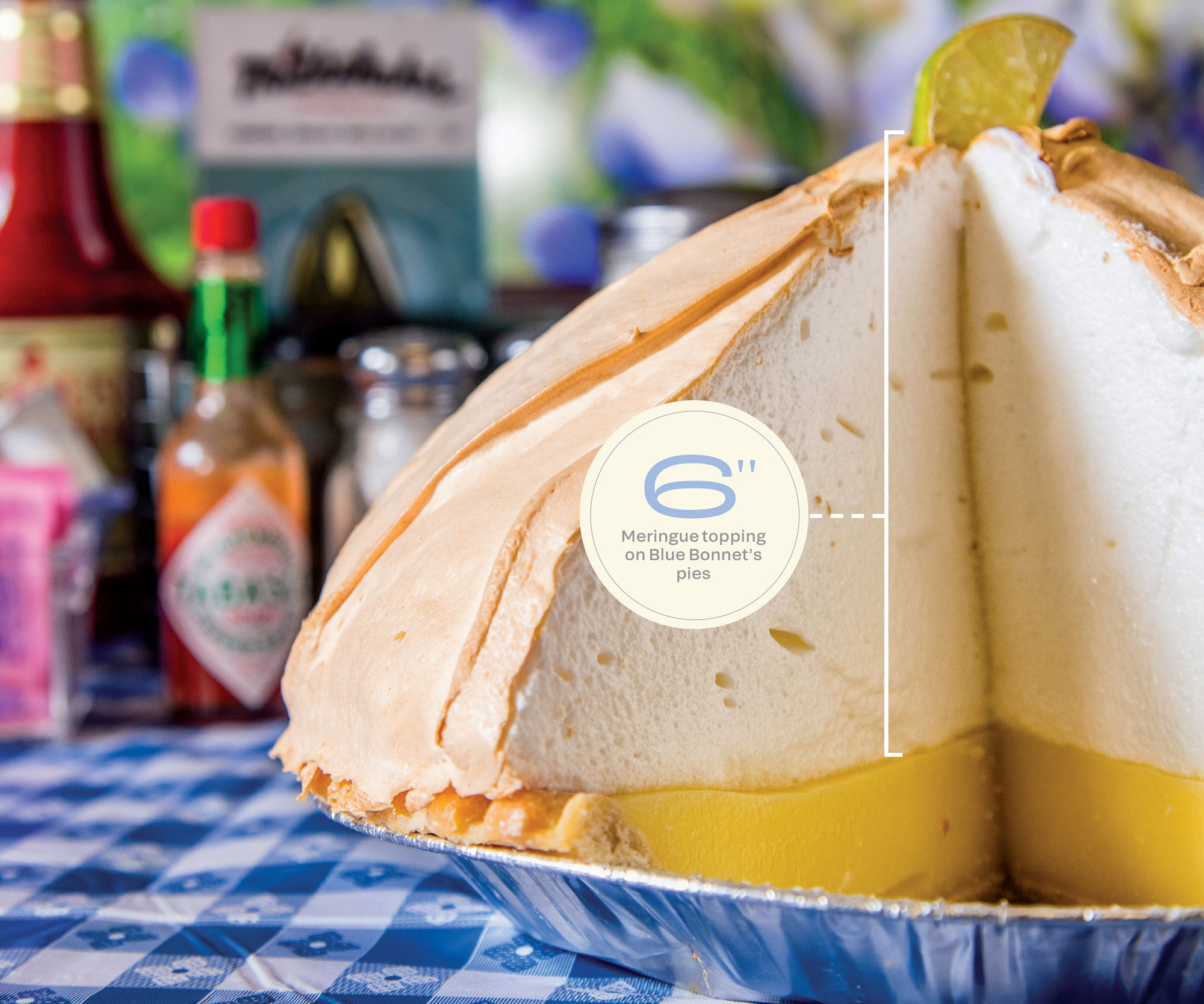
And it’s not just the sales volume that elicits eye-popping reactions. Blue Bonnet also aims high with the pies themselves. Though the bakers keep the diameters standard, they build the meringues to mountainous points, with each snowy peak reaching 6 inches. These architectural masterpieces require a practiced hand, particularly in the vexing Central Texas humidity. To start, the veteran staff utilizes a proprietary meringue powder to ensure a weep-less pie that can stand up to a scorching Marble Falls summer. Then, before baking, they pile on generous scoops of the fluff, sculpting it into tall domes.
“They’ve been doing it for so long that they are lightning fast,” Plante says of her spatula-wielding team. “They almost make it look easy.”
Keeping up with the demand requires a breakneck pace, despite a priority list that also includes scratch-made biscuits, cinnamon rolls, doughnuts, and cornbread. Luckily, Plante counts on bakers who have been around since her parents ran the operation starting in 1981. John and Belinda Kemper passed down those recipes to their daughter and her loyal team, so decades-long regulars never saw a drop in quality. And that kind of consistency and longevity is even more remarkable than a banana cream pie with Everest-like summits.
BIG DATA

185
Number of yolks in a batch of 48 custard pies
3,600
Amount of pies sold during Thanksgiving week
41,586 LBS
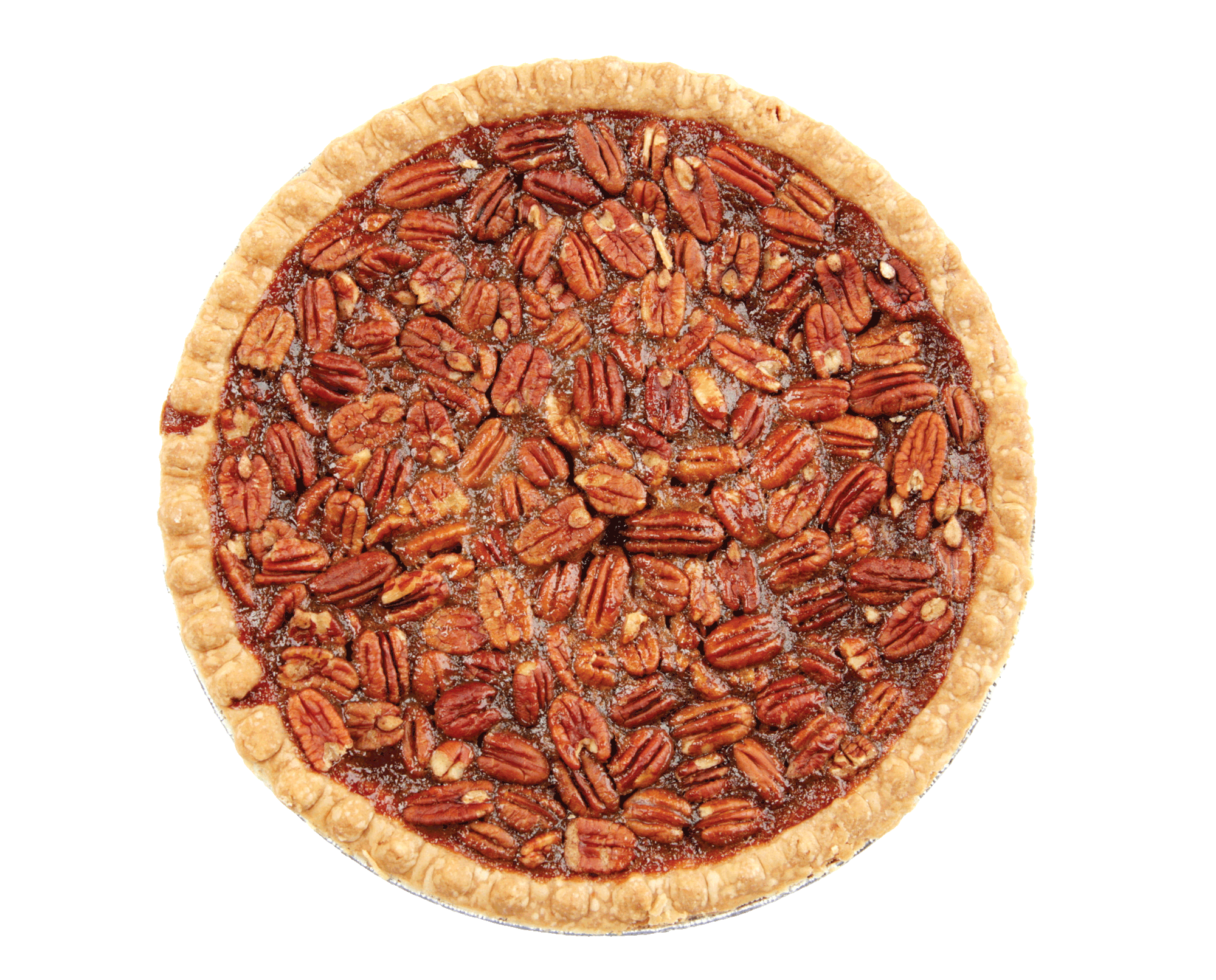
Weight of the Guinness World Record-holding pecan pie, which was baked by the El Paso Diablos Baseball Club in 1999
41,586 LBS
Weight of the Guinness World Record-holding pecan pie, which was baked by the El Paso Diablos Baseball Club in 1999
STEAK HOLDER
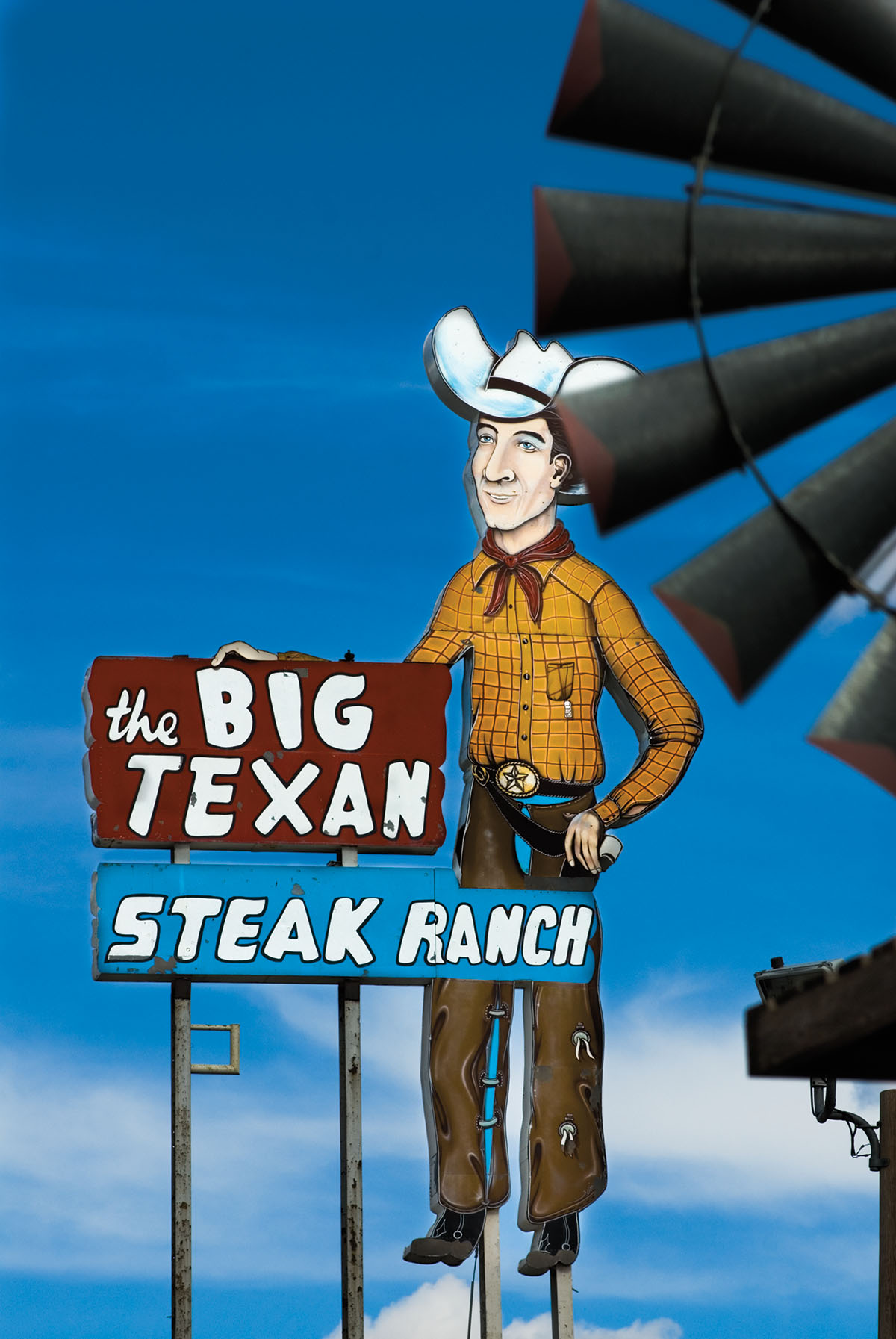
Looking for a way to blow off steam after a grueling day, Amarillo cowhands in the 1960s gathered at the Big Texan Steak Ranch for beef-consuming showdowns. Ever vigilant, founder R.J. Lee watched these exhibitions of insatiable appetites and saw an opportunity as enormous as the restaurant’s 60-foot neon cowboy sign.
“When Big Texan first opened, grandpa noticed a bunch of ranchers coming in after working in the field who would compete to see who could eat the most 1-pound steaks in an hour,” says third-generation owner Jordan Lee.
Eight months after opening its doors, the steakhouse hosted its first 72-ounce steak challenge. Lee’s rules were simple: Customers had 60 minutes to devour a slab of beef—accompanied by a baked potato, a salad, shrimp cocktail, and a buttered roll—or pay the $9.72 price tag.
Soon, word spread among travelers on Route 66 looking for a novel dining experience. By the time the restaurant moved to the outskirts of Amarillo in 1971, the challenge was part of Texas lore. The gut-busting feast now costs $72, but the Lee family hasn’t tinkered much with the winning formula in 65 years.
Since a 2008 episode of Man vs. Food, the restaurant has been an essential stop on the competitive eating circuit. Few, however, are up to the task. Of the 2,100 diners who attempted the challenge in 2024, only one in 10 gained a spot on the wall of fame.
Still, Lee doesn’t want that to discourage folks from grabbing a fork and knife. He notes that women have a 50-50 success rate. In fact, the current record was set by Molly Schuyler, who bested Joey Chestnut, the 16-time Nathan’s Hot Dog Eating Contest champion. Unfazed by her accomplishment, Schuyler celebrated her victory with another steak to cap off the evening.
HUNGER GAMES
Mere mortals might want to bring a crowd—and maybe a forklift—for these other eating challenges
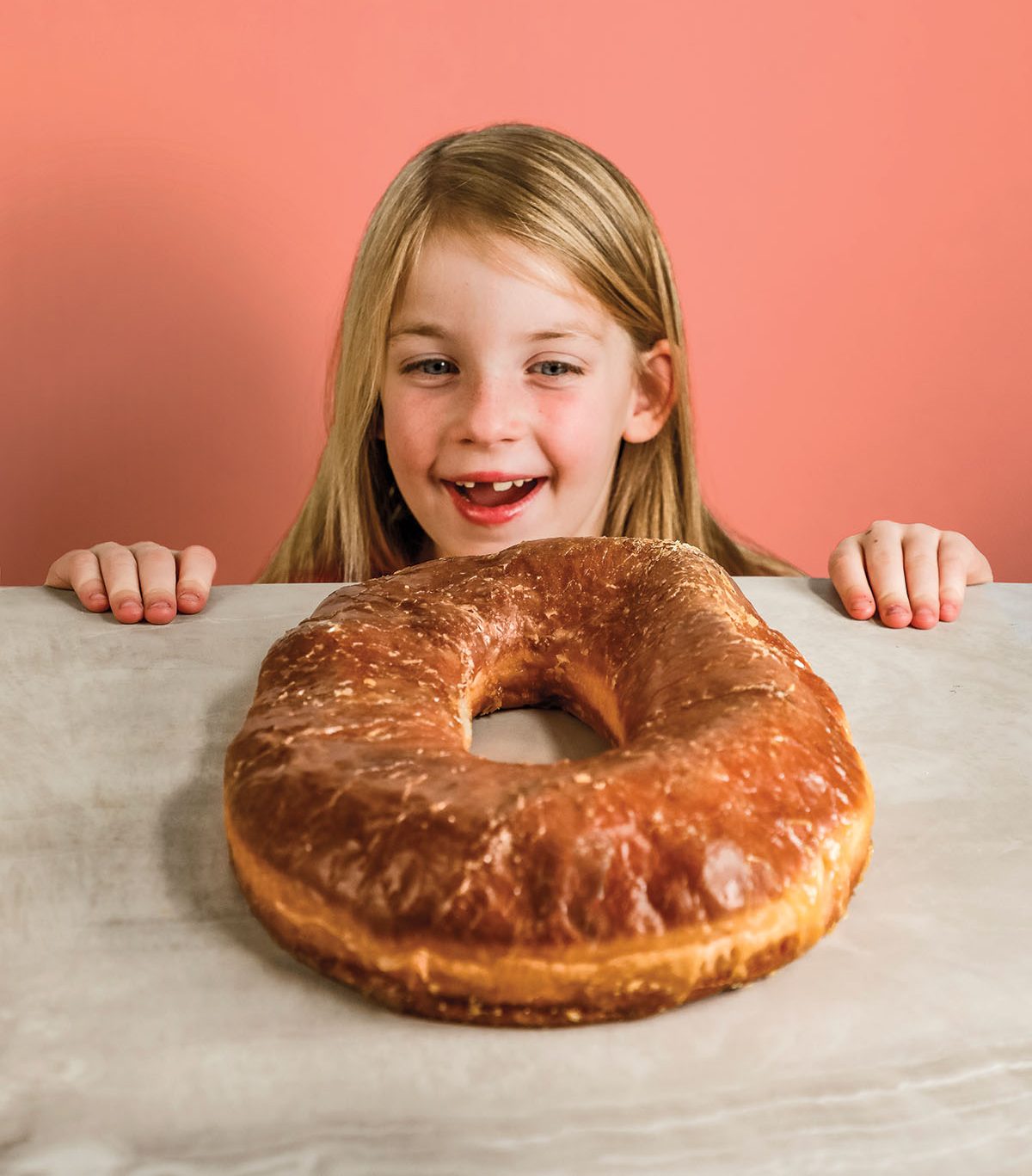
Texas-Size Donut at Round Rock Donuts
Round Rock and Cedar Park
This orange whopper of a glazed pastry, tinted with food coloring to mimic the shade of an egg yolk, clocks in at 2 pounds and 14 inches. The donut was first introduced as a novelty in the early ’40s when the shop was still known as Lone Star Bakery.
The Zellagabetsky at Kenny & Ziggy’s
Houston
If Dagwood Bumstead’s comic sandwiches came to life, they might look like this 4-pound, eight-layer behemoth. Those who conquer every tier of Swiss cheese, pastrami, corned beef, tongue, turkey, and salami, score a free slice of cheesecake. At that point, what’s a few extra calories?
Chicken-Fried Steak at The Wagon Wheel
Eagle Pass
Some chicken-fried steaks approach the edges of a dinner plate—owner Selena Buentello Price’s version encompasses a large pizza platter. The more than 2-pound stunner is breaded, fried crisp, and doused with a ladle full of white gravy.
Big Lou’s 62 at Big Lou’s Pizza
San Antonio
This pizzeria’s 62-inch pie, available by special order, makes its other massive specimen (42 inches) look like something out of the pee-wee leagues. Topped with 88 ounces of sauce and 16 pounds of shredded cheese, the mammoth iteration requires custom-made tools and several servers to deliver it to the table.
Giant Cinnamon Roll at Green Vegetarian Cuisine
San Antonio
Chris Behrend came to oversize eats by birthright. His mother, Lulu Singleton, was a household name in San Antonio for making a massive 3.5-pound cinnamon roll. Lulu’s bakery closed a few years back, but the pastry lives on at her son’s restaurant, which debuted in 2007.
Giant Torta at Tacos Locos
San Angelo
Call ahead for this humongous sandwich filled with
5 pounds of meats like
steak and chorizo, as well
as cheese, lettuce, and tomatoes. Be warned: The torta is also liberally slathered in crema. A family-sized roll of paper towels should do the trick.

ABOVE THE RIM
BY BRYAN C. PARKER
When San Antonio Spurs all-star Victor Wembanyama stretches out to block a shot, it recalls the arm of God in Michelangelo’s classic painting, The Creation of Adam. With his awe-inspiring physique, Wemby as savior isn’t that far-fetched. “He just gives people a sense of hope that their team is represented and has potential to get back to the pinnacle of basketball,” says Spurs CEO R.C. Buford.
The 21-year-old phenom has breathed new life into the city of San Antonio while becoming the next face of the NBA. On his way to winning Rookie of the Year by a unanimous vote in 2024, Wemby led the league in blocks and posted 21.4 points and 10.6 rebounds per game. His arrival propelled the Spurs’ average home game attendance from 27th in the league in 2022 to 17th last year as fans flocked to the Frost Bank Center.
He may be French, but Wemby’s outsize presence feels right at home in Texas. At 7 feet, 3.5 inches, his height does more than just provide an advantage on the court. That towering frame pokes through the clouds of culture in a way that transcends basketball, making him an international icon poised to fill the enormous shoes of global sports symbols like LeBron James and Shohei Ohtani.
Despite the buzz, Wemby has a quiet power that echoes previous Spurs greats like Tim Duncan and fits the ethos of San Antonio—a franchise that emphasizes hard work and humility over Los Angeles flash. How did the global superstar spend time when the Spurs visited New York City to face the Knicks? Playing chess in Washington Square Park. Thoughtful and studious, Wemby also loves building Lego sets and reading The Lord of the Rings.
Impressively down-to-earth for a guy so lofty, his personality has endeared him to the San Antonio community. In September 2023, the up-and-coming center even showed up to dine at a local Tacos al Carbón Cabrón, where a giant fiesta-colored mural depicts him chowing down on Mexican fare. The local artist behind it, Alan Calvo, has painted murals in town since 2010—including four of the beloved baller. “People are more Spurs-patriotic now,” he says. “You see more people at games, buying more jerseys, and it’s cool to see that revival of Spurs love again.”


CROWNING
GLORY
BY PAULA MEJÍA
Roughly halfway through a tense football game against Georgia last fall, a University of Texas at Austin student named Grant Walther (below) became an unwitting ambassador of a storied (and soaring) standard of beauty. When an ESPN camera crew briefly showed Walther on the televised broadcast, the image went viral—not because of the stoic expression on his face, but rather for the 20-year-old’s abundant coif. The internet swiftly transformed Walther into a meme, dubbing him “Texas hair guy.”
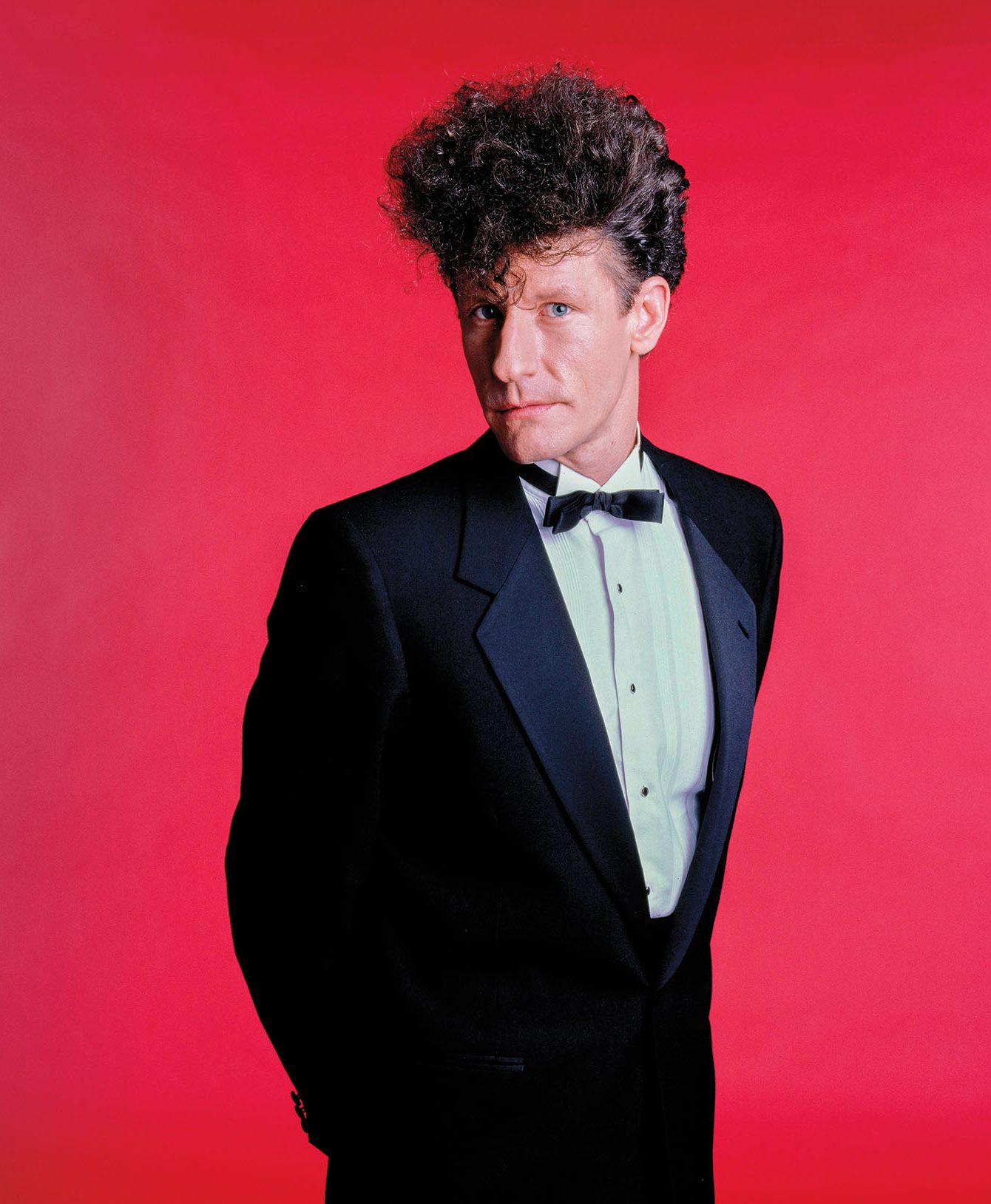
Given that hirsute habits no longer dominate popular culture the way they did in midcentury America, Walther’s moment in the spotlight might seem like an anomaly. But not in Texas. If anything, the passage of time has transformed a bold aesthetic preference for voluminous hair into a Lone Star State lifestyle exemplified by the likes of musician Lyle Lovett and late Gov. Ann Richards.
“THE HIGHER THE HAIR,
THE CLOSER TO GOD.”
Dolly Parton is credited with
coining the phrase back in the ’60s.



Yet big hair looks a little different these days from the stiff, helmetesque ’dos of decades past, says Kevin Ozowski, a stylist at Tangerine Salon in Dallas. Although Ozowski says some of his older clients tend to take a more traditional approach, a modern look with more layers, movement, and bounce is now in vogue. The hairstylist and Dallas-based drag queen Tasha Kohl has also seen the trend moving toward “big waves,” which she believes nods to another hair icon of yesteryear: actress and Corpus Christi native Farrah Fawcett (below).
Some things about the trend have remained constant, though. “You basically go in and just tease, tease, spray, spray, spray,” says Kohl, who first began building her hair to astronomic heights back in the 1980s as a means of accentuating her figure. These gravity-defying tresses also continue to test the amount of hairspray humans can possibly apply to a single head of hair. By Ozowski’s estimation, his clients on the Dallas Cowboys Cheerleaders use half a can of hairspray on game day, as they continuously restyle their coifs. This ensures those sitting in the nosebleeds can still see their hair standing tall and mighty.

$600
The high mark of what a cut
and color complete with big hair styling
will cost you in Dallas
10
Cans of hairspray that
Ozwoski’s salon goes through in
a typical week

Ozwoski’s salon goes through in
a typical week