
Growing up, my father’s records were like siblings. I competed with them for his attention, if not his affection. When I left for college, they moved into my old room and eventually every room in my parents’ house in Abilene.
My father, Joe, began to mail newspaper clippings to me about children who didn’t understand the worth of their dead parents’ record collections, selling everything for a song. Or worse, debauching the albums in a yard sale where the vinyl would be exposed to direct sunlight—the horror! While my father worried about what I might do to his near-mint condition Velvet Underground LP with the Andy Warhol banana sticker still intact, I had my own worries. How would I go through his approximately 20,000 LPs and 45s if he were to die before doing it himself ?
Now I’m middle-aged and my father is old, though still in stubborn good health. My parents have lived in the same three-bedroom bungalow in Abilene since I was born, but this year, after much handwringing, they’ve decided to move to Austin to be nearer to family.
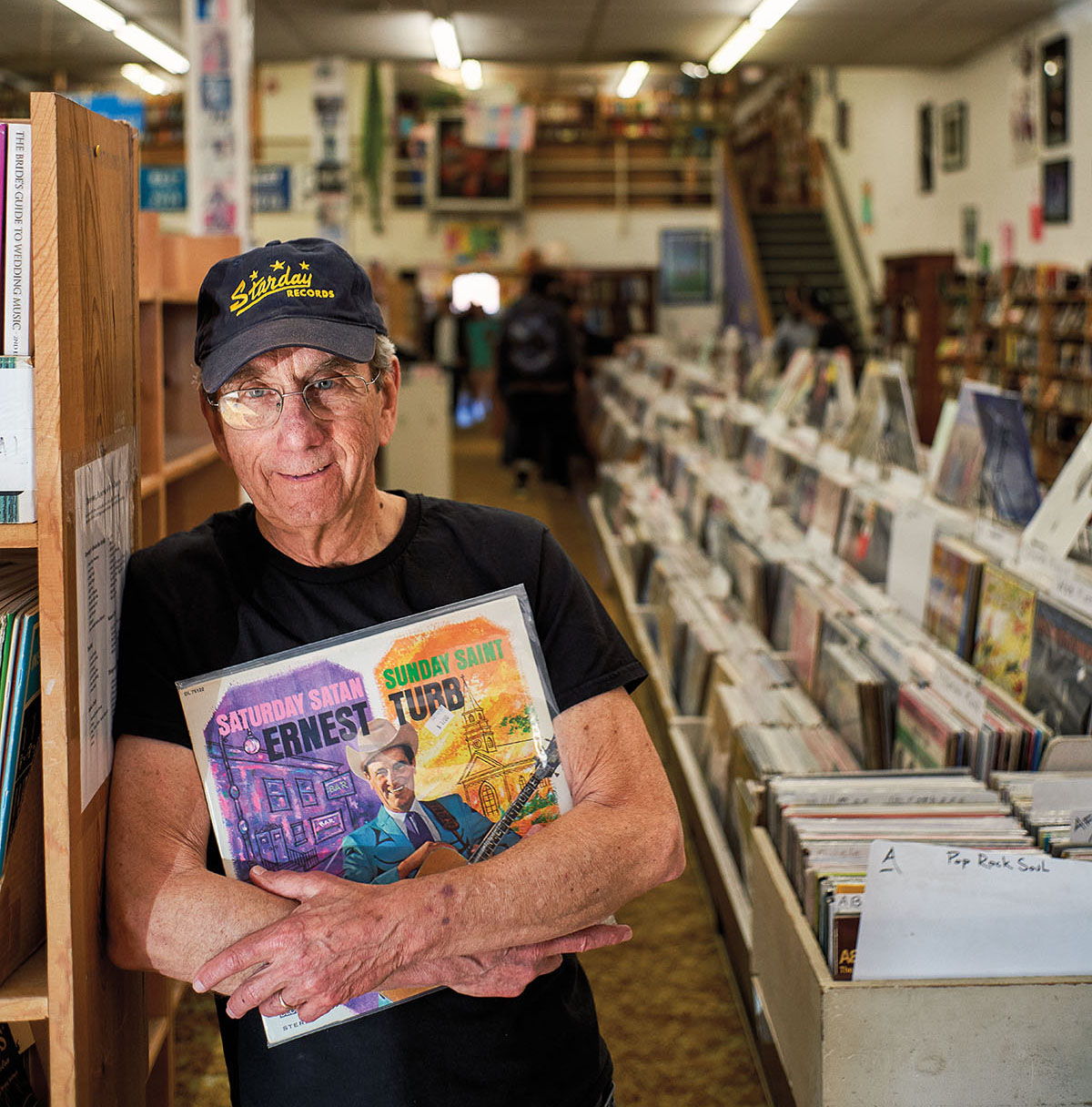
It’s time for the dreaded down-sizing of the collection, and my father has been getting on with it. He’s keeping a few things and giving others to me or friends as far away as Sweden. Some albums will be donated. He’s giving a chunk to Rice University for its Houston Folk Music and Houston Blues Museum archives. He’s also slowly selling the majority to his old friend Don Foster, aka Uncle Don, owner of Recycled Books Records CDs in Denton square. Since 1983, Uncle Don has created a haven for the generalist as well as the specialist, the literary curious, and the musically inclined.
I’m heading there today in my dad’s Honda Accord stuffed full with boxes of rockabilly 45s. We park, and I notice how downtown has changed. Decades ago, my grandfather managed a Duke & Ayres dime store on one side of the square and my aunt married into a family that ran a clothing store on the southeast corner. When I was a kid, my cousin and I terrorized the derelict antiques and junk stores. Now there are gastropubs serving cheese boards and coffee shops that are actually good. I stop into the phantasmagoric Atomic Candy to buy a chocolate Hermione wand for my kid and More Fun Comics & Games for a couple graphic novels.
 Enjoying this article?
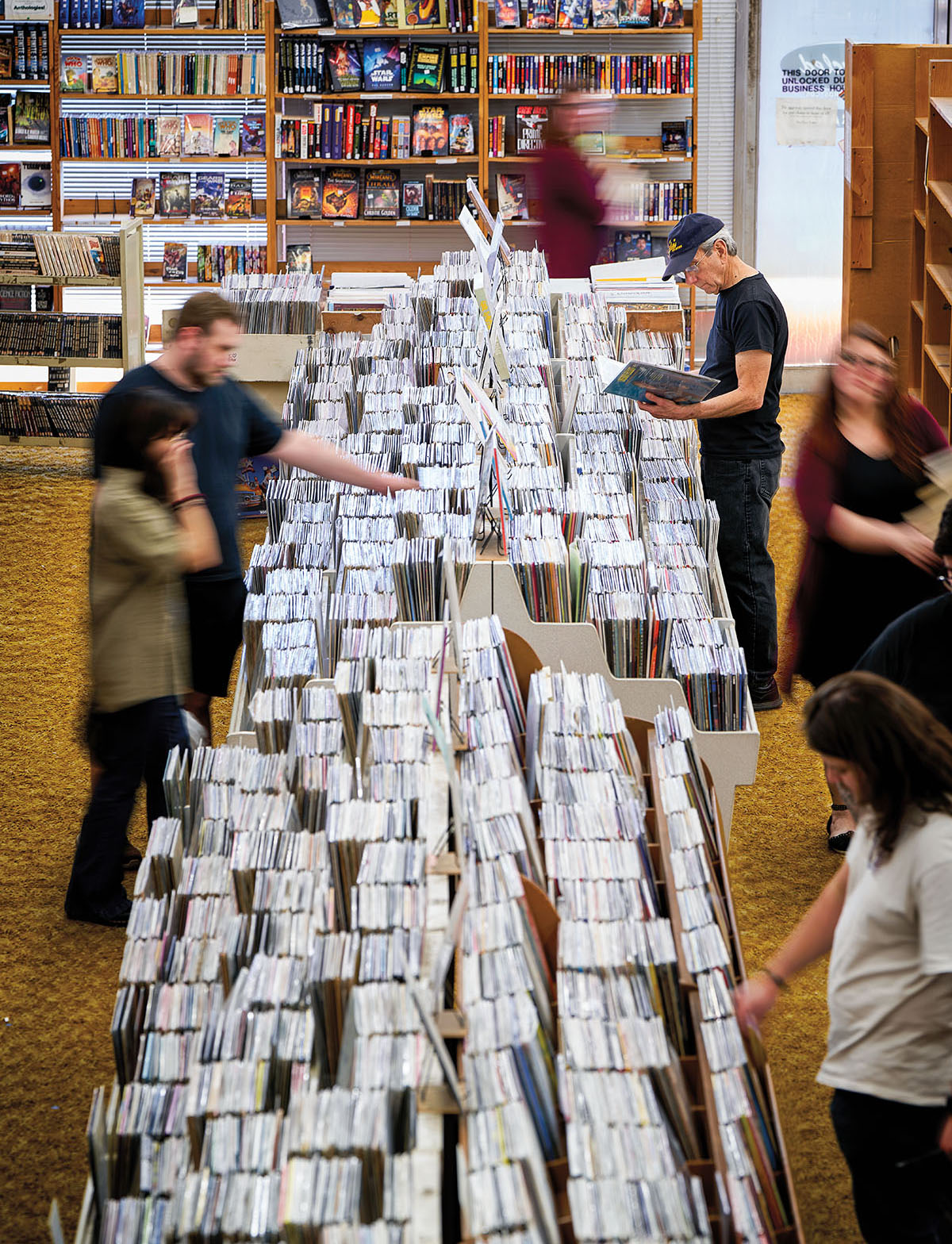
Recycled resides in the square’s historic two-story lavender Opera House. We walk through the glass doors, and I’m hit by the best smell: mass-market paperbacks with an undertone of incense. It’s crowded even on a weekday. There are older folks looking for stuff in their outmoded media of choice (VHS lives!) and college students in dramatic eyeliner searching for the self-defining finds of their age.
The employee recommendations shelf includes cassettes of synth-pop and noise metal, and most of the workers are that special brand of long-haired Texas hippie. Don is here—always. His hair is white now, but he still reminds me of a better-looking Tom Petty.
“The music scene has pretty much exploded,” he says, surveying the crowd. The two local universities—Texas Woman’s and North Texas—always meant there was a funky edge to Denton, but now, Don says, “There are so many bands out there, something’s going on every night.”
There’s a ramshackle wonder about this place, a labyrinth of shelves piled high in every direction, a feeling of pure abundance. Hand-drawn signs point to sections on Local Vinyl, Vintage Pulp, and Gardening “Bestsellers.” Walls are adorned with movie posters hung catawampus, funky displays of ephemera. I’ve always loved how the witchy book section in the back has its own soundtrack of witchy music piped through the speakers.
My father wheels in boxes of 45s on a dolly. “I knew it would be great stuff,” Don tells me. “Your dad al- ways had great taste.”
Don has been a big influence on my father’s musical taste. They met at Denton High School in 1962 but became friends when they worked together at the North Texas campus print shop during college and made forays into Dallas and Fort Worth looking for records. Don had “a different ear,” and he turned my dad on to free jazz and indie labels putting out weird and amazing stuff. Once, at Top 10 Records in Oak Cliff, around the corner from The Texas Theatre, where Lee Harvey Oswald hid out, Dad couldn’t purchase the Warne Marsh LP he wanted, as he had already blown his budget. Don told me they went back a year later, and my father made a beeline for the Easy Listening a section where it turned out he’d hidden the album. It was still there.
This was the late ’60s and early ’70s—the golden era of cheap vinyl. The record labels were moving to stereo, so stores were overrun with mono. Dad and Don raced each other from the car to be the first to get eyes on the cut-out bins of remaindered records. Eventually Don opened his own shop, first across from Texas Woman’s University, later moving to the square.
My father has spent the last year going through his records one by one. He even claims to have a wrist injury from the tedium. Sometimes he calls me crying. He’s not sleeping well, he says. He remembers where he bought each album: U.V. Blake’s in Lubbock, Oscar Glickman’s The Record Shop in Big Spring, Jimmy Stinson’s Ernest Tubb Record Shop at the Fort Worth Stockyards, Roger Kirkpatrick’s Off the Wall Records in Abilene.
As a kid, I was often dragged along on these outings. Sometimes I hung around inside; other times I read Nancy Drew in the back seat of the car. At The Record Shop in Big Spring, they would sometimes refer customers to my dad because of how well he knew the basement stock. He’d say, “Oh, yes, there’s some Roy Orbison under that box.” In any town, when we’d arrive, Dad would get out the Yellow Pages and find the local record store. He and my Uncle Randy would listen to their finds on a battery-operated portable record player in the motel.
My father’s record room was a magical place in my childhood. The pink wallpaper was obscured by pinned glossy photographs of musicians and stacks of wooden LP cubbies my grandfather built. The shotgun-style room had two doors, so music from the speakers flooded the house—Ray Price, Lightnin’ Hopkins, Joan Jett, Johnny Bush, Ornette Coleman, Buddy Holly, Little Joe y La Familia, Madonna—and rocking chairs for Dad and his friends to sit and drink and listen, argue over their top 10 thises and thats. There’s a photograph of me as a baby, sitting myself up by holding on to a Lone Star longneck for dear life, a life-size cut-out of Conway Twitty behind me. Instead of lullabies, my father would sing Ernest Tubb’s “Walking the Floor Over You” and Hank Williams’ “There’s a Tear in My Beer.”
As a kid, I wasn’t allowed into his record room without supervision, but I still snuck in. I would listen to Nine Inch Nails or Hole while he was out of the house, careful to put everything back exactly as I’d found it. Somehow, he always knew.
When he calls to tell me about the records he’s boxing up, I walk loops around my Austin neighborhood listening to his stories and ponder that it’s not just about the disappearance of the physical record collection, but eventually—not today, not tomorrow thankfully, but eventually—the disappearance of this man and his deep knowledge and love of Texas music.
At Recycled, someone asks Dad if he feels pleasure knowing new people will enjoy his albums. My dad says it’s bittersweet. He admits that when he’s at the store and needs to head to the restroom, he never turns right or left because he doesn’t want to see his old LPs on the shelves. “My music is being dispersed to the wind.”
The following weekend, my dad and mom are in Austin looking at houses, and he stops in at Antone’s Record Shop on The Drag.
“Dad,” I scold him. “You’re supposed to be getting rid of records, not buying new ones.” I don’t bother mentioning the existence of streaming and digital, notions he refuses to entertain.
“These are CDs,” he says, holding up his purchases. “They’re smaller.”
I nod. “A sound investment.”