

Jace Tunnell is used to discovering strange items scattered across the Texas shoreline.
As the director of community engagement at Texas A&M University-Corpus Christi’s Harte Research Institute, he conducts weekly beachcombing surveys along the 100-plus-mile stretch between Matagorda Island and Padre Island National Seashore. While on these expeditions, he’s found everything from doll heads to jellyfish to dolphin skeletons. Needless to say, he’s developed an eye for hidden gems—both the natural and human-made kind.
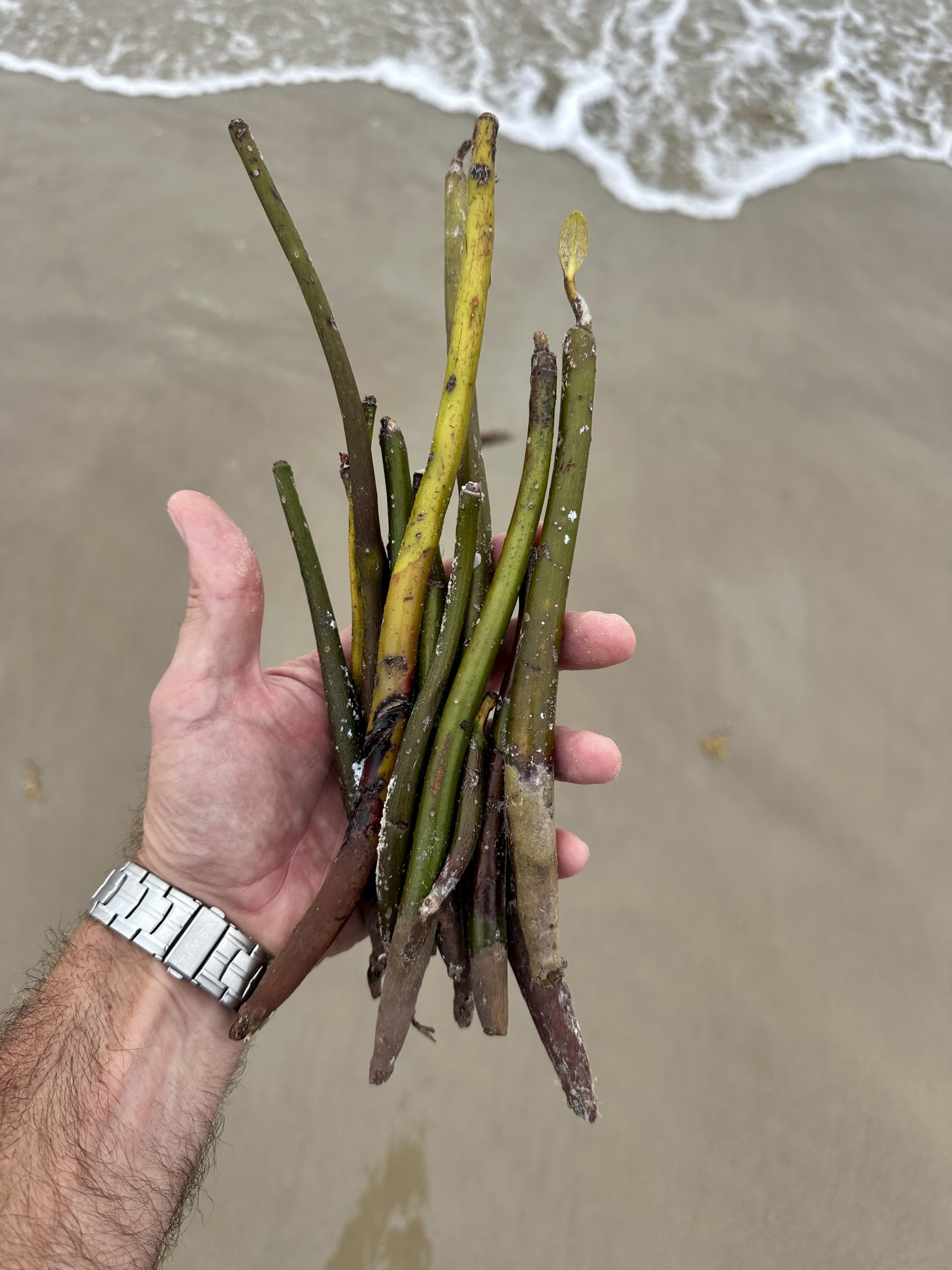
So, it was no surprise that when bright green torpedo-like figures washed up alongside brown algae called Sargassum in May, Tunnell was quick to take notice. He instantly recognized the objects not often found on the Texas coast—objects that an average person might assume to be an out-of-place asparagus stalk. Tunnell’s cigar-shaped findings were red mangrove seeds, some of which were viable.
“I’ve grown these,” Tunnell says. “So I know the ones that you can put in water, and they’ll grow.”

Red mangroves are tropical evergreen trees that thrive in coastal, estuarine ecosystems. Recognizable for their large prop roots, these plants provide habitats for aquatic creatures and protection for coastal communities. The species is native to places like Florida and Mexico—and even farther south in the Caribbean and Central America. But every once in a while, these plants pop up in Texas’ Coastal Bend region.
In 2020, Tunnell knew of only 10 red mangrove plants in Texas, including one that had survived for 15 years at Lighthouse Lakes. Black mangroves, on the other hand, are much more widespread across the state’s coastline. The species withstands the cold better than its red counterparts, which generally die when exposed to temperatures only slightly below freezing.
When Winter Storm Uri hit Texas in February of 2021, the state’s black mangrove population dropped, but the red variety was entirely wiped out. The species hasn’t made a significant reappearance in Texas since, which is why Tunnell knew he’d found something special with the discovery.
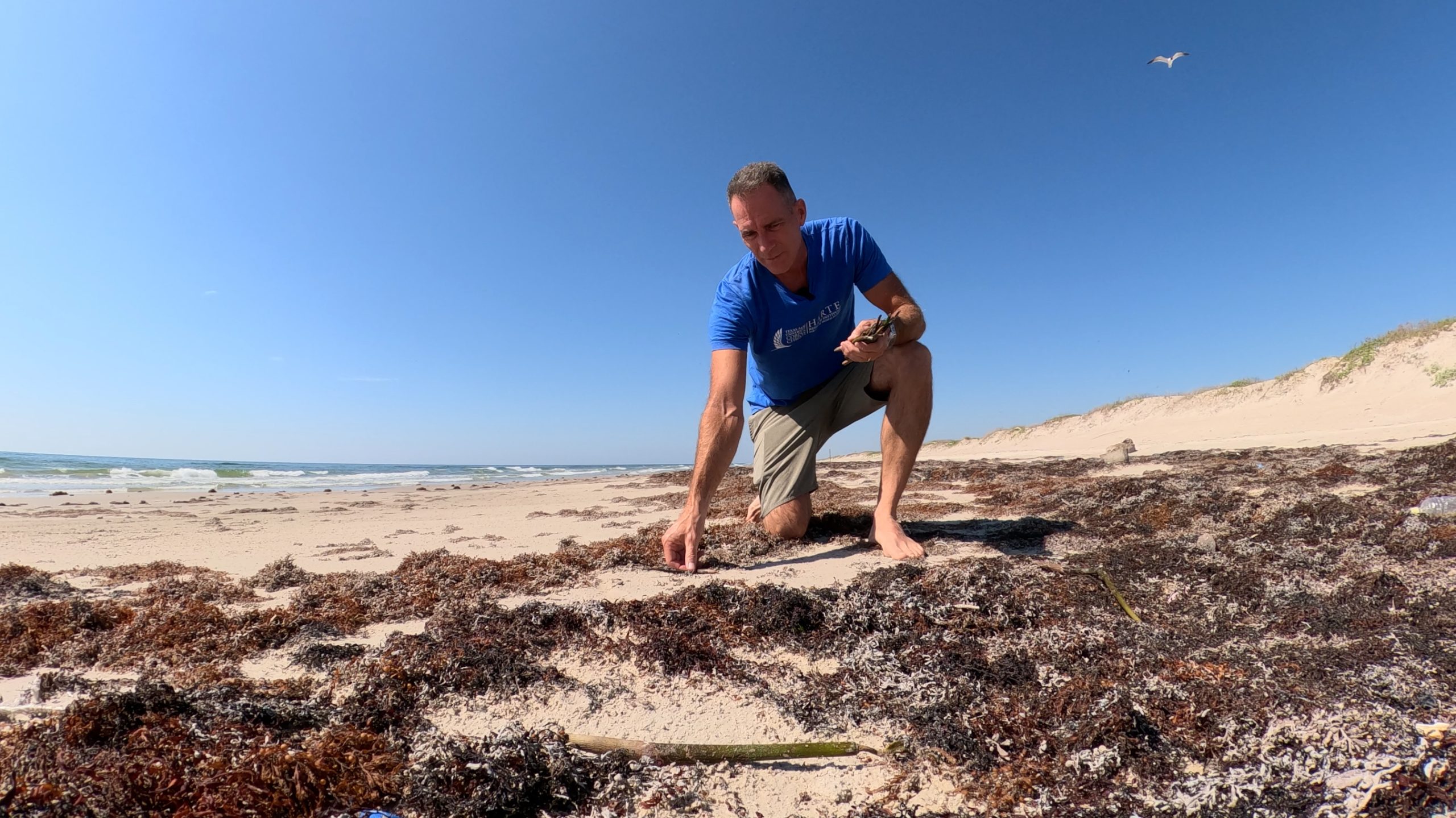
That morning in May, he easily counted more than 50 seeds scattered across just 100 yards of beach, and he continued to find them mixed in with Sargassum over the next few weeks.
Alejandro Fierro-Cabo, a University of Texas Rio Grande Valley professor who researches coastal restoration ecology, says these seeds are likely coming from areas farther south of Texas—like Mexico or the Caribbean—where red mangroves grow significantly taller and their population is more abundant. The species is “very prolific,” Fierro-Cabo says, producing seeds almost all year that drop from trees and into their coastal habitat.
“They are designed to be dispersed by water,” Fierro-Cabo says. This allows the seeds to float for long distances before washing up somewhere new, like the Texas coast.
But for Tunnell’s seeds to take root, they would first need to be carried through a channel that disperses on the bay side of the coast’s barrier islands where the conditions are more conducive to growth. Then, if a seed’s root system gets stuck in the mud or sediment in that area, a mangrove tree could start to develop. At least, until there’s another freeze.
However, changing climate patterns could mean changes in red mangroves’ ability to survive in Texas. Researchers across the state have already seen increasing temperatures driving black mangroves farther north into previously inhospitable areas. A similar effect could occur with red mangroves, says Texas A&M University at Galveston marine biology professor Anna Armitage. If climate change causes warmer winters and fewer freezes, the species could survive longer, giving it a better shot at reproducing and establishing a population.
“Climate change is definitely a player here,” Armitage says.
Although the species’ future along Texas coastlines is still uncertain, Tunnell sees the potential reappearance of red mangroves as highly beneficial. Their prop roots that dangle in the water create a habitat for fish and oysters—and even attract certain birds too. The mangroves also filter and reduce nutrients in the water that they grow in, stunting the small plants that turn the water green and block sunlight.
But the red mangrove function that Tunnell finds most important is that the species’ large roots protect city shorelines from storm surge and erosion—a significant problem facing the Texas coast. As of 2021, nearly 80% of the state’s Gulf shoreline was critically eroded. And the red mangrove’s ability to tolerate high salinity and strong wave action makes it a natural barrier that is more effective than some man-made attempts to limit erosion.
While there’s no guarantee that red mangroves will reappear in Texas, Tunnell says he believes in the plant and its potential for forming a “living shoreline” along the coast—a habitat that could protect the region’s native wildlife and neighboring communities.