

SOUND
FOUNDERS
COUNTRY, SOUL, ROCK, AMERICANA, TEJANO—IN TEXAS, WE PLAY IT ALL, AND WE PLAY IT OUR OWN WAY. MEET THE NEW GENERATION OF ARTISTS PUSHING MUSICAL BOUNDARIES.
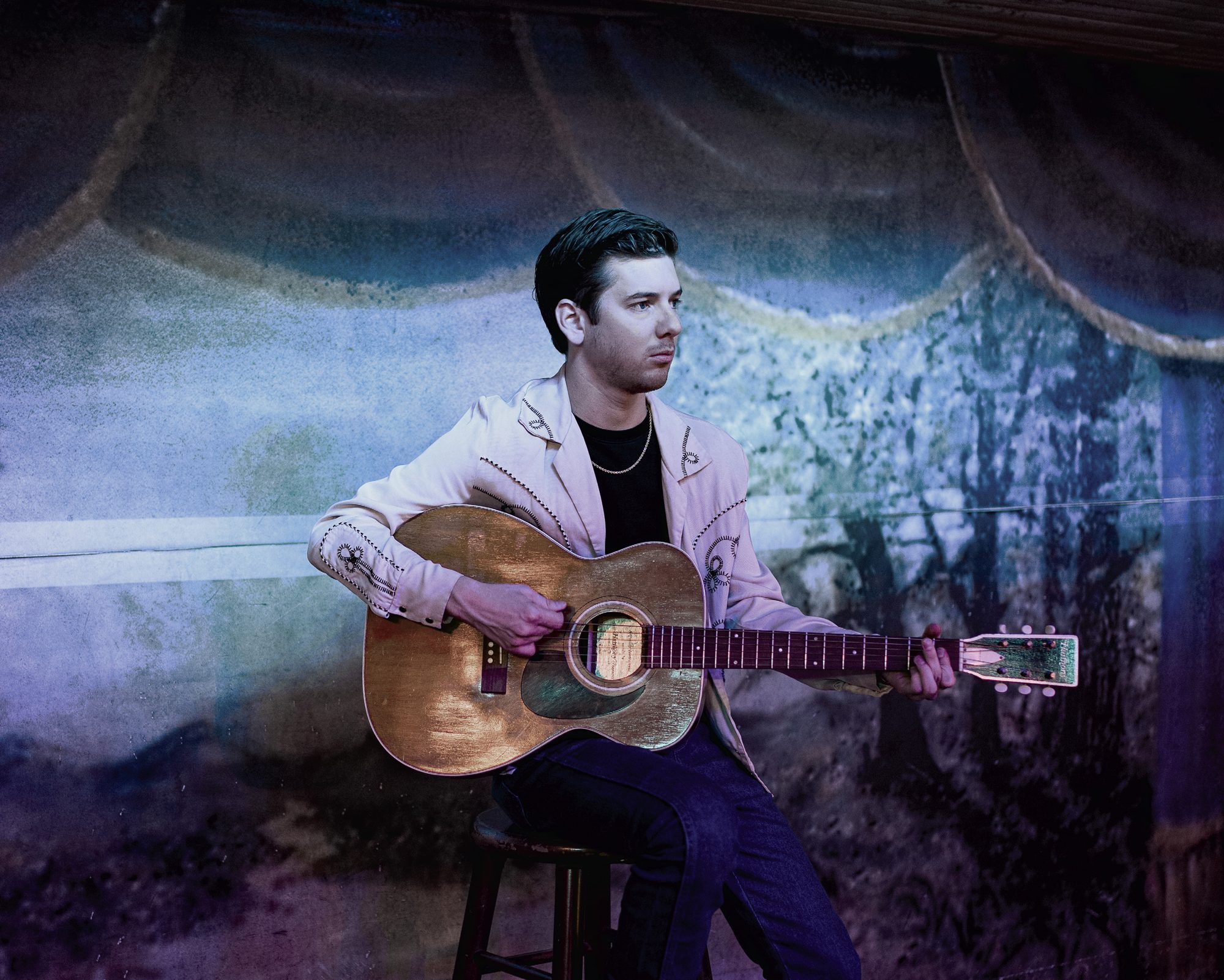
WILLIAM BECKMANN
William Beckmann stepped into the circle at Nashville’s famed Grand Ole Opry for the first time in the spring of 2023. The then 27-year-old up-and-coming country star had only two songs to win over the audience. He began with his original track “Bourbon Whiskey,” a smooth lovesick ballad, but it was his next choice that earned him a standing ovation.
Sporting a teal Western suit in a video that’s since gone viral, he told the Opry audience, “Where I’m from, you’ve got to sing at least one song in Spanish.” Then he launched into a silvery rendition of “Volver, Volver” by iconic Mexican singer Vicente Fernández.
Beckmann is a tried-and-true country crooner whose velvety baritone vocals and subtle twang land somewhere between Frank Sinatra and George Strait. His pedal steel-tinged songs touch on classic themes of heartbreak, life on the road, and late nights spent at the bar. But peppered throughout some of these tracks are flourishes of norteño music, references to South Texas locales, and Spanish lyrics—all glimpses of his Mexican heritage and upbringing in Del Rio, the southwestern Texas border town he calls home.
“It feels like the clock slows down a little when you’re in Del Rio,” Beckmann says. He splits his time between Central Texas and Nashville now, but he tries to get home often. This spring, he performed two packed shows at Del Rio’s Mesquite Creek Outfitters. “When I go back, I feel like I’m in high school again, driving around the town where I learned to play guitar.”
FILE UNDER: COUNTRY
SIREN SONG: “BORDERLINE CRAZY”
williambeckmann.com
Del Rio wasn’t exactly a hotbed of music industry connections. Luckily for Beckmann, his high school sociology teacher, John Wardlaw, recognized his passion junior year and arranged for Beckmann to meet with one of his childhood friends: Radney Foster, a country singer-songwriter who had grown up in Del Rio and wrote several Top 40 hits for artists like Gary Allan, Sara Evans, and Keith Urban, as well as himself.
“I told him what I wanted to do and played him a George Strait cover,” Beckmann recalls, “and he told me I needed to start writing my own songs.”
Foster gave Beckmann his email address and advised him to reach out when he had some originals. “I’m sure they were god-awful,” Beckmann says. “Some people are just born with this, but for me, I had to teach myself everything.”
Beckmann did more than just get things right. Since graduating from college in 2017, he’s released three studio albums, including this year’s Whiskey Lies & Alibis. He also performed at the San Antonio Rodeo, signed with Warner Music Nashville, and continued to make waves online with his Opry debut.
His rendition of “Volver, Volver” was more than a well-done cover; it was a piece of his home platformed onto country music’s legendary stage. Though Beckmann seemed confident delivering it, he initially wasn’t sure how the audience would respond to the song.
“It definitely took people by surprise, which was kind of the point,” he says. “But now I can’t walk offstage without playing that song. Everyone will riot.”
When Beckmann was last in Del Rio, he invited his abuelo onstage to sing the song with him. As with his own bilingual songs, like “Danced All Night Long,” Spanish covers like “Volver, Volver” or Pepe Aguilar’s “Por Mujeres como Tú” just come naturally.
“I’m from such a specific place,” Beckmann says. “This is what makes sense to me—because these are classics in Del Rio. You can’t grow up here without hearing them. ‘Volver, Volver’ is our anthem.”
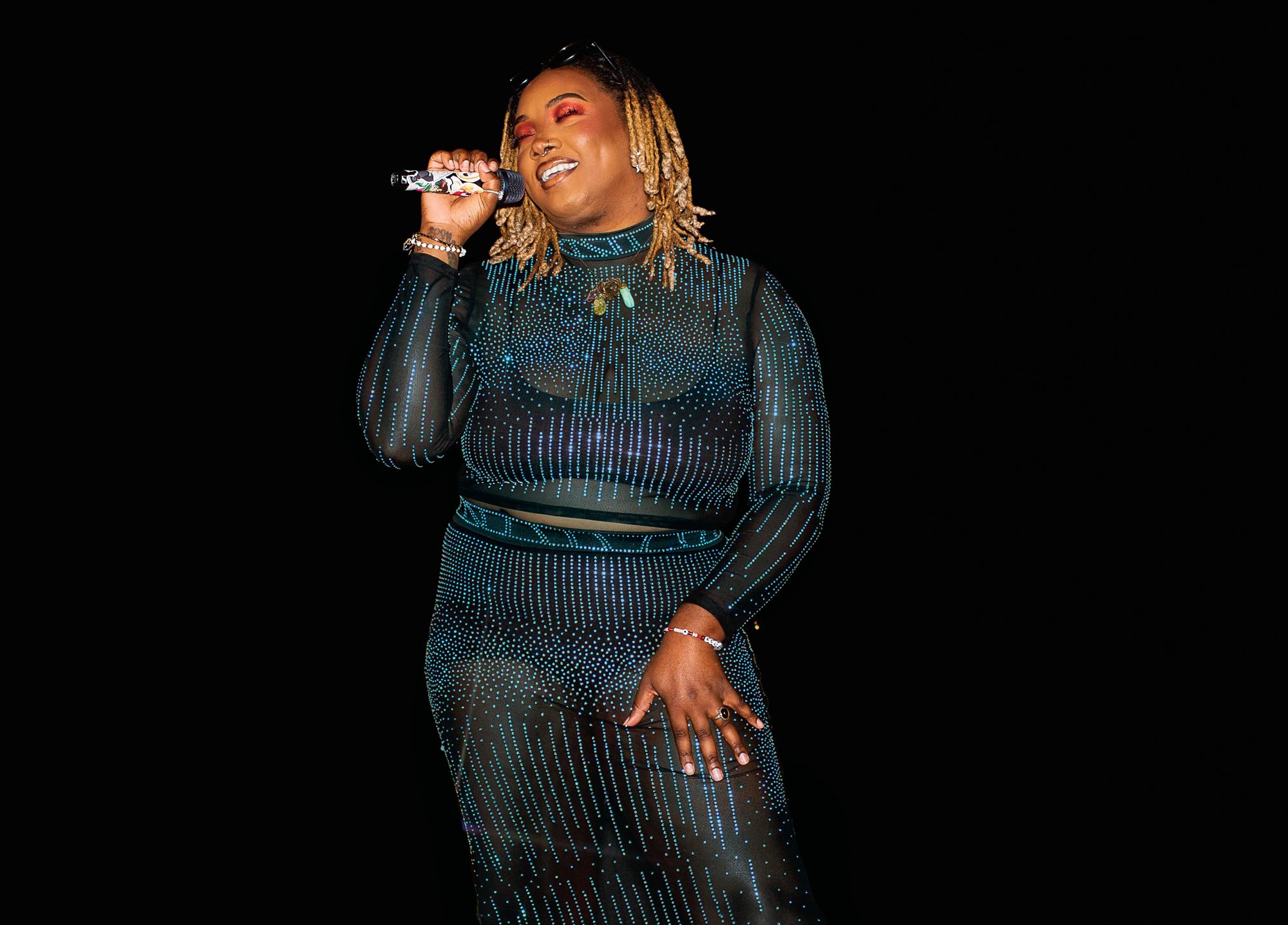
CHIEF CLEOPATRA
Jalesa Jessie was born and raised in Corsicana—what she calls a “blink and you’ll miss it town” you might drive through on the way to Dallas. It’s small, to be sure—the population is 25,000—but it’s also the birthplace of legends like prolific outlaw country artist Billy Joe Shaver, celebrated tenor saxophonist David “Fathead” Newman, big band jazz trombonist Tyree Glenn, blues pioneer Blind Lemon Jefferson, and honky-tonk icon William Orville “Lefty” Frizzell. Jessie wasn’t always keyed into her hometown’s musical history, but these icons would nonetheless lay the foundation for her powerful rock soul persona: Chief Cleopatra. She assumed the moniker after moving to Austin more than a decade ago, taking on a name she felt was imposing and strong, yet feminine.
Cleopatra’s music is Santigold meets Tina Turner—a funky, psychedelic mix of pop, rock, and soul best showcased on her 2024 single “Cold Dancer.” It’s a melting pot of styles informed by her parents’ eclectic playlist of Aretha Franklin, Wu-Tang Clan, Kenny G, and the Eagles, but it’s also a product of her environment. When she finally learned about Blind Lemon and Lefty, she felt a connection to them.
“Lefty had that flair, man,” she says. “He was quiet but effective. That’s like me, too: I’m quiet until you get me onstage, and suddenly I can do everything. Even if I’m not doing the same thing as him or Blind Lemon Jefferson, I think those things—that jazz feel, that soul—they seep into the ground and into your subconscious. They come from here, the same way I do.”
FILE UNDER: SOUL
SIREN SONG: “COLD DANCER”
chiefcleopatra.bandcamp.com
Cleopatra’s first experiences performing were in the church choir with her older sister. It’s where she learned to let her voice soar and heard her earliest harmonies. “It’s the first place where I felt like I might have any kind of gift,” she says.
While she was watching MTV, at around 8 years old, the video for the Smashing Pumpkins song “Bullet With Butterfly Wings” flicked onto the screen. “It changed my life,” she says. “It’s like it broke through a barrier in my brain, and I was just hooked.” Suddenly, the possibilities of what she could do with music burst out of the walls of the church.
After a few stops and starts, a brief move back home, and a revolving door of new bands and bandmates, Cleopatra went solo, with collaborator Leonard Martinez, in 2019. Throughout her career, she’s dealt with a changing industry for rising musicians, trying to navigate record labels, distribution, and social media while working a full-time job. “It hasn’t been easy,” she says. “I’ve had to fight tooth and nail to just keep playing and putting myself out there. It’s draining, mentally, to figure out how you’re going to write, record, perform, and promote yourself, especially without help. But you do get those shows or those emails from time to time that make it worth it.”
One of those moments came last year, when Cleopatra landed a slot performing at the Austin City Limits Music Festival. “I was in shock when I found out,” she says. “This is something you dream about doing, and the fact that it happened just five years after going solo? I was over the moon.”
It took her some time to embrace her stage name, but now it feels like an identity she’s grown into. “I’m really proud to call myself Chief Cleopatra,” she says. “I feel like I’m myself when I hear it.”
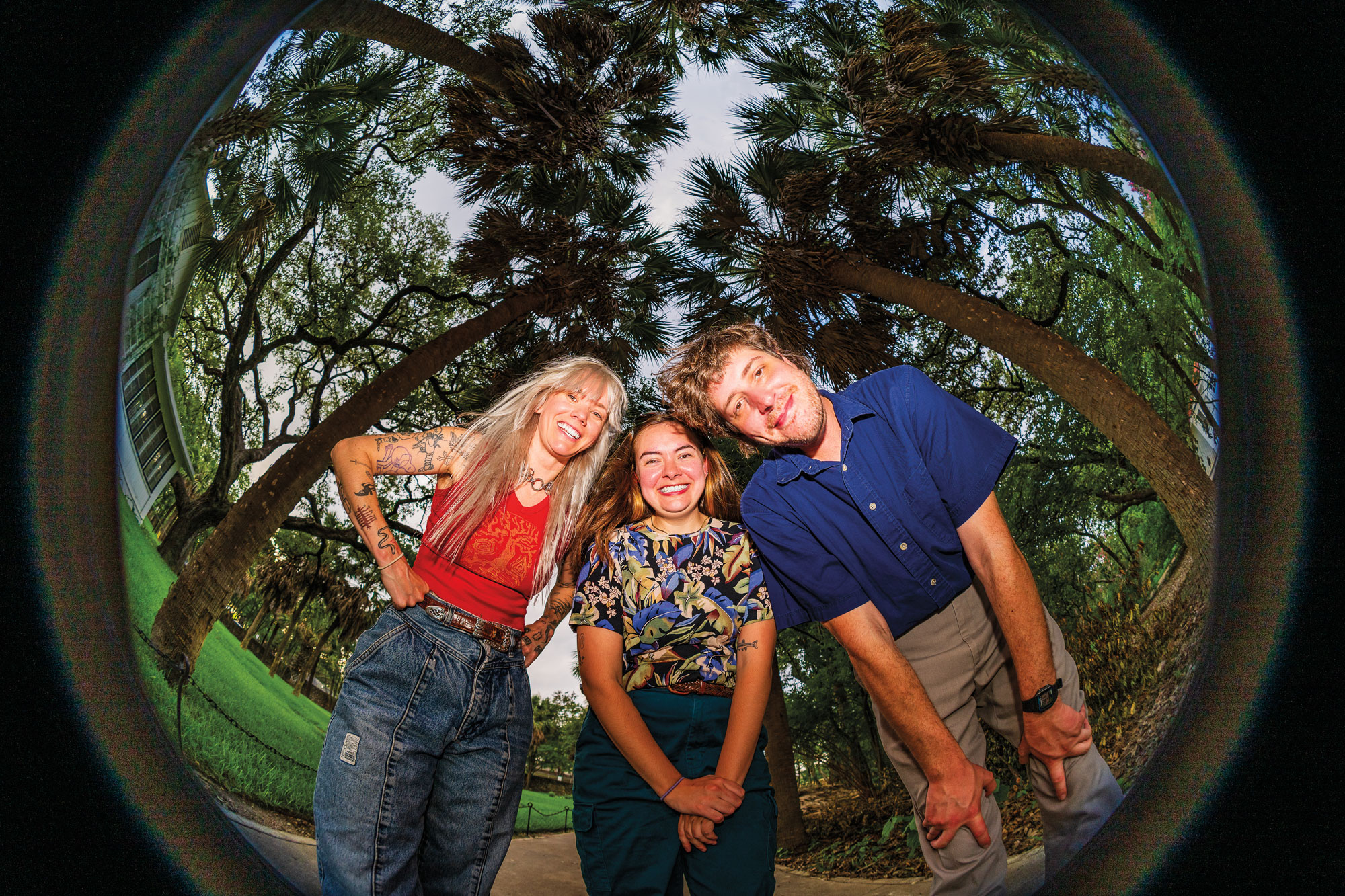
BEING DEAD
Austin rock trio Being Dead appears to be lost. It’s mid-April, and they’ve been on the road all morning. They know they’re somewhere in the Smoky Mountains, but at the moment all they can tell me, over the phone, is they’re posted up at a rest stop near a picturesque stream. For now, I’m inclined to believe them.
See, Being Dead has a … let’s call it “creative” approach to the truth, one that makes it difficult to ascertain something as simple as how they even came to be. It’s as if the band members—Falcon Bitch, Cody Dosier, and Nicole Roman-Johnston—exist not just to create music but to crack inside jokes. Depending on whom or when you ask, Falcon and Dosier met at a video store … actually, they were failed members of the University of Texas marching band … no wait, it was at their high school reunion. On this particular day, their answer would require you to believe in immortality.
“Well, we met on a rainy afternoon in 1918,” Dosier begins.
“And you were a moonshiner,” Falcon prompts.
“Exactly, we met underground,” he continues. “At first, the moonshining thing was going well, but once that started dying down, we saw that the music industry was really popping off and we decided to get in on that.”
Maybe that’s not the response you’d expect from a band that’s received critical acclaim from Rolling Stone and Alternative Press, and even earned a hard-to-come-by 8.3 rating in Pitchfork. But if you’ve listened to their music, it’s perfectly on brand.
FILE UNDER: ROCK
SIREN SONG: “FIREFIGHTERS”
beingdead.bandcamp.com
The group has just kicked off a breakneck tour in support of their sophomore album, EELS. A slight departure from their cheerier 2023 debut, When Horses Would Run, the album is a shifting kaleidoscope of shoegaze, surf rock, garage punk, and hazy psychedelic sounds anchored by Falcon and Dosier’s harmonies. It’s the kind of music that could serve as the score to a surreal dream—songs that would be perfectly at home onstage at the Roadhouse in David Lynch’s Twin Peaks. Like the aquatic creature it’s named after, EELS is slippery and hard to pin down—one moment it’s dark and twisted, and another it’s unserious and goofy.
Album opener “Godzilla Rises” tells the story of a misunderstood monster with a heart of gold, while new wave track “Ballerina” is more like a country line dance from another dimension. Then there’s “Firefighters,” a fuzzy, gritty song with a driving guitar beat about a firehouse dalmatian who yearns for a different life. (“If I could turn back time,” Dosier sings plaintively, “I’d live by the oceanside.”) Their music channels emotion through often absurd points of view and colorful metaphors. “I think it’s more fun to play and be imaginative,” Dosier says.
The trio feels less like a band and more like an improv troupe that gets together and just jams, free-form and spontaneous, until they arrive at something they agree on. Their approach to life is the same as their approach to music: “We kind of just go for it,” Roman-Johnston says.
The final product is unpolished, sometimes messy, but undeniably authentic to them. “It feels pretty lucky,” says Falcon, reflecting on their creative chemistry. “It’s hard to describe how it all comes together, but I think the basic elements you need to have are some rock ’n’ rollers, friends who are open to trying new things, and people who are ready to laugh.”
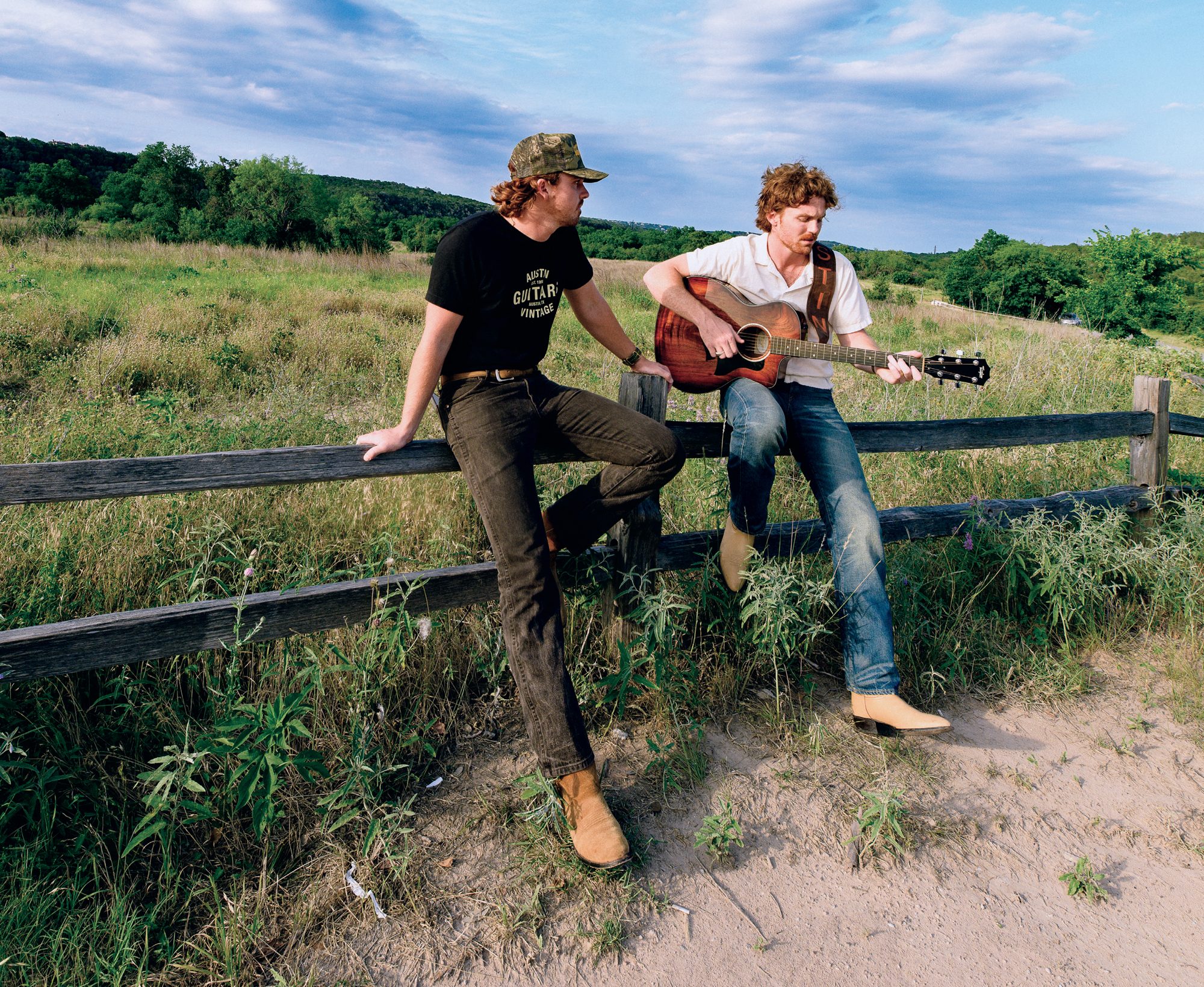
BRISCOE
When the duo Briscoe started working on their debut album, West of It All, they looked
to the landscapes that shaped them for inspiration. For Philip Lupton, that meant the Concho River running through his hometown of San Angelo and the wide-open expanse of West Texas desert that stretched out beyond it. For Truett Heintzelman, it was the stormy skies and winding roads of the Hill Country—a nearby respite for him and his family while growing up in San Antonio.
The result was 10 tracks of Americana-infused folk rock that’s both intimate and classic, like a faded Polaroid from an old road trip. It’s the soundtrack of the guys’ adolescence and nascent adulthood, underscored by gentle harmonies, banjo, guitar, and even saxophone.
Lupton and Heintzelman officially began making music as Briscoe in 2020, when they were at the University of Texas at Austin, but the roots of the band go back to when the two first met at Laity Lodge Youth Camp in Leakey as middle schoolers.
They discovered a lot of commonalities—they were both athletes who had recently picked up the guitar. They even shared the same taste in music, listening to artists like James Taylor, Simon & Garfunkel, the Avett Brothers, and the Eagles. But there was something else: “We realized we looked incredibly similar,” Lupton says, gesturing to their curly red locks. The duo gravitated toward each other and performed together in the camp’s talent show that first year, singing a cover of John Prine’s “Paradise.”
FILE UNDER: AMERICANA
SIREN SONG: “THE WELL”
briscoetheband.com
After camp, they kept in touch. Lupton had started working on original songs in high school as “Briscoe,” his grandfather’s name. Eventually, the pair began making music together. Not long into their time at UT, they released their first single, “Sailing Away,” closely followed by their self-titled debut EP. On it, there are glimpses of the sound they would refine on West of It All, mixed in with some funky experimentation.
“I think in our purest form, we’re folk musicians, but we want to leave room to grow into different sounds down the road,” Heintzelman says. The EP put them on the radar of ATO Records, the Dave Matthews-owned label whose roster also includes Alabama Shakes, Black Pumas, My Morning Jacket, and Brandi Carlile.
At the time, Lupton was a sophomore and Heintzelman a freshman, and already they’d gotten a green light to pursue their dreams. But their manager posed an important question: Were they planning to graduate? “We told him we’d like to, and that our parents would really like us to,” Heintzelman says.
The next two years at college gave them the chance to develop. They gained more live experience, wrote and rewrote songs, and built the debut album of their dreams. “We got to incubate,” Lupton says. “A lot of artists are thrown right into the fire, but we had the chance to build gradually and organically.”
Briscoe has had the fortune of opening for Zach Bryan, Noah Kahan, and the Avett Brothers. They also performed at Willie Nelson’s Luck Reunion in the spring, and this fall, after the release of their album Heat of July on Sept. 19, they’ll make their Austin City Limits Music Festival debut.
“It boggles my mind,” Lupton says. “The passion to do this was always there, and the belief in ourselves was always there, so you buckle down trying to make it happen and then, all of a sudden, you look up and it’s happening.”

VANITA LEO
Vanita Leo stepped out onto the stage at this year’s South by Southwest with the confidence of a veteran performer. Her hips swayed to the cumbia wepa—a Northern Mexican variation of the Colombian dance—as the audience buzzed around her. With the steady pulse of a backing drumbeat, she hopped and twirled along to the music, kicked off her shoes, and walked straight into the audience.
“Alright y’all, I know we just did some sad songs, but I’m here to party,” she said. “Who knows how to wepa?”
The 22-year-old Tejana from San Antonio is an up-and-coming cumbia sensation. But that’s no surprise—music runs in the family. Her aunt Esmeralda Jaime was part of the booming Tejano scene of the 1990s, sharing stages with Mazz, Emilio Navaira, and Selena. Leo’s father, Marco Jaime, was a vocalist in several cumbia and Tejano groups, including Los Hermanos Jaime, Grupo Rodeo, and Grupo Maldad. And her grandfather Refugio Jaime performed Tejano, mariachi, and boleros with a trio in San Antonio.
“I like to say that my family has been working for the past three generations to pursue music,” she says.
As a child, Leo and her grandmother watched her father perform in Market Square during San Antonio’s annual Fiesta. There, she almost didn’t recognize him. “My dad’s not this superconfident person when he’s just going about his life, but onstage, it’s crazy the way he could control the crowd,” she says. “I remember watching him and wanting to be able to experience that.”
FILE UNDER: TEJANO
SIREN SONG: “CABALLITO”
linktr.ee/vanitaleo
During her teenage years, Leo witnessed the breakthrough of several bilingual, bicultural influences like Cuco and Kali Uchis, who effortlessly weave boleros and cumbias into bedroom pop and R&B. It opened a world of possibilities in her mind.
“I feel like the only person who really gave me that representation before was, of course, Selena,” she says. “Part of me always wanted to rebel a bit against Tejano music because of my dad, but it all started to align for me.”
Leo gravitated toward romantic, soulful boleros and lively, pulsating cumbias. Her style has just enough old-school flair with cheeky Gen Z lyrics that dip in and out of Spanish and English. As she started performing around San Antonio, Leo paid attention to the crowd’s response. “If you can get people lit, then people will keep bringing you back,” she says.
A diverse range of sounds and styles congregate under the overarching cumbia umbrella, but Leo wants to make the Tejano version her own. Her 2025 single “La Cumbia Wepa” is the perfect distillation of this aim. It’s a song about dancing off a breakup, in which she sings in Spanish: “They saw her crying around here / Over some dude who never stops lying / There’s no better cure than going out / Till 3 to dance the wepa.”
Some Tejano purists are skeptical about Leo’s spin on the genre, but that’s only served as encouragement. “What Selena accomplished was through innovation and dedication to her craft, and she also struggled with people who didn’t like her doing something new,” she says. “So, if I’m dealing with that too, then I must be doing the right thing.”
With her forthcoming yet untitled cumbia EP, Leo wants to deliver get-over-your-ex songs, songs to fall in love to, and songs that will get you up on your feet. She also wants to make music that speaks to Mexican American youth like her. “I want to make things for the kids who felt like me growing up, like they weren’t sure where they belonged,” she says. “I want them to feel like they can find a place for themselves when they’re at my shows.”