
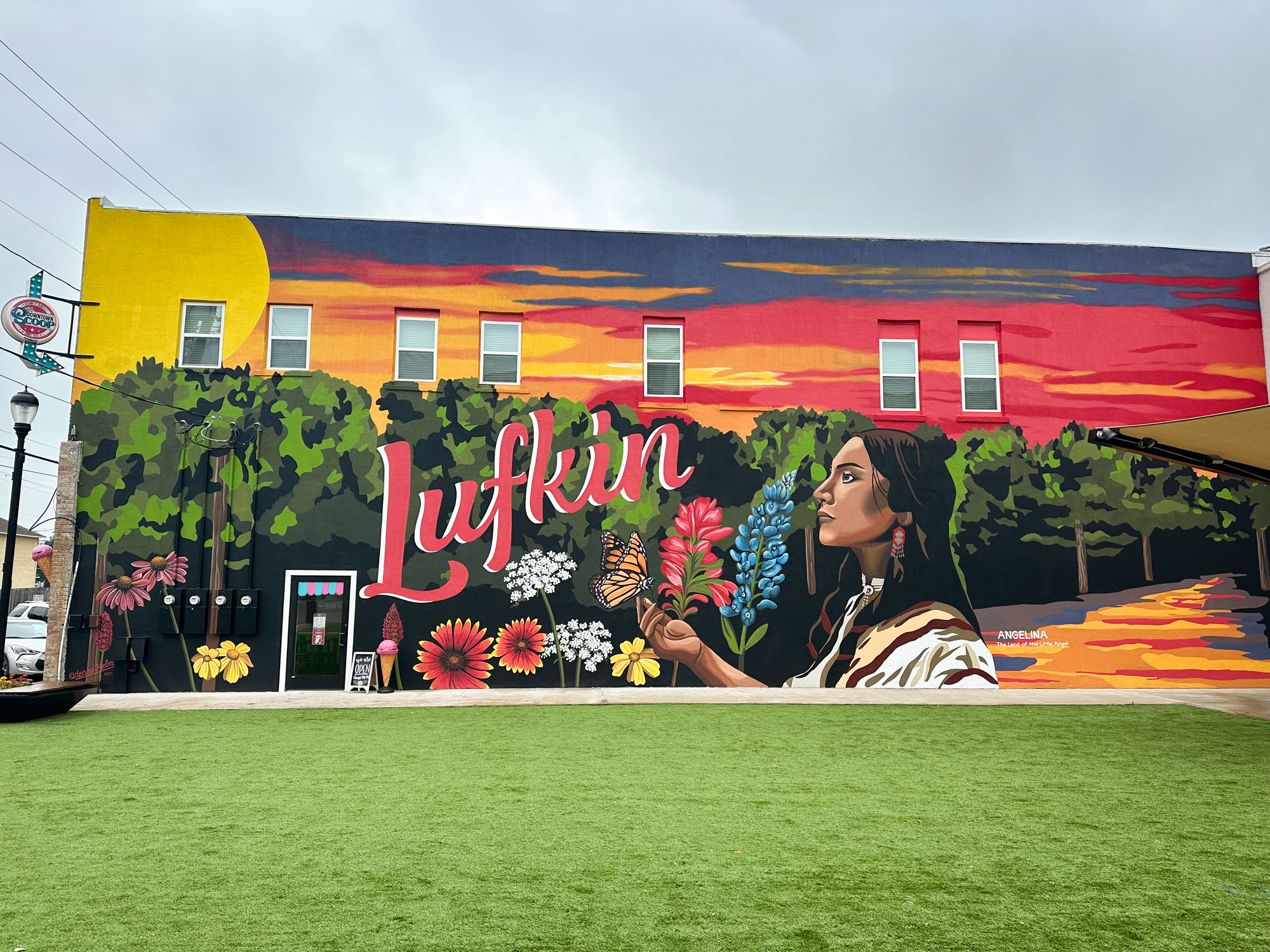
If you find yourself wandering through the Piney Woods, you’ll see the same name over and over: Angelina. In addition to the Angelina River and Angelina National Forest, Angelina County is the only one out of 254 in Texas named for a woman. A new mural depicting Angelina, a member of the Hasinai Confederacy, part of the Caddo Nation, showcases her immense contributions to the area’s rich history.
Painted by the East Texas muralist Odessa Helm, the sprawling piece, located at the corner of West Lufkin Avenue and South Cotton Square, prominently features Angelina set against a backdrop of the Angelina National Forest and Angelina River. Local wildflowers line the bottom, reinforcing a sense of place. Angelina’s likeness is based upon a popular image from the area displayed in and around the city.

”Since that image is what most locals associate with her, we wanted to honor that familiar likeness,” Helm says. “I also made sure through my research that her hairstyle was one a Caddo woman of her age would have worn, and that the jewelry she’s wearing is authentic to the Caddo tribe.”
Even though much of Angelina’s story remains unknown or speculative due to a lack of written records, local historians agree that she played a significant role in East Texas history.
“Angelina served as a friendly host and interpreter to both the Spanish and French as they were passing through,” says Jonathan Gerland, executive director of The History Center in Diboll, just a few miles south of Lufkin.
Angelina, as it appears in Spanish records, and Angelique, or Angelica, in French ones, was only mentioned by a handful of European explorers from their East Texas expeditions. Despite slight variances in her name’s appearance, it translates to “angelic” or “little angel” in both languages.
Though its historical accuracy is somewhat debated, Angelina’s first written mention comes in a French account from 1712 or 1714. André Pénicaut noted a native Spanish-speaking woman who had been baptized by Spanish missionaries that assisted with the hiring of guides for their journey. Another French account from 1720 reveals that she had two children, both old enough at the time to serve as guides themselves.
The last written record of Angelina comes less than a decade later, during a Spanish expedition. Led by the second Marqués de San Miguel de Aguayo, its purpose was to reestablish Spanish claim on the area, restoring missions and constructing presidios. According to the group’s official diary, they encountered Angelina on July 25, 1721. Their notes, again, referenced her helpfulness as a translator and intermediary.
“While we don’t know exactly everything about her, we know her name because she made an impact. She was an important figure in the history of East Texas,” says Emily Hyatt, senior archivist at The History Center.
Though Angelina’s final resting place is unknown, downtown Lufkin has a statue with a historical marker dedicated to her. The inscription notes that, “In 1846, when Angelina County was formed, it was named for the Indian maiden and the Angelina River.” This comports with maps from as early as the 1760s that use Angelina’s name alongside the river. President Franklin D. Roosevelt established the Angelina National Forest on Oct. 15, 1936, after proclaiming the purchase of more than 153,000 acres for the National Forest system.
While Angelina’s name lives on, Helm hopes that younger generations continue to learn about her story.
“I hope [the mural] sparks curiosity and conversation about Angelina herself and the history and heritage of this area,” the artist says. “My goal was for it to be both visually uplifting and meaningful, so people walk away knowing a little more about the incredible woman who helped shape East Texas.”