
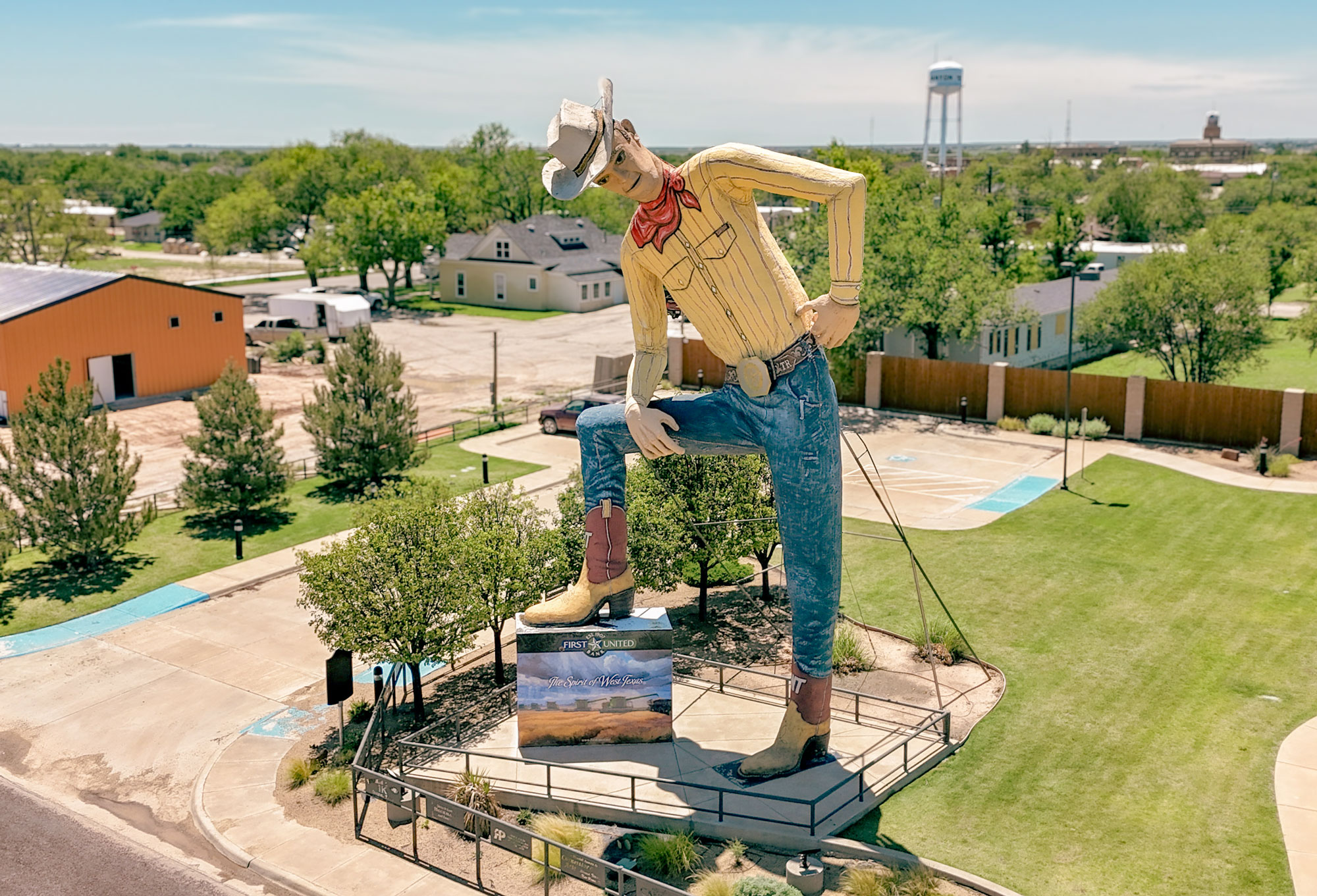
A key character in Canyon’s history stands over Highway 60 in boots bigger than the average Luccheses. Just north of downtown, the 47-foot, 7-ton cowboy statue known as Tex Randall might be Canyon’s most well-known resident.
Local businessman Harry Wheeler built the larger-than-life cowboy in 1959 to advertise his roadside Western shop. Originally, Tex was outfitted in real, supersized Western duds: a pair of enormous Levi’s denim jeans, a giant Western-style shirt, and a bandana. The cowboy quickly became a Panhandle landmark, but weather, vandals, and accidents took a toll on Tex over the years.

A restoration campaign in 1987 gave him a new painted look, but by 2010, the cowboy had fallen into disrepair. His paint was faded and chunks of the structure were chipping away. That same year, Tex’s previous owner, Danny Byrd, donated him to Canyon Main Street, a nonprofit that supports community-driven projects. With the statue under their purview, the group began making plans to save Tex.
“When you see something is a part of history, you want to do whatever you can to keep it around,” say Audry Miller, the Canyon Main Street program coordinator.
To keep Tex standing, he’d need a full reconstruction and a new paint job. Plus, Miller says Canyon Main Street wanted to create an attraction around Tex—that meant adding lights, a new fence, and landscaping. The group launched a fundraiser, and between support from Canyon residents, businesses, and grants, the city reached its goal of $400,000 by 2016.
While construction officially began in October 2015, the question of who would paint Tex remained. Thanks to her Canyon-based family’s suggestion, artist Rhonda Timmons was chosen for the tall order. For an artist, Tex presents some unique challenges. He’s taller than a typical canvas and has support beams that can make maneuvering around his frame difficult. Timmons says the weather resistant paint was heavy and quick to dry, and the wind and heat made it harder for her to paint.
She journeyed up and down in a cherry picker—a hydraulic lift commonly used in construction—each day to paint, and worked mornings and evenings to beat the midday heat. As Timmons painted the intricate creases and folds of Tex’s new outfit, she remembers visitors gathering below her, watching as Tex came together in front of their eyes.
“We had a couple of people that came in campers, and they camped out there for a few days and watched,” Timmons says. “I think they really did want it there in Canyon because I had a lot of people go by.”
After four months of painting, Timmons was done; Tex looked like a brand new cowboy. It’s the details that bring Tex to life. His yellow pinstriped shirt creases as it tucks into his blue jeans, where visitors can see the clip of a pocketknife and snuff can outline in his jean pockets. He’s decked out in the Western classics: boots, a cowboy hat, and a Texas-sized buckle. By September 2016, Tex’s full restoration, from structural repairs to the park built around him, was done.
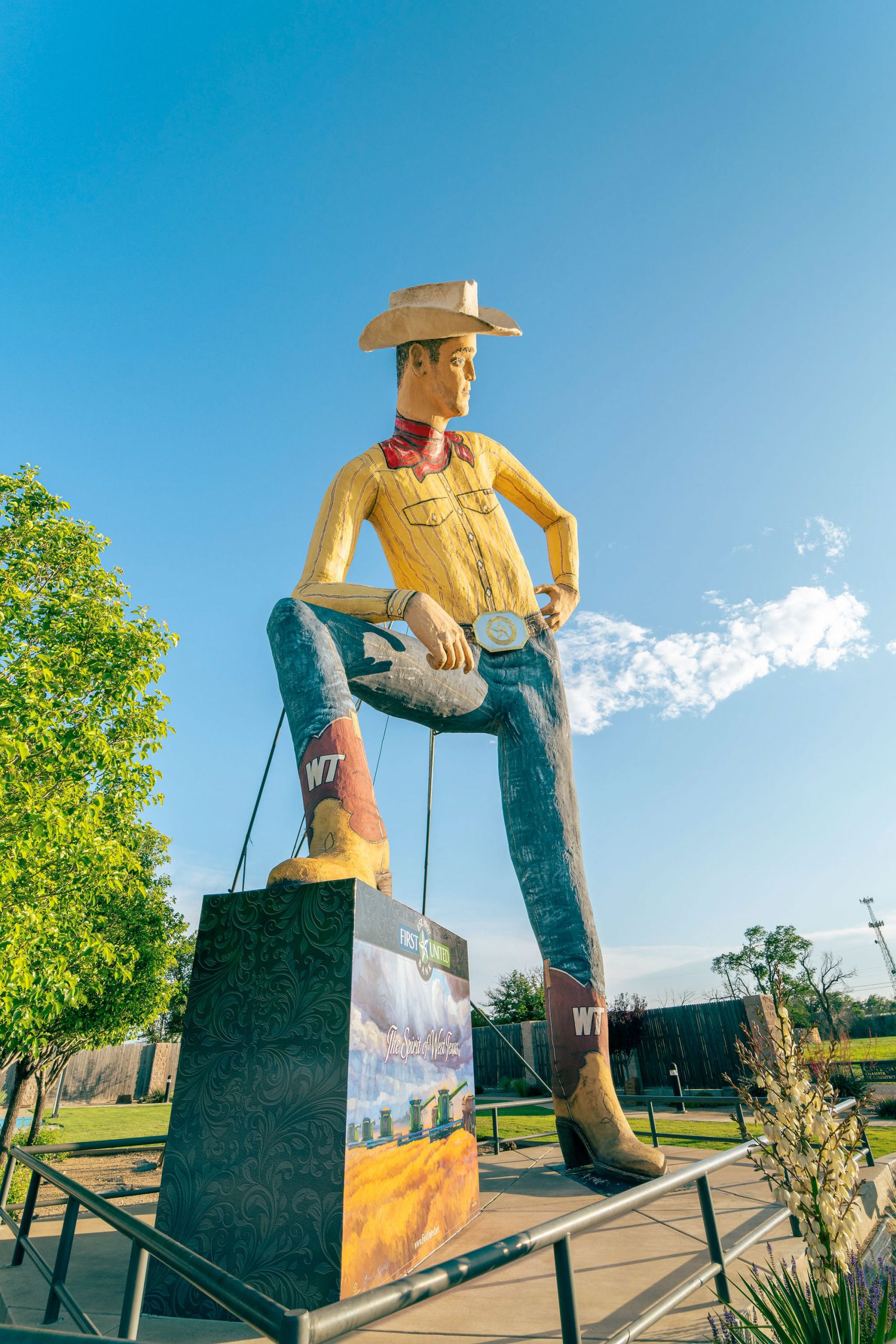
“When people come in from outside the community and they drive through and see him, the ‘wow’ effect is there,” Miller says. “I think that’s really special.”
Ten years later, Tex still sports the same look, albeit a little faded. According to Miller, he’s about to get another refresh: Canyon Main Street is planning another restoration project for next year. It’s in the beginning stages, but Miller says the cowboy might have a new Western wardrobe in 2027.