
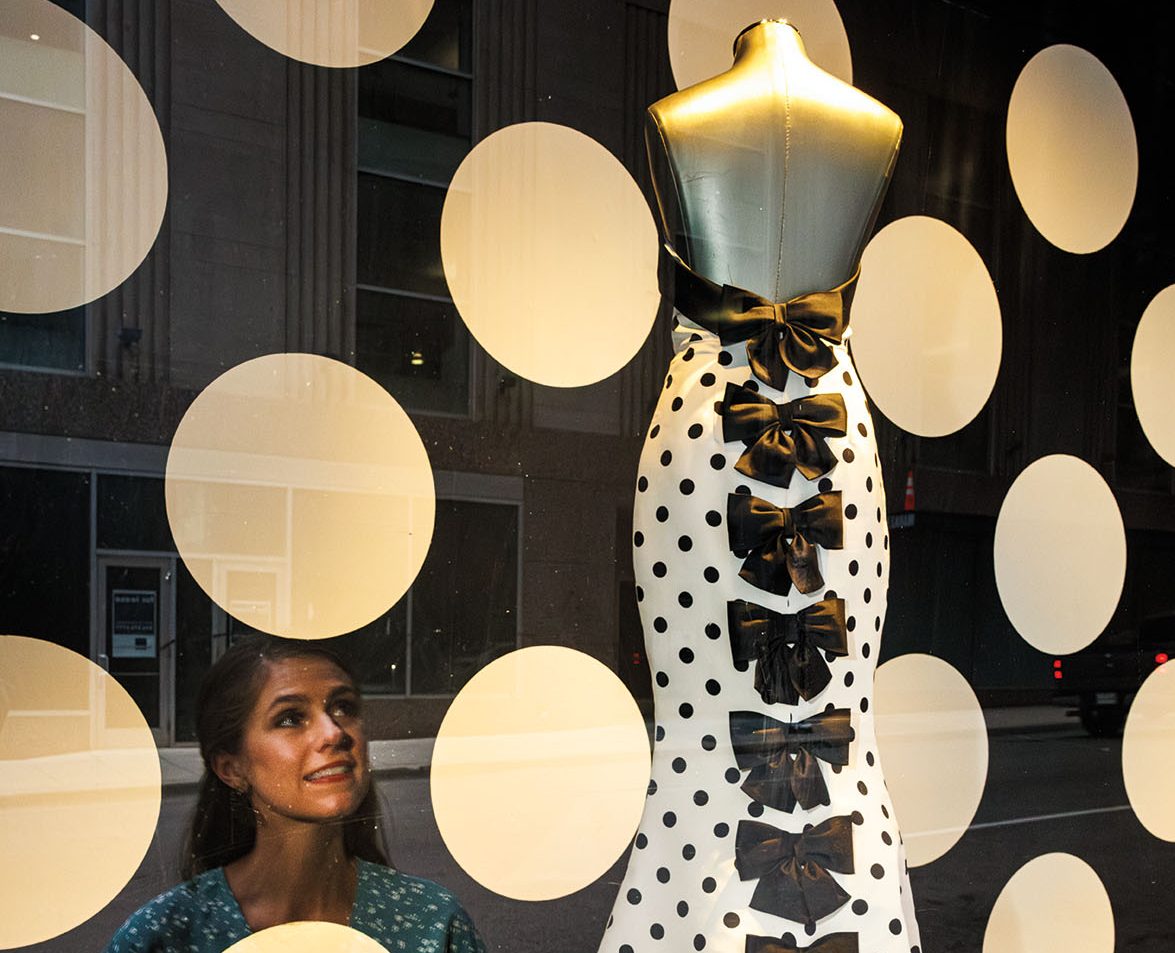
I’m standing under the classic red awnings that adorn the flagship Neiman Marcus, marveling at how this style icon has served Dallas for almost 120 years. It’s a beautiful March day, and the downtown window displays play on the spring theme: “Café Society – Fashion is Served.” In one, a mannequin is a baker clad in a ball gown while another sprawls across a kitchen counter in a white ensemble that evokes cake frosting. It’s all fun and vibrant, with no indication the curtain may soon fall.
Last year, Saks Global acquired the Neiman Marcus enterprise, and after much debate on the fate of this location, Saks has agreed to keep it open through 2025. What comes next remains uncertain.
Most Texans understand how the lavish splendor of Neiman Marcus is intertwined with our state’s over-the-top grandeur—take one look at their epic Christmas catalogs—yet for me the connection is deeply personal. My great-grandmother Gran Jeanne worked here for 20 years. I come from a family of Texas women, and she was the matriarch, a beacon of resilience who died in 2004, just shy of her 95th birthday. I’m named after her: Shannon Jeanne.
While Neiman Marcus has passed through several owners, it began as a family establishment. In 1907, two years before my great-grandmother’s birth, three brave souls opened the boutique to offer a revolutionary trend for Texas: luxury ready-to-wear clothing. Herbert Marcus and his sister, Carrie Neiman, hailed from an immigrant farm family, while Carrie’s husband, Al Neiman, grew up in an orphanage. All of them were Jewish, none came from wealth, and none were born in Texas—they chose the location for its centrality and appetite for boldness. Their earliest mantra was, “There is never a good sale for Neiman Marcus unless it’s a good buy for the customer.”

Herbert Marcus’ firstborn son, Stanley, advanced the company’s reputation. An ingenious marketer, champion of the arts, and passionate civil rights advocate, he worked at the family business for 50 years. Dallasites still sing his praises as a unifying yet forward-thinking business and community leader. Under his direction, Neiman Marcus elevated Dallas, defining the city worldwide as a fashion powerhouse while holding itself to the highest standards in its treatment of patrons, employees, and the community at large. Thanks to Stanley, Neiman Marcus was one of the first businesses in Dallas to desegregate. His work solidified the company’s ethos as a place that lifted people up.
During Stanley’s reign, Gran Jeanne arrived seeking opportunity after ruin. She must’ve been near my age now, in her mid-30s.
Born Jeanne Harton, she grew up in the small town of Kaufman and married my great-grandfather Jack Nash when she was 17. They had two daughters and moved to Midland, where Jack worked as an oil rig roughneck and developed alcohol and gambling addictions. Gran Jeanne would send her daughter Nan to the local saloon to collect Jack’s paycheck before he could blow it on booze and cards.
I wonder how she felt, isolated and poor. Was she desperate? Scared? Enraged? Eventually, she had enough. My Aunt Amie, who’s helped me unravel the timeline, found a diary describing Gran Jeanne and her children taking a bus back to Kaufman—without Jack.

Her mother-in-law took them in while Gran Jeanne sought work. Her first job post-divorce was at a bank. According to my mother’s cousin, Jane, Gran Jeanne struggled there, often mixing up numbers. No one knows for sure how she ended up in retail, but the story goes it was because of the striking way Gran Jeanne altered her bank uniform.
“She nipped the waist and switched out the buttons,” Jane says. “This customer comes in and says, ‘Your uniform looks so smart. You should go get a job at Neiman Marcus.’”
Sometime in the 1940s, she was hired at the famed institution. Gran Jeanne grew into her independence and climbed the ranks, ultimately working in fine couture through the 1950s and ’60s. This was the era of the glamorous Fortnights, where for two weeks every fall, the flagship store transformed itself into a dazzling replica of another country, highlighting its style, cuisine, and art. She dominated the peak department of the peak establishment during a time of explosive creativity and transformation in Dallas. Her found strength shaped fashion history, as well as our family.
“Gran Jeanne was a huge influence on me,” Aunt Amie says, recalling a memory of her laying into a racist neighbor. “I’d never seen a woman stand up to a man, and watching her, I went, ‘I can do that, too.’”
As I find myself at the steps of this legendary building, the weight of history bears down. I linger by the glass doors, eavesdropping on a family lamenting the store’s future. “We do our Christmas pictures here every year,” the mother says, a child in tights clinging to her chest. They’ve just come from the Zodiac Room, the city’s ultimate lunch spot, which is—of course—tucked inside Neiman Marcus.
I fluff my hair, channel my namesake’s courage, and enter the building. I’m taken aback by the open, airy first floor. The elevators, embellished with a gold-and-mirror crisscross pattern, feel too elegant to ride. I choose the escalators, which turn out also to be plated with a delicate gold. Even the water fountains are marble, but not a boring, stuffy white. Instead, they are a bold sea green.
Aunt Amie spent several childhood birthdays here with Gran Jeanne. “I remember the lady in charge of the furs—she would let me go into the room where they stored them,” she says. “It was cold. I’d run up and down the aisles and feel cold fur on my face.”
Stanley was known for treating staff like family, and during visits, this kindness extended to her. “He’d take me to the toy department to pick out anything I wanted, but Gran Jeanne always told me, ‘You’ve got to pick out the smallest thing and make sure it isn’t expensive.’ I’d just get a little stuffed animal, but he was like, ‘No, no, you need to get this.’”
I wander from floor to floor, admiring the beauty in every detail. “Can I help you?” the salespeople ask, warm and dressed impeccably. I tell them I’m just looking, though I peek at the price tag of a stunning floral Oscar de la Renta dress: $2,000. I settle for snapping a picture. I peer past the eclectic fine art collages and historical exhibits into the bridal suite, where a young woman tries on a timeless off-the-
shoulder white dress.
Rawlins Gilliland, an illustrious Dallasite born in 1945, helps me keep perspective about the potential closing. A celebrated poet, local activist, and retired national director of sales and product for Neiman Marcus, he’s frequented the store since his youth. He and I talk about the company’s reputation for taking chances, embracing women, and allowing nontraditional talent to rise.
“As early as 9 years old, I’d get on the bus alone, and I went downtown the way other people would go to Disneyland,” he says. “The only thing that seemed to me like it was otherworldly and cinematic and lustrous and imaginative and inspiring and curious was Neiman Marcus.”
Gran Jeanne would’ve been there then. I’m proud knowing she helped instill that sense of wonder.
At present, Saks Global claims they will work with the city to develop a plan for the space that preserves the Neiman Marcus spirit, but we’ll see. As Stanley Marcus stated in his memoir, Minding the Store, “Remember the past, but don’t worship it.”
No matter what, change is inevitable. People shop differently than they used to, and now there are many Neiman Marcus locations. Still, none have this legacy.
I exit back on Main Street and study the displays one final time, envisioning Gran Jeanne adjusting a mannequin’s gown. I can still hear her quivering voice and picture the girlish flip of her soft white hair, pushed back stylishly with a headband. Though she was essentially blind when I knew her, she could still spot a fashion faux pas and never held back in letting you know.
She taught me that what we wear can be a form of art and self-expression, and that reinvention is always possible.