
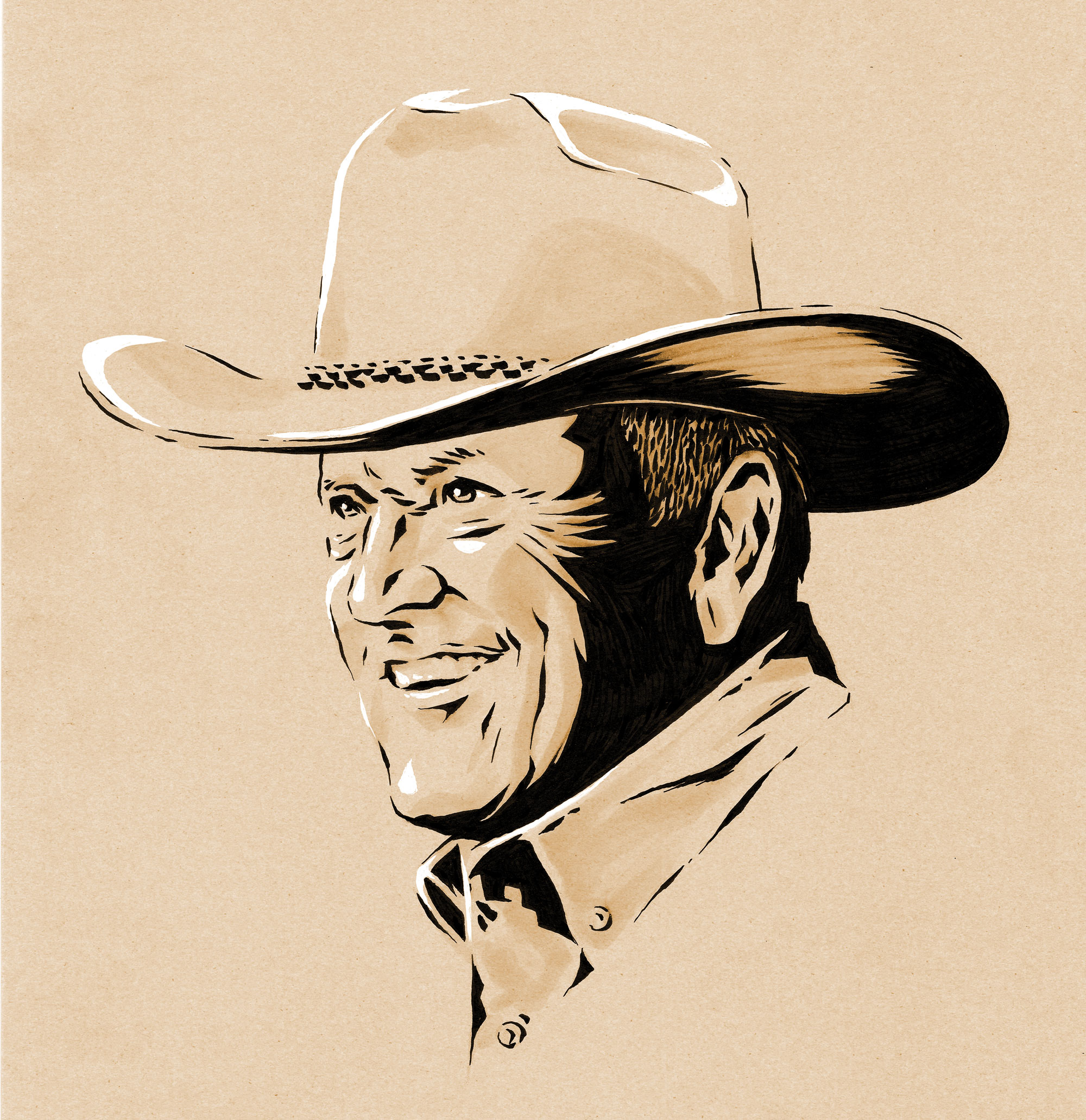
No athlete embodies Texas’ gritty determination like Nolan Ryan. The young pitcher wasn’t touted as the next big thing when he was drafted in the 12th round shortly after graduating from high school in 1965 in the small town of Alvin, 30 miles southeast of Houston. But thanks to a powerful arm and an even stronger resolve, he played for four major league teams over a staggering 27 seasons, racking up unbreakable records like 5,714 strikeouts and seven no-hitters. Ryan’s boyhood idol, Sandy Koufax, has the second most at four. No other pitcher has more than three.
Embracing the Lone Star State’s love of all things grandiose, Ryan’s famed fastball was clocked at 100.9 mph in 1974 for Guinness World Records, but modern adjustments for technology suggest it was a blistering 108 mph. Plus, he was the first Major League Baseball player to sign a million-dollar contract.
Married to his high school sweetheart, Ruth, since 1967, the pair have three children and seven grandchildren. These days, the family man spends time on his Texas ranches working with livestock, which serves his business ventures Nolan Ryan Beef and the premium Goodstock label. But even in retirement, the entrepreneur has stayed close to the game, founding two Minor League Baseball franchises: the Round Rock Express and the Corpus Christi Hooks.
Known for his distinct accent, Ryan has a penchant for folksy wisdom that almost feels like the final word on any given topic. “I like to think that I have the same mindset in business that I had in baseball,” he says. “That if you’re going to be successful, you have to be willing to work hard and stay with it.”

Texas Highways: What was life in Alvin like when you were growing up?
Nolan Ryan: The principal livelihoods were rice, cattle, and oil, and it was a laid-back town. We built a baseball field on an empty lot so the neighborhood kids could play ball there. Your mother wanted you out of the house in the summertime, and as long as you showed up for dinner, everything was fine.
TH: Which other places in Texas are special to you?
NR: A lot, because of the diversity of the state. I like the Big Bend area. I like the Gulf Coast for bay fishing, and I go to Port Mansfield. We have a ranch between Junction and Sonora. It’s an old military fort called Fort Terrett. We spend a lot of time there with the family and hike and fish because it’s the headwaters of the North Llano River. That’s a special place for us.
TH: What were the biggest contributing factors to shaping your identity?
NR: I think a lot of it has to do with your parents and the expectations they had of you. The work ethic of my parents was an influence for all the kids. That definitely had a bearing on how I was raised and who I was. I was one of six kids, and I was the baby. I had my sisters and a brother to look up to, and they pretty much set the tone for how you acted and who you were.
TH: You played in both New York and Los Angeles. How did it feel arriving in those big-city markets being from Texas?
NR: I can remember going to New York for the first time and being overwhelmed by that environment. It was certainly something I wasn’t accustomed to and was definitely different than my lifestyle. It was an adjustment living in New York and made me appreciate Texas even more—the laidback atmosphere and not such a hectic lifestyle.
TH: How much of what made you a singular player was physical and how much was mindset?
NR: Once I realized I was given a gift—and it wasn’t anything I did; it was a gift from the Lord that I had the ability to throw a baseball like I did—I decided that I needed to try to make the most of it I possibly could. So, I really dedicated myself to being the best I could be and pitching as long as I possibly could. That was the mindset I had.
TH: Is it true that your wife talked you out of quitting early on in your career?
NR: Yeah, I was so disappointed in how my career was going with the Mets that I felt like maybe I needed to go do something else. She thought I was giving up on myself too early, that I needed to stick it out and see if things would get better.
TH: How did you keep your family so close-knit over such a long career that has such a demanding schedule?
NR: When the kids got out of school in May, we incorporated our family into the travel cycle of baseball, and they enjoyed seeing different places. We just made the most of it and included them in our activities. Once the boys got big enough to be batboys and stuff like that, they were around the players and on the field. That was important to them, and they felt like they certainly were part of the operation.
TH: What was the most crucial turning point in your career?
NR: I was in an Army Reserve unit in Pasadena, and I had to come home every month to go to meetings. And I was gone for two weeks in the summer for camp, and that definitely interfered with me being in the rotation and being consistent. When I got traded to the Angels, my military obligation was over, and that allowed me to pitch on a four-day rotation. That was one of the definite turning points. I accumulated a lot of innings and was able to stay focused and not have any kind of interruptions in my routine.
TH: Your career has led you to cross paths with some amazing people. Who are some of the most memorable ones?
NR: George H.W. Bush. He had an uncle who was one of the minority owners of the New York Mets, so it gave me the opportunity. He invited Ruth and me to the White House to go to a state dinner and to stay in the Lincoln bedroom. And then with George W., he invited us to a Christmas party at the White House, and we were able to take the kids. That’s a special memory for everyone.
TH: Which games stand out the most over your career?
NR: I think the Detroit no-hitter was the most overpowering I was in a game, but they were all different. There’s always a play made during a no-hitter that puts you in that position—whether it’s by your infielders or outfielders—that makes the game unique and also gives you an opportunity to accomplish that.
TH: How does it feel to have fans from two rival fanbases with the Astros and Rangers?
NR: They were in two different leagues at the time, but now with them being in the same division, it’s different. I have been blessed with the fact that the fans have been very supportive of me throughout my career, and I really appreciate that. Both the Rangers and the Astros have become very competitive, which earlier on in their years they weren’t. People are more prideful of the fact that they’re a Ranger fan or they’re an Astro fan, so I think that’s changed over the years.
TH: Now that you’re a spectator at the ballpark, what makes the experience special?
NR: Sharing the experience with friends or with family, and the uniqueness of the game. Sit there and watch a ballgame develop, and you’ll see something different every time.