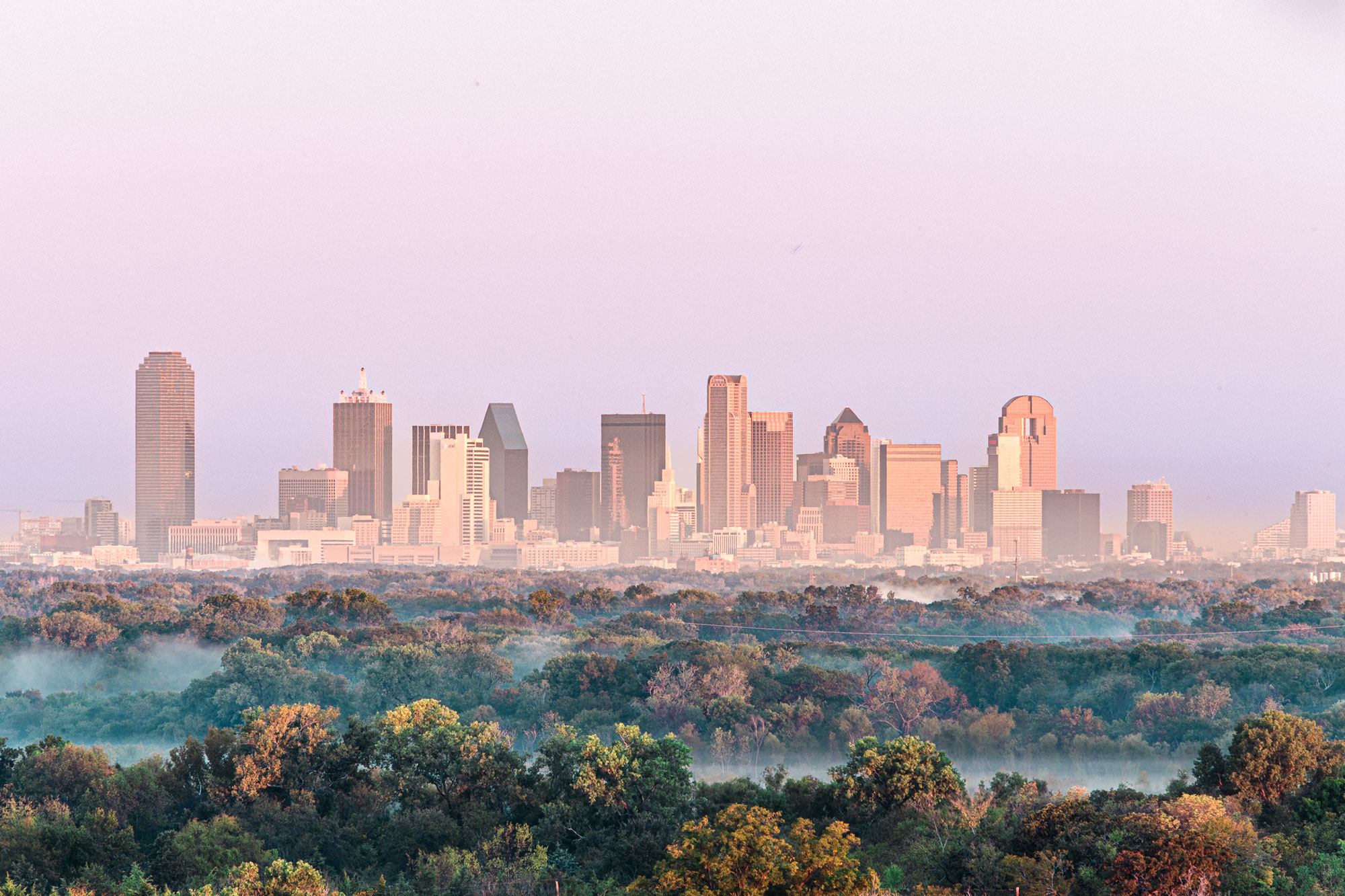
A few years ago, I kayaked on the Trinity River into the Great Trinity Forest. Though I could see the downtown Dallas skyline, I was surprised when I pulled my kayak up the muddy bank next to a man fishing. I could see highways but couldn’t hear the constant drone of cars or urban life that’s seemingly inescapable in a city of more than 1.25 million.
This aspect of the Great Trinity Forest has always been a source of wonder for me, whether I’m cycling under the large woodland canopies or spotting deer, rabbit, birds—and once, a wild hog!—while hiking on the trails. No matter which part I visit, it feels like I’m somewhere in East Texas, not in a forest just a 12-minute drive from downtown on Interstate 45 and State Highway 175.
The Great Trinity Forest is the country’s largest urban hardwood bottomland forest, defined by Native Plants of North Texas as, “a transition area between more arid upland hardwood forests or prairies and very wet river floodplains and swamps.” It’s also home to 6,000 acres of centuries-old trees and archeological remnants from the Caddo, Wichita, Comanche, and Kiowa nations buried under layers of land covered in wild mushrooms, shrubs, and flowers. Paved trails weave around Big Spring; ponds; lakes; and wetlands, and egrets; eagles; beavers; otters; bobcats; and coyotes abound under a canopy that is 5 degrees cooler than anywhere else in the city.
Despite all its natural wonders, the Great Trinity Forest is known for something else: not being well known.

“When you think of Dallas, you don’t really think of forested areas,” says Sofia Lopez, an educator at the Trinity River Audubon Center, which oversees a portion of the forest that used to be an illegal dumping site but has since been revived.
Even Texas A&M’s Forest Service’s website, which highlights urban forests, doesn’t mention the Great Trinity Forest (or Dallas). It’s surprising, considering the forest is nearly three times the size of the largest outdoor space in Austin.
While the Great Trinity Forest spans across some private land, much of it is accessible and free to the public. Joppa Preserve, William Blair Jr. Park, Trinity River Audubon Center, and McCommas Bluff Preserve all sit within it, totaling just a portion of the forest at 1,530 acres. There’s also an adventure park, where visitors, for a fee, enjoy zip lining and rope courses.
“You can go hiking [in the Great Trinity] and feel like it’s not overcrowded,” says Amaris Ribeiro, center director at the Trinity River Audubon Center. “You can feel what you want to feel like in the forest, like you’re the only one that would hear a tree fall.”
Despite its proximity to downtown, the forest doesn’t have the same foot traffic as Dallas’ White Rock Lake or the Cedar Ridge Preserve. Lopez believes most people just don’t know it exists.
“We are such a hidden pocket,” she says. “We’ll have people native to Dallas comment, ‘I’ve never noticed that this was here.’”
Although some of the parks within the forest have been open since the 1980s, the site where the Trinity River Audubon Center sits was once the largest illegal landfill in the state. While it’s hard to say why the Great Trinity Forest is not as popular as Dallas’ other green spaces, a portion of it being a former landfill site probably doesn’t help.
The creation of the Trinity River Audubon Center led the city of Dallas to introduce a long-term management plan for the forest in 2006. It addressed everything from tree conservation to wildlife habitat protection, flood control, and public access. In the past 20 years, strides have been made to rehab the forest and make it more accessible.
People visit the center for guided hikes, outdoor dining experiences, birding adventures—there are 240 documented species in the area—summer camp, or events like Moth Night, where stations with backlit white sheets are created to attract nocturnal insects for visitors to observe.
The trailhead outside of the center leads directly into other areas of the Great Trinity Forest, as well as part of the AT&T Trail that links with the Trinity Forest Trail. These trails and others connect to form the Dallas Loop, a 50-mile paved bike and hike trail circling the city that is expected to be (mostly) completed at the end of 2026.
Paved paths in the forest and public parks—which are home to playgrounds, ball courts, and ponds for fishing—can be explored by bike, scooter, or on foot, though soft trails exist throughout the forest, too. Some, like the Sycene Overlook Trail in Piedmont Ridge, lead to scenic overlooks, and offer seasonal views of the forest and the Dallas skyline. There’s also horseback riding with River Ranch at Texas Horse Park. Without a doubt, the forest’s centerpiece is the Trinity River. It attracts anglers, kayakers, and canoeists paddling the Trinity River Paddling Trail, which ends in the Great Trinity Forest.
“The forest feeds that river, and the river feeds the trees,” Ribeiro says. “It’s magical.”