

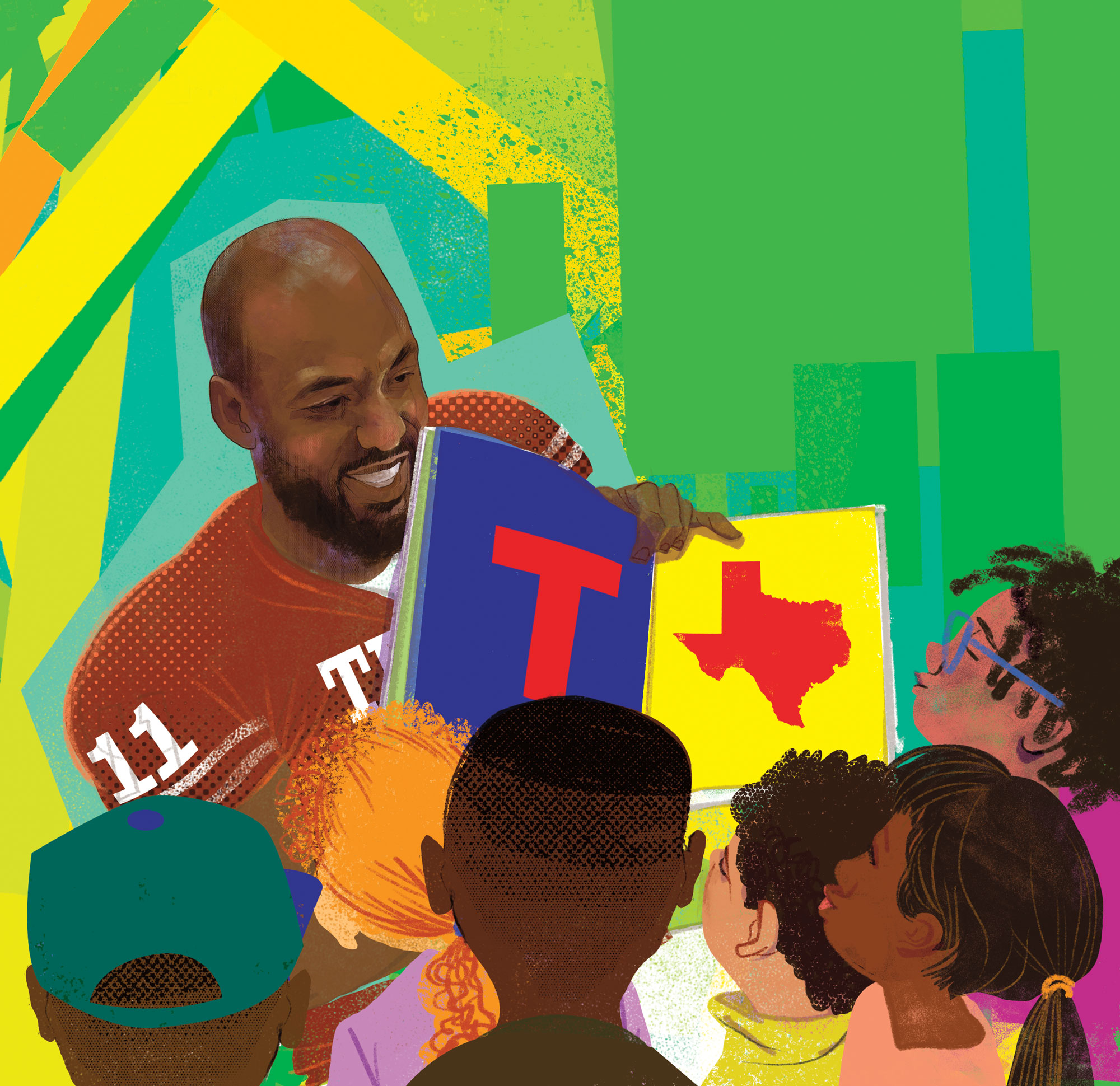
For much of his life, Derrick Johnson spent weekends striking fear into the hearts of men. If the 6-foot-3 linebacker glowered at you over the rest of his defensive squad, that usually meant you would be thrown to the ground like a crumpled aluminum can. Across 14 seasons in the NFL, the first-round draft pick and four-time Pro Bowler racked up 955 solo tackles, making him 18th on the all-time leaderboard in the category.
But beneath that brutish exterior is a guy who values education above all else. Born in Waco to a mother who was a schoolteacher, Johnson was instilled with an appreciation for learning and literacy. The former University of Texas Longhorns and Kansas City Chiefs defensive specialist made a career out of his on-field intelligence and inventive approach to the game.
Johnson became known for ducking under offensive linemen, avoiding blocks, and finding gaps in the line to make big plays. For most of his career, he wore the green dot on his helmet. This signifies the defensive player who receives calls from coaches and communicates them to the team on the field—think of him as the quarterback of the defense. It’s a position that requires mental acuity as much as it does physical strength.
Now, the husband and father of six spends his time passing on a passion for knowledge through his Defend the Dream Foundation. Launched in 2012, the nonprofit works in low-income schools to provide much-needed resources to students and renovate libraries. So far, the organization has provided new infrastructure, furniture, and thousands of books to 24 Title I elementary schools in Austin, Waco, and Kansas City, Mo. Last August, Johnson and his wife, Brittni, published a children’s book, Super DJ Saves Field Day, in which Super DJ (a nickname derived from Johnson’s days on the field) helps young people discover their unique abilities through hard work, determination, and kindness. “It’s not about being the best, it’s about being your best and discovering the superpowers you already have inside you,” Johnson says.

TEXAS HIGHWAYS: You’ve spent your whole life on the Interstate 35 corridor—you were born in Waco, came down to Austin for college, and went up to Kansas City to play for the Chiefs. Do you have any good stories from being on the road?
Derrick Johnson: I used to ride with other players back home to Waco on I-35. I didn’t have a car my first year, and I would jump in the car with whomever was going to Dallas. A couple guys I would ride with would scare me. They would put their hands out on my chest suddenly and stop hard right behind a semi while I was sleeping.
TH: You were born and raised in Texas, played high school and college football here, and then left the state for 13 years for a professional career. What did you miss the most when you were away?
DJ: The weather. I like when it’s hot. When you’re in Kansas City, you get all the seasons. But when you get to October and November, man, it’s done after that. I never got used to it. Whenever I finished the season, I rushed back to Texas every single year. If we didn’t make the playoffs, or we lost a playoff game, that next day after the team exit meeting, I’m out.
TH: What makes Texas football culture so iconic?
DJ: Football in Texas is like a religion. Even if it’s a small town, football is religion here. At 7 o’clock on Friday, not a lot of people are in the house. And that’s how I grew up. My brothers played, and I watched a lot of football, being the youngest in my family. Friday night was an event that I would look forward to. It really shapes your mind on what football is and how big it is. And when it’s your time, it’s like, I’ve been watching this forever. It’s my time now.
TH: Kansas City is supposed to have good barbecue, but did you miss Texas food?
DJ: I give Texas the edge with barbecue. I say that very slowly because when I’m in Kansas City I am not missing out on barbecue— from Q39 to Arthur Bryant’s to Joe’s Kansas City. But I like the brisket here a little bit better. Terry Black’s is my favorite.
TH: You made an impact as soon as you got to the NFL. How did your time at UT prepare you for a pro career?
DJ: You play at such a high level with big games and big-time opponents, and you’re getting coached by the best. You are around the best players in college football, some NFL-level guys. And when you can perform at that level, when you go to the NFL, it’s a step up, but it’s not a leap.
TH: Does being a first-round pick put extra pressure on you to perform in the NFL?
DJ: Yeah, it does. But it’s not a thing we shy away from. You’re a first-round pick for a reason. Whoever is a first-round pick wants to be a first-round pick. We ask for this; we dreamed for this moment. Sometimes the pressure is too much for others because what you did in college said first round, but when you got to NFL, it didn’t show. If you can’t handle it, I think you were just ranked higher in college and probably shouldn’t have been a first rounder.
TH: What’s the biggest lesson you learned on the field but have applied to life in general?
DJ: It’s never as good as you think it is, and it’s never as bad as you think it is. You just have to keep focusing on getting better. That’s life in general. Life is 10% of what happens to you, 90% on how you respond. What do you do after you make a mistake? What do you do when your confidence gets shot? Do you shy away, or do you stand up and get better? Some of my best moments in football happened after adverse moments.
TH: Did you have pre-game rituals that you still do today?
DJ: I’m a big spiritual guy, so for me it’s about being able to pray, clear my mind, and have peace going out on a battlefield. I listened to music, but I didn’t listen to a lot of music that hypes me up. Some people need that hype—everybody’s different. You see guys jumping around; they’re ready because they’re listening to something. I’m already there. I wake up there. I need something to give me peace, like gospel music and R&B music. I’m a fan of Stevie Wonder, Brian McKnight, Joe, SWV, and Mary J. Blige.
TH: Often, offense gets the glory and there’s sort of a quiet power to playing on the defensive side of the ball. Is that something that you enjoyed or lamented?
DJ: It’s always going to be that way just because of fans. People like to see a touchdown. But for us, we’ve always got that chip on our shoulder because we’re defensive guys. They want to see these guys make touchdowns, so we’re going to spoil their plans.
TH: You’ve worked with so many legends. Who taught you the most about football?
DJ: Coach Gary Gibbs. He was my linebacker coach for nine years at the Chiefs. He let me be myself within the scheme. Imagine you have a scheme and you’re approaching the linebackers, and you want them to do it a certain way. And you’ve got this athletic, tall linebacker who dips under lineman, shoots gaps. Coach Gibbs was like, “I’m not teaching that, but you know what? Let’s keep that. What you have is special.” He coached me from where I was at.
TH: Who were the most memorable opponents you faced?
DJ: Tom Brady’s always memorable. To play against him in his prime kind of sucked because you don’t really win that much against him. But during that time, you learn a lot and it really sharpens your game. Peyton Manning, Russell Wilson during his prime, Randy Moss, Marshawn Lynch. I like going against them because that tells you if you’re playing at a high level or not. If not, they’ll let you know.
TH: What made you want to write a children’s book?
DJ: When we open these libraries in Title I schools, I’m in a position to talk to the kids, read to the kids, give some wisdom, and I have their full attention. I love Dr. Seuss books, Pete the Cat books, but I’m like, let’s get more specific. Let’s write something where these kids say, “Hey, this is that football player I saw who told me hard work pays off and that education is super important.” Super DJ is a dad turned superhero who helps kids overcome challenges and define their own superpowers by trying their best to be their best.
TH: You’re an athlete, a coach, and a podcaster—and now you’re an author. What role is the most fulfilling for you?
DJ: Being able to serve the youth through doing library makeovers at Title I elementary schools with my foundation. To be able to give them the proper resources to help them reach their full potential. You find out a lot about yourself when you serve. My mom was a schoolteacher for over 40 years. She taught math, and she was big on reading. Reading is in everything, so that gives you confidence. When I inspire kids to do their best and work hard on the football field or in the classroom, I think that’s a big deal.