
My dad cut the head off a cottonmouth snake when I was 9 years old. He draped the body delicately over a tree branch and continued to hike, alongside my mom, two brothers, and me, down to Pedernales Falls State Park. This is how I was reintroduced to Texas after spending most of my early life elsewhere. I had not even met our neighbors.
My childhood was defined by outdoor adventures like these. We spent every vacation traveling to a new state park or geographic oddity. Usually, the family fished while I read Harry Potter or got lost in the woods, collecting sticks and poison ivy rashes. Pedernales Falls was a frequent destination for us once we moved to Dripping Springs, about 25 miles west of Austin. The state park offered something for each of us, with its prevalence of catfish, sprawling views of the Hill Country, and a swimming hole tucked away downstream. Plus, it was only a 20-minute drive from our house.

The land where the 5,212-acre parcel sits historically functioned as the Circle Bar Ranch. The state purchased it from Harriet Wheatley in March 1970 and opened the park in 1971. Wheatley offered the land to the state with the “wish that it be conserved, and all of the wildlife be taken care of, and that it be enjoyed from generation to generation,” according to John J. Leffler’s book Farmers, Ranchers, the Land and the Falls: A History of the Pedernales Falls Area, 1850-1970. The park’s territory grew in 1992 after rancher Herman Reiner sold additional land to the government.
The cascading rock formations surrounding Pedernales Falls must be deftly maneuvered by hikers. More than once, my family wandered in circles after sunset looking for our way back up. But these challenges made each journey memorable. At some point while growing up, I had an epiphany that while other families sojourned at Disneyland or a beach resort, I was gutting carp. Discovering this resulted in shock—then envy. Today I feel gratitude for the time spent absorbing a natural beauty that is slowly but surely diminishing.
Based on 2016 data, the most recent available, the Texas Hill Country Conservation Network reported that 7% of the Hill Country was developed. However, only 5% of the Hill Country was conserved as of 2021, falling far short of the conservation network’s 30% goal.
Living in Austin, the development boom is especially evident on the road. Leaving the city at 4 p.m. on a Friday and heading west on US 290 is an arduous task. The stretch of highway out of South Austin is characterized by bumper-to-bumper traffic and widespread expansion. The highway’s development supports our thriving metropolis and once completed should provide relief from the congestion. But this isn’t the beautiful gateway to the Hill Country that I moved to when I was younger.
One recent afternoon, back in Austin after graduating from college, I make my way through the perilous traffic of 290 toward the old grounds of my childhood wonder. As I approach Pedernales Falls, my indignation toward the Mazda that cut me off earlier becomes quiet anticipation for the stretch of undeveloped land ahead. I pass my parents’ house, which they bought in 2013 because it was close enough to Austin for my dad’s job but far enough that we were surrounded by trees rather than industry. Thousands have had the same idea in recent years, and the verity of that verdant fantasy is slipping away.
The population of Hays County, where my hometown is located, grew by 100,819 residents, or 59.9%, between 2012 and 2022. In the capital region overall—encompassing Austin and most of the Hill Country—the growth rate was 30.9%. The region also witnessed a surge in employment across major industries including computing and data infrastructure. Such growth necessitates rapid land development and resource consumption—but our state parks remain.
Past my parents’ house, the newly expanded subdivisions begin to fade into Ashe junipers and live oaks. I can finally hear birds rather than bulldozers. Around 5 p.m., I arrive at the park. Since it’s after regular hours, the headquarters has closed. There is not a ranger in sight. I deposit six $1 bills into the after-hours pay booth, collect a trail map, and head for the falls, which will require a short hike downhill.
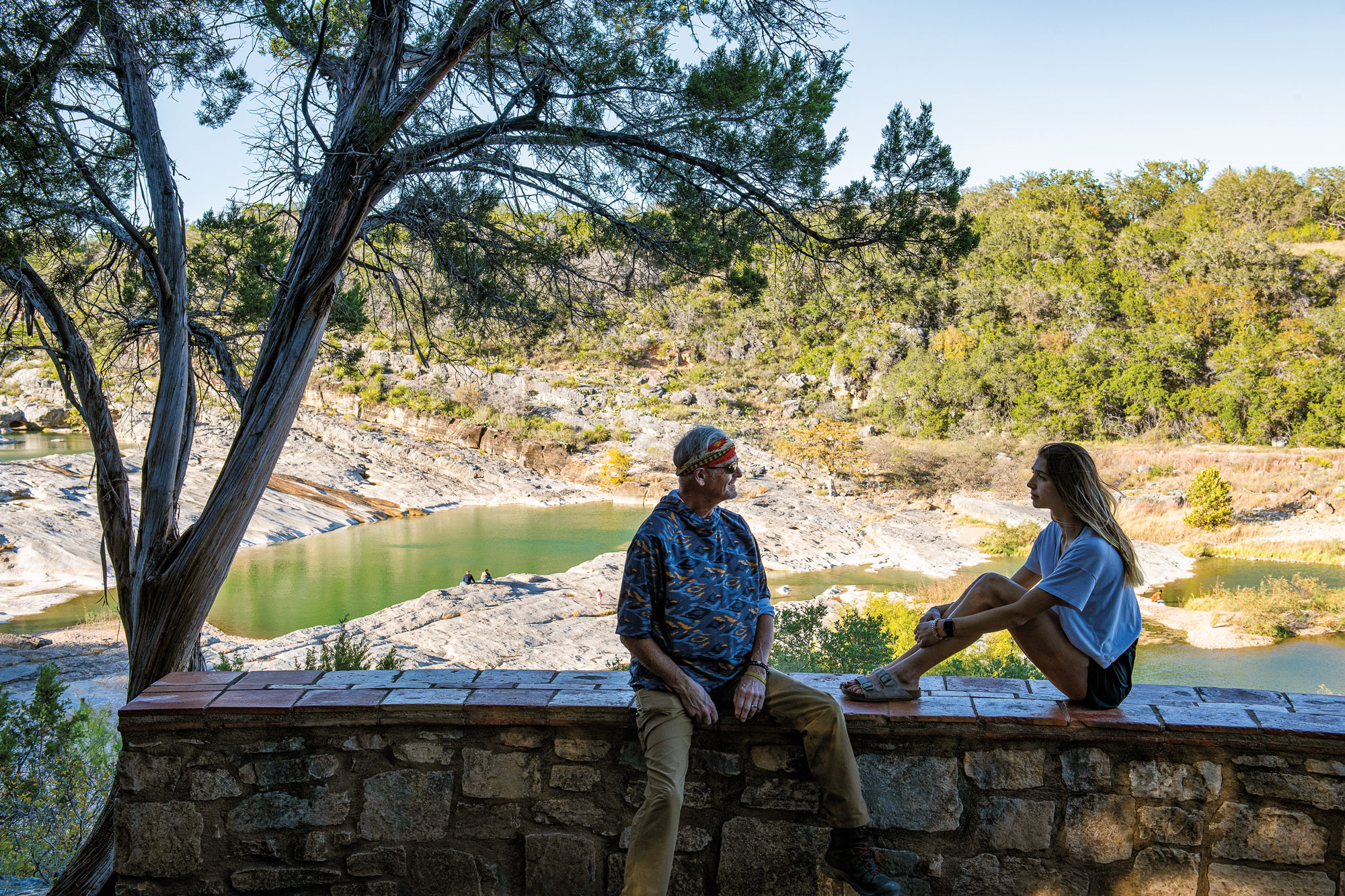
The parking lot is nearly empty, partially due to the late hour. I fill my Hydro Flask with water from the fountain outside the bathroom and begin my descent. At the falls, a few young people laugh as they splash around on the banks with their golden retriever. I steal a spot away from them in the shade, listening to the water flow down toward the river while I wait for my dad, Mitch, to meet me.
The water levels are low, but no lower than expected. It’s mostly rocks here these days. There’s a small beach directly to my right. During the flood of September 1952, “a wall of water 60 to 100 feet high roared down the Pedernales,” according to Leffler’s book. This occurrence deposited sand to form the beach.
Hidden underneath, natural springs supply water to the river. My family used to stumble upon the odd spring, and each time I took a drink, cupping crisp, clear water into my hands.
I look over the water that remains and lean into the setting sun. Dragonflies flutter around me. I remember trying to catch these delicate creatures when I was younger to study their wing patterns. Even in the shade, I start to sweat. Like the falls themselves, my mouth grows dry.
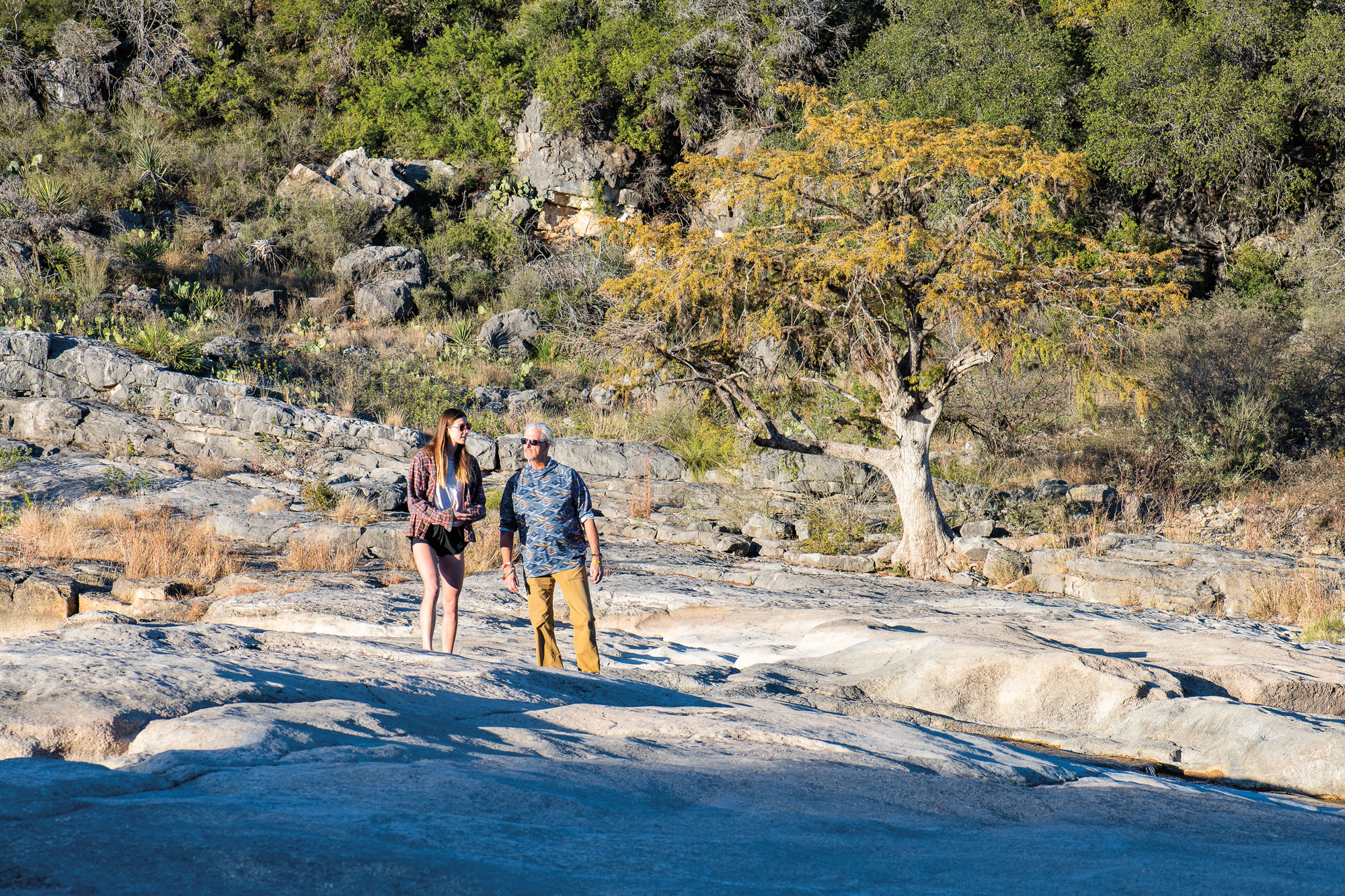
My dad eventually arrives with two dogs in tow. This is our second duo venture to Pedernales Falls in the last month. Today, we stumble upon Trammell Crossing, one untraveled during my youth, and wrangle the dogs into their harnesses. I take our younger dog, who my younger brother named Skyburglar. (I don’t know what it means, either.) My dad has the easier task of walking our older and less hyperactive dog, named after Willie Nelson—because my dad has always connected to the world through music.
The path to Trammell Crossing, much rockier and less defined than the major trails, tests the limits of our dogs’ cardiovascular strength and my dad’s two artificial hips. “We’re in redneck country now, Pipe,” my dad chuckles.
The elevation is in constant fluctuation. Somehow, we seem to go uphill the entire time, but we never complain. The rocky terrain forces my focus to shift between keeping my footing and appreciating the flora. As an exercise addict, I enjoy the surprises the hike is providing and reflect on those days stumbling in the dark with my brothers after a night of catfishing. Modern life requires far too little physical challenge.
We pass exactly two sets of fellow hikers during our trek, looking up from our tracks to pant the obligatory “Hi” or quickly nod with pursed lips. At Trammell Crossing, the path reaches a dead end, water rushing smoothly over concrete, with nothing paved ahead. We begrudgingly turn back in the growing darkness, not realizing the trail continues on the other side of the river.
At the car, we supply the dogs with water from a massive red Yeti. I pull out a bag of Corn Nuts and some trail mix. “Nut?” I ask my dad. “Oh, yeah!” he replies, and I pour him a handful.
“Thank you,” I say, turning to him after chewing, “for coming with me today, and for taking me here so many times before.”
It’s easy to get caught up in city life and spend all day indoors. I’m scared to lose these moments, breathing fresh air with the people who taught me to appreciate the outdoors. But with days like these, I know that won’t happen.
Satisfied, we get back on the main road. Willie is sticking his head out the window and Skyburglar is sleeping, while I peer out at the sunset. My dad turns on The Beatles and sings along. Ob-la-di, ob-la-da, life goes on, brah.