
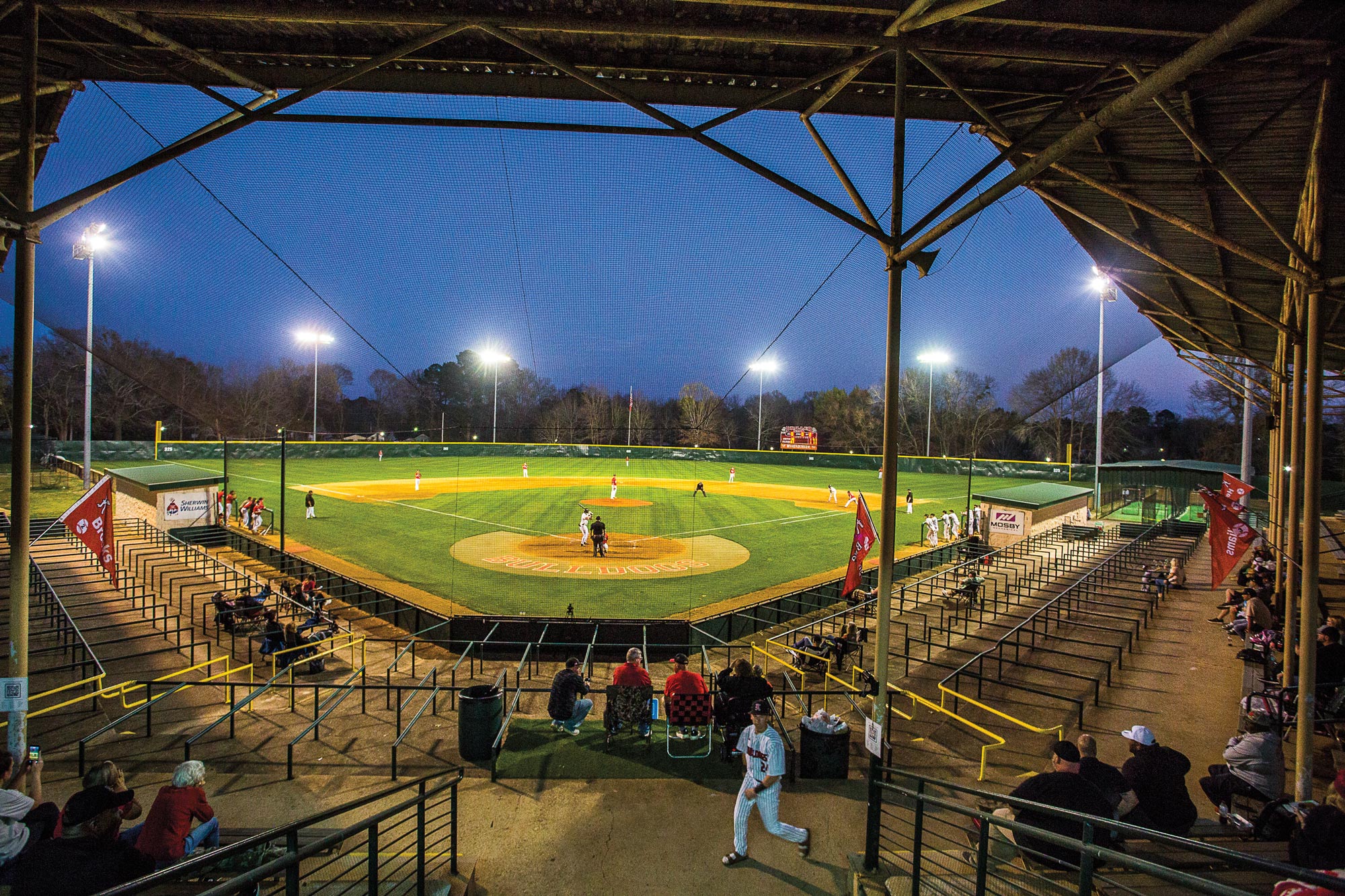
We’ve barely entered Driller Park’s grandstands when my 76-year-old father, without breaking stride, angles away from the Kilgore dugout and toward the visitors’ side—what I’ll tell him on the drive home looked like a man being pulled by dowsing rods to his long-lost people. He shuffles into an empty row of bleachers and stares down. What he’s trying to determine is this: Which unenumerated seat, which section of East Texas pine, will provide a modicum of comfort during this high school baseball rivalry?
It’s mid-March, smack-dab in the middle of the 2025 season. We’ve traveled 120 miles from Dallas to watch the Kilgore Bulldogs take on the Lions of Henderson, my father’s alma mater. (“Live like you roar,” the team bus says.) It’s a consequential matchup in the District 16-4A high school power rankings, but my father’s distracted. Over the pregame popping of mitts, over the turnstile thwack of a fungo bat, my father cranes his neck one way and then the next before pulling it back down into the shell of his fly-fishing shirt. “I hope no one asks about the high school reunion,” he says.

Over the last decade and a half, my father and I have chosen a stadium to visit every few years. This experiment in father-son exploration has landed us in Busch Stadium, Wrigley Field, Navy-Marine Corps Memorial, and “The Big House” up in Michigan. Each location carries its own weight, and each offers an atmosphere untempered by its continuous smelting of historical largesse. One cannot see the Midshipmen standing shoulder to shoulder, aligned like penguins in their caps and peacoats, without contemplating much deeper, searching thoughts. Nor can one see Wrigley Field, one of the last matchstick castles still standing against the bulldozers of opulence and bloat and not feel a strange sense of longing. But this is why we visit. This is why tickets are purchased and gates are entered. This is also why—through mouthfuls of peanuts and hot dogs—words like “pilgrimage” and “hallowed ground” are occasionally coughed out.

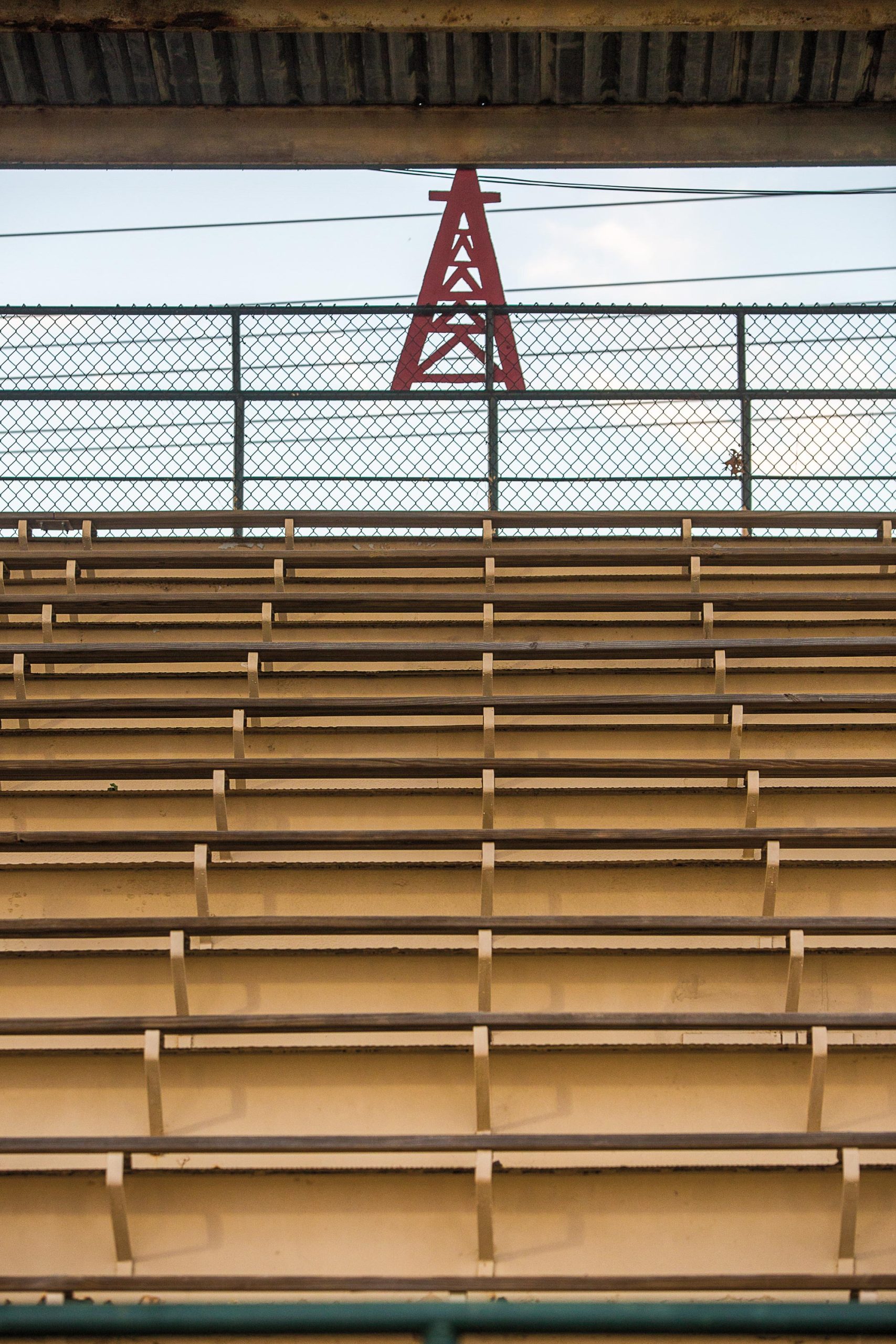
Driller Park may not host the World Series or a national championship, but it’s drenched in a vernacular architecture that’s hard to come by, and that alone makes it a worthy stopover along any journey through the nation’s great sporting venues. But truth be told, the stadium packs personal sentimentality as well. It’s the only ball field that my father and I, in our ever-receding youths, both jogged onto.
Before the first pitch, I turn to my father, who’s already embarked on his one-man Abbott and Costello routine—questioning why players need to be introduced like pro athletes ahead of the national anthem—and I ask him the one question every aged athlete gets queried upon reentering a house of former glory. “What’s it feel like being back?”
He looks toward the flagpole as if he’s checking the wind, then he rescans the crowd before leaning into me, conspiratorial-like. “It feels,” he says, “like victory.”
Constructed in 1947—the year before my father was born—Driller Park stands as a shadowbox of time and place. Its perimeter is hugged by pine trees and acorn streetlamps, and its facade is dotted with little oil derricks, an almost inescapable image across this former boom town. Then there’s the pumpjack. Like some caged, Sisyphean workhorse, it toils away behind barbed wire along the eastern edge of the parking lot, a reminder not just of the area’s economic indebtedness, but also of the man who donated the land so this stadium could be built. His name: S. S. Laird.
Outside, the park appears squat, snub-nosed, and pugnacious, but inside, there’s a simplicity to its design, a theatrical rectitude that was seemingly lost when baseball regionalism entered its mid-20th century golden twilight. Concrete slabs stack 3,000-some-odd seats to the base of a corrugated, cantilevered canopy, and pipes salvaged from the East Texas Oil Field pitch the roof outward. The whole thing looks like a giant, antique viewfinder. The outfield wall is a patchwork of flattened boiler tanks. From the grandstands it resembles a green ribbon, but up close it’s a hopscotch of dings, dents, and gouges, offering a texturized coat that might best be described as reptilian.
But Driller Park isn’t all oil tributes; far from it. The actual playing surface—the grounds that help determine whether hops are true and scorecards are clean—is top-notch. The grass is composed of Tifway 419 Bermuda, meaning Jack Nicklaus would be more than happy laying up on it; and the pitcher’s mound is packed with “black gumbo” clay, what you’ll find Major League groundskeepers pushing around in wheelbarrows. I half expect Robert Redford to appear and go lollygagging after a fly ball in center field. But the park’s true value lies in its continued reckoning with past and present. It allows us, generation after generation, to participate in a ritualistic competition that informs us of who we are, were, and would like to be.
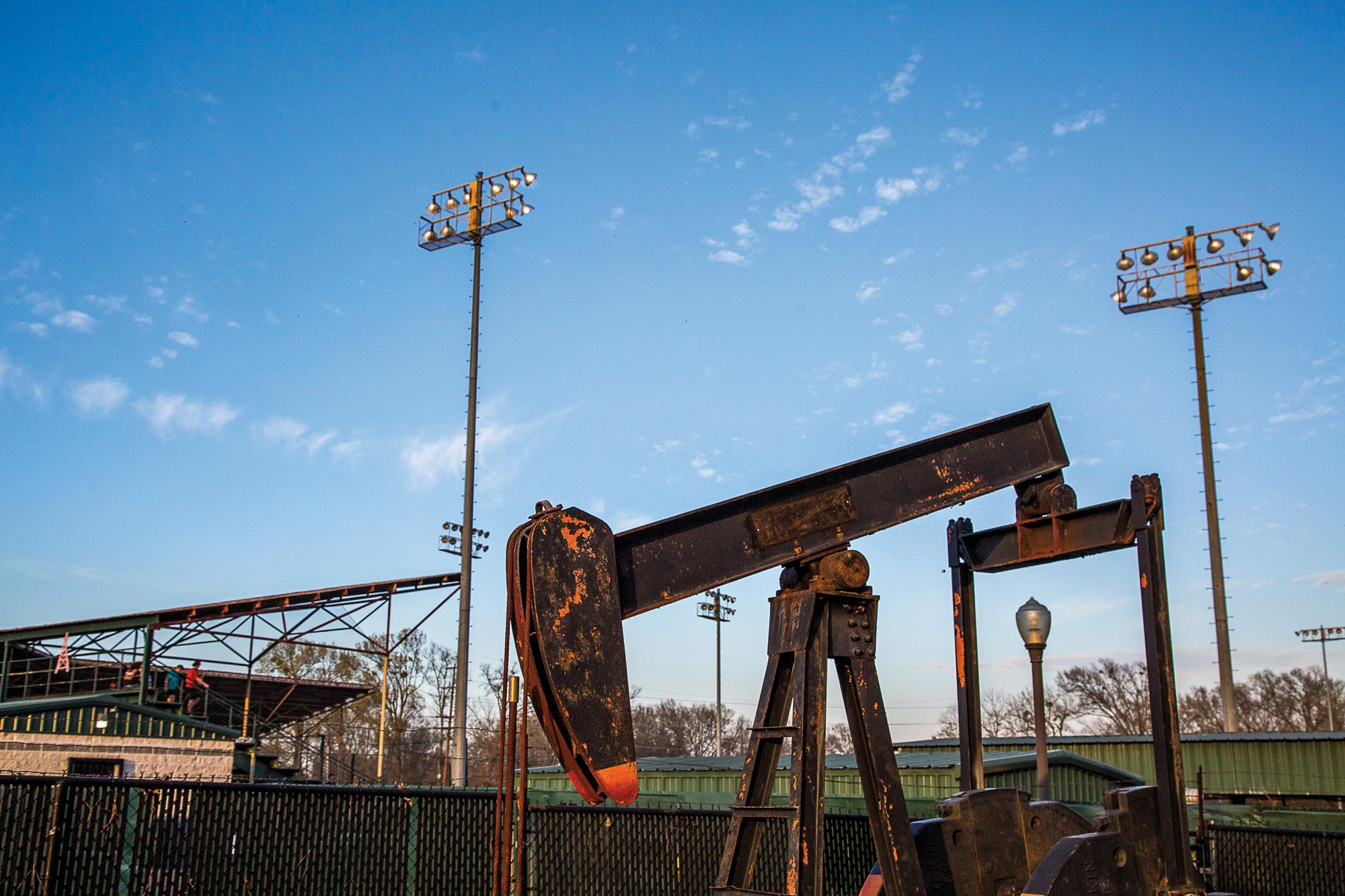
Driller Park was built for the Kilgore Drillers, the team that only played from 1947-50 but still managed two championships and one other finals appearance. Driller Park is also home to Tom Bennett, the heavily bearded, hard-throwing curveballer who took the mound for the Kilgore Black Drillers and stared back at a segregated grandstand. It’s the boys from Borger and De Kalb and everyone else from LA to Indianapolis who got off the bus, took one look around, and must have thought they’d stumbled upon some enemy outpost buried in the weeds. It’s even Elvis Presley, of all people, standing in a peach-colored jacket right down there at home plate in 1955, no more than 100 people in the stands. “I didn’t think Elvis was going to make it,” my grandmother admitted in hindsight.
“Good grief,” my father says.
I look up, my mind elsewhere. Neither team is having a good night—booted balls here, overthrows there, baserunning mistakes galore. I have to tune back in to figure out what he’s going on about.
“Why are they doing that?” he says, pointing at the dugout.
The young men in the gray uniforms with blue pinstripes are leaning out over the dugout railing, throat-humming as they hammer the blades of their hands up and down from the crux of their elbows, a gesture popularized around the Florida State Seminoles, the Kansas City Chiefs, and the Atlanta Braves. It’s the motion that pop culture has dubbed “the tomahawk chop.”
“I don’t know why they’re doing that,” I say.
My father looks genuinely perplexed. “Shouldn’t they be bow-wowing or something?”
I look over at the Kilgore dugout, where the Ragin’ Red Bulldogs are sitting quasi-stoically in their white uniforms with dark pinstripes, the remainder of them scattered across the field. I look back at the other dugout, where the commotion is coming from.
“That’s the Henderson dugout,” I tell him. “Henderson is doing the war chant. That’s your side.”
My father raises his eyebrows, then hangs his head and wags it side to side, the same response he’s had to every strikeout, error, and wild pitch that he can’t quite comprehend. In the end, Henderson wins 7 to 5.
Before we exit, I walk behind the right field grandstands so I can get an alternate view of the stadium. I find a young boy who’s probably 7 or 8 in the batting cage. He’s wearing a Kilgore cap and T-shirt, and he’s throwing a ball up to himself before belting it into the netting. He hits it, scampers after it, then lofts it in the air again before wildly swinging at it, the whole process repeating itself over and over.
This is something my father said he used to do for hours when he was growing up, though he did it with acorns in his backyard. Watching this little boy, as this small window of spring comes to a close, I can almost picture my father as he was. I can almost hear the muted sounds of my grandmother watching basketball through the sliding glass doors behind him. I can almost see his gnarled calico cat stalking through the underbrush out before him. With an untethered future that must seem so unfathomably far away, I watch as acorn after acorn goes soaring into the darkness.