
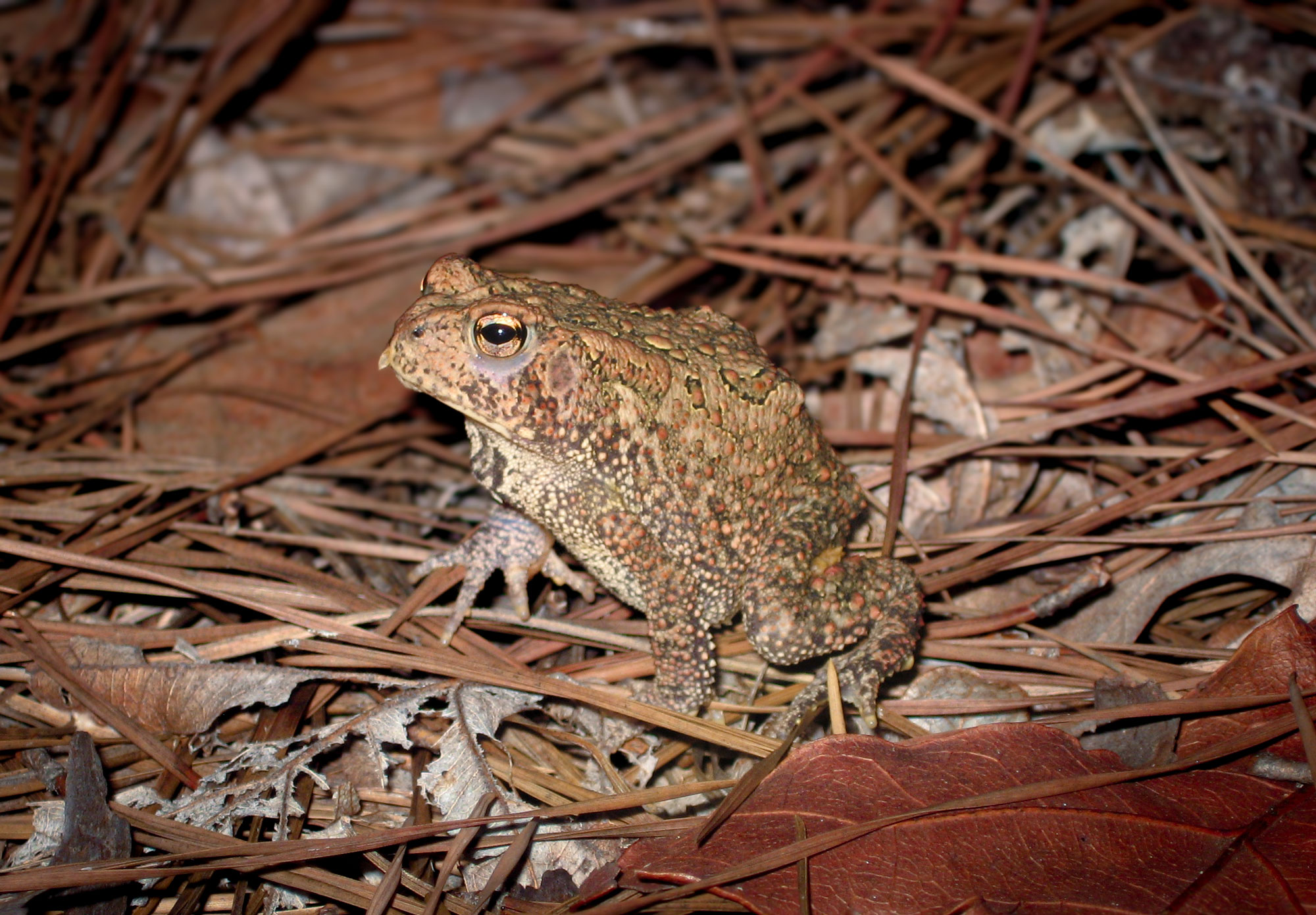
The first time I laid eyes on a Houston toad it was creeping after a June bug on my parents’ front porch. The hungry critter was a little misshapen, with bulging eyes and an orange hue. Even then, I felt privileged to spot a creature that is now so rare.
The Houston toad used to thrive in Texas’ piney woods and post oak savannas. Today, they are rarely found outside of Griffith League Scout Ranch, a 5,200-acre parcel of protected land in Bastrop County.

“That’s the last kind of stronghold for the toad,” says Diane Barber, the senior curator of ectotherms (cold-blooded animals) for the Fort Worth Zoo. “Back in the day when Houston toads were more abundant, there was a lot more forested habitat.”
In the mid-20th century, rapid development depleted Texas’ forested area, reducing and fragmenting the toad’s habitat. Barber says the species was listed under the 1973 Endangered Species Act to “protect what little habitat remained.”
The toads breed in ephemeral wetlands and require modest temperatures and sandy soil for survival, so their habitat has always been restricted. However, continued urbanization, poor land management, and ongoing drought make survival especially difficult for the tiny Texans.
In 2011, the Bastrop Complex Fire rendered the population functionally extinct, according to Matt Lammers, the Houston toad recovery coordinator for the Houston Zoo. Thanks to recovery efforts, the population is back to where it was in the ’80s. A review conducted by the Austin Ecological Services Field Office recorded 710 male toads on Griffith League Ranch in 2023.
It’s currently the breeding season for the Houston toad, and the Fort Worth and Houston zoos are helping sparks fly for this critically endangered species. The goal: introduce millions of toads at early stages of development into the wild, and pray for survival.
This spring, the Houston Zoo will distribute eggs on the banks of ephemeral ponds in Bastrop County. The Fort Worth Zoo is beginning a similar process with tadpoles in Milam County to the north.
In 2007, the Houston Zoo revitalized a toad conservation program from the 1980s, and the Fort Worth Zoo started their effort in 2010. These releases have become an annual tradition involving the U.S. Fish and Wildlife Service, Texas Parks and Wildlife Department, and Texas State University.
According to Lammers, the combined programs released around three million eggs in 2024 and 2025. Similar numbers are expected this year.
The Houston and Dallas Zoos released and monitored exclusively at Griffith in years prior, but that’s not the case this season. Barber says that they are expanding efforts, even partnering with Texas A&M for the monitoring component. The zoos will still release at Griffith League Ranch this year. They’re also releasing a million eggs in Bastrop State Park for the first time since 2019.
The conservationists plan to compare survival rates between the three places and allow the wild population to move outside of Griffith.
“They’re doing very well where we’re putting them, but they aren’t quite finding the quarters to move out and establish in other spaces,” Lammers says.
Survivorship year over year for the toad is low: 3% in premium conditions. Barber says that this is typical for amphibian species, as they are “food items for everything.” To improve the toad’s chances, the Houston Zoo keeps the eggs in protective baskets at the onset of their release.
Awareness and conservation efforts are expanding beyond the releases, too. The Houston Toad Education and Outreach Working Group hosted its first Lost Pines Habitat and Wildlife Day last year. They are planning the next one for Nov. 7 at Bastrop State Park, according to Jessica Snider, a representative for the Capital Area Scouting Council.
The zoos have held landowner workshops with TPWD for the past four years to boost collaboration and idea sharing. The state also offers easements to those who agree to make their property a protected home for the toad.
“Any conservation question, whatever the species, always ends up being a land management question,” Lammers says. “How do we maximize the efficiency of these little land pockets that we have?”
Keeping the Houston toad—and other endangered species—alive is crucial for biodiversity, according to the conservationists. The presence of amphibians in an environment is also a water quality indicator.
“Animals like the Houston Toad are the canaries in the coal mine,” Barber says. “And if they aren’t existing, something’s broken in the ecosystem.”