

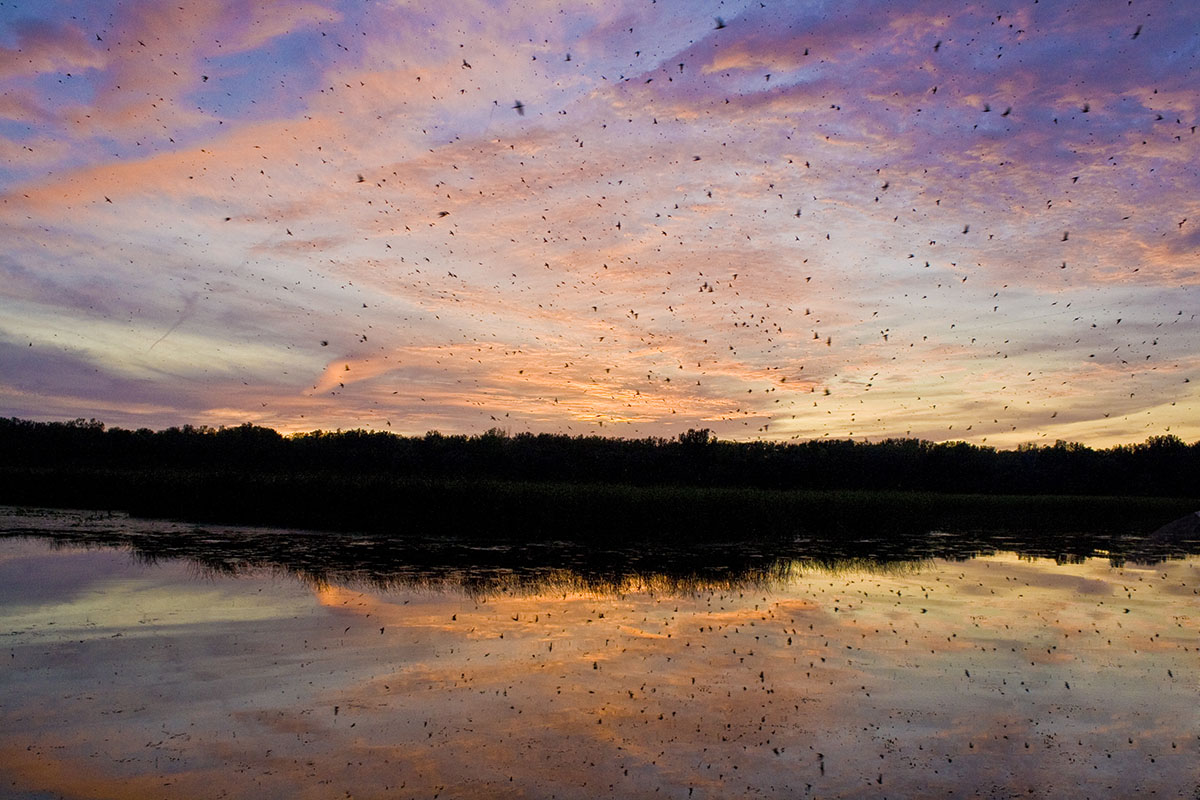
When customers exit the Round Rock Crossing Shopping Center as the sun sets on July and August evenings, they’re greeted with a view that might seem out of place in a concrete parking lot. Faint chattering calls begin to fill the air as hundreds of thousands of large iridescent swallows called purple martins descend from the sky, swirling and wheeling around one another before eventually diving into trees to roost for the night.
The same performance happens at an Old Navy in a suburb about 15 miles southwest of Houston and an HEB near San Antonio’s Brooks City-Base, as well as innumerable other parking lots and shopping centers across the state. These seemingly random aerial productions are actually a common occurrence at purple martin roosts, which exist for around six weeks in the summer before the broad-chested, fork-tailed birds set off on their epic migration to Brazil. The nightly ritual allows the acrobatic swallows to feed and socialize in open areas safe from predators, in preparation for their journey ahead. It’s a spectacle that Purple Martin Conservation Association President Joe Siegrist says everyone should see “at least once in their life.”
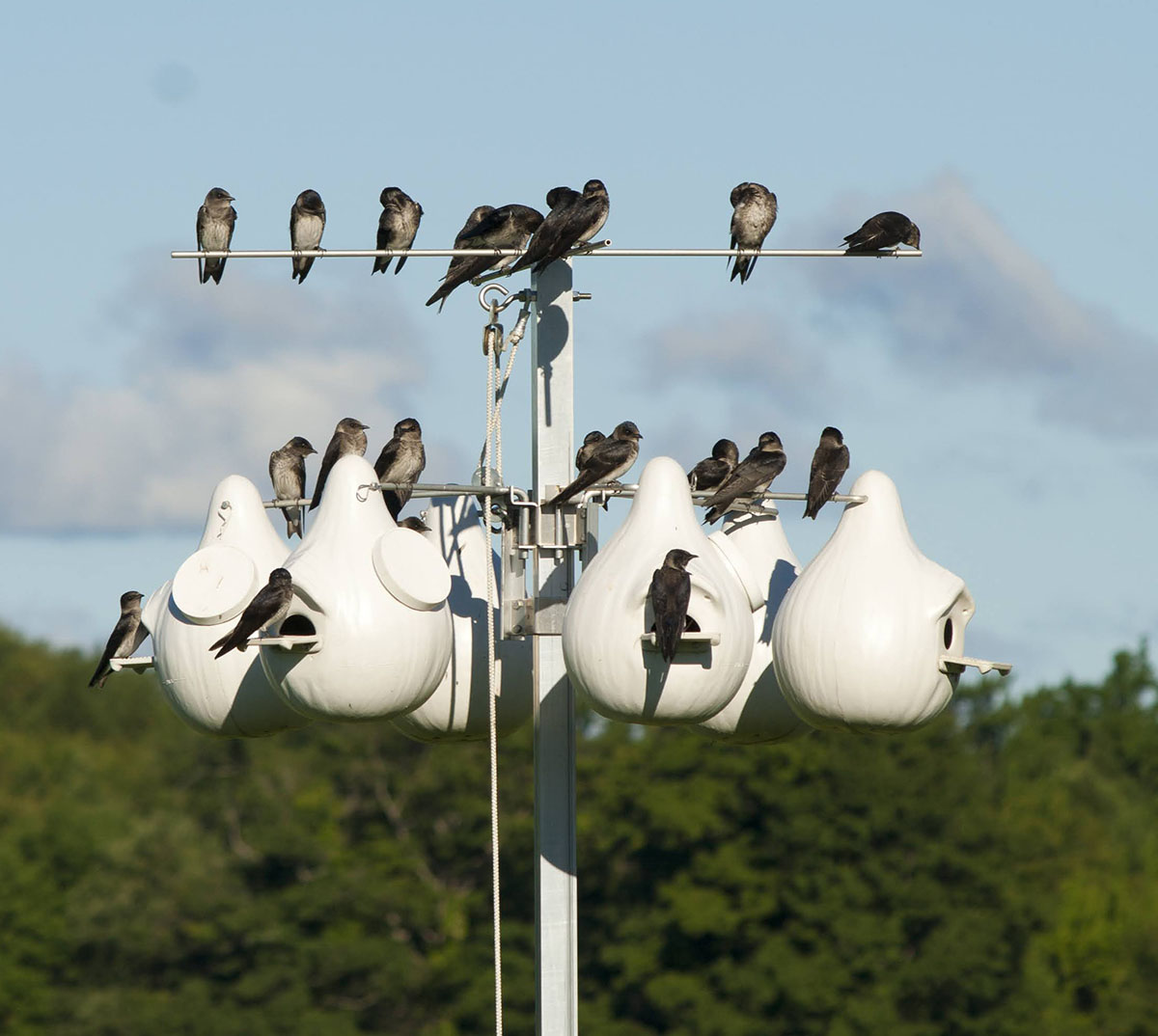
This phenomenon is the culmination of purple martins’ months-long stay in the United States that, in Texas, begins around February. But what most viewers don’t know is that in those months leading up to the July roosting period, purple martins survive solely because of human intervention. Known as purple martin landlords, these avian enthusiasts spend the bird’s entire spring nesting season providing housing—often shaped like gourds or miniature apartment complexes—keeping out predators, and helping the birds safely fledge their young.
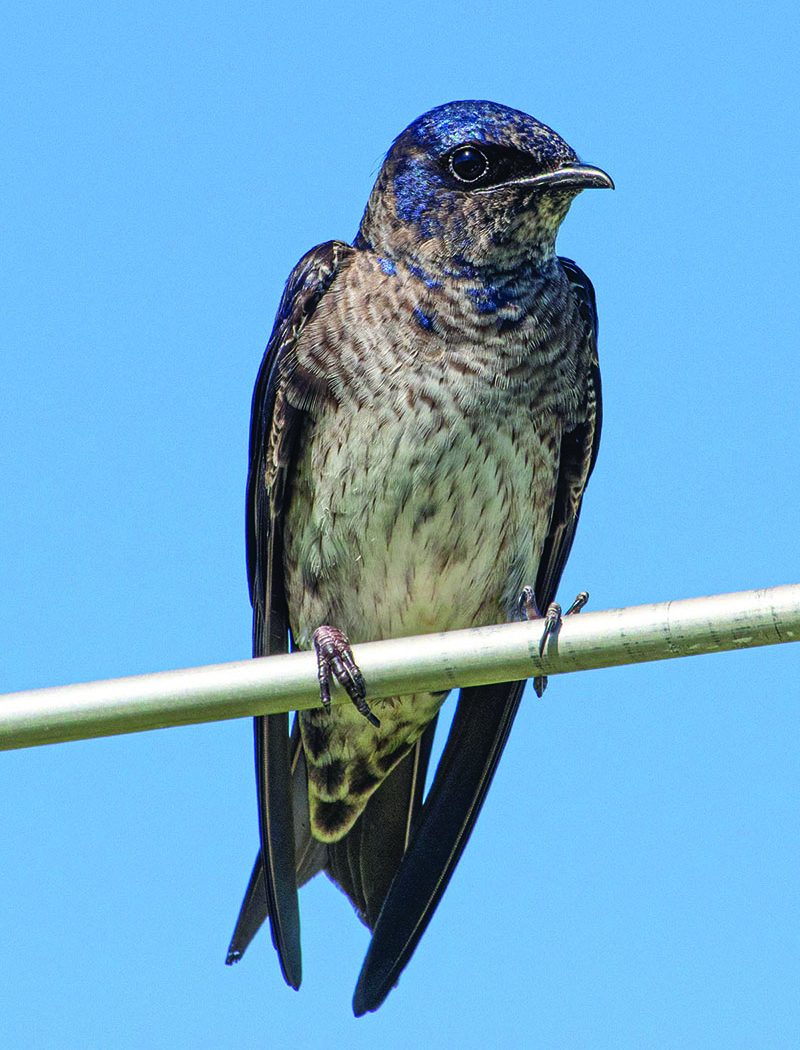
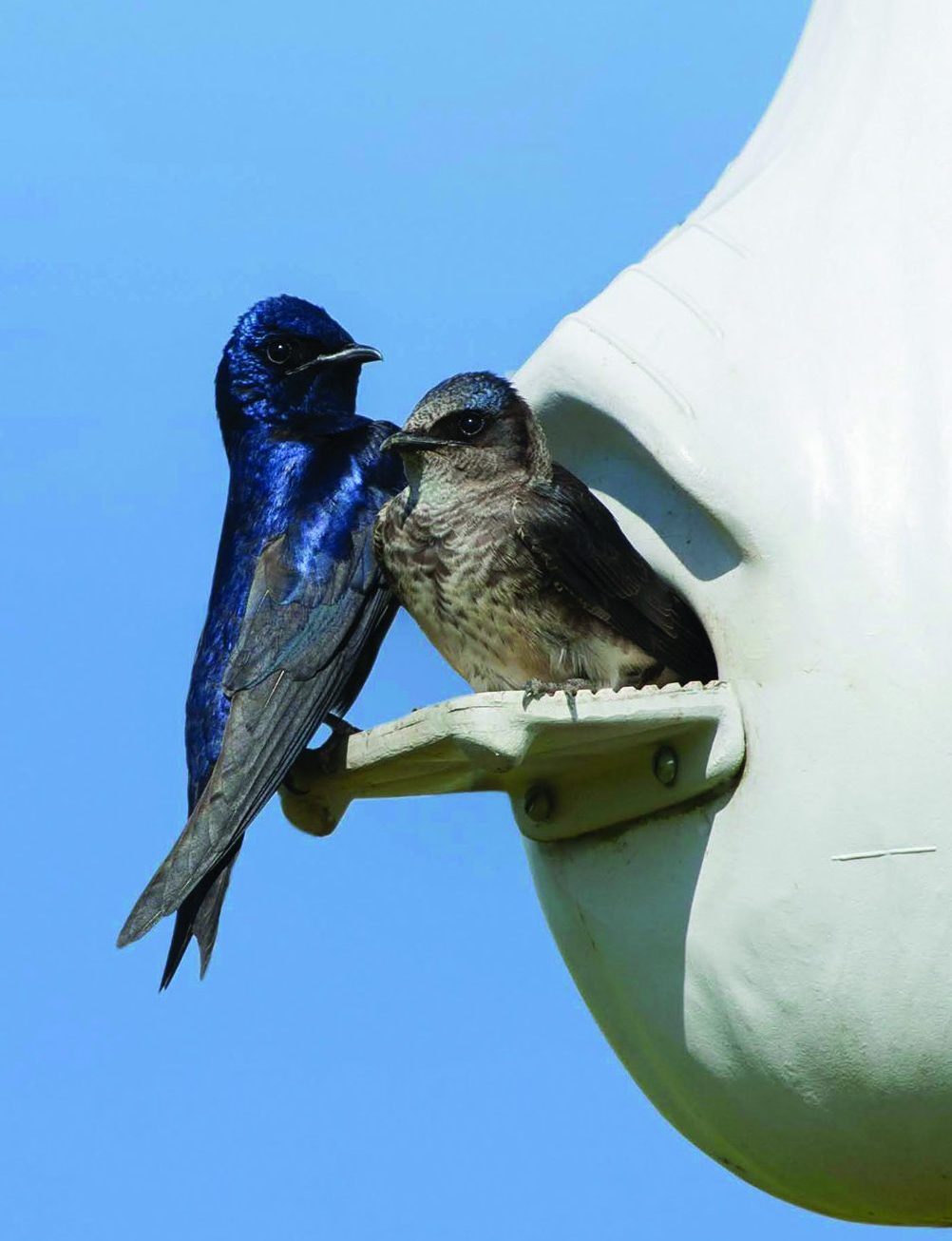
“Every single purple martin that you see in Texas all hatched in somebody’s backyard,” Siegrist says. “Humans putting out bird houses are what keeps the species alive.”
History suggests that purple martins have been relying on landlords in North America since before large-scale European settlement in the 15th century. Members of the Choctaw and Chickasaw tribes are believed to have often hung hollowed-out gourds in their villages that the birds used for nesting, in addition to natural cavities like tree holes, rock piles, or cliff faces.
But when invasive species like the English House Sparrow and the European Starling were introduced to North America in the late 1800s, they began to take over the few natural habitats available to purple martins. The less tenacious martins just couldn’t compete with their new rivals.
Now, everywhere East of the Rocky Mountains, purple martins nest exclusively in human-made structures, relying heavily on landlords for survival. Flocks often return year after year to the same houses where they previously nested in a behavior known as site fidelity. With this kind of loyalty, it’s not surprising that many landlords develop deep bonds with their birds.

Robert Mohler, a Fort Worth landlord who’s housed purple martins since 1993, says that in recent years, he’s been able to recognize the first returning bird—which he describes as a scrappy and rough “Hells Angels” type of character. Without fail, the adult male returns annually, feathers ruffled around his face, seeking out prime real estate for mating and nesting.
Purple martin landlord responsibilities typically begin in January, shortly before the birds return from South America. Mohler says he starts out by cleaning his martin houses and filling them with pine needles to prepare the birds for nesting. Trickling in a few at a time, the returning martins add live oak leaves and sticks on top of their pine straw base to create the perfect home for raising their young. Or, as Mohler puts it, “They find a girlfriend, show her the house, move in and get down to business.”
Once a martin house is full, it’s the landlord’s job to keep watch over the home and make sure nothing disturbs the birds’ nesting process. Denise Dailey, who manages two purple martin houses in Austin, says she visits both of her colonies once a week to check each cavity on her gourd rack for predators or any non-martins, particularly house sparrows and starlings. If she sees any sign of an invasive nest—often noticeably made from Bermuda grass, feathers, trash, or cigarette butts—she’ll clear it out. She says she practices “safe sex” for house sparrows, removing their eggs and preventing their reproduction. After all, the house sparrows—unlike the purple martins—have no trouble surviving and mating in the wild.
In April, the martins begin to lay a single egg per day for up to 7 days. Because of this pattern, Dailey can predict when eggs will hatch and when the young martins will fledge. But the natural world is not always kind to purple martins. Droughts, unusual warm or cold spells, predation, and a number of other uncontrollable factors can make the birds easy targets.
Louise Chambers, a purple martin landlord in Corpus Christi, recalls a year when one of the female birds nesting in their colony lost her mate after her chicks had hatched. In the thick of raising her young, the bird couldn’t bring back enough food to sustain her family. So, Chambers took matters into her own hands.
She’d cook up scrambled eggs, cut them into tiny chunks, and launch the pieces into the air. The mother martin, an aerial insectivore used to catching bugs midflight, easily snatched up the food, and carried it back to her young.
Developing this type of connection with a bird, Chambers says, is just in the nature of being a purple martin landlord. Unlike other species, martins let humans get close to them—let them handle their nests, their eggs, and their young. Their graceful flying and mesmerizing song make for natural entertainment. After taking care of purple martin nests, defending the birds from predators, and keeping them alive for months, Chambers says it’s hard not to feel a sense of ownership over the creatures. That’s why she makes a point to visit the pre-migratory roosts in her area, to see the birds one last time.
“Those are your birds up in the sky,” Chambers says. “Every bird that’s up there flying around came out of a house or a gourd—maybe yours, maybe your neighbors. Each bird is somewhat tied to us.”