

IT’S
DEAD
AROUND HERE
A GHOST TOWN ENTHUSIAST SEARCHES FOR THE ESSENCE
OF THESE SCARCELY POPULATED LOCALES
I don’t believe in ghosts. This is not a story about ghosts. But if you want to see a ghost, I can think of no place more promising than Baby Head Cemetery, where I am pretty sure I almost saw a ghost.
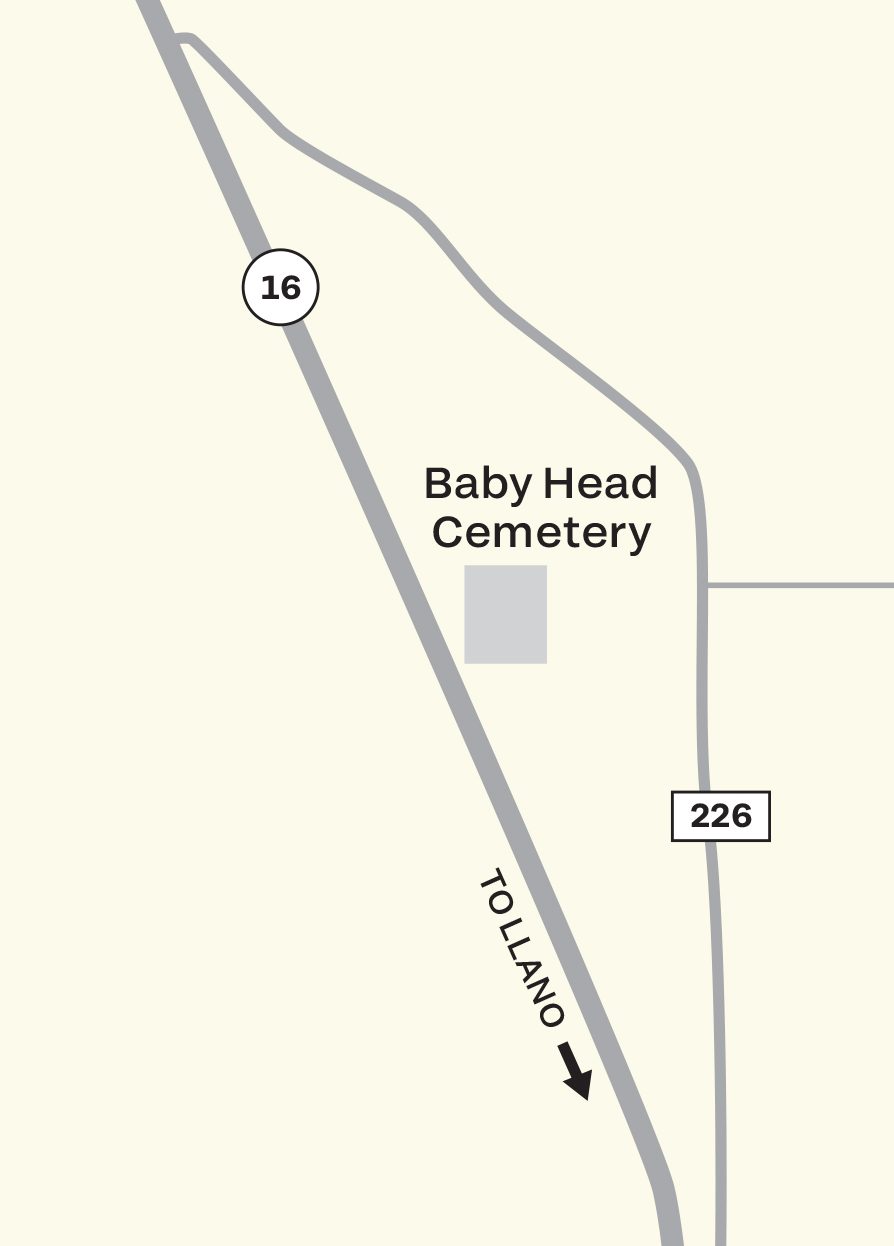
Last November, I loaded my dog, Woody Guthrie, into the truck for a day trip from Austin. The rain starts as I head out of town, and the low-hanging clouds feel right for this mission. On State Highway 16, just north of Llano, I pull up to Baby Head, a place I did not make up in my nightmares. But to double-check my sanity, I read the Texas Historical Commission marker. Everything I’ve read online about this place—the hill, the community, the cemetery—quotes this marker, which puts the blame for the haunted name on oral tradition. The story goes that after a raid by Native Americans in the 1850s, an Anglo child’s remains were found on the so-called mountain.
It’s pouring rain, but my dog’s happy to get out of the truck and stretch his legs after the drive. I’ve already decided I don’t want to be here. I’d come here to see a ghost town—and this is not a ghost town. But it feels disrespectful to just leave.
We head to the grave markers. About halfway down the little path, my dog stops. I call him. I tug his leash. He doesn’t budge. He lowers his head and employs the superpower every dog channels at the door of a veterinary clinic: He becomes an immovable object. Then, he starts whining. I admit, he’s had his moments of stubbornness, but this isn’t normal.
Listen, all that stuff I said about ghosts is true. I’m not a person who believes in things, least of all ghosts. But when you’re standing in a graveyard and there’s no one around, the wind is howling and it’s getting dark, and then your dog turns into a stone … I don’t want to admit this, but I feel a shiver run up my spine.
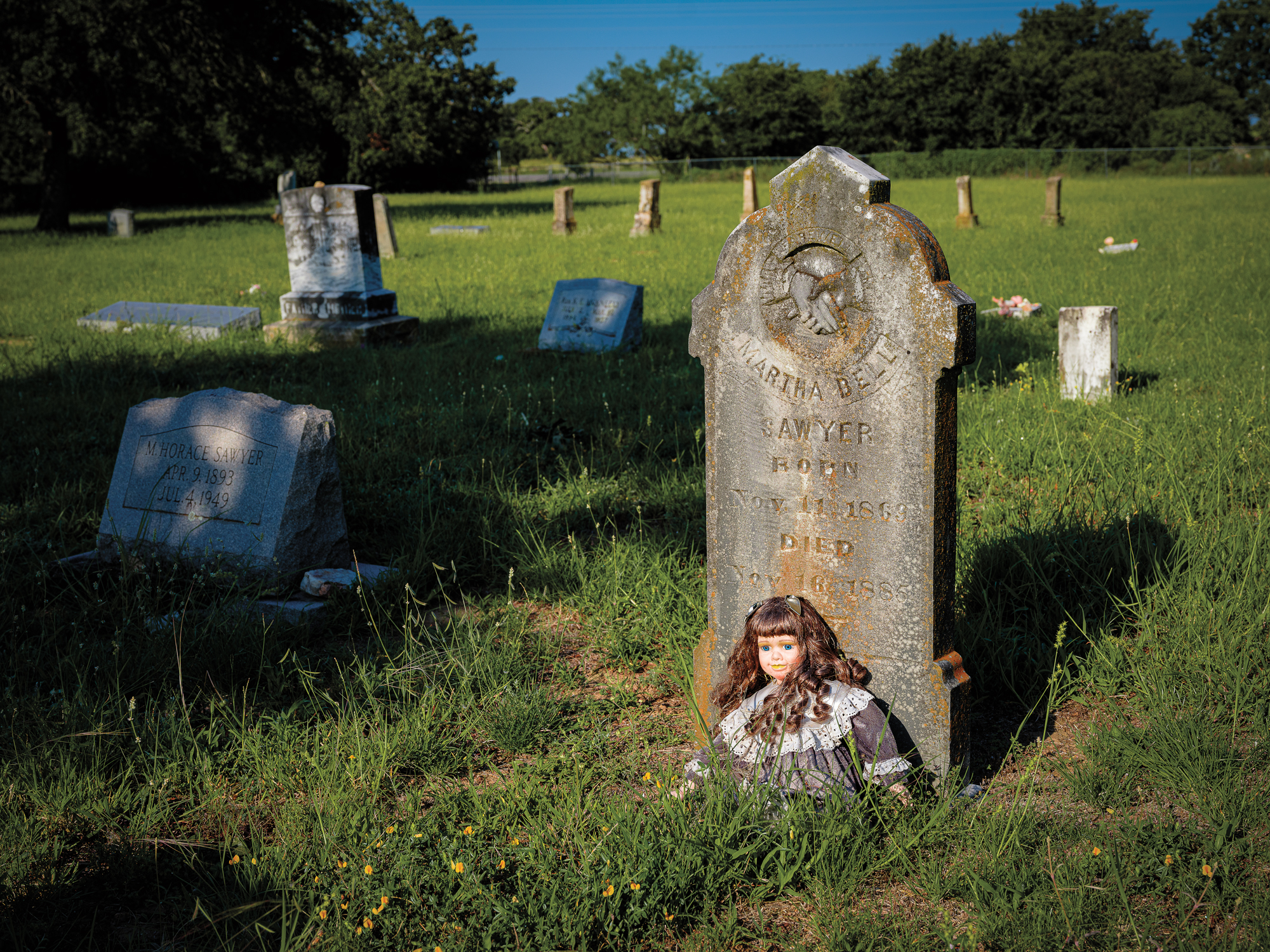
Hanging out in a graveyard makes me reconsider my belief system, or lack thereof. Maybe the ghosts don’t care what I believe. I look around. For what? I don’t even know. Then Woody Guthrie, realizing I’m a moron, lifts a front leg to show me the problem: His paws are full of stickers. I apologize to the ghosts I don’t believe in because it never hurts to be polite, and I carry him back to the truck.
I’ve always loved a ghost town. Maybe it’s because I’m a fan of history. Maybe I’m just nosy. But I’m obsessed with seeing how people used to live, imagining the stories in what they leave behind. I can see a ghost town in my mind—dusty old buildings, crumbling bricks, sun-bleached boards, and signs blasted clean by the wind. A general store. A railway depot. A courthouse. A jail. Maybe a saloon. Off the main street, a few houses in varying states of decrepitude. I don’t know where the images come from. Movies maybe, or pictures in a magazine. Because I can’t think of a single ghost town I’ve visited, though not for lack of trying.
I went to Marfa a couple of years ago, and while I was there, I saw a little dot on my map for a town called Shafter. Wikipedia told me Shafter was indeed a ghost town, an old silver mine 20 miles north of the U.S.-Mexico border. But when I got there, the place was fenced off and marked with No Trespassing signs in a manner that looked like someone was serious about it. I was surprised to find myself sad that I couldn’t walk around. The next ghost town I visited was Terlingua. You say “ghost town” in the vicinity of Austin or Marfa and someone will ask if you’ve been to Terlingua. But the day I went, it was crowded and the bar was open.
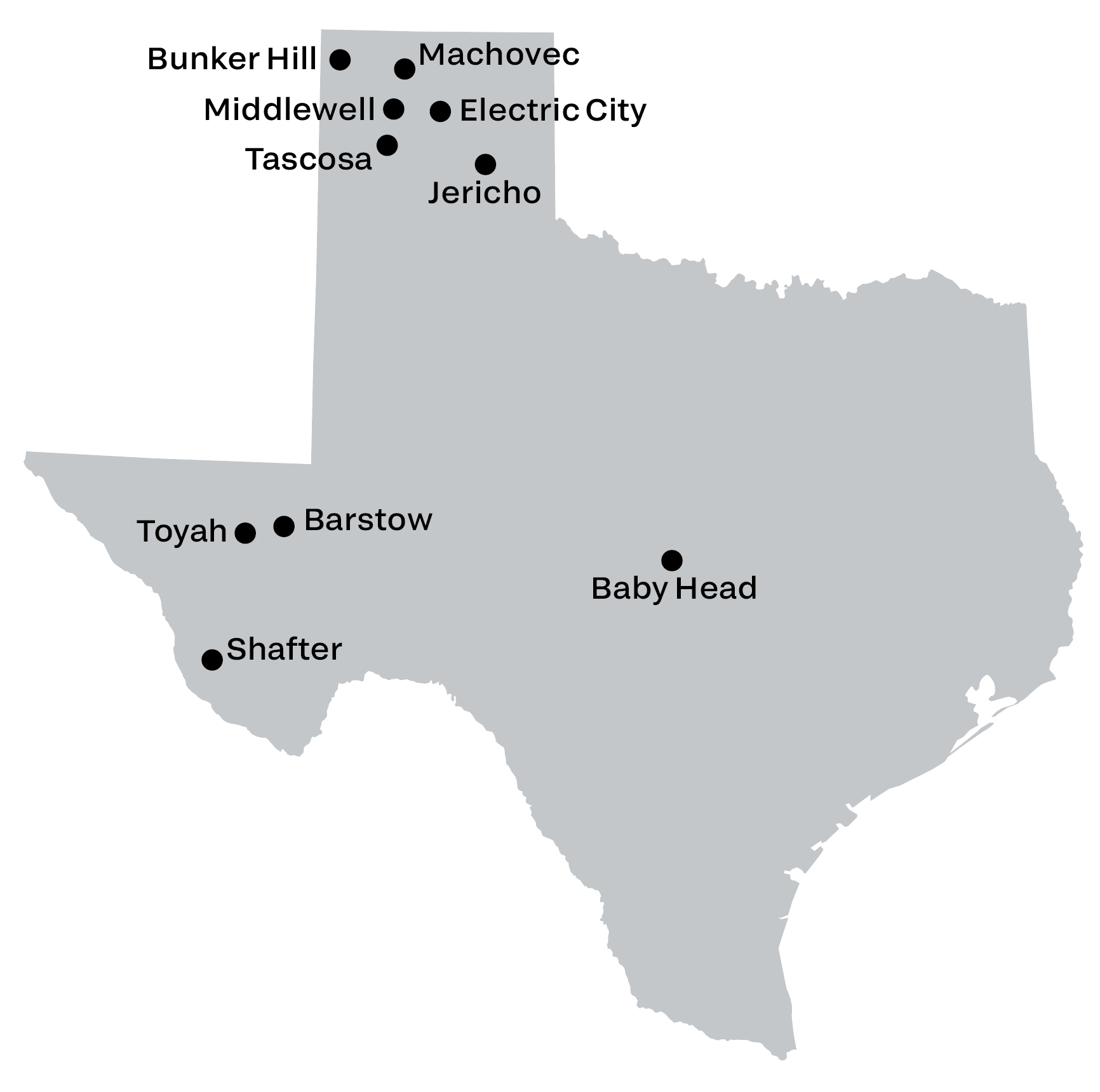
I take a lot of road trips. And I’ve pinpointed at least 20 purported ghost towns on my map, mostly up in the Panhandle, bearing names like Machovec, Electric City, Middlewell, Tascosa, and Bunker Hill. I’d drive to the spot on the map. Look around. Drive some more. Take a left this time instead of a right. And every time, I’d find nothing. Shouldn’t be hard. I can see 50 miles into the distance. But any direction I looked, there was nothing but farmland. Not even the ghost of a ghost town.
I’ve seen plenty of abandoned farmhouses alone in the distance or right by the highway. Well ran dry. Mine went bust. Bank took the land. People moved on. Or, as I imagine, they built another house somewhere, planted a few trees, and hung a tire swing.
I want to see a real ghost town, but clearly, the internet can’t be trusted to identify one. So, I call T. Lindsay Baker, a retired history professor at Tarleton State University and author of Ghost Towns of Texas and More Ghost Towns of Texas. I start with the basics: “What is a ghost town?”
“A ghost town is a town for which the reason for being no longer exists,” Baker says. He had three criteria for a town to be included in his travel guide. One, there must be some tangible surface-level archeology. “It’s no fun to drive out to what turns out to be a paved parking lot,” he says. Two, the town has to offer public access. And three, there must be even geographic distribution, so
wherever you are in the state, you can easily visit a town on a day trip. He didn’t specify a population other than to say fewer than 100 people sounds right.
Baker identified more than 1,000 towns in Texas that met the three criteria. And they’re all over, not just here. “It’s the nature of the United States,” he says. “The stereotypical ghost town is a mining camp. The mine goes bust when the minerals run out or when the market for those minerals disappears. So, people move on.”
I tell him about trying to see Shafter and how it was fenced off. “Oh, that happened to me scores of times,” he says. “You have to have surface archeology. Hard to find a ghost town without it.”
I think of the time I tried to find a ghost town called Gay Hill, just north of Brenham, in Washington County. I’d seen pictures of Gay Hill—the general store and the cotton gin. According to the Texas State Historical Association, a post office opened there in 1840. But in 1881, the railroad established a stop 2 miles away and the town was moved. The old town was renamed Old Gay Hill. After World War II, with the decline of cotton, the town dwindled. By 1971, it was all but empty. Still, there’s a dot on Google Maps that says “Gay Hill,” and it was only a two-hour drive from Austin.
I filled up my tank, grabbed my notebook, and headed out. I drove around for an hour at least, in a downpour. Up and down State Highway 36 and Farm-to-Market Road 390, and every road and lane that met 36 and 390. I found a farm, another farm, a few fences, more farms, and nothing more.
The first week of March, Woody Guthrie and I head west. The sky’s candy blue, and there’s a cloud of dust up ahead. When we hit the first dust storm, I think maybe we should’ve waited another week. It’s just a little squall, though. The world disappears for a moment, and you’re through. Then, we hit the big one. In a couple of years, I’ve gone from seeing no dust storms, and now we’re at four dust storms, three in one day. The world is sepia toned, and I’m not sure we should keep driving.
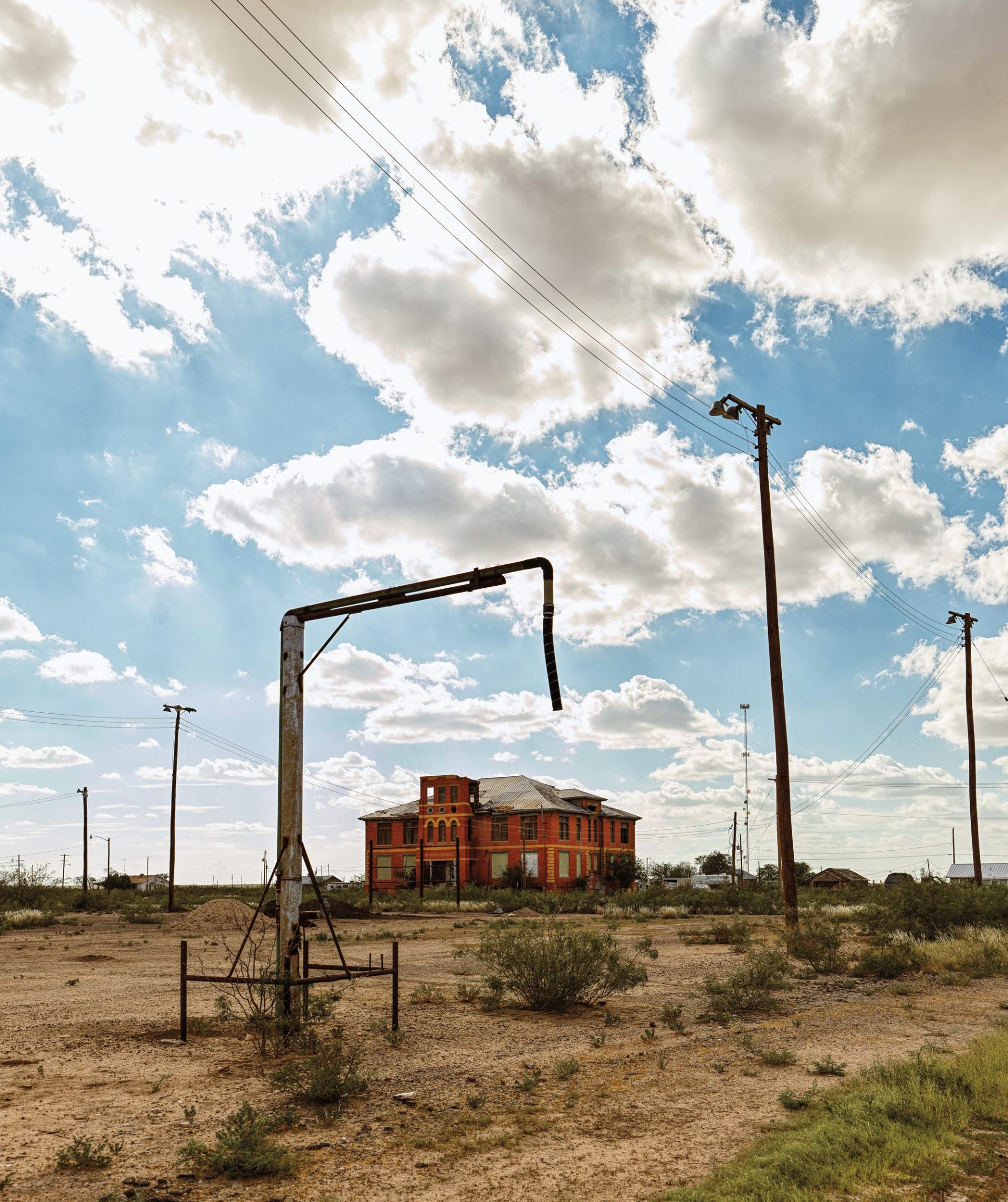
By the time we get to Toyah, about 20 miles southwest of Pecos on Interstate 20, the wind’s howling and there’s still dust flying. It’s annoying but not apocalyptic—perfect ghost town weather. It seems I’ve found a real ghost town, the way I want a ghost town to look, sandblasted and lonely.
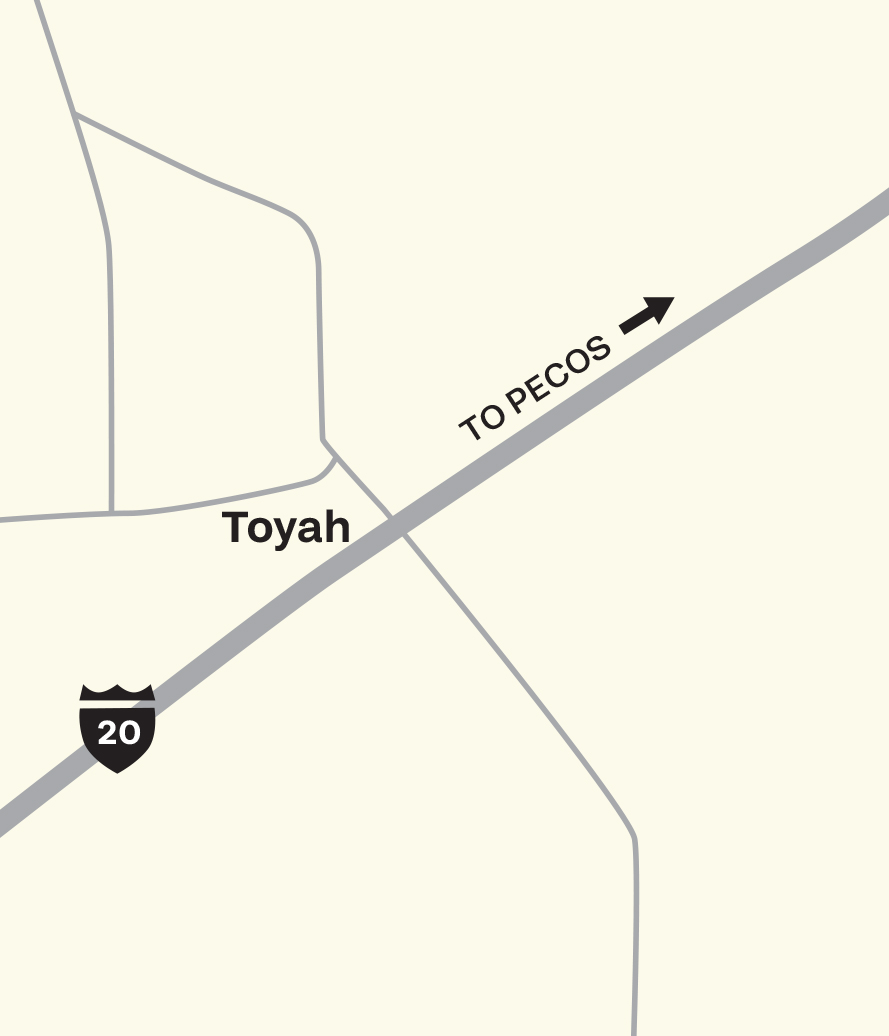
Toyah started as a trading post in the 1880s, boomed after the railroad came through in 1881, and peaked at 1,062 residents in 1914. But apparently the railroad moved, and even a small oil boom in the 1920s couldn’t save the town. By the Great Depression, the population had dropped by half. The grocery store is thought to have closed in 1940.
There’s a massive brick school building at what looks to be the center of town. The wind’s pushing a swing out front and rattling what’s left of the metal roof. I walk the deserted streets with Woody Guthrie, both of us squinting against the dust. Floods and a reported tornado took their toll. Piles of bricks are all that’s left of one building. Others, you could see a hipster turning into an overpriced ramen shop with some paint and a new roof. Cars sit on rusting frames, and the requisite bathtub lounges beside what’s left of a window.
I can’t get over the feeling I’m trespassing. I’m not, to be clear. But it’s strange to look through the window of what used to be someone’s house, someone’s business, someone’s hopes and dreams. Woody Guthrie has no such qualms. But I keep him close. A car passes, and I realize what’s bugging me. This doesn’t feel like a ghost town. People still live here—but only a couple dozen. No wonder something’s not right. Or maybe it’s just the howling wind.
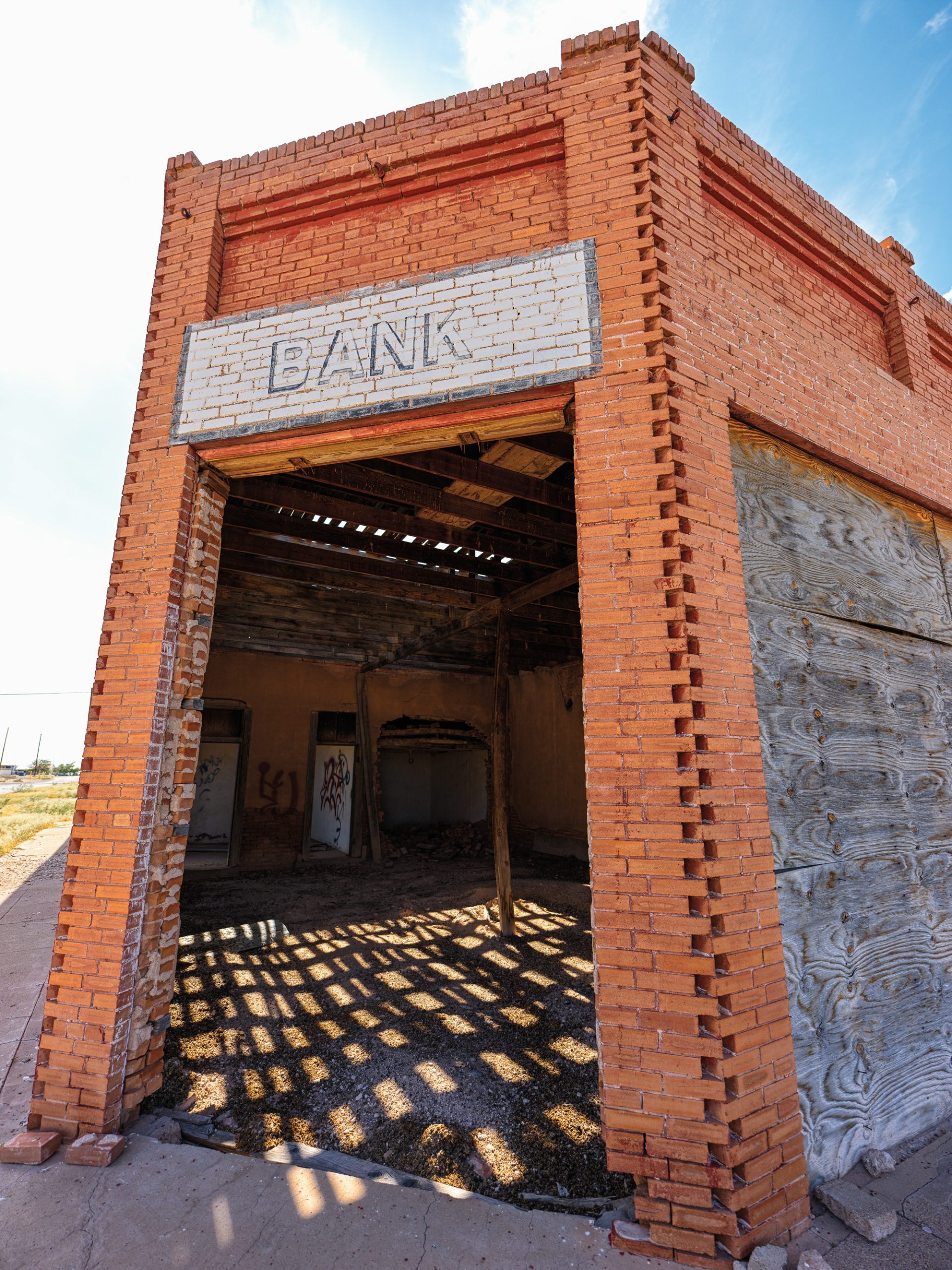
Barstow, east of Pecos, is the next ghost town on my itinerary. Again, though, it’s a ghost town that’s not quite a ghost town, or not how I imagined it. Barstow formed in 1892 and was largely abandoned after droughts in the early 1900s. A bank that says “Bank” on it remains on a corner, but the roof’s long gone. A pile of dust is stacking up against the remains of the Modern Food Market. Up the street, a truck pulls out as I’m pulling in. A guy in a felt hat waves at me, and I wave back. But I’m not the sort of person who can go knocking on doors, asking questions like, “Where did everyone go?”
I’d probably get some great answers if I could do that sort of thing. But I cannot. What I do instead is I complain to people. The trick is to complain to the right people. The first right person I complain to is Jac Darsnek, who runs Traces of Texas, a history-themed Facebook page with more than 1 million followers.
Darsnek sends me a photo he took in Barstow circa 2007. “I was taking this photo when an older gentleman in a beat-up pickup truck drove up, stopped, and said, ‘We just had a meeting at the coffee shop and decided we’d sell the whole thing to you—kit and kaboodle—for $117.82,’” Darsnek says. “I smiled and asked, ‘Why the 82 cents?’ He said, ‘Because that’s how much a cup of coffee with tax costs over there.’”
I reconsider talking to the ghosts I don’t believe in, but then my complaining pays off yet again. A family friend, probably tired of hearing me talk about ghost towns, looks at her husband and says, “Don’t we know a guy who bought a ghost town?” That’s how I am introduced to Blair Schaffer and his wife, Blanca.
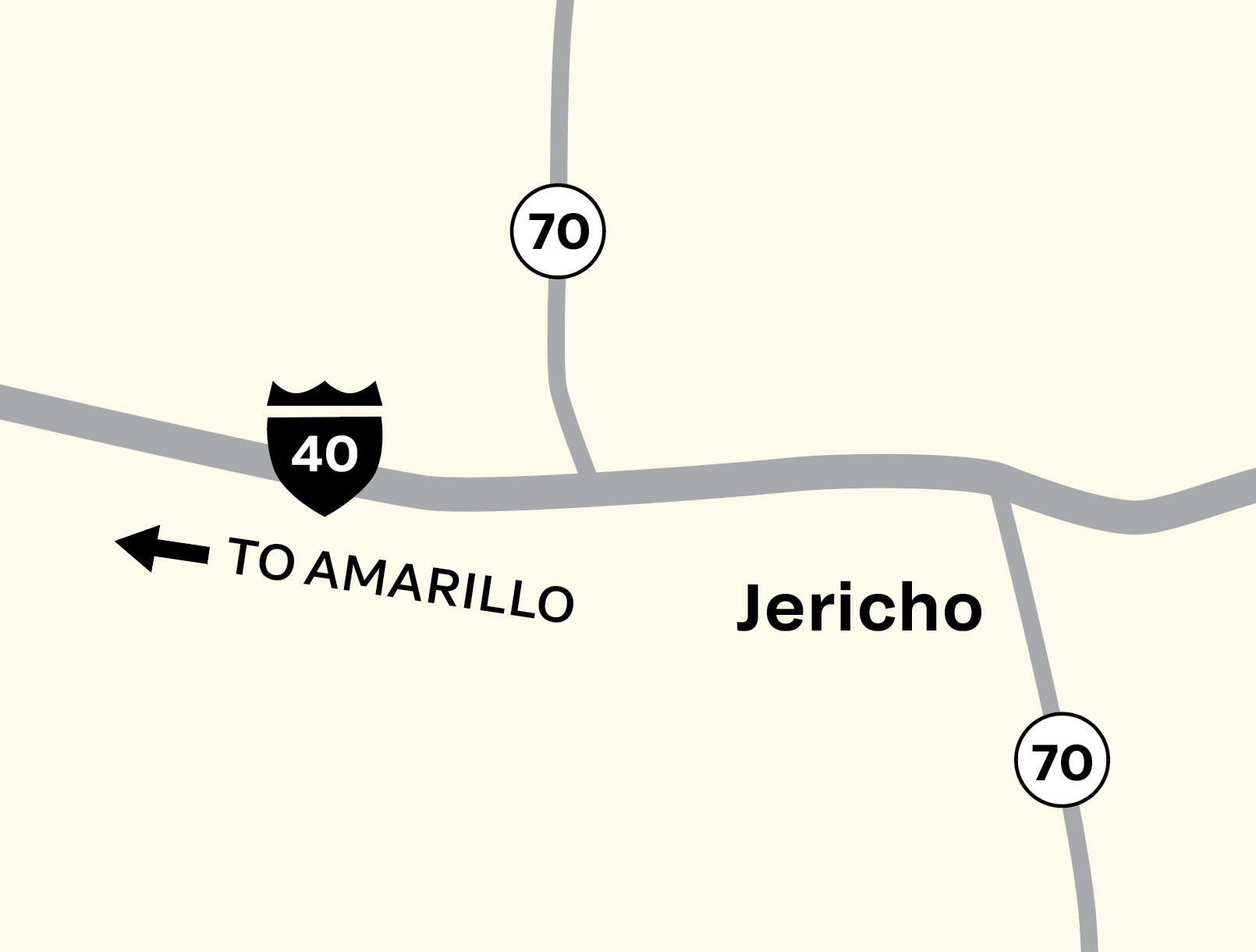
Blair gives me directions to Jericho and says he’ll meet me there. I head up to Amarillo and go east on Interstate 40. A little past Clarendon, I get off on State Highway 70. Blair’s truck is idling on the side of the road. He gets out as I pull up behind him. He waves and shouts “Hi!” then “Lauren?”—though mine is probably only the second truck on this road all day, and his is the first.
I follow him to Jericho. Once we’ve parked, Woody Guthrie’s out of the truck like a shot, chasing smells or ghosts of smells. He doesn’t care. This was the destination he expected. Me too.
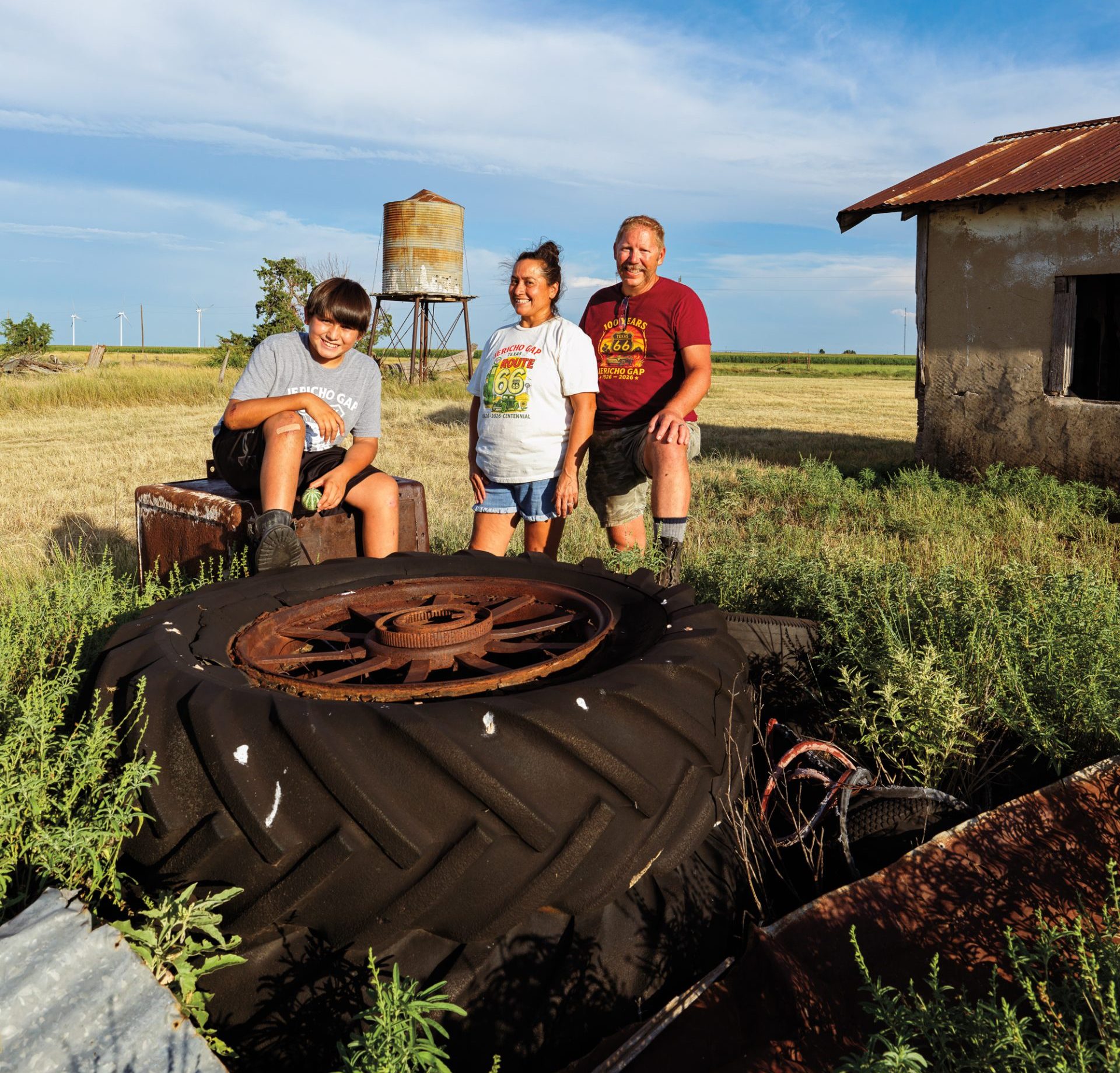
Blair walks up in square-toe boots and a glorious red mustache. Blanca’s black hair is whipping over her face, so she ties it back. I get right to it: “How and why on earth do you buy a ghost town?” They both laugh, and I add, “I guess y’all get that question a lot.”
Blair’s a fireman in Amarillo and a Potter County commissioner. Blanca’s a history buff. They always talked about buying a little land as a homestead, somewhere they could retire, something they could pass on to their kids. In 2020, the gym they owned in Amarillo was hurting due to COVID, so they started looking for land. That’s when they saw Jericho come up for sale. In the late 1800s, Blair’s family moved to Jericho from Missouri in a covered wagon. “We used to come out here when we were kids to visit their graves and clean up the cemetery,” he says. “I’ve been coming to Jericho my whole life.” When the land was posted for sale, they knew it was meant to be.
The sun reflects off an old school bus as we walk into a light breeze. Up ahead, there’s an L-shaped building, the old Reeves Filling Station and Motor Court. The rooms are intact, but the roof’s caving in and the doors are missing. There’s a bed frame and wallpaper in one room, a chair in another. At last, I feel like I’m allowed to poke around.
For a long time, this land, first settled by buffalo hunters, was nothing more than a trading post. But in 1902, the railway established a station in Jericho, and in 1926, when Route 66 was commissioned, the town became a real town, complete with a service station and this tourist court.
Blair points out how they used the old saw blades from the mill as rebar in the concrete, and Blanca shows me a safe they pulled from the dirt. Blair says they’ve decided it must be a safe Bonnie and Clyde stole. It’s empty, but that only proves their theory as far as I’m concerned.
We come to the outline of another building, but this one has a basement. “That was the birthing center,” Blanca says. “A midwife would’ve lived in the house. And if you were giving birth out here, a little far from a hospital, you’d come here to have the baby.” The building’s long gone, but the irises planted in the yard over 100 years ago are in bloom.
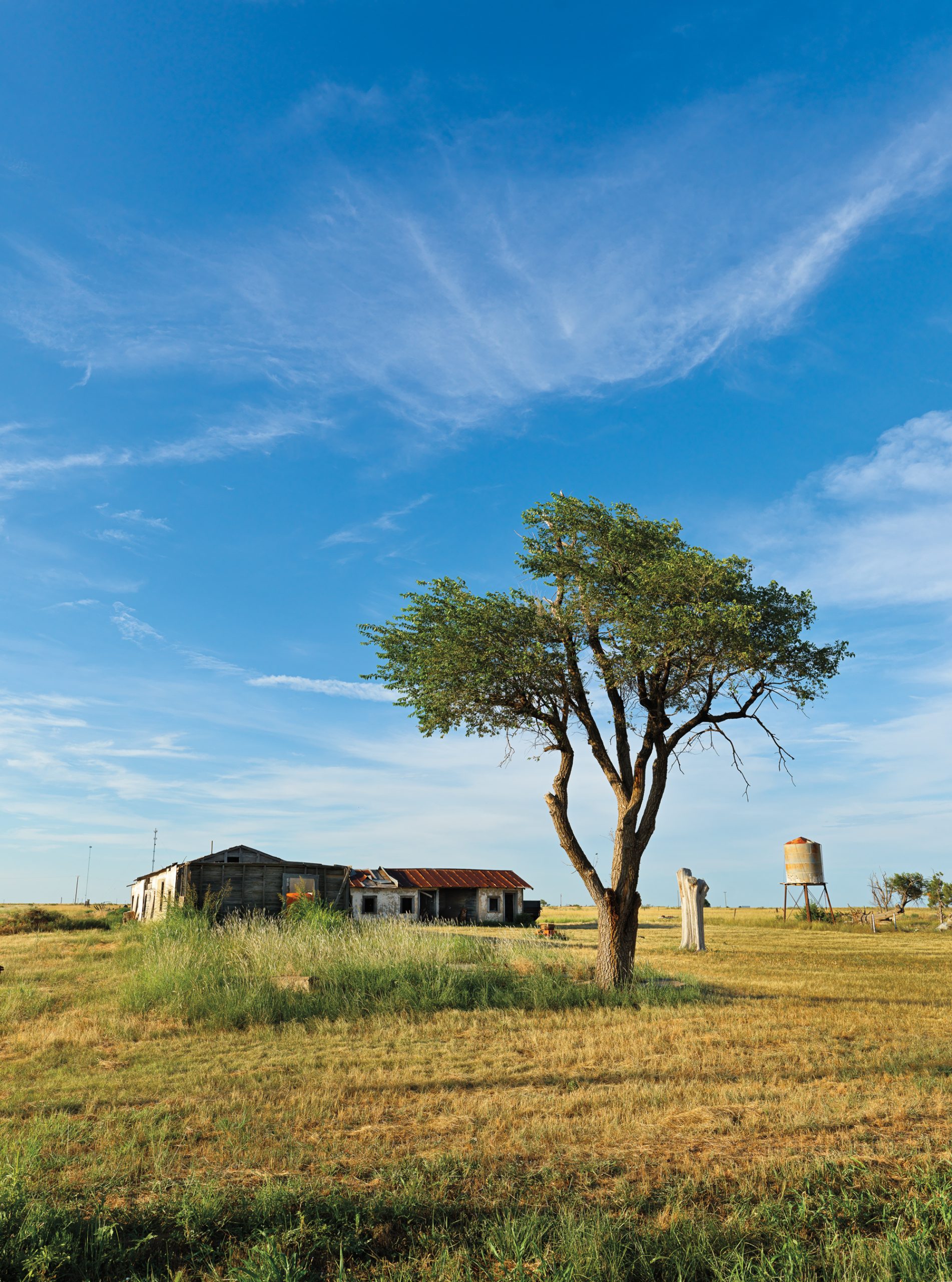
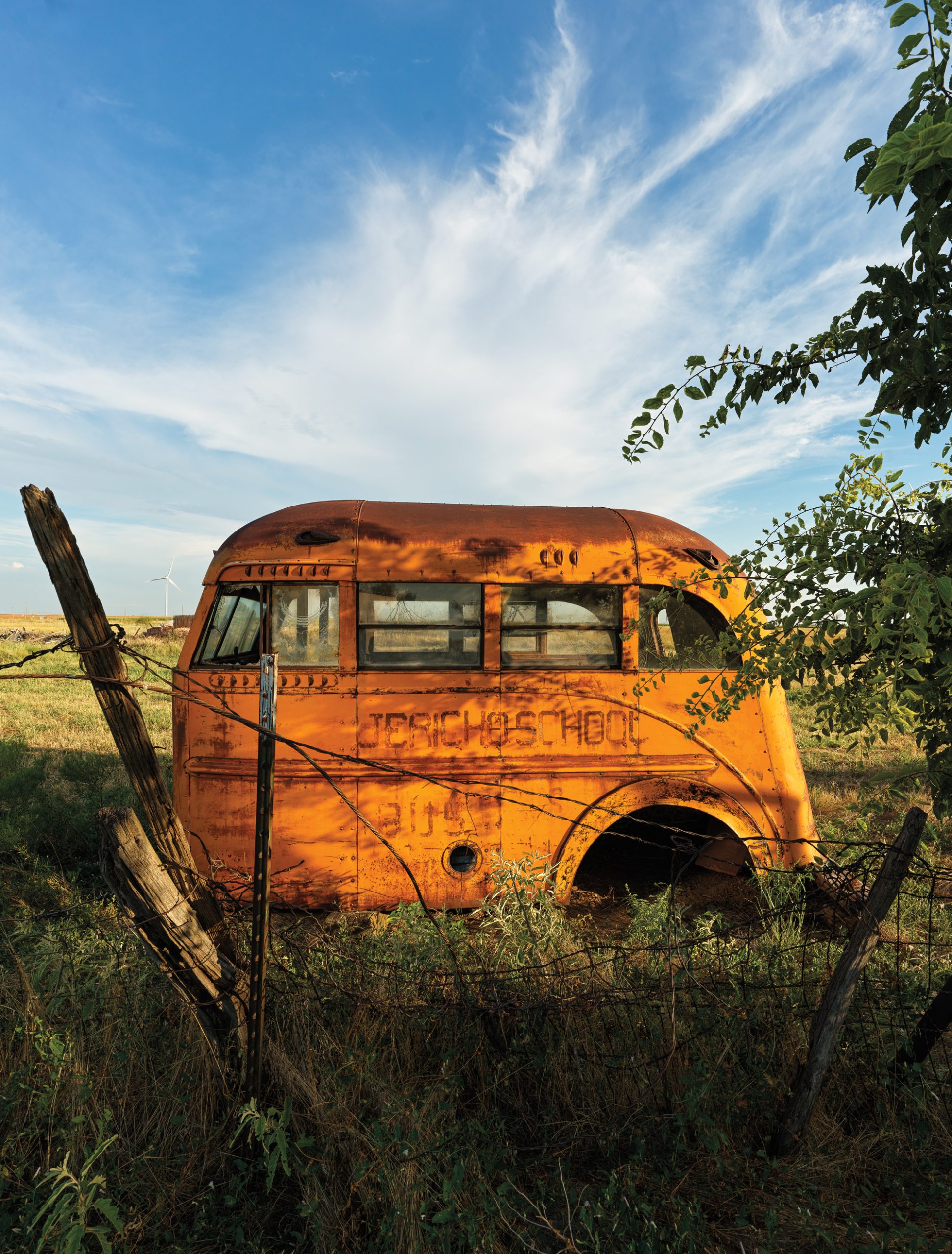
Blair shows me the pit generator they found buried, which would’ve powered the buildings. What’s left of a shower still stands behind a house—so the people who lived here could wash up after work without tracking in dirt.
I’m so lost in these details, I realize it’s been too long since I’ve seen Woody Guthrie. Blair spots him running up the dirt road, back from chasing something he probably shouldn’t. Blair says that’s the old Route 66, and I think he’s kidding. “This part was unpaved. It was called the Jericho Gap,” he says. “Mostly it was fine. But if it rained, it was unpassable. So, people would have to wait it out in Jericho.”
The Schaffers show me where they plan to build, the gardens they’ve started, the roof they’re trying to save over the tourist court. They want to rebuild the old hotel as a museum. To raise funds, they host ghost tours, hayrides, and even a 10K race. They offer stargazing nights and welcome RVers to camp. They may have planned a homestead, but what they’ve found is a mission—to save Jericho.
We look out at the sun setting across the fields, standing where their living room will be someday. “This is it for me. I found my place,” Blanca says. I’m glad the Schaffers are here now, to preserve their family history and to tell us the story of a true ghost town.
Funny how I went looking for something haunted, but what struck me—what made the ghost town come alive—was the people I met on this little quest. “Texas ghost towns began as a dream, an idea, a response to opportunity. People came chasing something,” Darsnek reminds me.
People like me see a ghost town as a curiosity, a reminder of the past, while the Schaffers see it as an opportunity. They see their dream coming alive. If a ghost town is a town without a purpose, I don’t know that Jericho qualifies anymore. I can’t think of a better purpose than fulfilling a dream.