
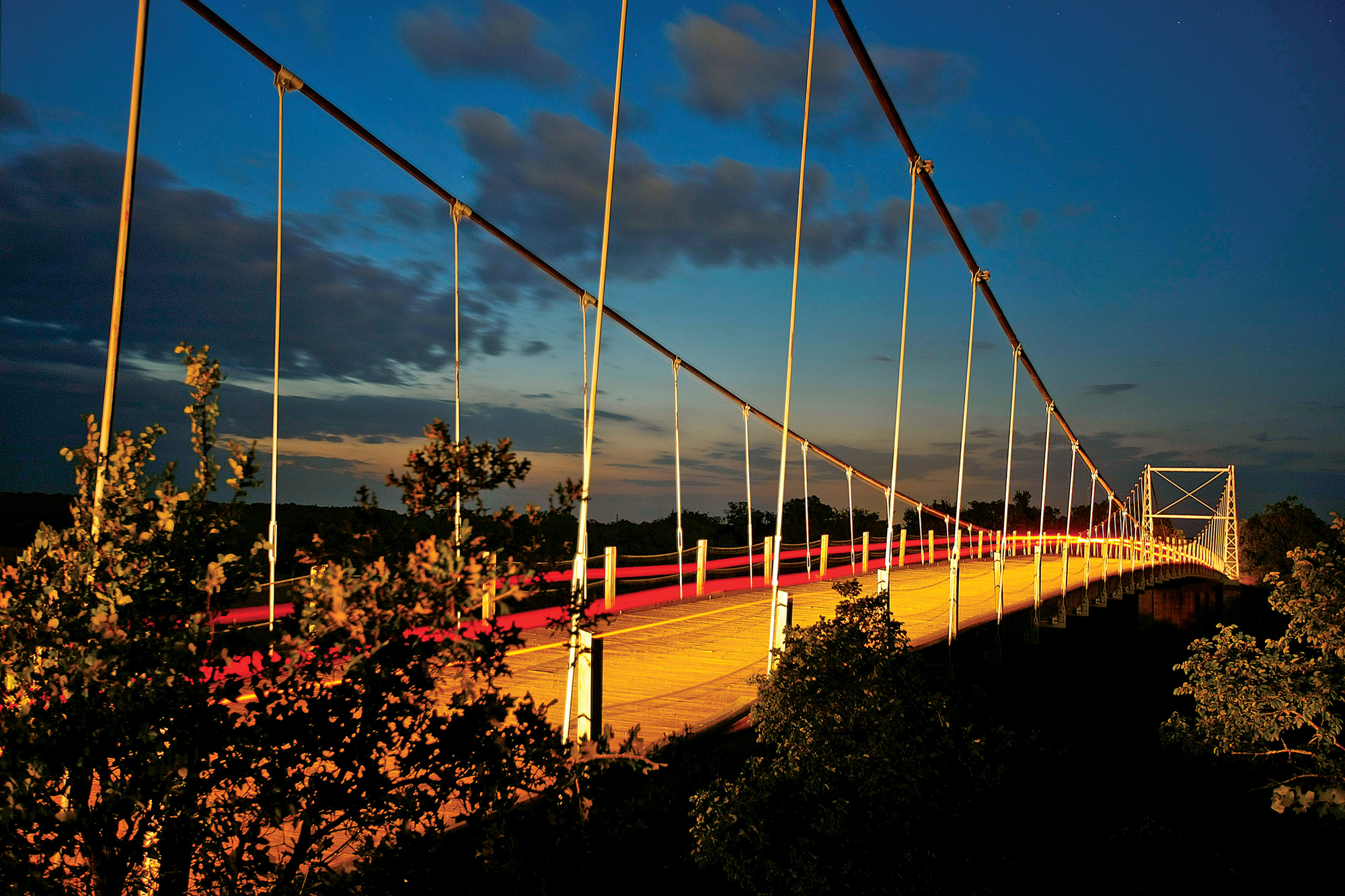
I gripped the steering wheel tightly and felt my heart race as the weight of my car caused a clanking commotion against the wood-planked bridge below. Once on the other side, I parked, took a deep breath, and ventured back on foot.
As I took in the rushing river, visible through the bridge’s open sides, I felt vertigo set in. Whirlpools of grass and limbs swirled in the muddy water, and I kept my eyes trained on the weathered wood, galvanized wires, and steel cables before me. On the opposite end of the crossing, a group of visitors began jumping playfully, which, combined with the breeze, caused the uneasy feeling of swaying on a swing.

This was my first trip to the Regency Suspension Bridge, located roughly 20 miles northwest of San Saba. The town may be reputed as the “Pecan Capital of the World,” yet one of its most peculiar attractions transcends this nutty reputation, drawing scores of inquisitive sightseers every year. For the curious, I can confirm it actually swings.
Unbeknownst to some, this rural pocket of the Hill Country is home to not one but two suspension bridges, including the Beverly Bridge spanning the San Saba River, and the Regency Bridge, the latter of which is purportedly the last of its kind in Texas open to vehicular traffic.
On my recent visit, I wound through farm fields and country roads, before stopping at an outcropping of verdant trees where I could barely make out the tucked away bridge. At the entrance, a plaque designating this as a Texas Historical Landmark recounted the structure’s history.
The story begins in the early 1900s, when a one-lane suspension bridge was constructed over the Colorado River to serve ranchers and farmers. Tragically, in 1924, the bridge collapsed after a herd of spooked cattle stampeded the structure, causing multiple casualties, among them a young boy and his horse who fell to their demise in the river below. In the 1930s, the rebuilt bridge was washed away in a historic flood, and rebuilt again in 1939, measuring more than 400 feet long.
After six decades of steady operation, the bridge underwent a large-scale restoration and preservation campaign, reopening in 1999 with a dedication by Texas Gov. George W. Bush. Since then, there have been a handful of closures and reopenings—one spawning from a fire lit by youthful partygoers—though it has always remained a bedrock of the Regency community.
Aside from its nostalgic appeal, the locally quipped “Swinging Bridge” serves as an important river crossing and thoroughfare for residents, connecting county roads 137 and 433.
“It’s a long way around if you can’t use the bridge,” says Bob Whitten, who owns and operates the popular Alamo Pecan & Coffee Co. in San Saba. “People come into the store on a regular basis saying, ‘How do we get to Regency and the Regency Bridge?’ It’s got a long history and is something people just can’t see everywhere.”
Viewers of Texas Country Reporter will recognize the impressive structure on the show’s opening credits, a cameo which has undoubtedly drawn many tourists (including myself) over the years.
Unnerving as it may seem, the swinging of the bridge is about as spooky as it gets. Locals like Whitten are quick to dismiss any ghostly feelings associated with the landmark. “That’s not something I know anything about,” he says, adding, “Our high school football field is what’s haunted. Among all the kids in San Saba it’s called the Graveyard.”
I made a mental note of this newfound knowledge, telling my skittish, scaredy-cat self that I’d cross that bridge later.