
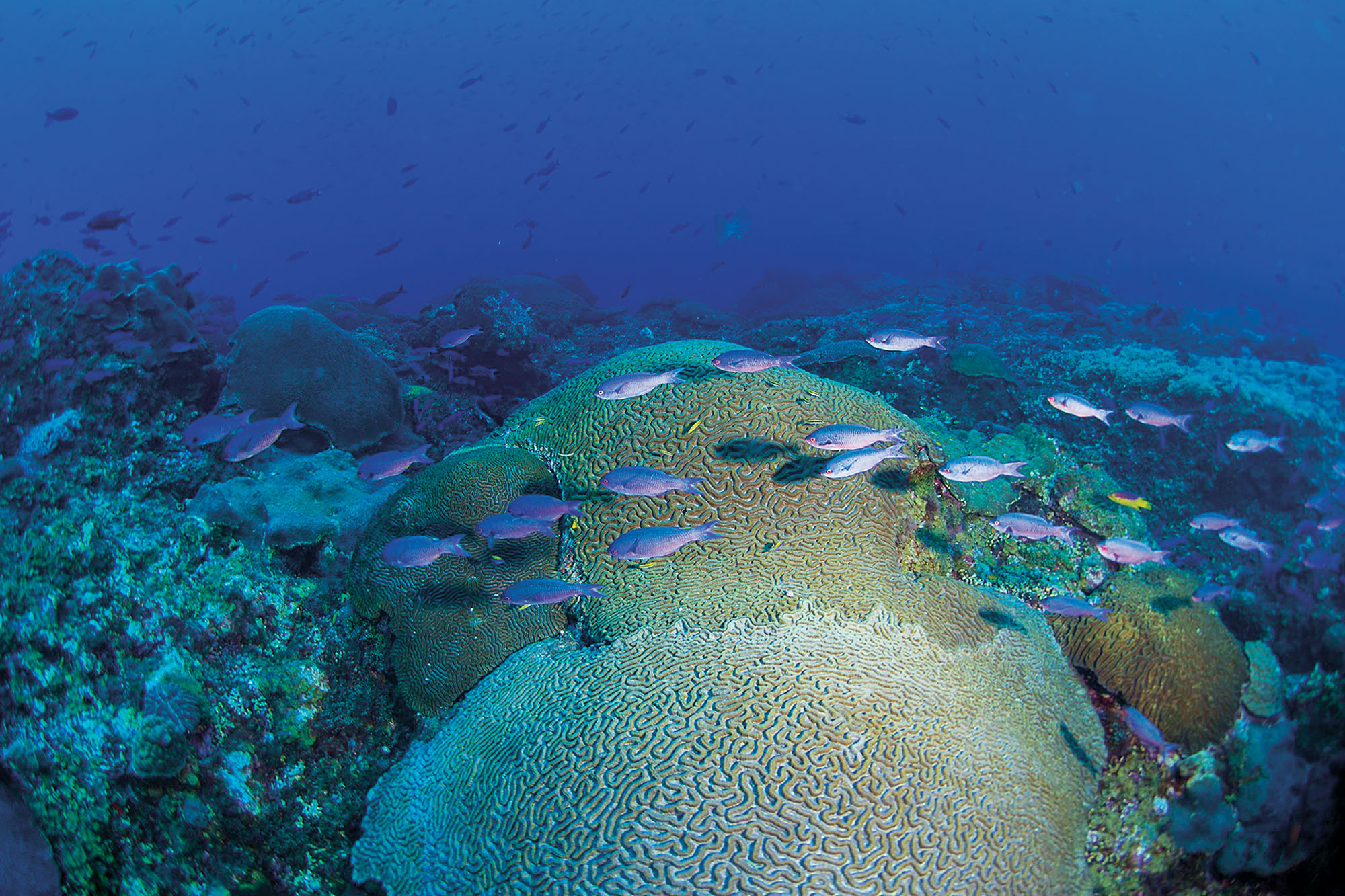
About 15 years ago, 100 miles off the Texas coast, Houston scuba diver Andy Lewis jumped off a boat and into the gentle waves. As he descended into clear blue water, he found himself surrounded by hammerhead sharks.
“It was like magic,” he recalls. “You’re out in the middle of nowhere, and suddenly it’s like you’re on top of the Caribbean.”
Lewis was visiting the Flower Garden Banks National Marine Sanctuary, created in 1992 to protect colorful tropical coral reefs that support the marine life along our shores. The “sanctuary” designation has helped these reefs remain among the healthiest in the world. But now, they face increasing threats including coral bleaching, a phenomenon where corals expel their energy-providing algae due to stress, sapping their splendid color. From 2023 to 2025, corals experienced three significant bleaching events due to warming coastal temperatures, causing corals to starve.
“It’s a global problem that we can’t solve,” says sanctuary superintendent Michelle Johnston, “but we’re looking at how to manage it.”

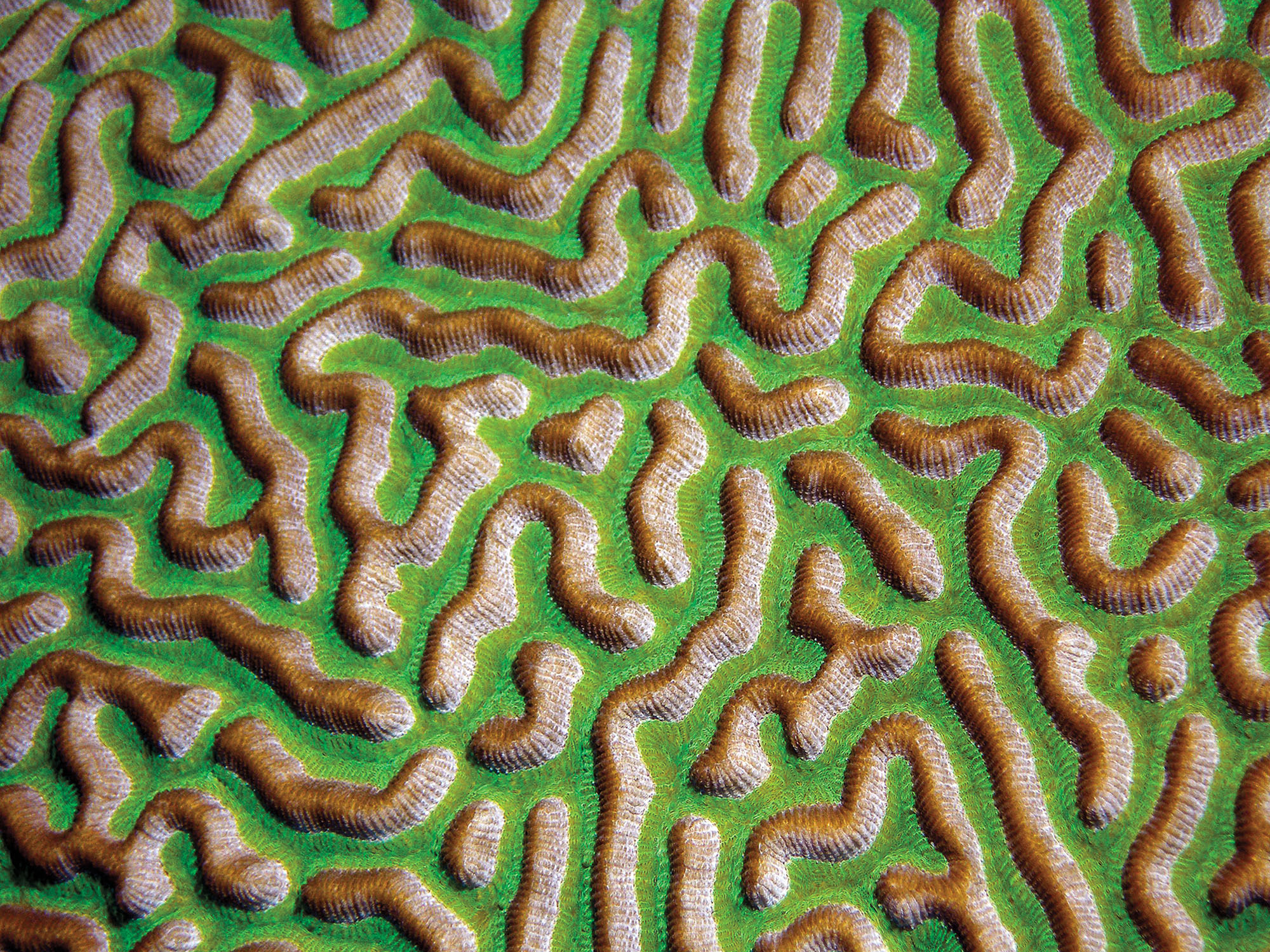
The corals that make up the banks started forming some 190 million years ago, when the Gulf was very shallow and evaporation left a thick layer of salt on its floor. Then, the sea deepened and rivers brought in mud and sand that covered that layer, pressuring it upward into dome structures covered with ridges and troughs, called banks. The marine sanctuary covers portions of 17 of these banks over 160 square miles. It is one of 18 sanctuaries under the National Oceanic and Atmospheric Administration, and the only one near Texas.
Coral reef structures, created by thousands of tiny, soft-bodied animals called polyps joined by hard external skeletons, provide shelter and food for at least a quarter of all marine life. In Flower Garden Banks, that includes sponges, octopuses, sea stars, sea turtles, vibrantly hued tropical fish, sharks, and rays. In summer, whale sharks—spotted, bus-size plankton eaters and the biggest fish on the planet—visit from waters off Mexico’s Yucatán Peninsula. Great white sharks tagged by scientists off the coast of Nova Scotia have activated detectors in the sanctuary.
“You see manta rays, schools of jacks like a tornado circling around you, big barracuda hanging out under the boat—all kinds of fish,” says Lewis, whose love for the place inspired him to become president of Texas Caribbean Charters, which runs dive trips here.
The sanctuary has offices and a dedicated research boat in Galveston to monitor coral health and fish populations. Staff scientists have studied three of the banks since the 1980s, collecting information on water temperature, coral cover, and marine life in what is one of the longest continuous reef monitoring efforts in the world. Despite the recent bleachings, the health of these reefs has been stable and even improved in some places.
“You never hear that with coral anymore,” Johnston says. “It gives us hope—a success story we can share.”
Gathering data helps the staff identify and respond to threats to reef health, such as invasive species like orange cup coral. This brightly colored coral from the Indo-Pacific Ocean likely arrived in the Caribbean on ships in the 1940s. Then, it leapfrogged from one oil and gas platform to another across the Gulf, where it takes space away from native corals and sponges. There are also venomous lionfish, voracious eaters from the Indo-Pacific that can drastically reduce the numbers of native fish. They were first documented here in 2011.
Physical removal proved ineffective in controlling orange cup coral, but ongoing efforts to curb lionfish populations are showing promise. The sanctuary now hosts several Lionfish Invitational fishing tournaments each summer, enlisting divers to help.
“Lionfish removals take stress off the reef,” Johnston says. “Every 300 to 400 lionfish we remove saves 1 to 2 million native fish each year—fish that they would have eaten.” As a bonus, humans find lionfish delicious to eat.
But the emerging threat of coral bleaching requires more complex solutions. Coral polyps receive most of their energy from algae living inside their tissues, but they expel these algae when the water is too hot. Because algae give corals their vibrant colors, the reef then appears white, or bleached. Unless temperatures drop enough for a coral to take algae back in, it will most likely starve to death.
Corals here first showed bleaching in 1990, then several more times between ’95 and 2016, the latter event affecting nearly half of one of the banks. Most recovered when the water cooled off, but the stress of the consecutive events over the past three years could make recovery more difficult. In addition, scientific models show Flower Garden Banks will continue to experience such regular bleaching for the next 20 years.
One plan is to identify genetic strains of corals that better tolerate heat and grow them in laboratories like the one at Moody Gardens Aquarium in Galveston. These hardy, lab-grown corals could be planted on the reefs to help them recover.
“We know what’s coming,” Johnston says. “We are seeing increased warming and bleaching. We’re being proactive to reduce stress and mitigate risk.”
People can help by being good stewards of their local area and participating in beach or river cleanups—and by eating the invasive lionfish.
“This is one of the few places in the world where it’s healthy coral as far as you can see,” Lewis says. “That is hard to find these days.”