
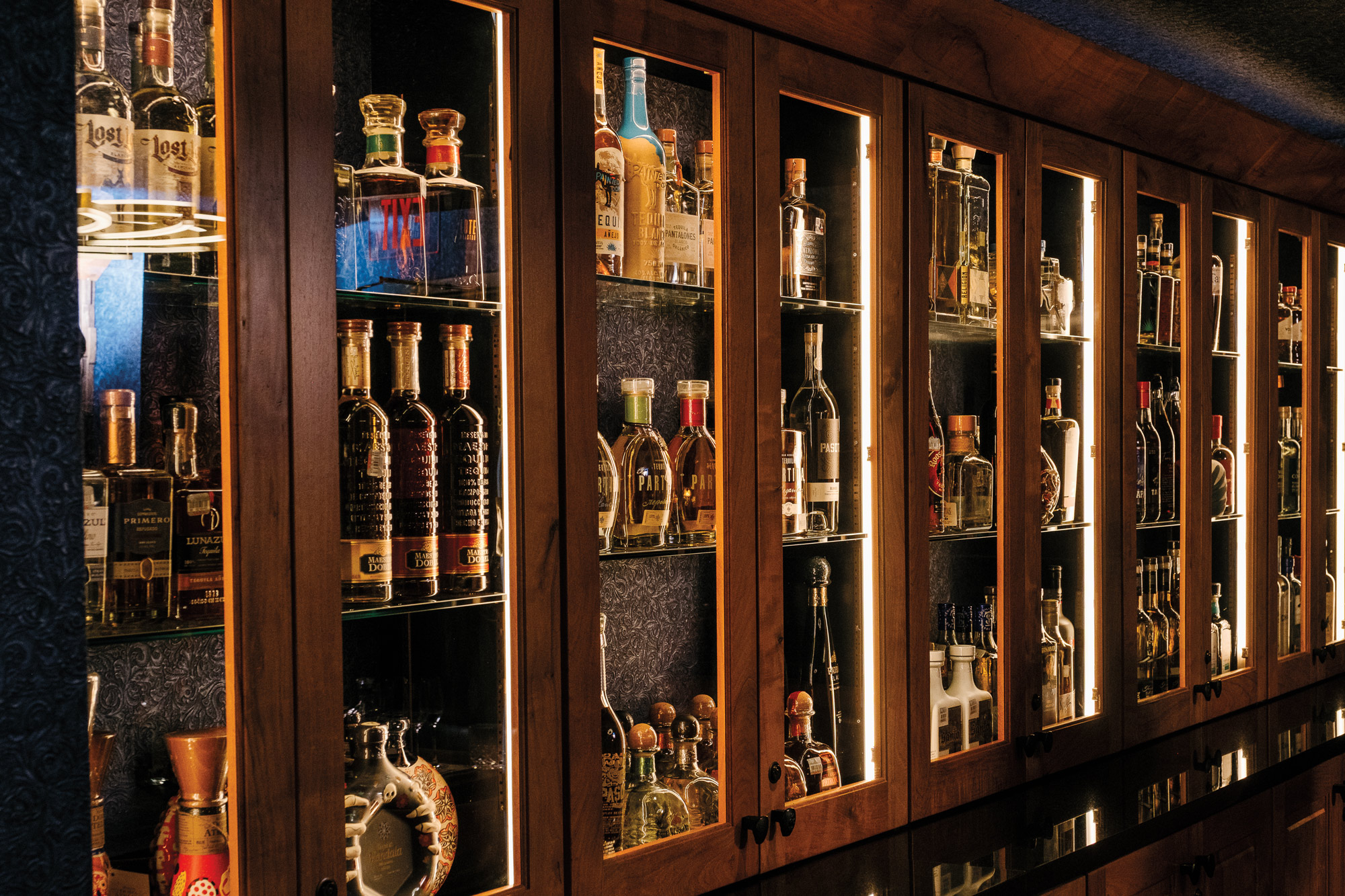
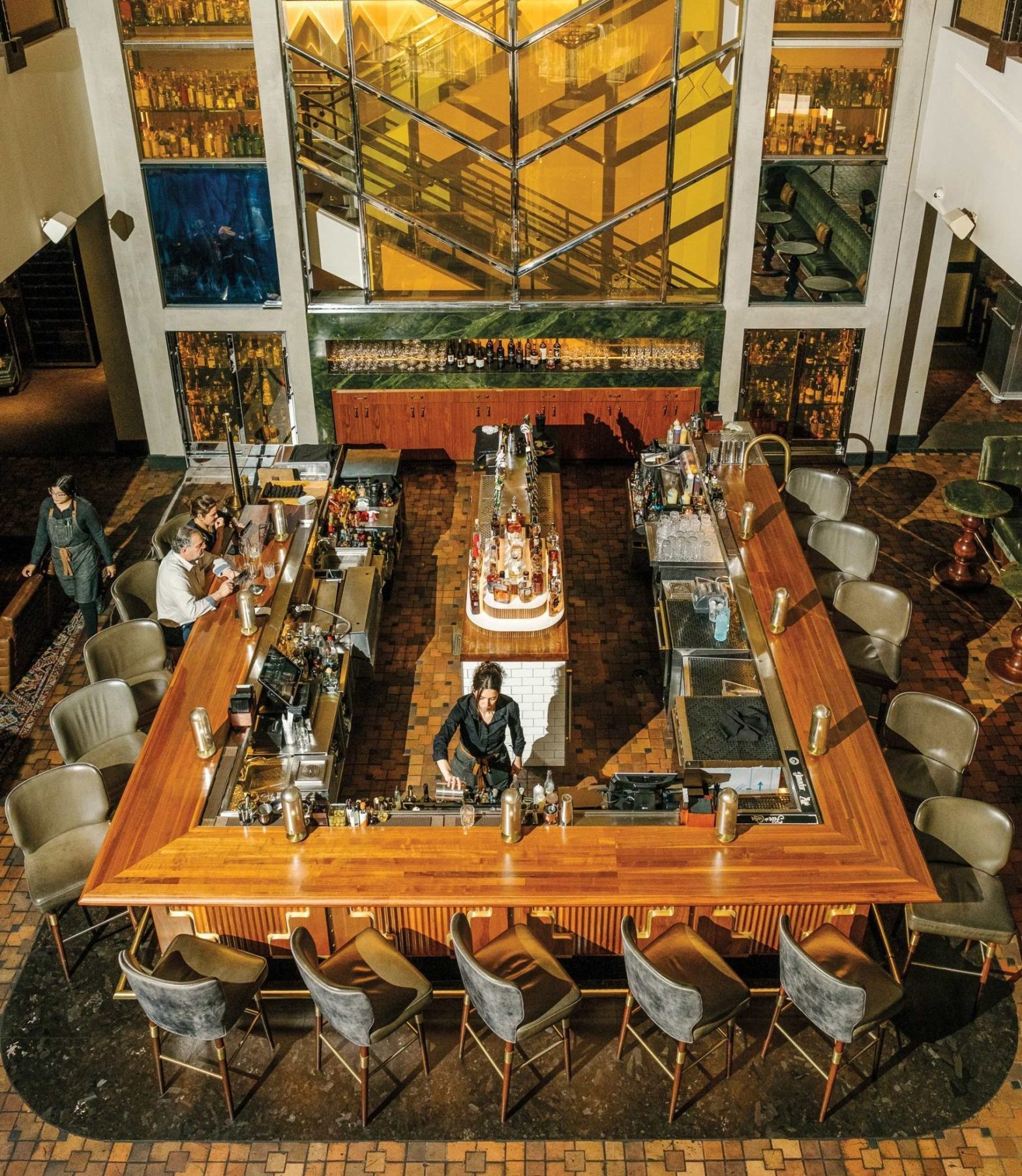
A marigold-hued stained glass installation rises high above the bar of El Paso’s Ámbar Restaurante, located in the historic Plaza Hotel Pioneer Park. Flanked by multiple floors of towering, glass-fronted shelves displaying over 1,100 bottles of mezcal, tequila, and related liquors—the second largest and rarest agave spirit collection in the U.S.—the overall impression is that of a boozy cathedral.
Since many Texans consider a night out incomplete without a margarita or Oaxacan old fashioned, Ámbar also has a subterranean, oak-paneled “Agave Room,” where executive chef and beverage director Lawrence Acosta preaches the gospel of the spiny botanical in weekly tastings, pairing tutorials, and maker dinners.

“We want to support authenticity and tradition,” Acosta says. “The category in general has so much romance and complexity, much like wine production.”
Also like wine, agave spirits can intimidate consumers. Ámbar’s programming works to dispel those concerns by educating guests on how microclimates, geography, and altitude impact the roughly 40 different species of agave used to produce mezcal and tequila—itself a type of mezcal. Both are DO (Denomination of Origin) spirits whose production is monitored and certified by Mexican regulatory agencies.
So-called alternative agave spirits refer to mezcals grown outside of the legally certified regions like Oaxaca, Michoacán, and Durango. These include bacanora, raicilla, and sotol, which are increasingly finding favor among more adventurous imbibers. Bacanora, for instance, is produced in 35 municipalities throughout Eastern Sonora and made exclusively from A. angustifolia, or maguey espadin. But unlike traditional mezcal’s smoky flavor profile, bacanora exhibits minerality and herbaceous notes that pair beautifully with beef and other red meats.
There’s also raicilla, made predominantly in Jalisco. Versions produced along the coast are mostly made from A. angustifolia and A. rhodacantha agave and exhibit briny, mineral qualities ideal with seafood. While the mountainous varieties yield subtly sweet, earthy notes more suited to wild game. Sotol, on the other hand, is made from several different species of the spiky evergreen Dasylirion plant, which is in the same family as agave and native to the Chihuahuan Desert. It makes for a vegetal, peppery product suitable as a gin substitute in cocktails.
“As a chef, I love these alternative spirits because they really represent the passion of the makers, who are preserving the story of their families and the character of their terroir in every bottle,” Acosta says. “You can taste the love and craftsmanship.”
While diners can request bespoke alternative agave spirit pairings, Acosta also conducts four-course themed Agave Room dinners that emphasize regional ingredients with each spirit. Participants learn the stories behind each brand, like the savory La Venenosa Raicilla Sierra del Tigre, recently matched with mezcal-cured tuna plated over aguachile negro and grilled avocado. Another favorite pairing is a glass of smoky, vanilla-tinged Rancho Tepúa Bacanora Blanco served next to grilled heirloom carrot tacos dolloped with salsa macha.
While Acosta encourages guests to first sample these spirits neat to more fully experience their taste and aroma, he also recommends trying them in familiar cocktails like a paloma or ranch water to drastically change the personality of these classic libations.
“The public is increasingly looking inward with regard to Mexican food, realizing how varied and regionalized it is,” Acosta says. “It’s no different with agave spirits. Raicilla, bacanora, and sotol each tell a different regional story. The best experience isn’t about covering up their intensity, but rather discovering the place, traditions, and people behind the pour.”