
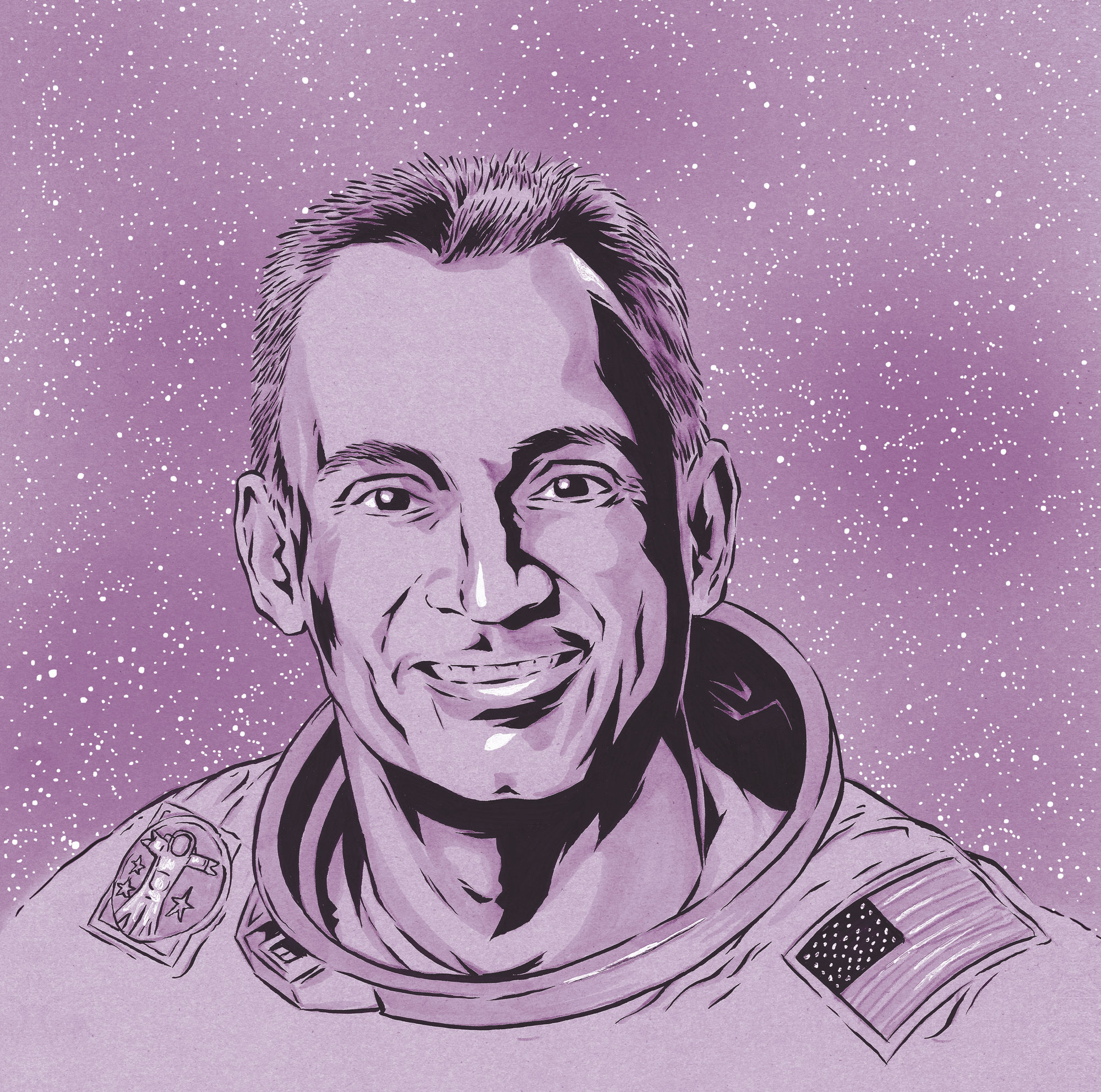
The 1979 movie Alien may have haunted a generation of moviegoers, but it inspired John “Danny” Olivas to become an astronaut. “I was in my early teens watching this movie, and there are two characters who are the flight engineers,” he says. “I’ve always been mechanically inclined, so I wanted to be one of those guys who fixes the spaceship so that the astronauts could fly. That’s how I felt I could contribute in space.”
Almost three decades later, Olivas made history as the first person to spacewalk to do a repair while in orbit on space shuttle Atlantis. Two years later, on space shuttle Discovery, he spent more than 20 hours working outside the ship. His background in engineering, which he studied at the University of Texas at El Paso, and his doctorate in materials science from Rice University made him the ideal person to do the exterior repair work.
But it wasn’t a straight shot into the space program. Olivas sent his first application to NASA almost 20 years earlier in 1988. “I thought, there’s no way I’m going to qualify,” Olivas says. “But I’m going to continue to apply. I want them to know I’m here.”
He kept applying for the next nine years. To stay close to NASA, he took a job at Dow Chemical Company in Freeport and earned a master’s degree from the University of Houston. Then, after earning his Ph.D., he got a job at NASA’s Jet Propulsion Laboratory in California by answering a newspaper ad. The lab was looking for a researcher with experience in failure investigations and failure analysis. “I said, ‘That kind of sounds like me,’” Olivas says.
Finally, in 1997 he was invited to interview for the space program and entered it the following year with 30 other astronauts. While his hard work and training had paid off, it would still be another nine years until his first space flight. “It was all about perseverance,” Olivas says. “It’s only when you give up that you no longer have a shot.”
Today, Olivas is channeling his energy and endurance toward the future with a nonpartisan organization, Astronauts for America. “When you bring people who have different backgrounds and frames of reference to the table, but all have the same ultimate goal in mind, we can accomplish great things,” he says.
Texas Highways: You were born in California. How did you end up in El Paso?
Danny Olivas: Our family has been rooted in El Paso since 1886, when my great-grandfather from Santo Tomás in Chihuahua, Mexico, crossed over through Juárez and into El Paso. My father and mother got married and moved out to Los Angeles in search of work after high school. Then my dad got an opportunity with the Pacific Free Express railroad, so I was about 4 years old when I ended up in El Paso.
TH: When did you become interested in science?
DO: In grade school. My dad got my older sister and me involved in the science fair projects, and I really loved them. I can tell you all of my science projects. My father passed away in 2017. He was a big influence in my life. He also bought me a telescope, and back in the day, the East Side got pretty decent skies at night. There wasn’t a lot of light pollution. I used to love climbing up on top of the roof with my dad. It felt like you were getting closer to the stars.
TH: Do you remember the first time you visited NASA?
DO: I was 7, and we took a family vacation to Houston. Going to Johnson Space Center was a big inspirational moment for me. My father calls my sister, my brother, and me over to show us a mock-up of a rocket engine. My dad was a machinist, and he built flanges that ultimately found their way into the rockets that were being built at the time. I’m thinking to myself, My dad had something to do with everything that I just saw in that museum. In later years, I would reflect on that moment: It wasn’t just about what my dad did but understanding and putting into perspective that it was also other dads and moms and aunts and uncles and brothers and sisters who made this rocket engine work.
TH: There’s also a physical element to being an astronaut. Did you play sports?
DO: I played football in high school, and I also did shot put and discus and track—though I was a much better lineman than I was a discus thrower or shot putter. My first semester in college was at Beloit College in a small town in Wisconsin. I was a lineman but very, very small. I got beat up pretty badly. I think I had three concussions. I decided I needed to do something else with my brain other than having it slosh around inside my skull, which is why I ended up coming back to El Paso to go to UTEP.
TH: When did you set your sights on becoming an astronaut?
DO: In 1988, before I graduated from UTEP, I already had this vision of becoming an astronaut in mind. That was something that I would tell people, and I’d get laughed at—who would ever think of anyone from El Paso becoming an astronaut? So, when I went to UTEP, it was always front of mind. I talked to the dean of engineering and eventually got into the mechanical engineering program. Then things started to crystallize.
TH: You applied for a long time before being accepted into NASA. That’s an amazing level of patience.
DO: Yes and no. Even when I became an astronaut and the nine years it took for me to fly my first mission, we had Columbia happen in between. Who could have planned for that? That’s nobody’s fault. That’s not something that we have control over. You just have to roll with the punches and deal with things that are outside of your control. And you can’t lose sight of the endgame.
TH: You were the first person to spacewalk to do a repair while in orbit. Outside of your training, how did you focus mentally to prepare yourself?
DO: You focus on what you know how to do. Whenever you’re called on to help solve a problem, all you can do is bring your frame of reference and your experience to bear on that problem. For me, I know how important this is. I know how delicate these materials are. I know how to operate in the suit. So, I brought all that together. When it came time to do the repair, I knew what was important.
TH: What’s it like being in space?
do: It’s a challenge to everything you’ve ever known. There is no up, down, left, or right in space. Things as simple as drinking, eating, and brushing your teeth are very different. You close your eyes and the movement of the air inside the spaceship is enough to push you so you’re no longer where you started. So, there are all these physical things, but the emotional things are more impactful.
TH: How so?
do: Looking down from above, you really get a perspective of how fragile our planet is and how thin the atmosphere is that protects us from the vastness of space. And you appreciate that we as this intelligent species are not even perceptible from that vantage point. The things that cause us to cause harm to each other, like borders, are not visible from space. They are a construct of the human mind. We have created these constructs, but from the perspective of the universe they do not exist. It’s disheartening and inspiring. And you really wish you could bring back space to everybody so they can experience it and their perspectives would be changed. We’re on this rock in the middle of nowhere, and we only have each other to rely on. We’re so incredibly trivial against what the universe really is, and maybe we need to put our own egos in check and realize we can all benefit from respecting one another.
TH: Is it disappointing to fly on a commercial airplane after space travel?
DO: I just take advantage of the ability to relax.
TH: What does your work entail now?
DO: I’m a consultant engineer and I provide expert consultation and witness testimony in primarily legal matters. I’ve always been an engineer who was lucky enough to become an astronaut for a period of time. And now I’m back to being an engineer again.
TH: What places do you like to visit when you’re in El Paso?
DO: I love Trans Mountain Road. I love Rim Road, especially at night. You feel like you’re looking at a treasure chest of diamonds and jewels glistening in the basin between the mountains.
TH: Is there a particular way that El Paso shaped you?
DO: El Paso was impactful by teaching me resourcefulness. My dad was such an inspiration, and he shared a very similar trait to a lot of people in El Paso: a willingness to roll up his sleeves, get his hands dirty, and get it done right. I love and cherish the can-do attitude of the people of El Paso. I’ve reroofed houses, repaved parking lots, worked as a janitor, driven a forklift. I’ve done it all—a lot of us from El Paso have done it all.