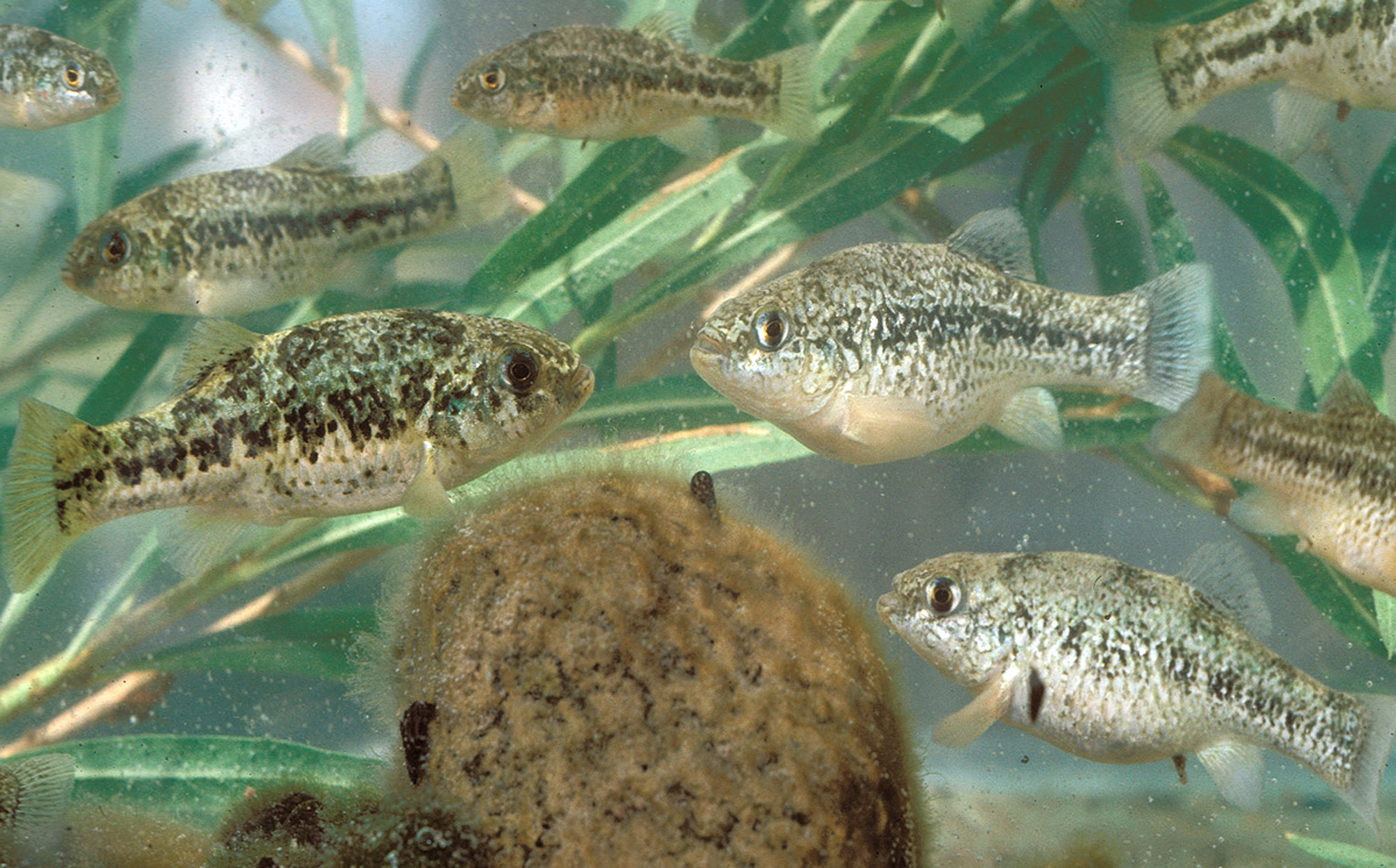
Schools of Comanche Springs pupfish and Pecos gambusia flit around the shady edges of the San Solomon Springs pool at Balmorhea State Park. Weaving around dangling toes and outstretched fingers, I swim alongside the fish in the cool, clear water, a refreshing retreat from the late summer heat.
My fellow swimmers are native to the springs of Balmorhea, where spring-fed water pools up into a human-made oasis in the middle of the Chihuahuan Desert. The waters also serve as a stronghold for the pupfish and gambusia, both endangered.
The Pecos gambusia is a small fish, around 2 inches long with a compact, reddish-brown body and a narrow, semitranslucent tail. The tiny swimmer is confined to two West Texas counties: Jeff Davis and Pecos. The Comanche Springs pupfish—similar in length to the gambusia but rounder in frame, with dark spots jutting down its sides—can only be found at Balmorhea State Park.

These species used to be more common across West Texas springs, with the gambusia’s territory extending into southwestern New Mexico. But inconsistent and infrequent rainfall caused many springs to run dry in the 1950s. In the ensuing, more arid years, the pupfish died off and was added to the federal endangered species list in 1967. The gambusia made the list three years later.
That water originally comes from a large aquifer system 400 miles northwest of Balmorhea, which is replenished by rains from the Davis Mountains before flowing through the park, Balmorhea State Park assistant superintendent Tara Fattouh says.
Though West Texas is drying out, the aquifer holds steady, pumping 15 million gallons of water through the San Solomon Springs and providing water to 11,000 Texans downstream, according to Fattouh. Built by the Civilian Conservation Corps in the 1930s, the 3.5 million-gallon pool at Balmorhea was designed to secure water supplies and provide habitat for wildlife. The corps also reconstructed a cienega, a type of desert wetland, giving native species additional space to roam.
“Preserving Texas land is a key role in the survival of native species and the continued maintenance or growth in population of the endangered species that reside in Balmorhea,” Fattouh says.
The consistent temperature of the water coming into Balmorhea—between 72 and 76 degrees Fahrenheit—provides the unique environment necessary for the gambusia and pupfish to live. Both species feed on small invertebrates and algae that only form along pool walls and in the marshes of the cienega within their current temperature range; the pupfish also feeds on the pool bottom.
Fish surveys, spring flow monitoring, and habitat maintenance help protect these endangered fishes. A collaborative effort between the Texas Parks and Wildlife Department, Texas Commission on Environmental Quality, U.S. Geological Survey, and U.S. Fish and Wildlife Service monitors populations as well as water quality and quantity.
“With long‑term protection of endangered species and the springs, our everyday visitors can make the biggest and most immediate impact simply by cherishing the place where they’ve built generational memories,” Fattouh says.
Swimming by the pupfish and gambusia that afternoon, I take Fattouh’s words to heart, careful not to disturb my petite companions.