
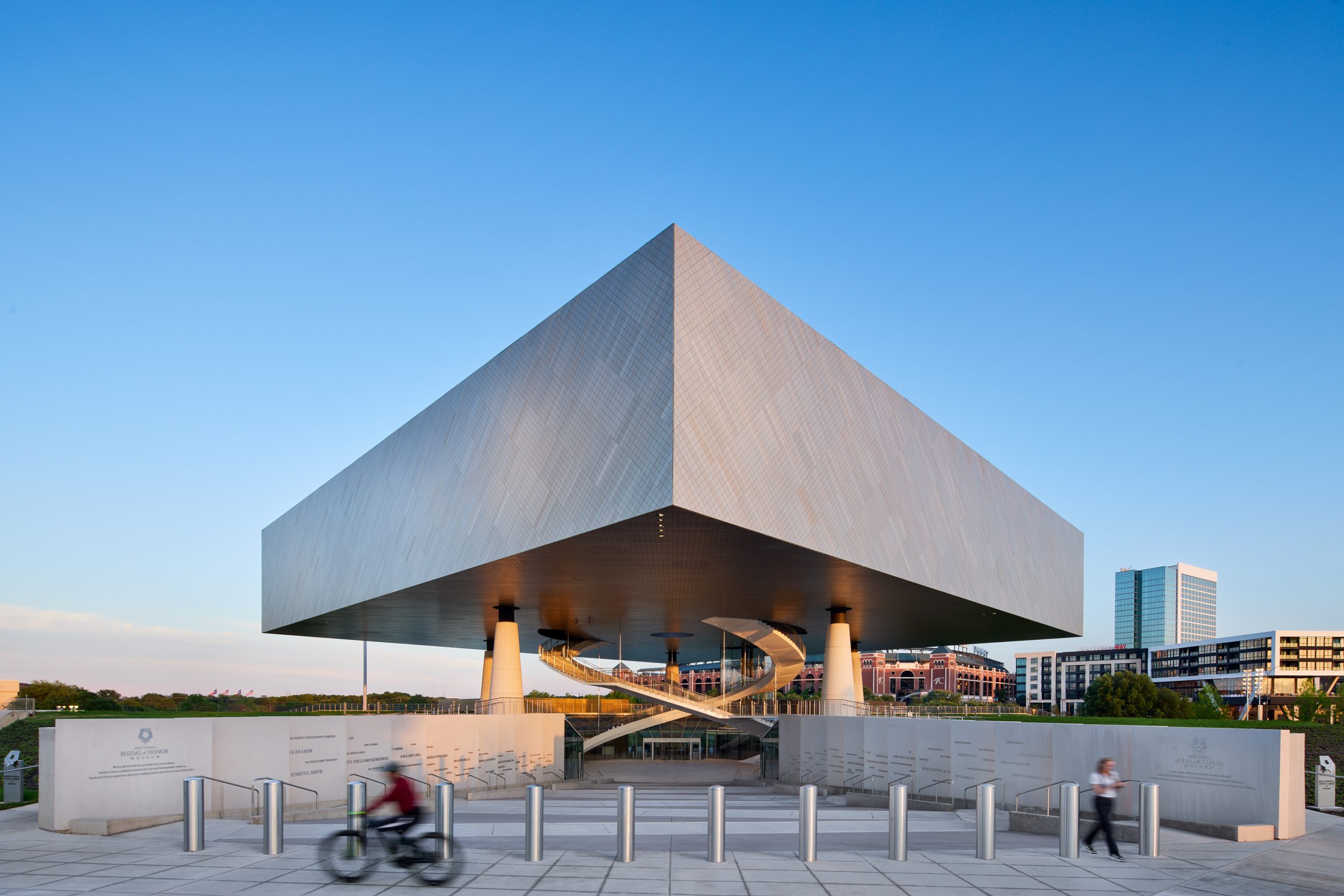
The National Medal of Honor Museum stands at attention in downtown Arlington, a solemn testament to American heroism amid the city’s otherwise busy patchwork of entertainment venues. Boasting a footprint of 100,000-plus square feet, the museum resides near Globe Life Field and AT&T Stadium and is a stone’s throw from Six Flags Over Texas. At first sight, its gleaming silver exterior feels incongruous to the complex. It isn’t until you begin your descent down a concrete set of stairs underneath the monolithic to the museum’s entrance that you begin to feel its impact.
“The idea for a National Medal of Honor Museum has existed for decades,” says Cory Crowley, executive vice president of the National Medal of Honor Museum Foundation. The search process began in 2019, led by Charlotte Jones, executive vice president and chief brand officer for the Dallas Cowboys, and the board of directors. Arlington beat out competitors like San Diego, Denver, New York City, and Washington, D.C.
They broke ground in 2020, and the museum officially welcomed visitors in March 2025. Former presidents Bill Clinton, George W. Bush, and Barack Obama also offered their support to the endeavor by serving as honorary directors of the museum. Veterans receive discounted admission, while active-duty military members get in for free.

The architect Rafael Viñoly—born in Uruguay, but who lived in New York City until his death in 2023—designed the building. Its Exhibition Hall, a 200-by-200-foot steel structure that hovers 40 feet above the ground, is supported by five columns, created to represent the five traditional branches of the U.S. Armed Forces.
“He had an incredible vision for the building itself to serve as a tribute to the bravery and sacrifice of America’s Medal of Honor recipients,” Crowley says. “The museum’s principal architectural gesture is to elegantly suspend a massive building in the air as if by some superhuman effort, evoking the extraordinary feats of heroism that the Medal of Honor recognizes and the exemplary traits of its recipients: courage and sacrifice, commitment and integrity, citizenship and patriotism.”
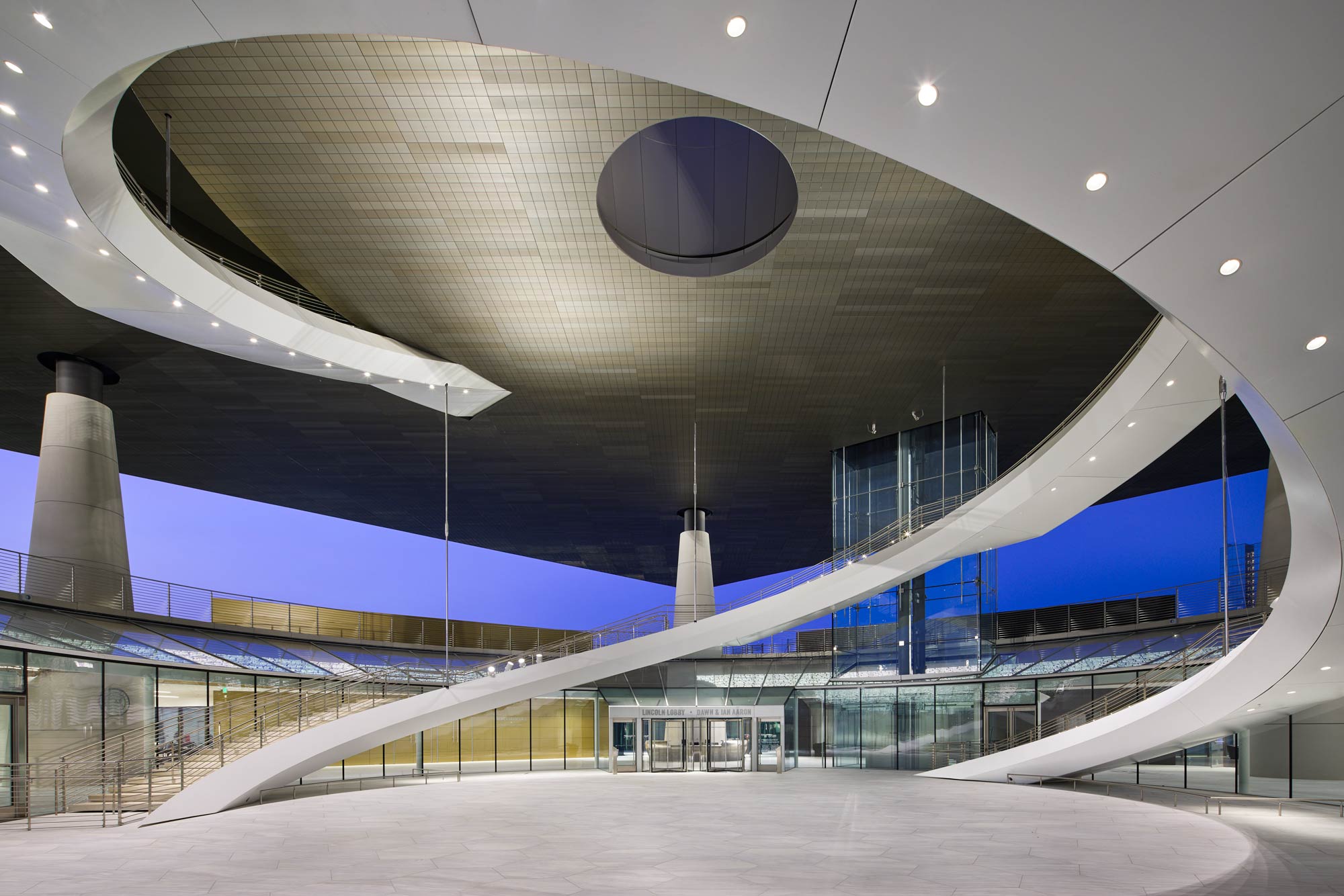
Once inside, I’m met with hundreds of names etched into a gold metal overhang attached to the glass ceiling. The metal circles the entire lobby, a seemingly endless list of individuals honored with the United States’ top military distinction. Included among them are Audie Murphy, a Hollywood film star in the 1950s who grew up in the Farmersville and Greenville areas, and Mary Walker, a recipient from the Civil War era and the only woman to earn the honor. Docents greet patrons, asking each person if they knew any of the people listed, ready to point out a friend or family member resting in that sea of letters.
An elevator takes me from the lobby, which is beneath ground level, up several stories to the main exhibition floor where I file into a round room with immersive video to watch a seven-minute documentary. It’s easy to become jaded by any show of patriotism, which can feel performative, but here the focus is on unity and sacrifice. The video features presidents on both sides of the aisle extolling the virtues of the honorees and their stories. I watch old recordings of LBJ and George H.W. Bush, among other presidents, as they present the medals to men whose own voices narrate their experience of war and its aftereffects.
Soldiers who fought in every American conflict from World War II to Afghanistan speak about unity and friendship, unexpected bravery, and the way people come together to defend the United States. The stories focus both on the individual and the nation through letters and photos, uniforms, and memorabilia, some of which were donated by soldiers themselves and some by the military. Walls feature interactive battle scenes or large-scale videos depicting their geography. The exhibits focus on soldiers’ stories and what motivated them to acts of extreme bravery.
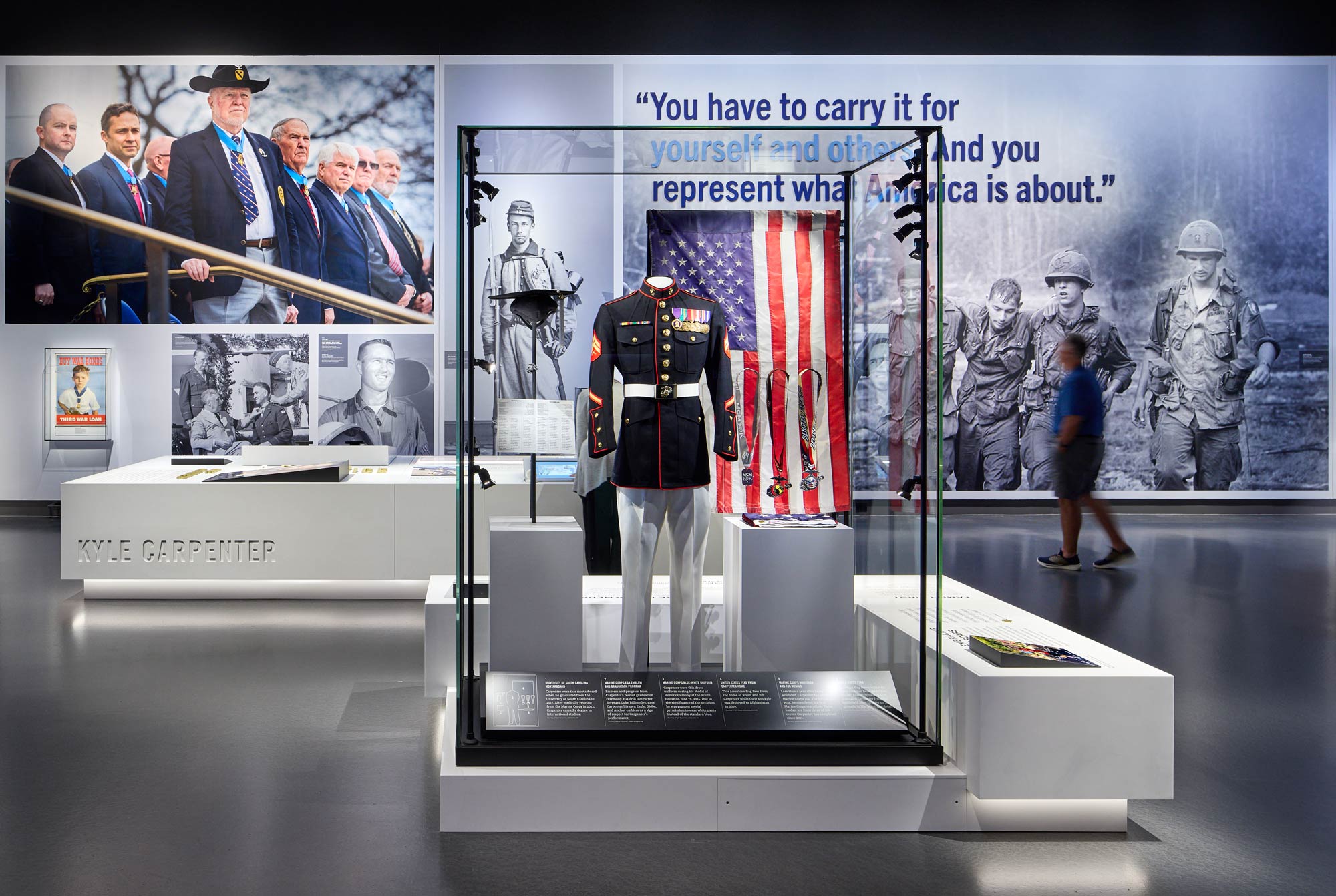
Near an interactive exhibit featuring medal winners who served in Vietnam, which includes a fully restored Bell UH-1 “Huey” helicopter, I see a couple reading every detail. They’re visiting from Lake Tahoe to spend time with their son. The father tells me he comes from a long line of service members dating to the Revolutionary War, making him part of the eighth generation of his family to serve. The museum is overwhelming for him. “The place is pretty personal,” he says. “There are a few members in this room that I know.”
He’s especially drawn to the Afghanistan portion. “Most of it was from the time frame that I was there. You hear [the honorees’] stories, and it’s very real,” he says.
Visitors can hear those stories via a virtual Q&A with Medal of Honor recipients. Documentarians recorded each participating recipient answering more than 700 questions over the course of three days. The result is magical. Sitting in a room, you simply press a button and ask a question, whether about the soldier’s family or friendships or their experiences in battle. From a screen, the soldier’s avatar listens and answers your questions directly.
“It has been especially meaningful to see veterans and active-duty service members visit the museum,” Crowley says. “Many describe the experience as deeply personal and reflective.”
Walking through the quiet, solemn halls of the museum, I thought of the veterans in my family, of the stories they never told, the soldiers they fought beside who didn’t come back to be with their families. I hadn’t anticipated being as moved by the museum as I was. It reminded me, as it will for anyone who visits, what can be accomplished under the influence of exceptional bravery.
Correction: A previous version of this story incorrectly had Chris Cassidy, a retired Navy SEAL and former NASA astronaut as well as president and CEO of the National Medal of Honor Museum Foundation, as leading the search for the museum.