
Illustration by The Red Dress
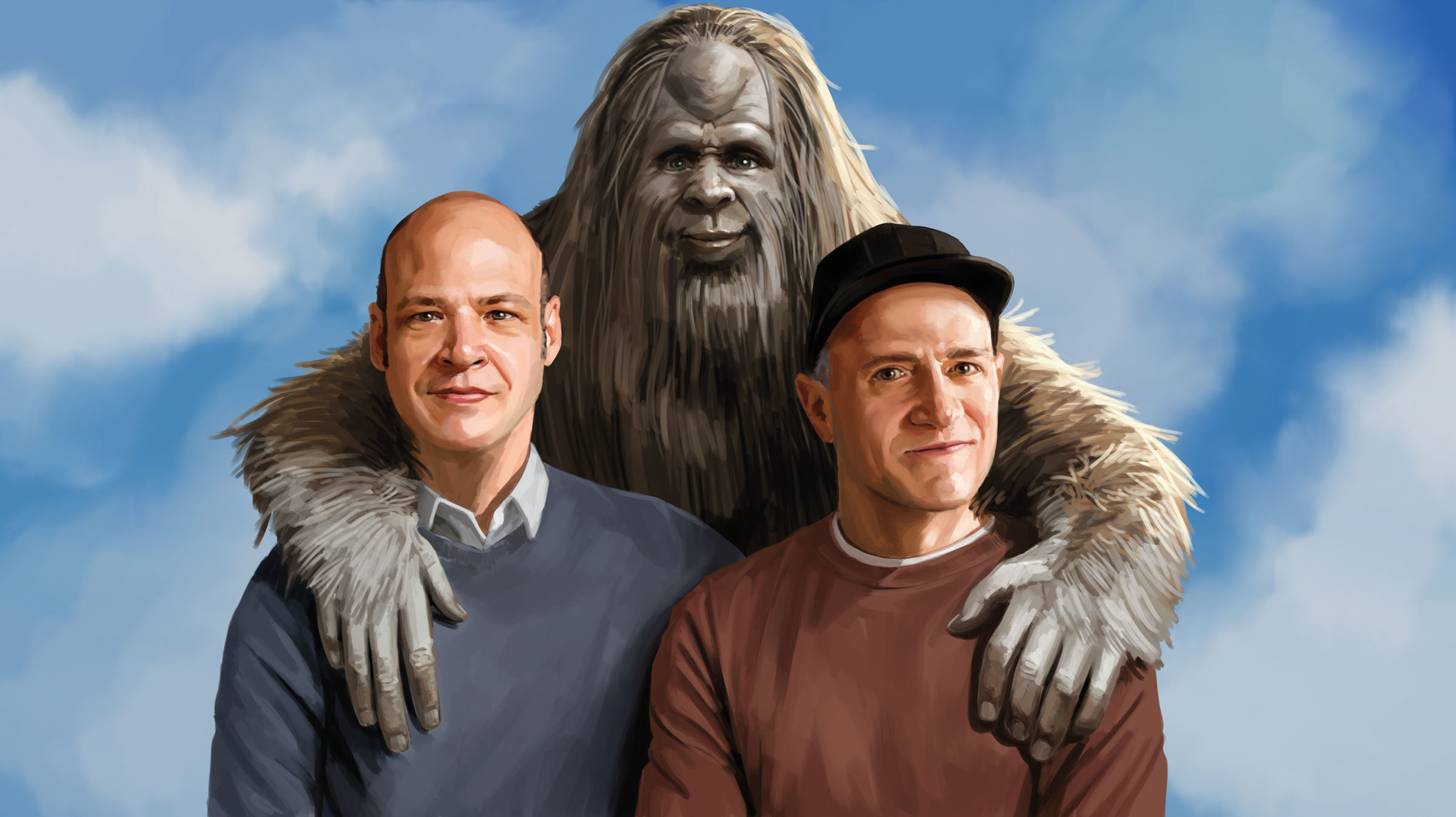
Filmmaking brothers David and Nathan Zellner have been obsessed with Bigfoot since childhood, when the elusive woodland creature entered their imaginations. Their lifelong infatuation inspired them to create Sasquatch Sunset, a 90-minute, dialogue-free movie about a family of sasquatches living in a Pacific Northwest forest. The cast is played by Golden Globe-nominated Riley Keough, Oscar-nominated Jesse Eisenberg, Christophe Zajac-Denek, and Nathan (both brothers act, but David isn’t in this movie). The characters emote and grunt under heavy prosthetic makeup and fur-covered body suits in a mundane yet curious portrayal of everyday life.
The Zellners were born in Colorado but moved to Texas as kids. As adults, they joined forces in Austin, where they immersed themselves in movies. “The Austin Film Society screenings exposed us to so many formative experiences. Now they have their own amazing theater, but in the ’90s we went to their screenings at the Dobie or on the UT campus,” the brothers say. “The Paramount Theatre, we’d always attend the summer rep film series.” This led the Zellners to create a resume of quirky movies including Kid Thing, Damsel, and Kumiko, the Treasure Hunter, about a Japanese woman who’s convinced Fargo is a documentary and sets out to find the treasure Steve Buscemi’s character buried in the snow.
Sasquatch Sunset is a provocation even by the brothers’ standards. The creatures do everything you’d expect to see animals do if you were out in the woods studying them. There were reports of walkouts at this year’s Sundance Film Festival, in reaction to scenes of the creatures partaking in routine mammalian bodily functions. “We knew it was going to be divisive,” David says. “But it’s interesting to hear that some people are shocked by it. I bet they have no problem seeing the horror movie of the week, where humans are getting eviscerated.”
 Enjoying this article?
TH: What caused Bigfoot to occupy your mind all this time?
DZ: In the 1970s, there was a Bigfoot craze. We watched that show In Search Of… and were mesmerized with the Bigfoot episode. And there was a lot of ape cinema that we were exposed to. 2001: A Space Odyssey is the main one, but also Planet of the Apes, and then maybe even Every Which Way but Loose. And Cha-Ka from Land of the Lost—he was huge for us.
TH: How was the short film you made 13 years ago a warmup to this?
NZ: We actually did two, but the one that played at film festivals was Sasquatch Birth Journal #2. It was a four-minute short, and most of it is just this sasquatch up in a tree in labor and then giving birth to a baby. It’s this kind of ridiculous idea. But the way it was shot was totally different. We made it look like it was surveillance video—kind of grainy. The short wasn’t really the idea that sparked the idea for the feature. It was always just this general interest in Bigfoot—this mysterious creature and the life that it lives that no one else gets to see. The famous piece of footage only showed Bigfoot walking or running away or something, and we were always joking, “What else is it doing?”
TH: I guess people walked out of the Sundance screening because they couldn’t handle the R-rated sasquatch action.
DZ: It’s good press, so we’re good with it. But you know, we were inspired not just by the other features we mentioned, but also YouTube videos and personal encounters we’ve had with animals doing crazy things. Basically, every animal is trying to mate or mark their territory. As humans, we like to separate ourselves from the rest of the animal kingdom. When you have this creature that represents the human missing link of sorts, it becomes uncomfortable because you have to face how we’re still connected to animals even though we like to distance ourselves.
TH: Nathan, in addition to being half the filmmaking team, you play a ’70s antihero Bigfoot.
NZ: He’s like the more stereotypical Bigfoot. We would refer to him as the alpha male of the family.
TH: He’s off in the woods looking for berries to get high off of, and then he gets really mad and enrages the others.
NZ: There’s a lot of Warren Oates energy in there.
TH: How did you and the rest of the cast prepare to play these creatures?
NZ: We did a lot of research online with primate videos, especially behavior videos. There are a ton of resources out there, from official stuff discussing how primates act to videos shot at zoos, where you can watch gorillas interacting with each other. The grooming in the film is very typical primate behavior. A lot of that was already detailed and planned out in the script stages. Also, Jesse had worked with a movement coach on a previous film who had studied under Marcel Marceau. We even read excerpts about the making of 2001. The actors playing early humans in that were what, mimes or something?
TH: Mostly dancers and mimes, yeah.
DZ: When we were making this, though, we knew that because there was a drama element, we wanted to cast dramatic actors like Jesse and Riley who would get it at the emotional level, then work with a movement coach toward acquiring primate movement skills and stuff like that. We had a sasquatch boot camp that we started on Zoom. We would practice different vocalizations and move around the room and try to be aware of how primates walk. And we also studied the original Bigfoot film from the ’70s where it’s just walking. Because everybody’s so familiar with that silhouette, that image, we wanted to build the physicality upon that baseline.
TH: Nathan, can you describe the process of going into makeup to play these characters?
NZ: We did full-body casts. The suits were skintight, and they had muscles built in, so it didn’t just look like a suit. There was actually a form to the creatures under the fur. As for the face designs, we wanted the actors to be able to emote from within the makeup, so we tried to get that material to be as thin and flexible as possible. And we kept the eyes human. We didn’t use contacts or anything like that. It was a way to further relate to these creatures on a human level. The makeup process was two hours every morning, with the four of us getting into the suits and the cowls and the prosthetics and then painting and gluing all the fur on.
TH: Were you taking lunch in the outfits?
NZ: We learned how to spoon-feed ourselves through these prosthetics.
DZ: Some people would take off some of the outfit, like the mustache or the chin, and take out the fake teeth—because they didn’t want food falling into the makeup or the wigs, which were really expensive to make.
NZ: For all the challenges, David and I keep telling people this movie was one of the most collaborative experiences we’ve ever had. The crew was amazing. The cast was great. By the end of the day, we got some amazing footage. Everybody had a really fun time.
For more information on the Zellner brothers, visit zellnerbros.com. Stream Sasquatch Sunset on available platforms.