
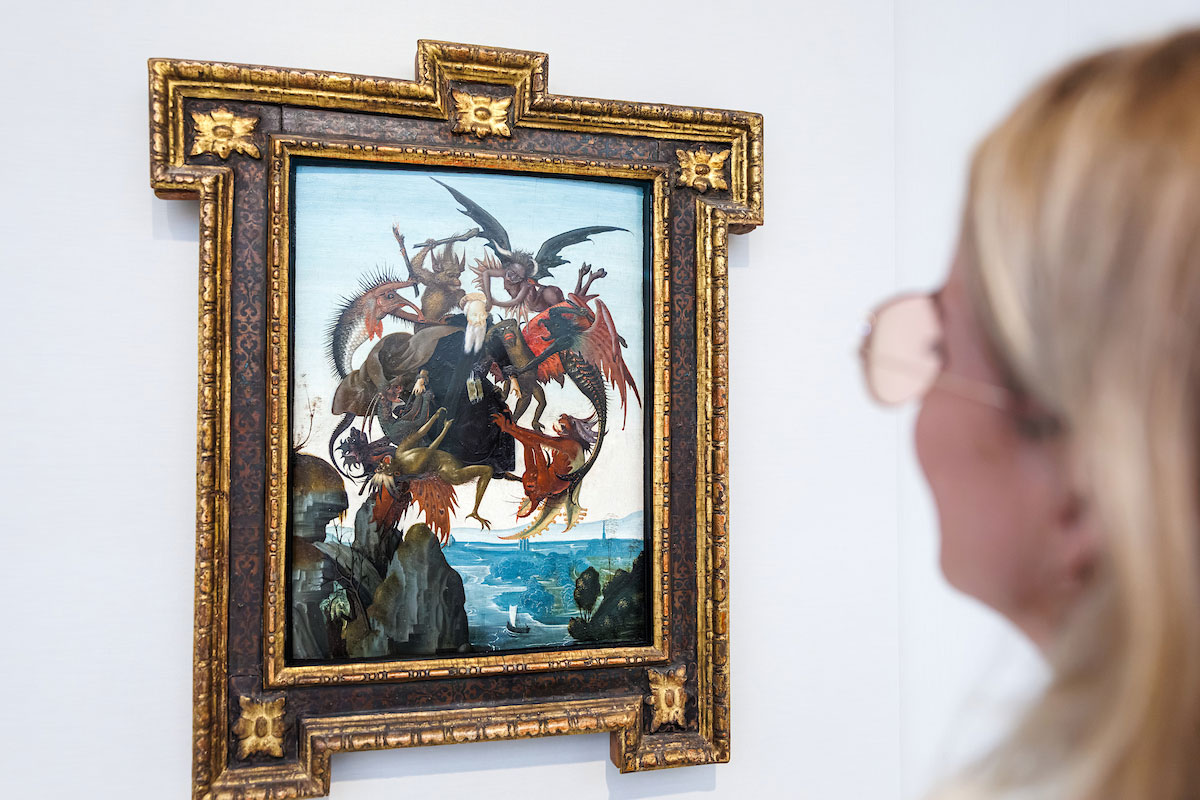
I pass the gazes of a Roman mummy mask and an Egyptian pharaoh as I turn a corner in the upstairs gallery of the Kimbell Art Museum and come face-to-face with Michelangelo’s monsters. I had no idea the Kimbell owned a Michelangelo, or that he painted anything other than the Sistine Chapel. But here it is, The Torment of Saint Anthony, an 18.5-by-13.75-inch work Michelangelo painted in 1487, when he was 12 years old. Within a 17th-century wooden frame, demonic hybrids of fish, gargoyles, and dragons hover around the airborne Saint Anthony, an Egyptian monk. They poke and pull at him, trying to frazzle the hermit who meditates in a cave most days, withstanding all temptation.
I have the monsters to myself. It’s late on a Tuesday, the museum is quiet, and I am in the final hours of a Fort Worth art trip with my family. We’ve admired Frederic Remington’s dust-streaked cowboys at the Amon Carter Museum and marveled at sculptures by Richard Serra and Martin Puryear at The Modern. Now my museum-weary teenager and husband have abandoned me for the sunlight of the Kimbell’s courtyard. I, too, am flagging, but not from gorging on masterpieces all day. I’m fatigued because a recent bout of 4 a.m. wake-ups has been stealing my sleep. Nocturnal worries, both trifling and immense, have been demanding my attention. Lighthearted by day, I’ve fallen captive to a swarm of subconscious fears at night.

I look closely at Michelangelo’s fantastical creatures. I am smitten by their winces and sneers. Could my enchantment be the symptom of sleep deprivation? Or the thrill of observing up close the brush strokes of a boy who would grow up to be one of the world’s greatest artists? The monsters’ spikes, claws, and wings glisten in shades of aubergine and forest green, the same rich hues Michelangelo would later use to paint the Sistine Chapel.
The realistic fish scales astonish me the most. Michelangelo wanted to show his disapproving father that he really was an artist. He frequented the stalls of the Florentine markets, studying fish from the Arno River to master their shimmer. I lean in as closely as I can without provoking the ire of the watchful attendant in the corner. I imagine Michelangelo’s young hand, determined to prove itself, shaping each iridescent scale in a time and place worlds away from where I now stand. And then I laugh.
These poor monsters are incredibly goofy. Annoyed that the meditating old saint is immune to enticement, they try hard to ruffle his feathers. A sad-faced fishy one with a long hose nose raises a firebrand. A winged demon with a massive underbite tickles Saint Anthony’s white locks. One pitiful creature with the misfortune of having a weird animal face for a booty—a detail you know a 12-year-old would love—grabs the saint’s robes with his claws. These monsters are so hapless, I think I love them.
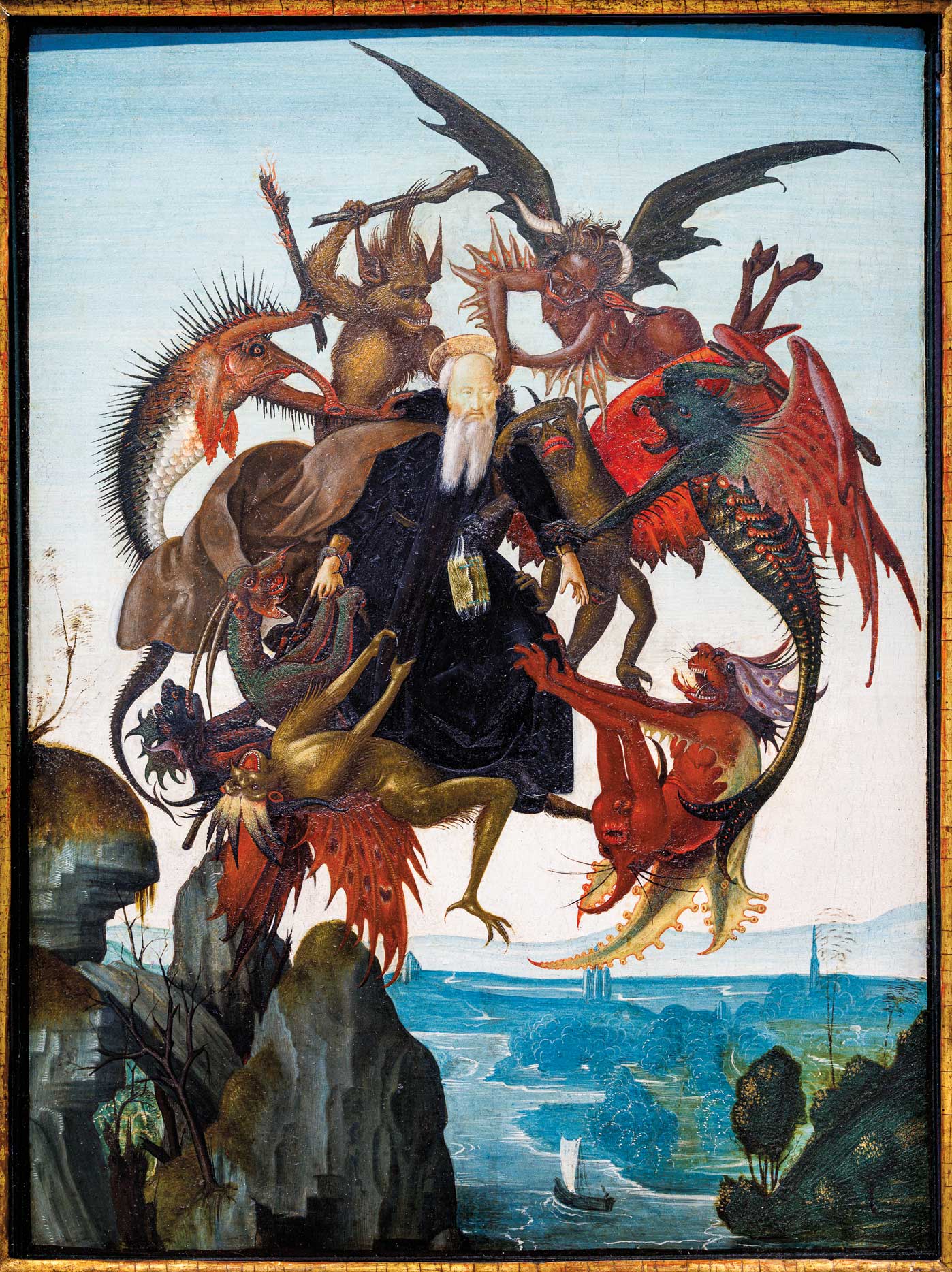
But the silliness of the monsters isn’t the only reason I laugh out loud by myself in the airy upstairs gallery. The story behind the painting, which Michelangelo copied from a black-and-white print by the German engraver Martin Schongauer, was well-known among Europeans in the 1400s. Saint Anthony the Great, a 4th-century Christian mystic who lived as an ascetic in the desert, reported this vision of a monster attack. But because he was unflappable—as perhaps anyone who meditated all day in a cave would be—he could withstand their torments. The beasts make me laugh not just because they’re goofballs, but because they seem familiar.
Could Saint Anthony’s monsters be ancestors to those sleep-depriving demons who’ve hovered about my own visions lately, waking me before dawn? Those who sometimes take the shape of pesky modern preoccupations Saint Anthony never bothered with—like, is it too late to return that package? Was my social media post too braggy? Or parenting doubts—am I too lenient? Do my kids need more chores? I can usually shoo away these smaller fears with deep breathing and maybe a melatonin.
But it’s the big fears, hard to even say out loud, that make me so jangly I want to spring from the bed. What if my teenager gets in a car wreck? Will this planet hold up for my children and someday grandchildren? How well will my husband and I face the inevitable trifecta of old age, sickness, and death? These sleep-stealing fears have fangs.
Once the sun has risen and the coffee is poured, the late-night monsters recede. But in the middle of the night, in the darkness, when all is quiet? Those bigger doubts cast long shadows. As I stand alone confronting The Torment of Saint Anthony, it hits me that perhaps my 4 a.m. anxieties could also be as powerless as the outmatched creatures clinging to our protagonist’s robes.
After our Fort Worth trip, I feel lighter at home in Austin. I’m sleeping better. That painting shifted something in me, and I don’t know why. So, I call my meditation teacher and friend, Flint Sparks, a Zen Buddhist priest and former psychologist who grew up in South Texas. He has worked in hospitals counseling cancer patients at the end of their lives. If anyone knows about grappling with monsters, it’s him.
“There’s still anxiety, but you can watch and know, ‘Oh, this is not total reality,’” Sparks says. “There are certainly bad things out there, but that’s not what you’re dealing with at 4 in the morning. You’re safe in bed. Like with Saint Anthony’s vision, these monsters exist in a virtual world.”
In Michelangelo’s painting, Saint Anthony isn’t fighting back and even seems unperturbed by his assailants. It’s like in horror movies when the teenagers finally stop running away from the monsters and turn around to look. “There’s something ancient and universal about that,” Sparks says. “When you turn toward something, it begins to lose its power. And then you see that they are not your fears. They are the fears. Universals. The nature of being human.”
A few months after my first encounter with The Torment of Saint Anthony, I go back to the Kimbell. This time, I meet Eric Lee, the museum’s director. In 2009, after he’d spent just a few weeks on the job, the museum acquired the painting. It was a risky move given that at the time the provenance was still in doubt, but scholars have since confirmed it as Michelangelo’s. The painting is meaningful to Lee on a whole different level.
“There’s great serenity there despite what’s going on around him,” he says, as we look at the painting together. Ah, to maintain equanimity regardless of what’s poking at you! He points out Michelangelo’s distinctive use of negative space and color and how he took Schongauer’s black-and-white print and made it come alive with the hues he’d studied at the fish market. “It says so much about Michelangelo’s artistic personality when you look at the changes he made,” Lee adds. “He said that nature was his only teacher.”
Lee tells me about a 16th-century biography of Michelangelo written by his friend Ascanio Condivi that references this painting. I track it down. These words excite me the most: “… there were many strange forms and monstrosities in the demons; these Michael Angelo executed with so much care that no part of them was coloured without reference to the natural object from which it had been derived.”
In the mysterious ways art changes us, young Michelangelo’s fierce willingness to look closely at his world is helping me, more than 500 years later, do the same. The Torment of Saint Anthony has opened a door. These oddball monsters not only charmed me, but they helped me realize what Flint described. Those big universal fears of loss, old age, sickness, and death—they are not my fears. They are the fears. Whether we face them or not, they belong to all of us.