
Say what you will about Dolly Parton and Burt Reynolds’ The Best Little Whorehouse in Texas, but consider this: I am hard-pressed to find any other movie that so perfectly mashes together so much of our state’s culture: the proud rural identity, UT vs. A&M football, state politics and the governor, big-city television personalities, even bigger hair, country sheriffs, sex, love, showoffs, and scoundrels.
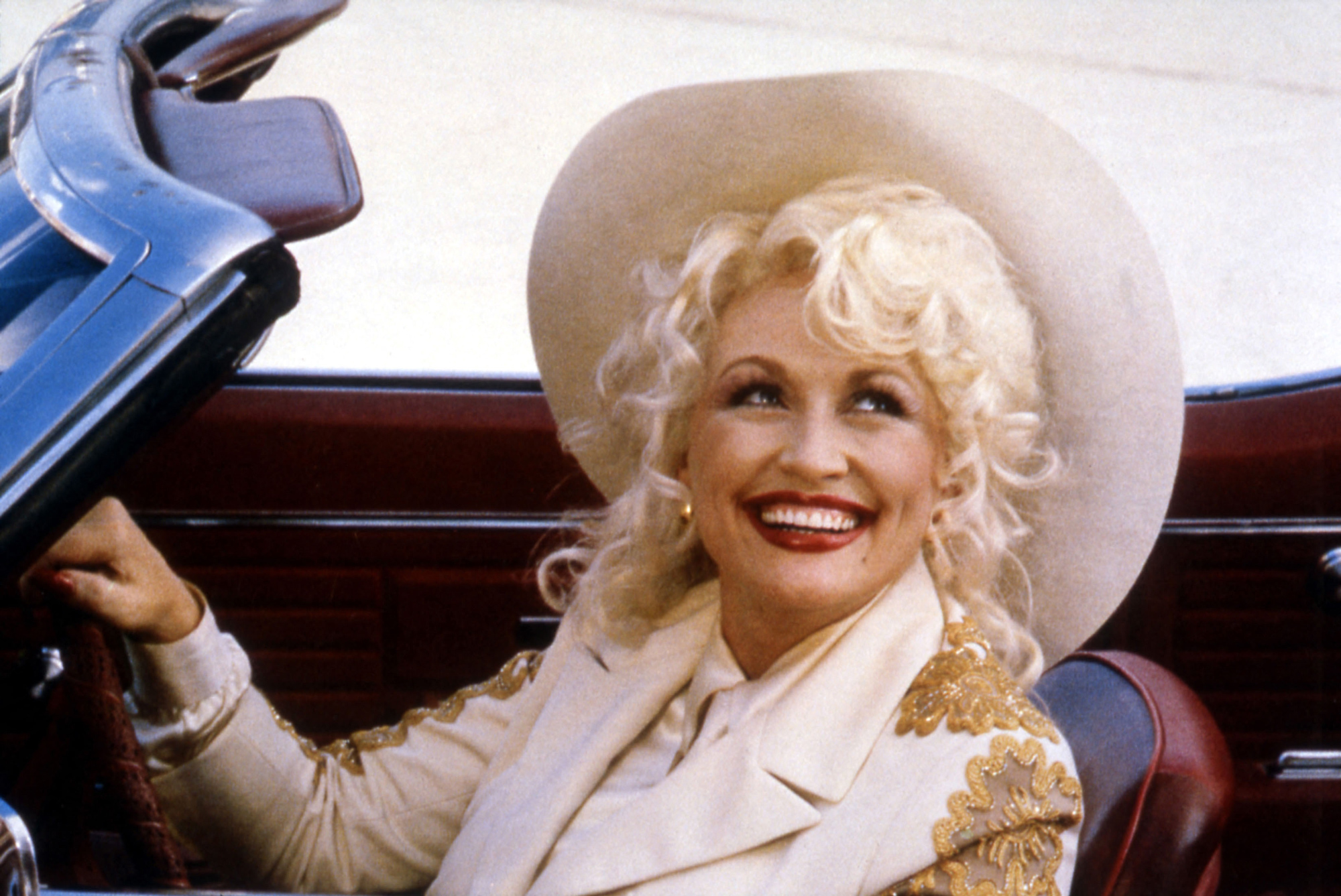
Released in 1982, the musical comedy stars Parton as Miss Mona, the no-nonsense owner of the famous Chicken Ranch—inspired by the real-life La Grange brothel—who happens to have been in love with Sheriff Ed Earl Dodd, played by Reynolds, since she was 16. Parton sings and dances and has at least 18 fabulous wardrobe changes over the course of the story as Miss Mona and Dodd enjoy a quiet romance on the side.
Life is good in the small town of Gilbert—a stand-in for La Grange itself—until a ratings-chasing television reporter from Houston named Melvin P. Thorpe, played with good humor by Dom DeLuise, crusades into town to shut it all down. Dodd dismisses the hubbub by soberly pointing out the facts: The Chicken Ranch is “older than rocks and dirt”—a secret known only to every single person in the county. But television loves nothing more than moral outrage, and when the cameras roll and fisticuffs ensue, the future of the Chicken Ranch ultimately lands on the desk of the Governor, played with delightful cornpone charm by Charles Durning.
Of course, what is most unbelievable about the whole affair is that it kinda, sorta, pretty much happened that way.
REEL TEXAS
We’re revisiting the classic films that shaped the mythos around the Lone Star State

It all started with a magazine article by one of the great Texas writers of all time: Larry L. King, the pride of Putnam. This story ran in Playboy in 1974, which helps explain its racy headline: “The Best Little Whorehouse in Texas.” The story centered on the 16-bedroom farmhouse southeast of La Grange that had served as the country’s oldest continually-operating brothel* until a zealous reporter named Marvin Zindler from Houston’s KTRK campaigned to have it shut down. As if that’s not enough, Sheriff T.J. Flournoy fought to keep it open—at one point confronting Zindler, shoving him to the ground, and, according to one report, snatching the toupee from his head. The controversy did in fact reach the desk of Gov. Dolph Briscoe, and the establishment closed in 1973. Isn’t Texas great? (*The official visitors website for La Grange points out that the Chicken Ranch was the longest continually operating “non-floating” establishment of its kind in the United States, a clarification that absolutely delights me.)
King’s article became a hit Broadway musical, opening in June 1978 at the 46th Street Theatre (now the Richard Rodgers Theatre) and running for 1,584 performances. Soon Hollywood came calling, attaching to the adaptation two of the country’s biggest stars at the time: Dolly and Burt.
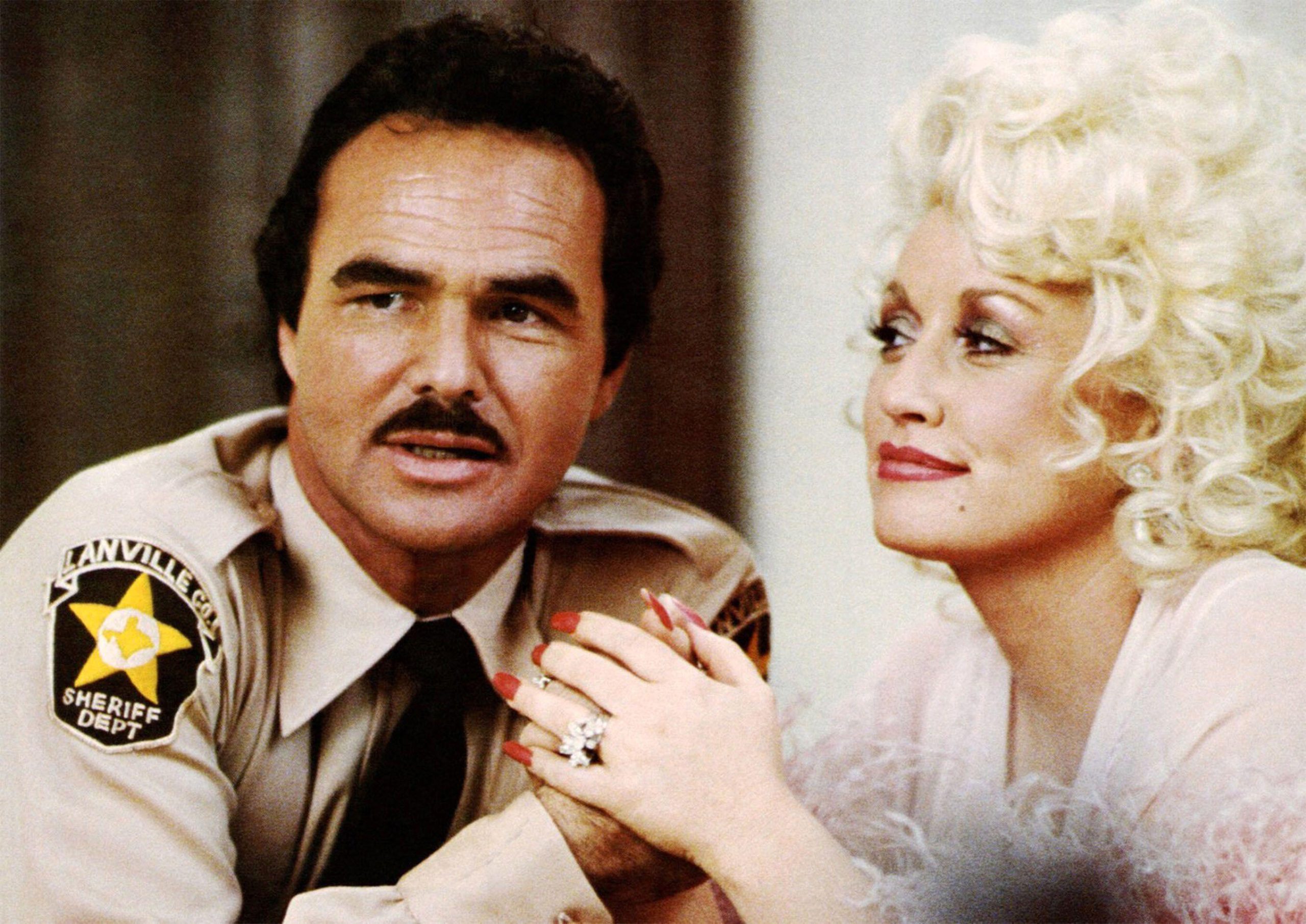
Parton shines in the film in a way that eclipses Reynolds. She is both disciplined and vulnerable as a character, whereas Reynolds feels suprisingly wooden as the sheriff certain of his actions. And while Parton fans are likely to rate this film somewhere above Rhinestone but someplace below Steel Magnolias, she is memorable for all the right reasons. In the overflowing, affectionate tributes to Parton after her recent death, I saw many fans quote this line that summed up her personality: “Well, I always just thought that if you see somebody without a smile, give them yours.” That comes straight from her character.
The film also marked the return of one of Parton’s most famous songs, “I Will Always Love You.” It hit No. 1 on the country charts when the single was first released in 1974, and the re-recording for the movie’s soundtrack climbed to the top of the charts again in 1982. (In a boss move, Parton refused to let Elvis Presley record it in the ’70s when his manager, Col. Tom Parker, asked for half of the publishing rights. In 1992, Whitney Houston recorded the song herself for the film The Bodyguard. Parton kept the full publishing rights, and the song went on to become the best-selling single by a female vocalist in the United States.)
But for all the sass and star power, most of the musical numbers are entertaining but predictable, and the song-and-dance routine featuring the shirtless members of the A&M football team prancing around in the locker room after a victory over the Longhorns hits a bit like a fever dream.
Perhaps the biggest surprise is the scene-stealing turn by Charles Durning as the Governor, who ducks the media as he dances through the Capitol, sliding past the famous statues of Sam Houston and Stephen F. Austin in the south foyer and performing soft-shoe on the second floor of the rotunda. Despite his short time onscreen, Durning received an Oscar nomination for Best Supporting Actor largely on the strength of that performance. In the end, as the film lampoons state politicians and big-city meddlers, the plot finds its own happy ending as it affirms that the good folks of rural Texas know exactly what they’re doing, thank you very much. Nationally, the film was a success in the moment, though in parts of the country the name of the movie was advertised as The Best Little Cathouse in Texas or censored altogether.
Texas, however, rolled out the red carpet. It was the first feature film to shoot inside the Capitol, and Austin’s Paramount Theatre, just blocks away, hosted the world premiere on July 11, 1982. Parton, Reynolds, and Gov. Bill Clements all attended to celebrate the release.
In addition to the Capitol scenes, the introduction to the Governor was filmed outside the Governor’s Mansion on Colorado between 10th and 11th streets (it’s now a lovely pedestrian walkway). The scene in which Melvin Thorpe first rolls into town with his entourage was shot in Hallettsville at the Lavaca County Courthouse, a gem of Romanesque Revival style at 109 N. La Grange Street.
As for the house that served as the Chicken Ranch, you can find that in Pflugerville as the Kuempel Haus, located at 16422 Cameron Road. Built in 1904, it now serves as an event space for parties, weddings, and retreats. Sadly, the original site of the Chicken Ranch is on private property east of La Grange on Rocky Creek Road, but the actual farmhouse was moved to Dallas in 1977 and converted into a short-lived restaurant in the 7100 block of Greenville Avenue (now the campus of Presbyterian Hospital).
While that piece of history is now long gone, it reminds me of one of my favorite lines by King. In 1966, he wrote about his hometown of Putnam for Harper’s in a story titled “Requiem for a West Texas Town.” King wrote: “For some 5,000 salts-of-the-earth, Putnam would still be standing when Rome had only a general store and an old stadium.”
King believed in the resiliency of small-town Texas, and it’s worth noting that La Grange remains famous worldwide. The Chicken Ranch inspired the ZZ Top hit “La Grange,” one of the most popular songs produced by any Texas artist ever. It was released in 1973, the same year the Chicken Ranch closed its doors forever.