
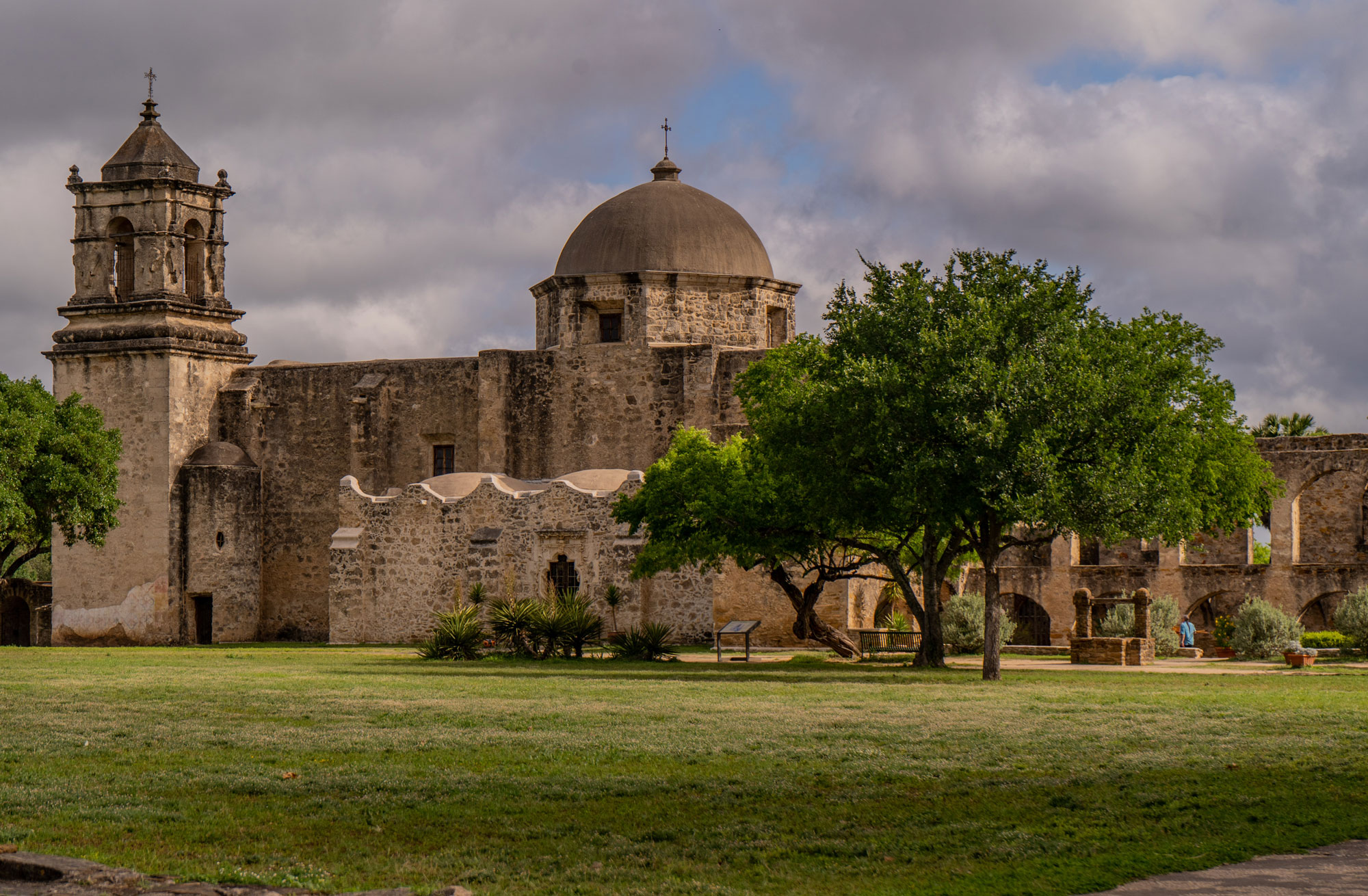
At Mission San José y San Miguel de Aguayo, July 4, 1776, was just another Thursday. Cattle had to be fed, children corralled, metal hammered, and meals prepared. And the indefatigable craftsmen who had been building a stone church for eight years had another day of chiseling, painting, and carving under a scorching July sun.
The stonemasons, carpenters, and painters working to the south of the provincial capital in San Antonio de Béxar on this particular Thursday were oblivious to what was happening thousands of miles to the north in the Pennsylvania State Assembly. But like the Second Continental Congress, these craftsmen were in it for the long haul. The neighboring missions strung along the San Antonio River all had working churches of their own, hewn from local limestone and covered in polychrome plaster that sparkled in the Texas sunlight. And the priests who ran Mission San José were determined to outdo the neighboring churches in terms of height, adornment, and solidity.
When Father Agustin Morfi arrived at Mission San José on New Year’s Day of 1778, he thought the priests and craftsmen had succeeded. Although San José’s church remained under construction, it left Morfi impressed. Its “size, good taste, and beauty would grace a large city as a parish church,” marveled the priest who hailed from Mexico City. “No one could have imagined,” Morfi wrote, “that there were such good artists in so desolate a place.”

San Antonio is no longer desolate by any measure, but posterity has come to share Morfi’s sense of awe. The four missions of San Antonio Missions National Historical Park (San José, Concepción, San Juan Capistrano, and Espada) and the five that comprise the San Antonio Missions UNESCO World Heritage Site (those four plus the Alamo) are far from the battlefields and halls we associate with 1776, but the missions are arguably unlike any other buildings that survive from that fateful year.
Built on the clashing borderlands of the Spanish Empire, Apacheria, and Comancheria, San Antonio’s missions are monuments to thousands of years of Mediterranean architecture and Mesoamerican craftsmanship on the most inhospitable and barren edge of Spain’s empire. The survival and eventual reconstruction of the mission churches was improbable given the secularizations, revolutions, and wars that wracked San Antonio for two centuries (including a battle of some note that was fought at one of the missions). But survival was, in a sense, as inevitable as the solidity of the Edwards Plateau and Austin Chalk bedrock that masons and artists quarried and sculpted into the churches still visible today.
When Frederick Law Olmsted, the future planner of New York’s Central Park, visited the missions in 1854, he found them “in different stages of decay, but all are real ruins, beyond any connection with the present—weird remains out of the silent past.” For visitors to Texas in the 19th century, the four missions on the city’s outskirts stood out in mesquite prairies like the ruins of ancient Greek temples. Olmsted found the “antiquity” of the ruined missions “distinct enough to breed an unaccustomed solemnity.”
San Antonio’s missions looked different from the edifices that Olmsted and many others had seen up north. Specimens of the baroque architecture that flourished in Mexico in the 18th century, the facades and decorations of the churches combine elements of Roman architecture with ornate Moorish geometry. The horseshoe herradura arch at Espada, the southernmost mission, evokes the niches of the Islamic buildings of southern Spain, all the while standing under the quintessentially mission-style belfry, or espada. The detailed decoration and ovular central window of San José make it, in the view of the contributors to The Buildings of Central, South, and Gulf Coast Texas, “the only true Baroque element” of the Texas missions.
There is something to be said for Concepción, explains Anna Nau, an architectural historian who contributed to the missions’ World Heritage Site application dossier. “It’s the most unique of the mission churches,” Nau says. “It has never lost its roof. We believe that Concepción has the largest unreconstructed masonry dome in the United States. There’s less intervention at Concepción than in the other mission churches.”
Nau, who works at the San Antonio-based architectural firm of Ford, Powell & Carson, has gotten to know the roof of Concepción unusually well. Ford, Powell & Carson began working on San Antonio’s mission churches in 1962. Under the leadership of architect Carolyn Peterson (who died in March 2026), the firm took on what were at first relatively small projects at the four mission churches. Peterson, who mentored Nau, characterized those restorations as “filling holes.” But when it comes to churches as old as the country itself, the holes are endless.
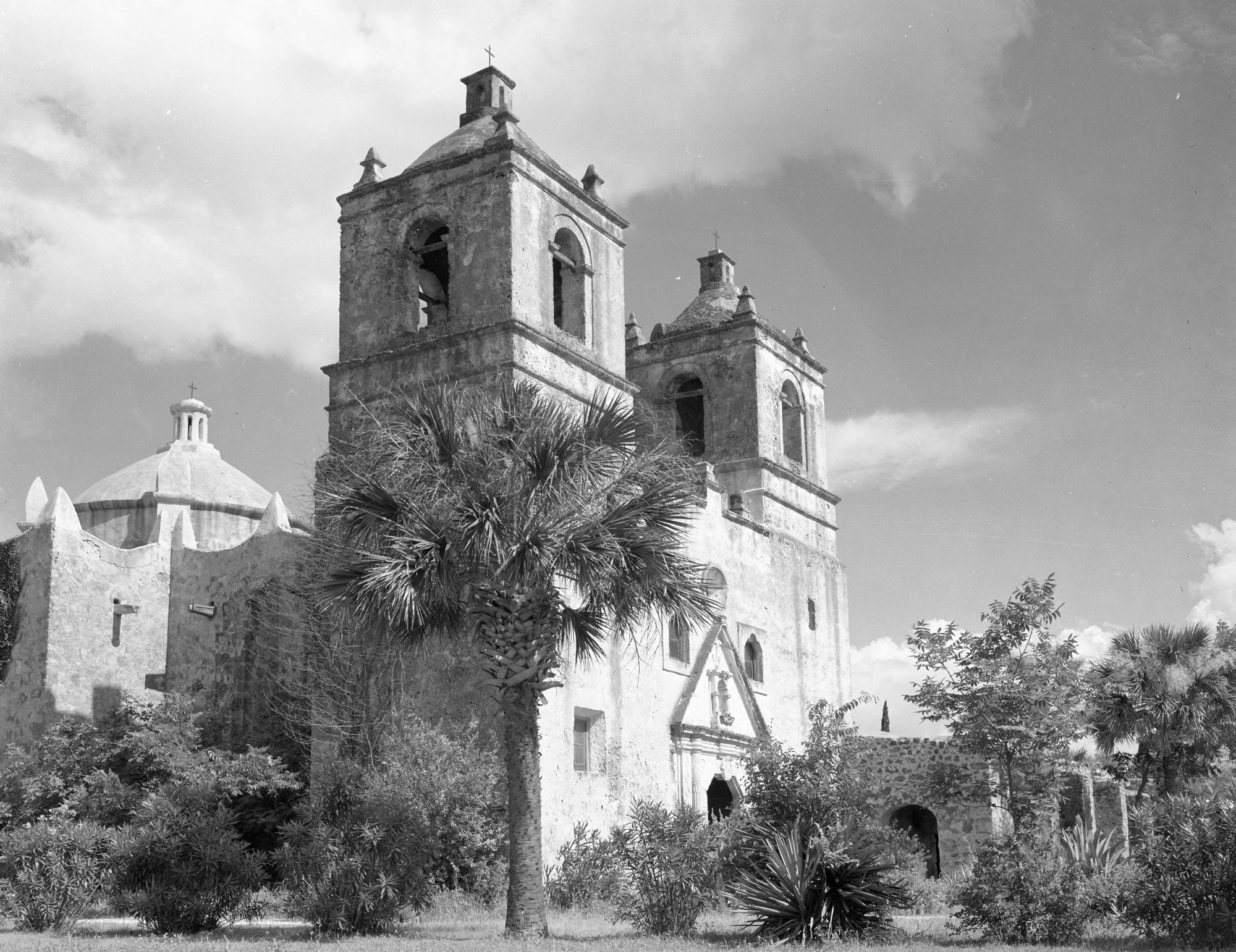
Over the decades, with increased backing from Las Misiones, the non-profit organization that supports the preservation of the four mission churches, Ford, Powell & Carson have repaired roofs, shored up bulky facades, and rehabilitated baroque window decorations that predate the signing of the Declaration of Independence. For the work, San José received the Texas Historical Commission’s 2025 Award for Excellence in Historic Architecture. That work continues: Nau is currently involved in a multi-phase and multi-year restoration project on Concepción that will stabilize the precious remains of the polychrome plaster that once coated the church’s limestone facade.
What today’s visitors see of the missions is a continuation of a restoration and rebuilding project that began in the early 20th century. With support from preservationist Adina de Zavala, the San Antonio archdiocese, the New Deal, and Las Misiones, these 18th-century edifices were brought back to life: facades cleaned, roofs rebuilt, and holes—many holes—filled. The mission churches are no longer the “real ruins” that Olmsted saw in 1854.
Still, they conjure up that same sense of antiquity that the famed landscape architect felt on his Antebellum-era visit to San Antonio. Today, the mission churches stand as monuments to the baroque fusion of the Old World and the new.