

Water poured through an interior wall of the R.E. Thomason Federal Building and Courthouse in El Paso in May 2023, saturating layers of plaster in the 1936 structure. The corroded pipe threatened more than the building: It soaked the Pass of the North mural by artist Tom Lea III, an El Paso native whose prolific career branched far beyond the Southwest. His work, from bestselling Western novels to illustrations of World War II for Life magazine, depicted America in the 20th century.
Tom Lea Institute
Tours available by appointment. 513 W. San Antonio Ave., Suite C, El Paso. 915-533-0048; tomlea.com
“We treated this as an all-hands emergency,” says Victoria Clow, a former General Services Administration historic preservation and fine arts specialist who coordinated the agency’s response. “This was a truly collaborative effort across disciplines.”

Lea took over a year and 50 pounds of oil paint to craft the 54-foot-long, 11-foot-tall ode to El Paso history, which includes imagery of frontiersmen, Apache, Franciscan friars, the Rio Grande, and Mount Franklin. He painted it all with small, detailed brushstrokes, showcasing the rough texture of far West Texas.
Contractors spent months dehumidifying the wall from the inside. That way, the mural avoided discoloration and could stay in place, not disturbing the lead adhesive holding the canvas to the wall. Historical preservation specialists and art conservators then painstakingly restored the artwork to its former detail.
The mural typifies Lea’s work, which spanned nearly 100 years and often explored the culture of El Paso and the American West. The son of El Paso mayor Tom Lea Jr., the artist was woven into the fabric of the city from the start. He grew up in a time of turmoil in the region, even watching the Mexican Revolution play out from the rooftops of downtown buildings. Though he studied art in Chicago and traveled the world, he always returned to his hometown.
“He loved this region,” says Holly Cobb, director of the Tom Lea Institute, which preserves the memory of the artist through classes, curricula, and exhibitions. “He could’ve lived anywhere in the world. But he chose to live here.”
In 2017, the Texas Legislature passed a bill to create the Tom Lea Trail, a guide for travelers to learn about the artist. The trail, opened in 2023 by the institute and the Texas Historical Commission, highlights 32 sites in Texas showing his life and work. Stops along the way cover his career as an illustrator for Texas folklorist J. Frank Dobie and as an author himself, whose titles include the novel The Brave Bulls, about Mexican bullfighting, and The King Ranch, an illustrated history. In time for America’s 250th anniversary, a new traveling exhibit, Tom Lea: Brushstrokes from the Frontlines of World War II, paints a timeline of the U.S.’s involvement through Lea’s illustrations for Life.
The oldest of three boys, Lea wanted to pursue art from an early age. His father was surprisingly supportive, telling Lea “he’d rather have his son be a good blacksmith than a poor preacher,” Lea said in a 1993 interview for Tom Lea: An Oral History. After graduating from El Paso High School, he studied at the Art Institute of Chicago and moved to Santa Fe, New Mexico, where he documented Indigenous pottery for the Works Progress Administration, a New Deal agency focused on public works.
Many of Lea’s murals are from his time as an artist for the WPA, in a branch focused on beautifying the country. In the 1930s, muralists adorned federal buildings nationwide with scenes from their local histories. In addition to the El Paso Courthouse’s 1938 mural, Lea painted Comanches at Seymour’s post office and The Stampede at Odessa’s.
As the U.S. began to indicate its entrance into World War II, Life commissioned Lea to illustrate a cavalryman at Fort Bliss, then to board a battleship in the North Atlantic to document naval operations. Once the U.S. joined the war, Life hired Lea as an artist–correspondent, a new role in which he would travel to battlefields and warships, make sketches, and return to safety to illustrate scenes he encountered.
“It wasn’t about portraying the gore; it was done in a way that was honoring the men he was depicting,” Cobb says.
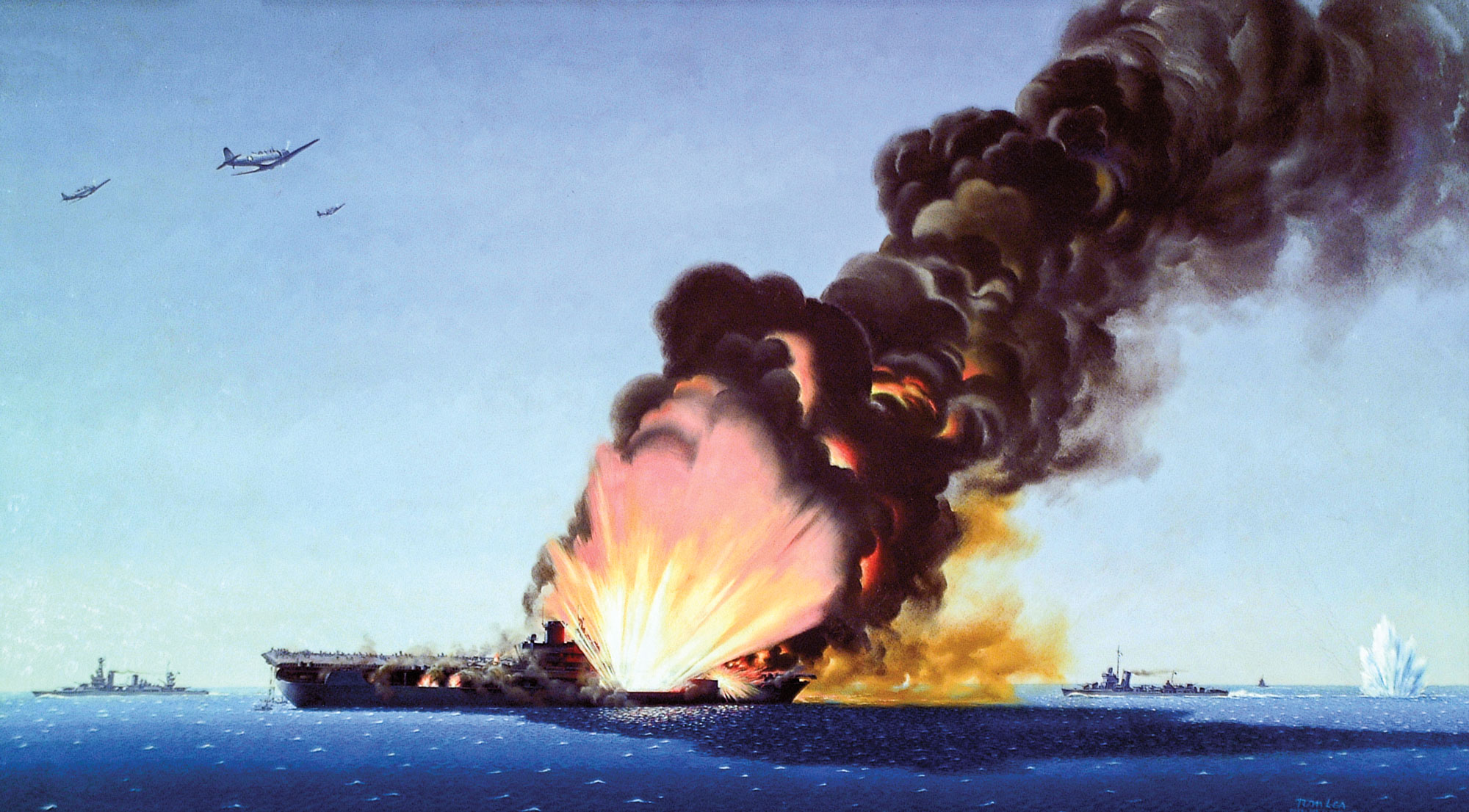
Rather than avoiding the front lines, as artist–correspondents often did, Lea witnessed the war up-close. He traveled 1,000 miles to various theaters of war, bonding with the soldiers and sketching battle scenes. He arrived with U.S. Marines at Peleliu, one of the most brutal battles of the war. From this, he painted That Two-Thousand-Yard Stare, a famous portrait of a U.S. soldier whose gaze shows the war’s psychological toll.
During his time abroad, he kept a photograph of his wife, Sarah Lea, in his wallet. And when he returned, he painted what he describes as his magnum opus: Sarah in the Summertime.
“He wanted to portray the beauty of the world because he had actually experienced this horror,” says Adair Margo, the founder of the Tom Lea Institute and a close friend of Lea. “He came back wanting to paint the things he loved most.”
This meant portraying not only the people in his life, but also the landscape he came from. He drew and painted the Franklin Mountains, which he could see from his porch, and scenes from his travels. His books, too, described far West Texas and Mexico, which he visited often. Two of Lea’s novels set in the region, The Wonderful Country and The Brave Bulls, were made into Hollywood movies.
Lea, who died in 2001, never had gallery representation. Instead, customers would line up outside his El Paso home to commission his work.
“He was an artist who was not trying to make it in the art world,” Margo says. “He always saw being an artist as a wonderful way to explore the world, which he did.”
With ties to Chicago, Santa Fe, and Europe, Lea could have lived anywhere. But, as he stated in the 1993 oral history, no place other than El Paso ever felt like home.
“I never did get over being homesick,” Lea said. “I loved this country. It was where I belonged.”