
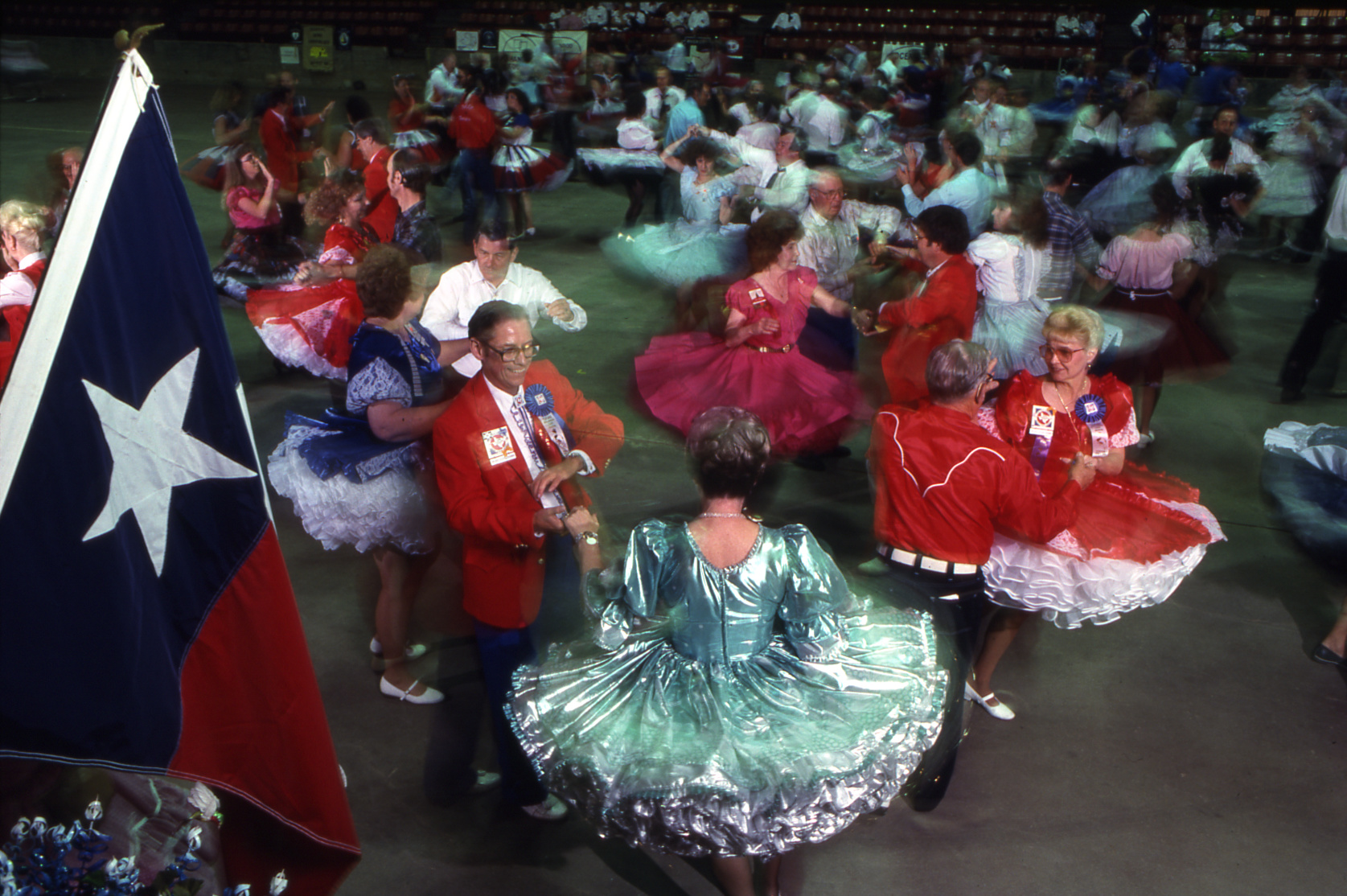
“Swing your corner. Promenade.” The caller’s voice echoes across a room in the Waco Convention Center as hundreds of dancers weave across the floor in small groups, or squares, with practiced ease. I walk into the organized chaos, and everyone knows where to go besides me.
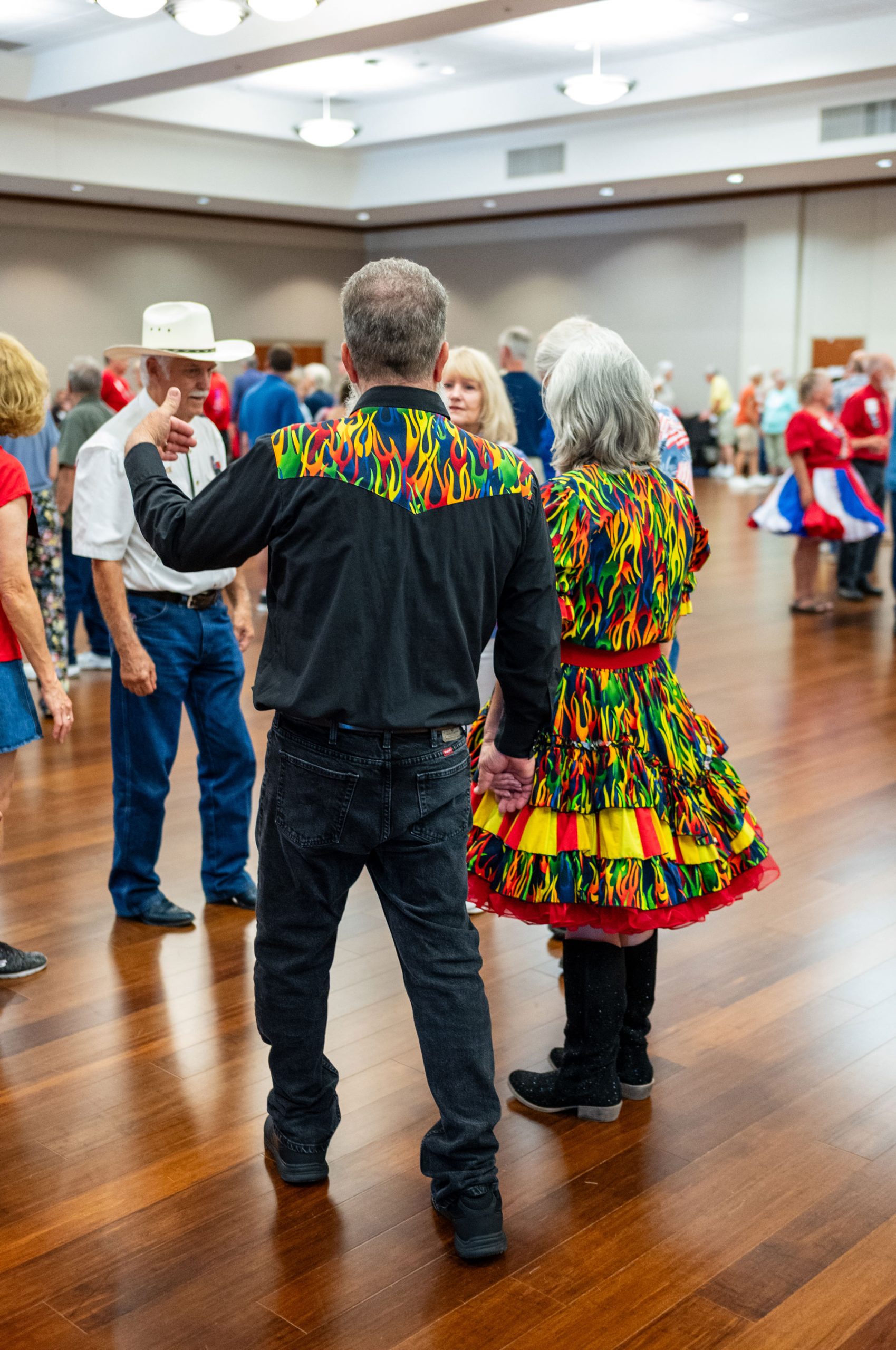
While I see a familiar slice of Americana—ladies in petticoats, gentlemen in cowboy boots and hats, couples sauntering around to old-time country music—I also notice more contemporary garb, all mixed together on the floor.
Dancers listen to the caller and execute their instructions through a series of turns, swings, and do-si-dos as the music switches from country to bluegrass to rock and swing. This is a broad community, one that stretches across Texas and around the world.

They are all here for the National Square Dance Convention, an event that brings together thousands of active square dancers from across the United States and several other countries including Germany, Taiwan, and Australia. This year’s convention, being held in Waco and celebrating its diamond jubilee, kicked off on June 24 with a dance across the Waco Suspension Bridge.
The tradition of square dancing has long been connected to Texas. Its roots in the state stretch back to 17th-century European folk dances and have evolved over time as immigrants arrived with their cultural contributions. While originally incorporating church and ballroom dances from Spain and France, in addition to English folk dances originally performed to celebrate the changing of the seasons, other influences spanning from Russia to Mexico have become part of the official state folk dance of Texas.
That designation arrived in 1991 with the passing of House Concurrent Resolution 153 and was signed into law by Gov. Ann Richards. Back then, there were 20,000 active members in 525 square dance clubs across Texas as a wave of popularity swept the nation, resulting in more than 20 states naming it their official state folk dance. Today, Texas remains home to 2,500 active square dancers, organized through local clubs and regional groups spread across the state, according to Matt Whiteacre, secretary-elect of the Texas State Federation of Square and Round Dancers, the largest organization in the state.
Whiteacre grew up in Sherman, a small town outside of Dallas, and has spent more than four decades in the square dance community. He believes Texas’ size has helped create a wide-ranging network of dancers.
“Texans are probably as laid-back as any people are,” he says. “Square dancing is a friendly activity: Everybody is friends and they’re smiling and happy out on the floor. We’ve got a lot of dancers from El Paso, Beaumont, Amarillo, Port Lavaca. It covers the spectrum pretty well going across the state.”
If anyone has seen the tradition change over the years, Tim Tyl has. He’s what is known as a square dance caller. The engine behind a square dance, the caller uses a standardized vocabulary of moves and strings together combinations on the fly, guiding dancers through each step while adjusting the pace and order of dance moves, also known as calls, to the crowd. More than simply giving instructions, a good caller reads the room, chooses the music, and creates a unique dance every time.
Raised in White Oak in North Texas, Tyl started dancing as a child and began calling dances at age 15. More than 50 years later, he has watched the form evolve.
“The biggest change I’ve seen is in our numbers right now,” Tyl says. “The number of square dance dancers and clubs in Texas and in the country is smaller than it was back when I was a kid.”
But fewer dancers does not mean square dancing has stagnated—in fact, it’s ripe for a revival. The music, clothing, and styles of square dancing have all adapted with the times, and efforts to expand membership and participation are focused on the local level, with community outreach and uniting regional districts at the forefront. At its core, the tradition of square dancing is centered on the community and creating a place for wholesome, family-friendly fun. Events like the national convention serve to show a unified appearance and draw in curious newcomers.
“People hear of square dancing, and they think of what you see on TV, on a Brady Bunch show, or on [the] Opry,” Tyl says. “A lot of that is not actually modern Western square dancing.”
Today’s callers use a wide range of music, from country and bluegrass to rock, jazz, and swing. The dance itself is about responding in the moment.
“It’s a lot like jazz improvisation,” Tyl says. “The caller really doesn’t get up there with a memorized routine.”
That on-the-fly improvisation by the caller is one of the elements that keeps dancers coming back, since no two dances will ever be the same. Teresa Berger, an Indiana-based caller and executive director of Caller Lab, the international association that helps standardize square dance calls, says the activity combines physical movement, mental focus, and social interaction.
“We’re the ones that standardize the activity, so that square dancing is the same here in Waco as it is in Indiana, as it is in Germany, in Japan, and all around the globe,” she says.
While the traditional dresses and petticoats remain part of the culture, square dance attire has also evolved. Many dancers now wear more casual clothing, including club T-shirts, gym shorts, and yoga pants.
“As long as you are comfortable and clean, that’s the goal,” Berger says.
For Whiteacre, the appeal of square dancing has always been the people involved. He experienced that when he retreated a bit after his wife died five years ago.
“The square dancing community was the family that kept calling and saying, ‘Hey, are you going to come to the dance tonight?’” he says.
The convention in Waco offers a glimpse of why that community continues to endure. The calls, the music, and the clothes may change, but the reason people show up remains the same.
“You come to square dance, you meet people instantly and make a bunch of friends,” Tyl says. “You’ve got an instant family, just about, in town, across the state, across the nation, anywhere you go.”