

Bandera middle school’s cafeteria provides an unlikely backdrop for a trip through time one Saturday afternoon in June. Residents crowd into rows of seats to watch a film presentation by the Texas Archive of the Moving Image, an independent nonprofit founded in 2003 that preserves the history of film production, commercials, and home videos. The projector fills the screen with grainy images of the Bandera region in the 20th century. Clip after clip plays without clear order or direction.
One video shows the “Special Senior Olympics” at the Medina County Livestock Association Barn from an old TV news broadcast in 1982, featuring a wheelchair obstacle race for local nursing home residents. In another, Patrick Swayze flaunts his handsome Arabian horse to onlookers in Kerrville circa 1996. The cafeteria crowd murmurs and laughs among themselves as the clips shuffle through home videos and amateur films, though the mood turns sober as videos of the catastrophic 1978 flooding in Bandera, called Tropical Storm Amelia, unspool. As the projector screen cycles through clips, TAMI curator Katharine Austin asks the crowd to assist in identifying individuals and places featured in submitted video footage. Understanding the richness of Texas’ story is a community endeavor.

Meanwhile, Elizabeth Hansen and the archivists on her team quietly document new donations in the back of the room, the sorts of videos everyone else is watching on screen. As part of the “Texas Film Round-Up” program, in partnership with the Office of the Governor’s Texas Film Commission, Hansen and her team from TAMI collect home movies, amateur films, local news broadcasts, and other historical media from across the state for preservation on their website. More than merely viewing history, TAMI gives Texans an opportunity to co-create the narratives of Texas and their hometowns. “This gives each one of the participants an opportunity to be involved in the process of preserving both their history and the history of their community,” Hansen says. “I think that’s really exciting.”
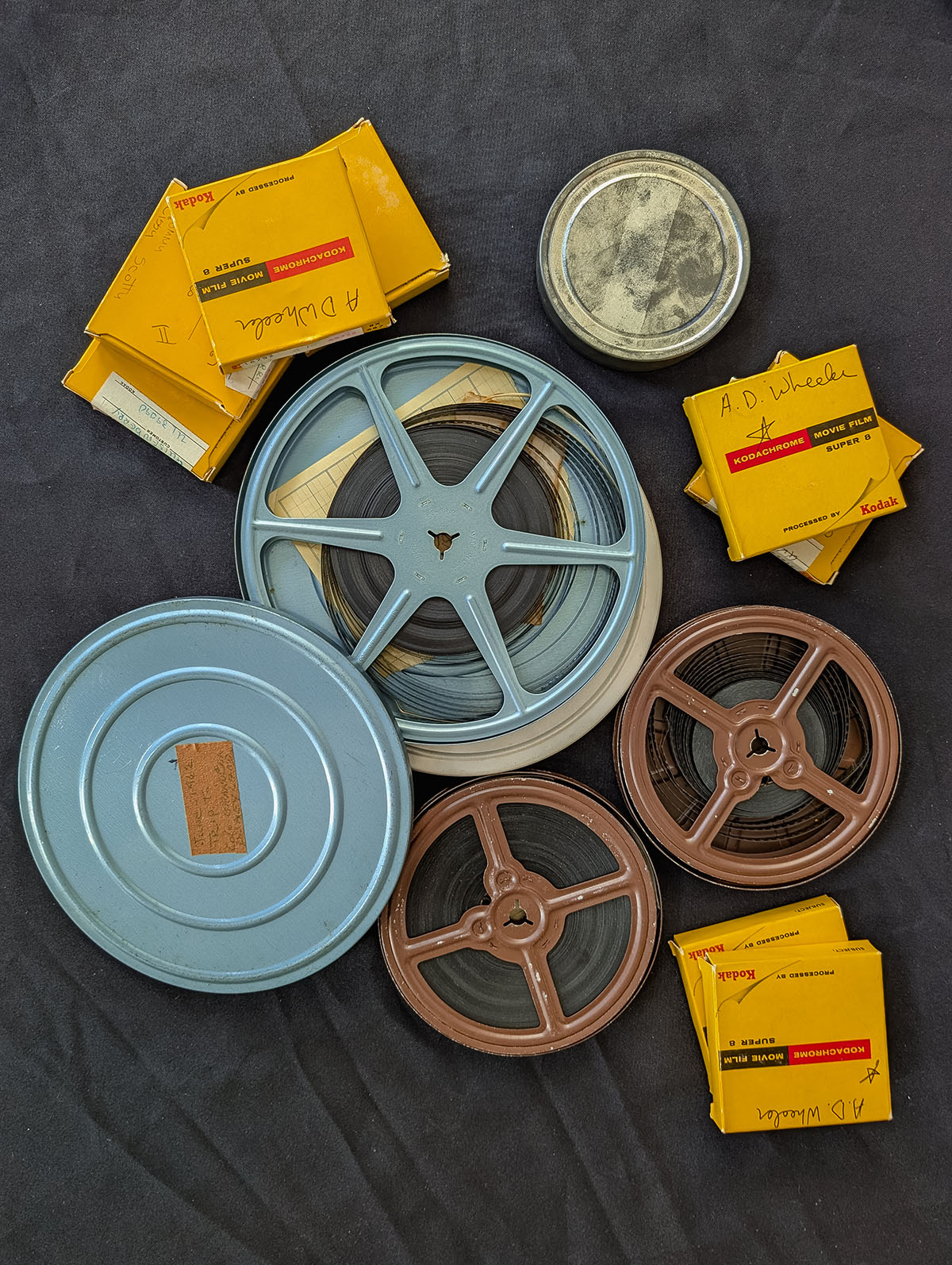
TAMI’s founder, Caroline Frick, conceptualized the archive as a public-focused endeavor, taking advantage of the rise of online video-sharing in the early 2000s to deliver moving images to as large of an audience as possible. The team collects old film materials from donors, creates digital files from their analog media, and returns the files on a hard drive for the donors’ own keeping. Since the project began in 2008, they have collected more than 50,000 VHS tapes, Super 8 films, and other archaic formats for preservation on their website, which sees regular use with researchers, journalists, and educators, among other curious parties.
The nonprofit relies on video donations from Texans. The Round-Up events, held at least twice a year, are also opportunities for the team to showcase portions of their collection from the host town and its surrounding area. “There’s a lot of change happening in Texas,” Hansen says, “and I think this is a great opportunity to help document that change.”


At the Bandera event, San Antonio resident Eduardo Diaz approaches the team with a handful of VHS tapes. He heard about TAMI in McAllen’s The Monitor several years ago, so when he saw a Round-Up would be held an hour away, he drove to Bandera to meet the team. Diaz says his love of creating home movies has led to a vast personal collection of videotapes that he feels could support the organization’s goal of preserving Texas history at the ground level. “It is fun to see the way our family was—and represent Hispanic culture in the Valley—and let people 50 years after, 70 years after, or 100 years after see the way we were,” he says. In addition to family birthdays, Diaz tells Hansen the tapes contain footage of the infamous Pemex union leader Joaquín Hernández Galicia, or “La Quina.” “We’d love to have that!” Hansen tells him. Diaz keeps several curators rapt in his storytelling while the others carefully place his materials in a sealed bag, label them with identification markers, and document them in the team’s laptops.
To draw more Round-Up participants and to deepen visitors’ understanding of the purpose of preservation, TAMI’s event was held in conjunction with a touring Smithsonian historical exhibition called Crossroads: Change in Rural America. The exhibit focuses on small town America’s role in the larger story of the U.S. by incorporating displays crafted by local curators, exploring country music, labor history, and significant local figures.
TAMI’s work is unique in its collaborative approach to gathering materials and in its presentation of the collection. The archive’s founders were inspired by teams in New Zealand and Australia who traveled their countries in the 1990s for their film reservoirs. TAMI is the only organization in the U.S. that digitizes moving images from such diverse sources for the sake of state history preservation and public use. Digitization is often an expensive service, but through TAMI’s Round-Up program, donors can digitize up to 50 film reels and 10 videotapes at no cost. Creating preservable files from media that will, over time, rot away, is a key part of their mission. “Our approach has always been the idea that lots of copies keep stuff safe,” Frick says. “We have had situations where people had their films digitized with us, we kept copies, and then they lost those films in a hurricane. They were able to come back to us, and we were able to give them back.”
Local residents don’t always realize the extent to which their communities have shifted over time. County judge Richard Evans once told Bandera historian Patricia Moore that “nothing changes in Bandera but the date and time.” But rural areas have shifted over the years, and TAMI’s work offers direct evidence of the past in motion. “It is a godsend to have the Texas Archive of the Moving Image,” Moore says.
Frick and the rest of the team at TAMI aim to engage Texans with their understanding of themselves in place and time. “We are all a part of Texas history,” she says. “The more people we can engage with that, the better.”