
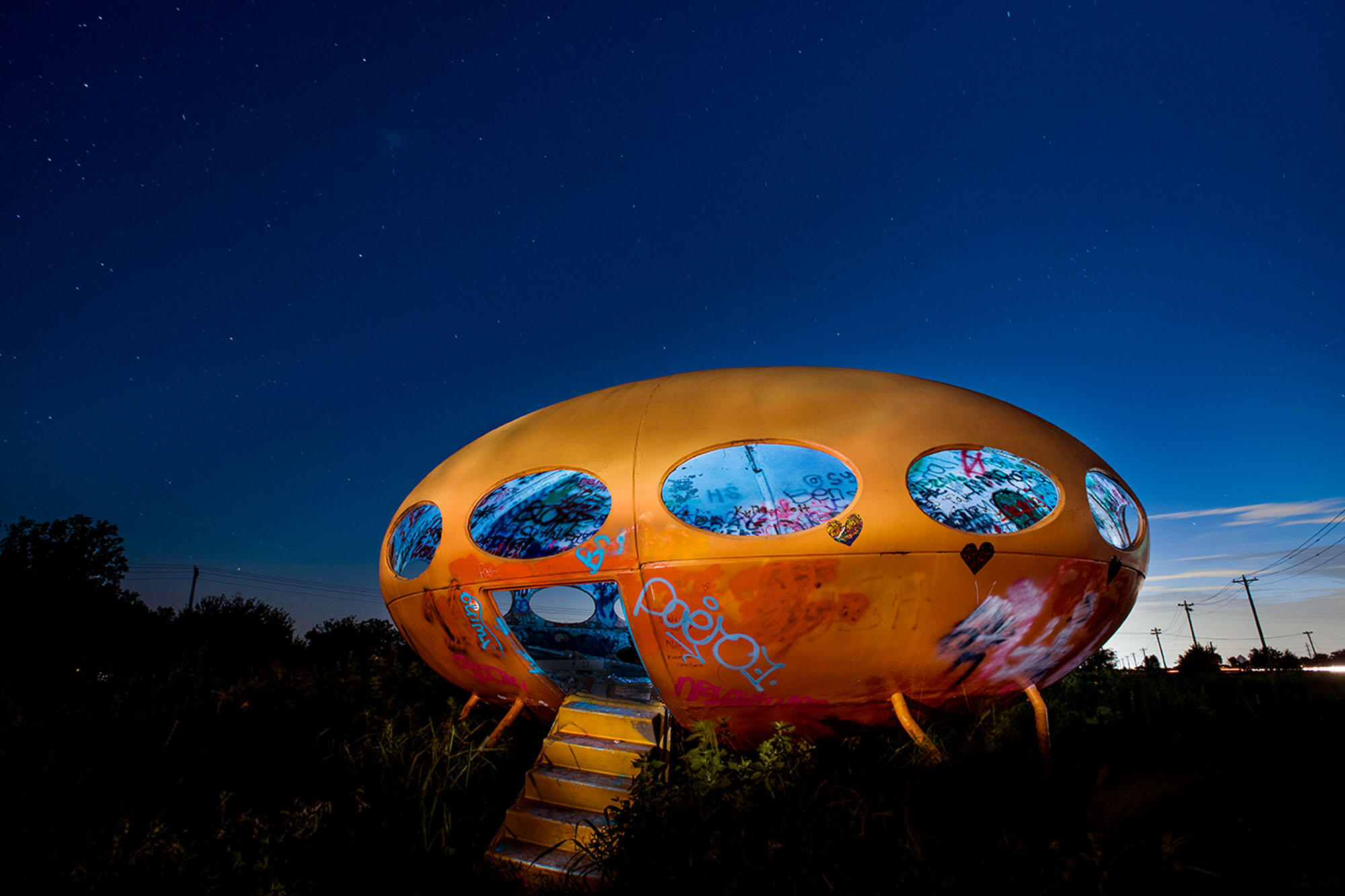
Heading east on State Highway 276, just within Rockwall County limits, a neon orange ellipse stands in the grass on metal legs. A hatch hangs open like a small jet’s airstairs. Oval windows ring the shell, facing the road. Near the door, a stencil reads: “AREA 276.”
Finnish architect Matti Suuronen designed the Futuro in 1968 as a portable ski chalet. Its light frame made it easy to airlift onto a snowy mountainside and, thanks to its round shape, quick to warm by way of integrated polyurethane insulation and electric heating. Its prefabricated shell of 16 fiberglass-reinforced plastic panels could be bolted on-site across diverse terrain. And inside, bed-seats molded around a central fireplace folded out to sleep eight.

On July 20, 1969, the same day Apollo 11 reached the moon, The New York Times ran an article on Futuro pods headlined “Saucer-shaped house arrives on Earth.” The timing seemed perfect: the Space Race reached its peak, and the UFO from Finland looked like tomorrow came early.
Then the 1973 oil crisis sent plastic prices soaring, and Suuronen’s design became too expensive to manufacture. Zoning boards had no place for a flying saucer, and plenty of neighbors wanted one nearby even less. Of the roughly 96 Futuro houses ever built, around 60 survive, scattered from New Zealand to Japan. Three landed in Texas, but Royse City’s is the only one viewable from the road.
How it landed beside SH 276 is uncertain. According to the Dallas Morning News, Rockwall car salesman Jerry Moore bought it in Garland sometime before 2001 and used it as an office, then a bachelor pad. He later sold to an investor who planned a restaurant. After those plans fizzled out, the saucer sat in disrepair for years, filled with trash and tagged with graffiti both inside and out.
“Ever since I saw that spaceship, I wanted it,” says Santiago Rivera, the Futuro’s current owner. Rivera moved to Royse City from Dallas about 30 years ago, and it caught his eye from the road shortly after. After wearing down the previous owner a decade ago, he bought it for his kids to use as a playground. He’s restored it twice since, but vandals keep coming back. “My next priority, again, is restoring those windows,” Rivera says.
The Futuro has become a landmark bright enough to use for directions. Rivera once told a man in Greenville, 20 miles away, that he’d been right there at the spaceship. “Oh yeah,” the man replied. “Everybody knows where that place is.”
A local Facebook group, Area 276, hosts movie nights at the lot, with food trucks, lawn chairs, fireworks, and alien-themed merchandise. Last July, they screened 1996’s Independence Day, the saucer looming behind the crowd. “That was one of the most fun things I’ve ever experienced there,” Rivera says.
Suuronen’s house of tomorrow was supposed to land everywhere. Instead, it docked off a two-lane highway, glowing orange against the North Texas sky, still awaiting a future that never quite arrived.