
At the Convention of 1836, delegates drafted the Texas Declaration of Independence and the Constitution of the Republic of Texas, naming Sam Houston commander in chief of the republic’s military forces. William Fairfax Gray, a land agent from Virginia, kept a journal of the proceedings, scribbling all that he observed into it. His eyewitness accounts of these and other historic moments of the Texas Revolution were eventually published as At the Birth of Texas in 1909.
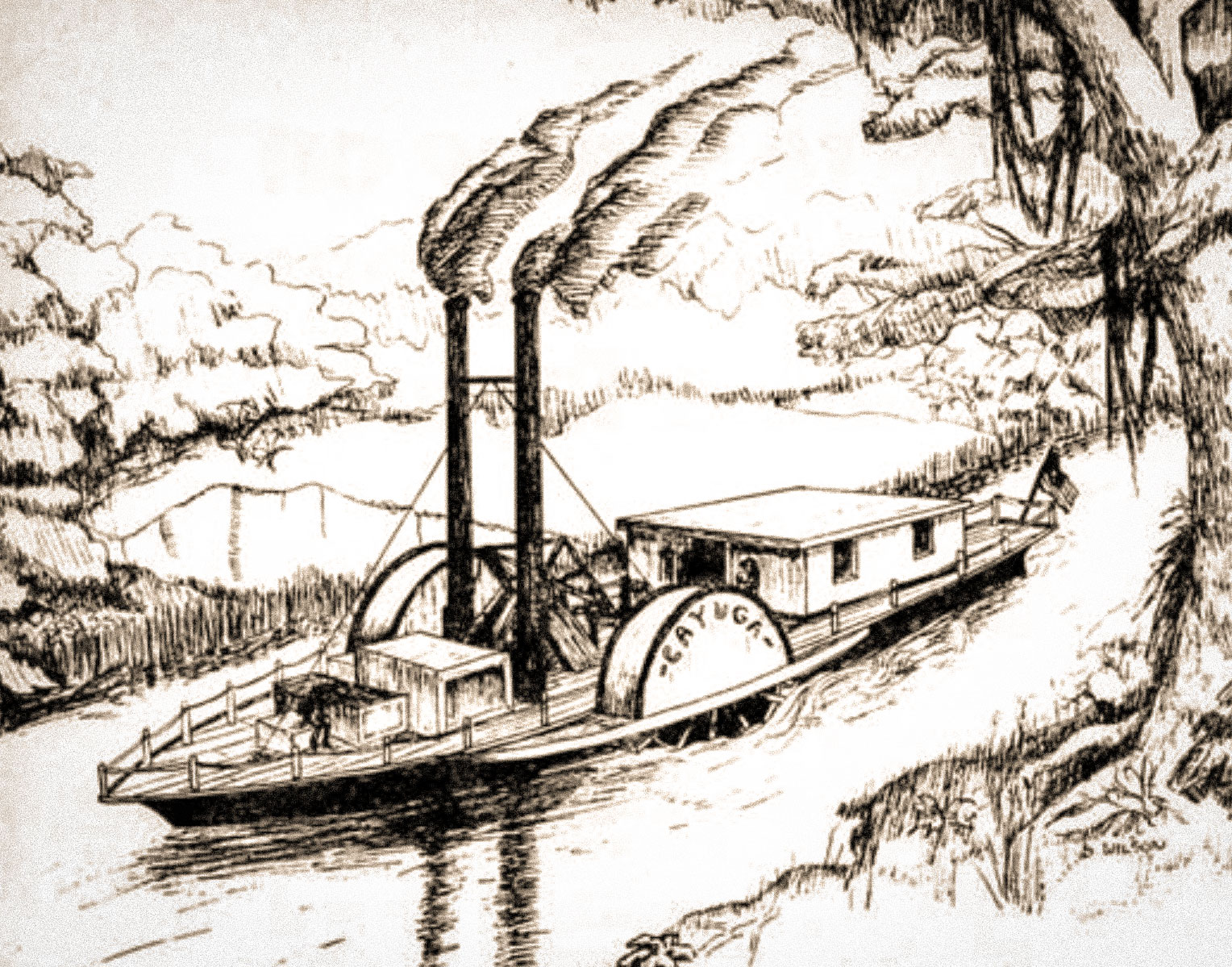
Gray’s chronicles contained oft-overlooked details about Texas history. Take, for instance, an entry from March 29, 1836. At the time, between the fall of the Alamo (March 6, 1836) and the battle of San Jacinto (April 21, 1836), the Texas Revolution staggered across the landscape, with wild uncertainty raging through the settlements as Gen. Houston’s army retreated eastward, and citizens fled the advancing forces of the Mexican army, led by Gen. Antonio López de Santa Anna. On that day, instead of describing that chaos, Gray chronicled the approach of the steamboat Cayuga in Harrisburg (today part of Houston). “The sound of her steam made my heart leap like the voice of an old friend,” he wrote.

Why was Gray romanticizing a steamboat? It turns out the Cayuga played an important role in the revolution. For some 11 days, the petite sidewheeler served as the temporary, floating capitol of the Republic of Texas.
Historians differ on whether the Cayuga was purchased or rented by the newly declared Republic of Texas, but most characterize the 97-foot-long steamboat as being among the smaller ships of the day. Regardless, in the decisive month of April 1836, at the behest of Texas President David G. Burnet, the diminutive Cayuga began delivering crucial supplies and rescuing colonists fleeing the advance of the Mexican army.
Then, according to the Online Handbook of Texas, on April 15, as the Mexican army drew near Harrisburg, the Cayuga evacuated President Burnet, his cabinet, and the town’s entire population. The cabinet remained onboard, conducting business as usual, meaning the Cayuga was the de-facto Texas capitol until the steamboat safely reached Galveston on April 26.
For at least another month, the Cayuga continued to serve under the orders of Burnet. In an undated address to the people of Texas, written sometime after the battle of San Jacinto, Burnet recalled that, when word reached Galveston that Houston’s army had arrived on Buffalo Bayou, “the steamboat Cayuga was despatched [sic], with a number of volunteers and some provisions for the relief and succor of our brave troops.”
On May 19, 1836, Texas Secretary of War Mirabeau Lamar instructed Col. James Morgan, commandant of Galveston Island, to order William P. Harris, one of the ship’s two owners, to take the Cayuga to the home of Republic of Texas Vice President Lorenzo de Zavala. His home was being used as an impromptu hospital for sick and wounded Mexican prisoners after San Jacinto. Lamar ordered that the Mexicans should be transported to Galveston, along with any injured Texians wishing to go.
The Cayuga’s military duty ended when it was sold at a Lynch Ferry auction in December 1836. Renamed the Branch T. Archer, the vessel continued serving Houston-Galveston commerce for three more years before it was sold again, in a Liberty County sheriff’s sale in September 1839. And there the Cayuga trail, for a time, went cold.
Hunting the Cayuga today proved almost as chilly. I contacted the Texas Historical Commission, the State Preservation Board, the Briscoe Center for American History, the Texas Maritime Museum in Rockport, and others, but no one could be found to expound on any recent Cayuga scholarship. The Texas State Historical Association recommended I reach out to Malcolm Lee Johnson, author of the two–volume Texas Tales and Tall Ships, which was published in 2021 and includes Cayuga documentation. Sadly, I discovered, Johnson had passed away just days before I searched his name.
Fortunately, the Texas State Library in Austin has his books, as well as other accounts from the 1830s and by more recent historians, of the steamboat’s role in pioneer Texas before the revolution. The preponderance of reports indicates that the Cayuga was built in Pittsburgh, Pennsylvania, in 1832. Her initial Texas owners, William P. Harris and Robert Wilson, had previously operated riverboats on the Mississippi. By the fall of 1834, the Cayuga was servicing Buffalo Bayou, Galveston Bay, and inland ports along the Brazos. Pamela A. Puryear and Nath Winfield Jr., wrote in their 2000 book, Sandbars and Sternwheelers: Steam Navigation on the Brazos, that a ball was thrown in honor of the steamboat’s arrival at San Felipe in early 1835.
Once an unsung hero of the Texas Revolution, the Cayuga had a short life, operating for only 11 years. Historian Jean Epperson McGinty, writer of the Handbook of Texas’ entry on the Cayuga, offered a possible conclusion to the little ship’s story in a 1981 article in the Port of Houston Magazine. Her research found that the Cayuga–turned-Branch T. Archer had been renamed the Pioneer after the 1839 sale. McGinty unearthed an 1843 Telegraph and Texas Register report that detailed the final days of the former floating Capitol of Texas.
As the purchasers attempted to take the steamboat to Matagorda, the Pioneer sprung a leak. “The Commander,” noted the antebellum newspaper, “was compelled to run her aground about 30 miles east of Passo Cavallo. The vessel will be a total wreck. Her engine and boilers, however, will probably be taken off uninjured.”
It was an ignominious end, it turns out, for the story of the Cayuga. But for a glorious, if brief, span, that “old friend” chugged toward Galveston with precious cargo aboard, serving as a crucial component in the history of our state.