
By 9:15 p.m. on a Friday in July, a crowd has filled the bleachers at Comanche Springs Pool in Fort Stockton. As the last light fades from the sky, a slight breeze sweeps away the day’s heat. The evening’s portion of the Miss Fort Stockton pageant has concluded, and two lifeguards take their places at the pool’s edge.
Abruptly, the bright stadium beams are extinguished, and purple and pink stage lights skim the pool’s dark surface. A moment later, a spotlight illuminates five actors portraying a family who stand on the far side of the pool. “Smell that? The fresh air of good ol’ Fort Stockton,” the father begins, his amplified words booming across the water. “Can’t wait to set up camp, just like when we were kids.” He explains to his children that, when he was growing up, he was part of a show called Water Carnival. Now, he’s brought them back to town to camp and to see the show for themselves—if only he can figure out how to set up the tent.
The spotlight disappears, and in the darkness a shadowy, giggling mass emerges from an opening in the backdrop. It wiggles over to the wide stretch of concrete in front of the bleachers and, as the lights come up, sorts itself into 22 breathless 4- and 5-year-olds. The music begins to play, and they bob up and down to the beat, moving their arms more or less in unison.

Since its launch 90 years ago, Water Carnival has drawn crowds to watch Fort Stockton locals perform aquatic acts. Instead of a carnival with a midway and rides, the performance combines dance numbers on the side of the pool, synchronized swimming acts in the water, and a plot that loosely links the dozen or so routines. More than 250 performers, a light and sound crew, a props team, and lifeguards contribute to the event, held the third weekend of July. The tradition is beloved among Fort Stockton families, some of whom have participated for several generations.
“Anytime anybody comes from out of town, they’re pretty surprised about what we have going on here,” says Ricky Gonzales, an actor in last summer’s show and a former Water Carnival board member. “It really is a great thing for our community.”
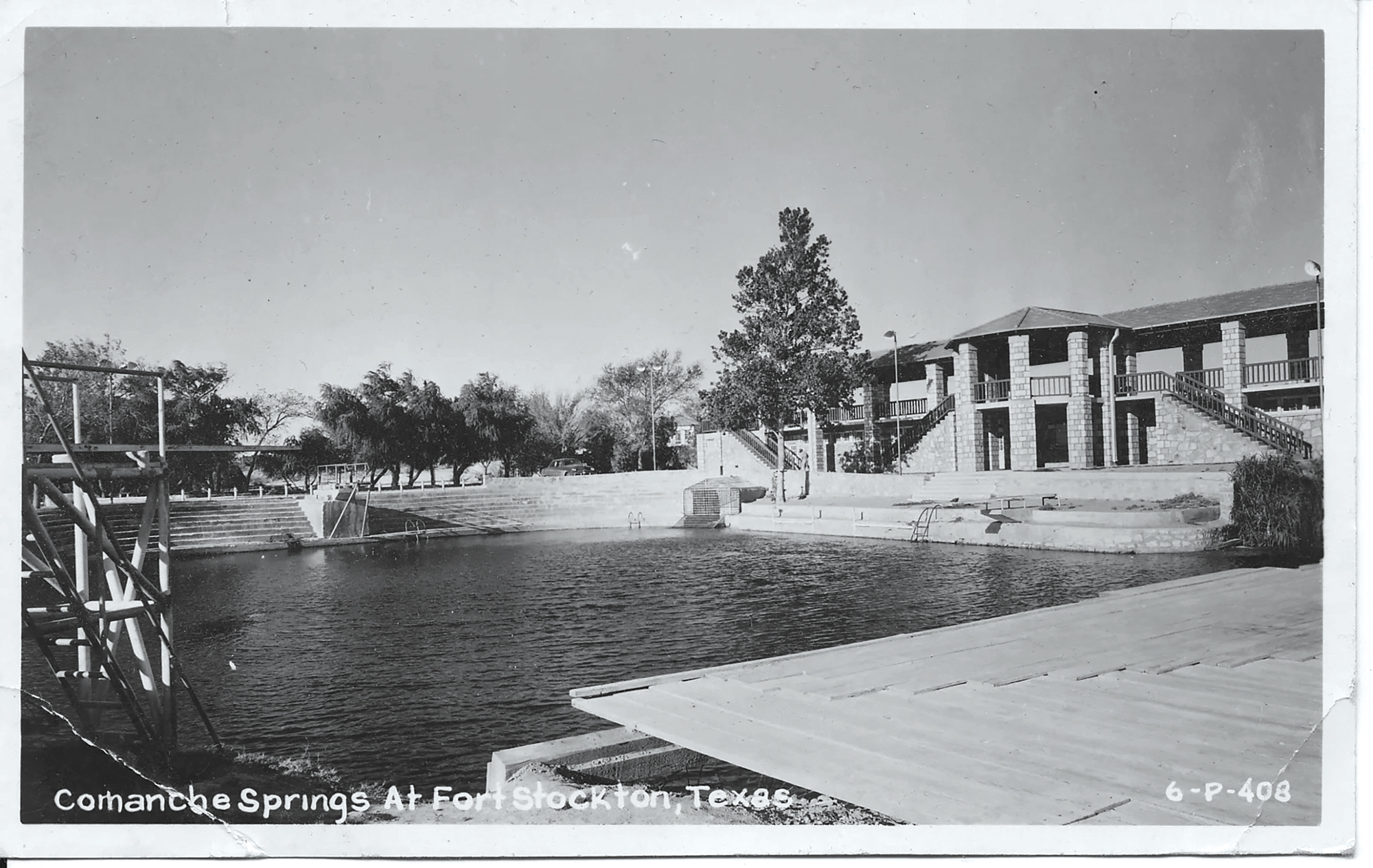
Water Carnival began in 1936, when the state Centennial Commission encouraged towns large and small to mark the state’s 100th birthday. Communities across Texas staged more than 250 harvest festivals, rodeos, historical plays, beauty pageants, homecomings, and reunions. Fort Stockton opted to showcase Comanche Springs, an expansive natural swimming pool fed by cool water that flowed from a fissure at one corner, similar to Barton Springs in Austin and the pool at Toyahvale’s Balmorhea State Park.
The springs once provided up to 40 million gallons per day, a supply that acted as a key resource for Indigenous tribes, European settlers, and newly arrived farmers in the dry desert. Mid-1800s U.S. Army exploration studies noted the large number of fish and soft-shell turtles in the springs, as well as the status of the springs as a Comanche campground along the tribe’s trail to Mexico. Fort Stockton was established, in part, to protect travelers passing by the springs, and Buffalo Soldiers were stationed there in the late 1860s-1880s.
The inaugural Water Carnival, held in June 1936, featured band concerts at the pool, swimming and diving contests, and a “bathing beauty revue” with contestants from 12 nearby towns. The production in 1947, when the show resumed after World War II, was the first with a script and a theme.
But the following year, the springs began to run dry. As farmers west of town drilled more irrigation wells, less groundwater remained to fill the pool. Water Carnival was forced into a six-year hiatus. Then, in 1953, Pecos County built a traditional swimming pool with a concrete bottom where the natural pool had been. With this newly constructed venue, Water Carnival resumed the next summer and has continued near-annually ever since.
“Water Carnival is the one time of year the whole town comes to life, and it brings everyone together,” says Avan Lujan, a college freshman who performed in the show for a decade as a child and now works concessions. “The word that always comes up during Water Carnival is community, because that’s what it is. It’s Fort Stockton reminding itself who we are.”
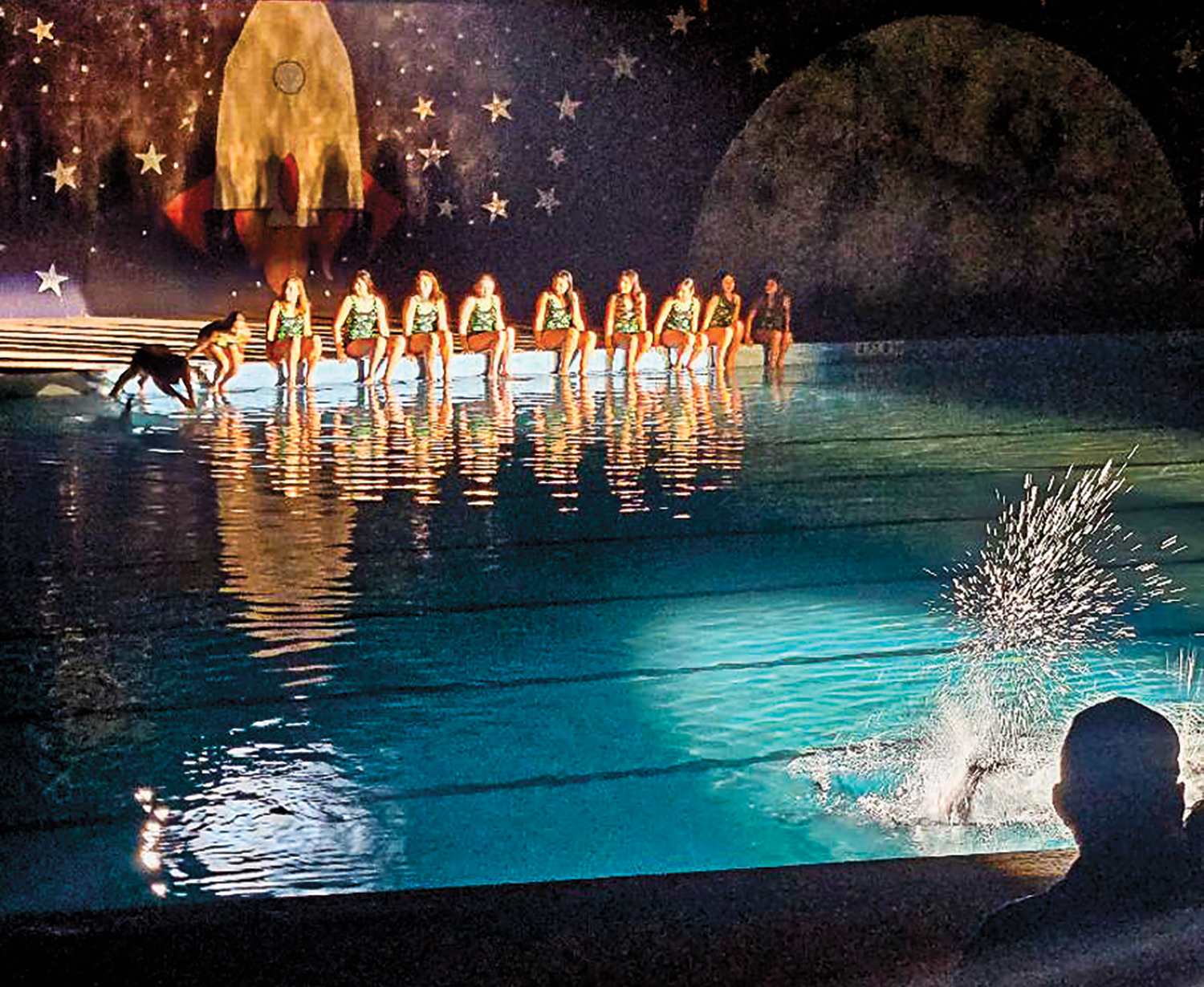
Every year the roughly one-hour show has a different plot and theme. Hopeful directors write a script and meet with the Water Carnival board to present their concept: the music, costumes, props, and their design for painting the 100-foot-long wall that serves as a backdrop. Once a director is chosen, they find volunteers to choreograph and direct each individual dancing or swimming act. Kids ages 4 and up start learning their routines in June while a crew of parents builds props. The week of Water Carnival, performers practice the entire show at night so they can get used to the dark water and spotlights.
The 2025 show, The Comanche Springs Encounters, was written and directed by Fort Stockton natives Dominique Luna and Cole Mitchell. It followed a family that comes to town to camp out and attend Water Carnival. The teenage children wander off, accidentally get blasted into space, and encounter aliens, astronauts, and anthropomorphized stars before returning to Earth. The storyline unfolds in segments a few minutes long, just enough to separate the swim and dance numbers.
Each year, younger kids learn simple dance steps; the first graders’ water act is more splashing than swimming. Other segments are elegant or impressively athletic. The defining feature of the Ladies’ Swim, for women who have graduated high school, is that none of the moves get the performers’ hair wet. The high school boys’ number is a showcase of feats of strength, such as a basket toss that flips one of the performers high in the air.
After the last act concludes, the cast emerges from behind the backdrop and dances as the crowd cheers. On Sunday, volunteers will disassemble the props and transform the amphitheater back into a regular swimming pool. And in a few weeks, the Water Carnival Association will begin planning for next year.
The 2026 Water Carnival theme, Stars and Stripes, commemorates the 250th anniversary of the signing of the Declaration of Independence, coinciding with celebrations being held across the country. The production was written by Angela Harral, who has performed, directed, and served on the board of the production over the years.
“It’s all volunteers,” Harral says. “We’ve kept it going so long, and yet the generations keep coming.”