
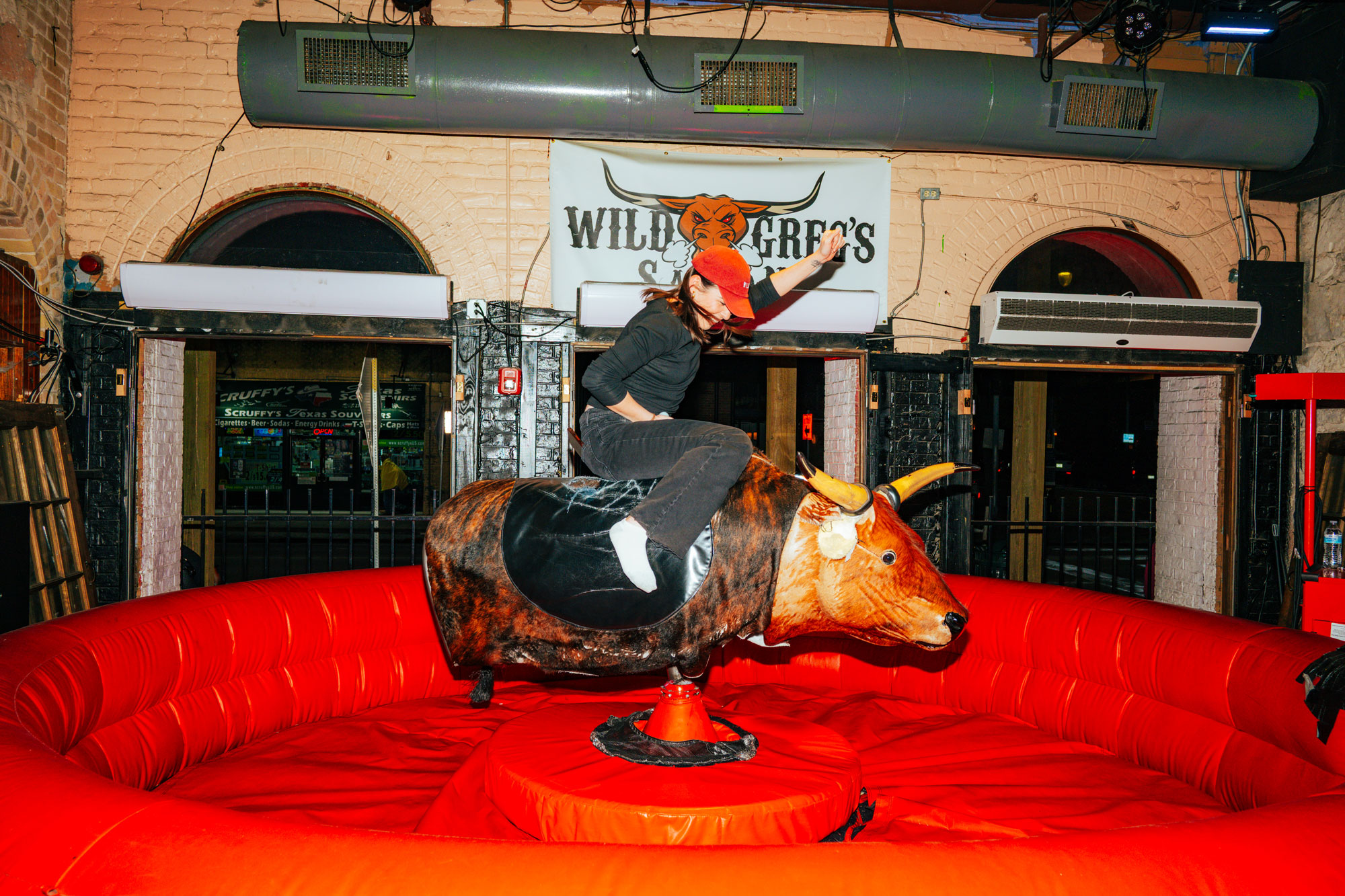
The first thing you should know about riding a mechanical bull is that it’s a lot like dancing. At least, that’s what Glen McIlvain tells me. I’m inclined to believe him. Before he started selling mechanical bulls, he spent nearly two decades riding real ones, winning the bull riding championship at the National Finals Rodeo in 1984. He was inducted into the Bull Riding Hall of Fame last year.
Pursuing a rodeo career was a foregone conclusion for McIlvain. His father, Frank McIlvain Sr., was a professional rodeo clown and bullfighter, and he grew up in Mesquite, the “Rodeo Capital of Texas.” At 18 months old, when his mother took him to the rodeo, he darted out of her sight. She found him seconds later climbing a fence to look at the bulls.

“I was just fascinated with them,” he says. “I always tell people that if I had been born at the racetrack, I’d probably be a racecar driver, but I grew up at the rodeo.”
By the mid ’90s, as his riding career was winding down, McIlvain transitioned to raising bucking bulls and selling a fleet of mechanical ones, too. According to him, while there might be a sizable difference in danger between the two—“A mechanical bull’s not coming after you when you get thrown off,” he says—some of the same principles apply: Whether you’re atop a nearly 2,000-pound bovine or a stuffed one in the corner of a crowded bar, the key to staying on is finding their rhythm.
“You have to be in motion with them,” he says. “If you’ve ever danced with someone who’s clubfooted, moving opposite to you, it’s just awkward. But when a dance partner follows your every move, it goes much more smoothly. That’s what you want.”
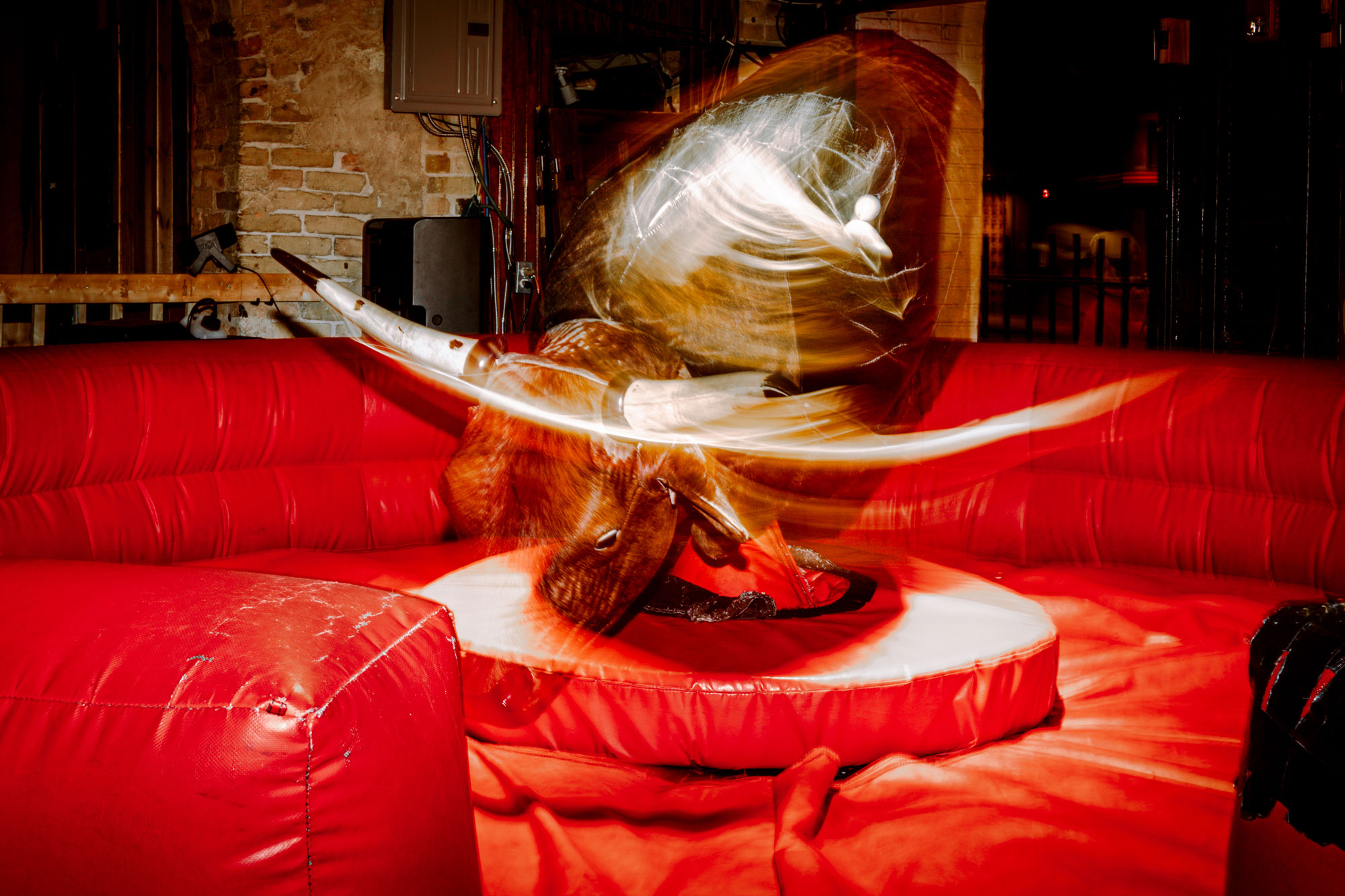
Unlike McIlvain, the closest I’ve come to bull riding is watching it play out from the safety of my seat at the rodeo. And while I grew up in Texas, my proximity to mechanical bulls never actually manifested in me riding one. That changed this year when I set out to right this wrong and get in the inflatable ring.
Before walking into Wild Greg’s Saloon on Austin’s Sixth Street, I consulted with Arnold Sanchez, the owner of Irving-based Silverado Ranch Mechanical Bulls, who comforted me by saying: “The best bull rider in the whole world is a 9-year-old gymnast girl. They’re Velcro-ed on, their balance is great, and their muscles are strong. It’s like a walk in the park for them.”
HOW TO RIDE A MECHANICAL BULL
TIP NO. 1: SIZE UP YOUR BULL
Every machine has a pattern, so if there are other riders ahead of you, take a minute to watch and observe how it moves.
“With a real bull, you’re dealing with a live animal that can twist and move in so many different directions; but with a mechanical one, there’s only a set number of motions,” McIlvain says. “That’s what some of the urban cowboys do, too: They come back to the same bars to watch and learn how to ride a specific bull.”
TIP NO. 2: BE KIND TO THE OPERATOR
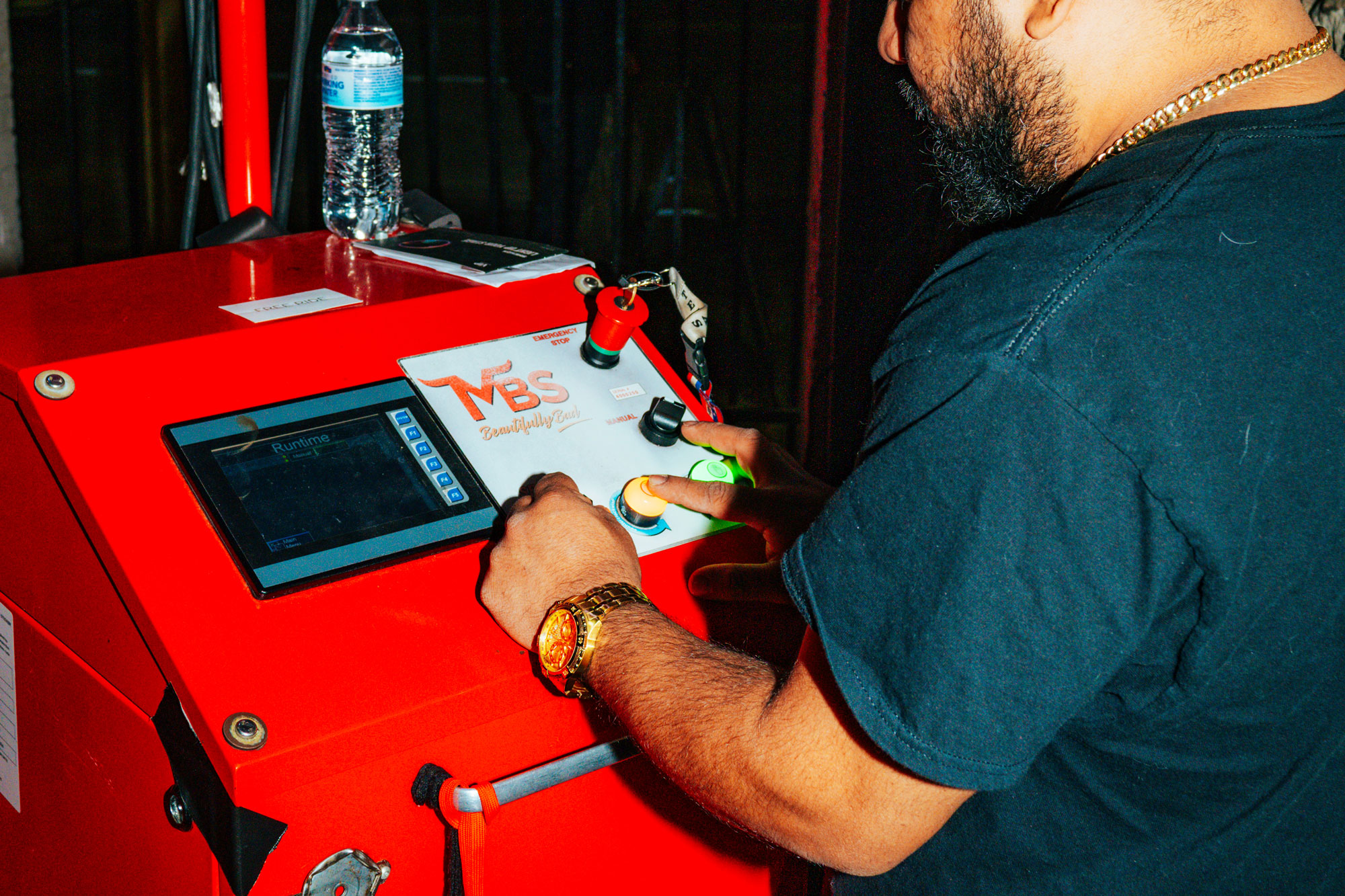
Once you enter the ring, you’re in the operator’s hands, so don’t give them a reason to crank up the dial from “easy” to “pro.” If it’s your first time riding, or you’re still getting the hang of things, a little kindness goes a long way. And unlike in a professional rodeo, where bull riders try to stay on the bull for at least eight seconds, inside an inflatable bull ring, operators make it worth the ride.
“We want people to last at least 30 seconds,” Sanchez says. “The point is to have people spinnin’ and grinnin’, so we try to gauge the riders and make sure they have a good time.”
TIP NO. 3: GET A GRIP
There are a few variations in grips you might encounter out there in the wild, from a simple loop handle to a rope strap. Either way, McIlvain suggests holding onto it with your dominant hand, using an overhand grip that’ll keep less tension on your wrist. Throw your free hand up in the air to act as a counterbalance once the bull starts bucking.
TIP NO. 4: IT’S ALL IN THE THIGHS
Your instinct might be to hold onto the handle as tightly as you can, but in reality, it’s your thighs that should be doing most of the work. Squeeze the sides of the bull and don’t get too distracted by your audience. Instead, focus on the back of the bull’s head to anticipate its next move. “When the bull zigs, you zag,” Sanchez says.
TIP NO. 5: BE ONE WITH THE BULL
Keep your legs tight, but your body loose. This is a balance game, not a test of strength, so when the bull’s head starts to tip down, don’t lean forward and risk falling forward, lean back instead.
“The best way to find your rhythm is to have the operator go real slow first, and that’ll teach you to move your hips and not fight the bull,” Glen says. “You have to start moving with it.”
In his experience, Sanchez says women typically make for smoother riders than men. “When they’re starting out, you’ll get a jock up there who just wants to be strong,” he says. “Those guys will tense all their muscles up and that just lets the bull jerk them around.”
TIP NO. 6: PREPARE FOR LANDING
While mechanical bulls are much safer than their real-life counterparts, there’s still a risk of injury. Every ride must come to an end, so when you feel yourself slipping off, make sure you let go of the handle, and don’t fight the motion. Then, roll to the sides of the inflatable ring or crash pad to make sure you’re out of the way of any foam horns. “If you start to fall,” Sanchez advises, “just let go and go with it.”