

A week after the rains of early April 1956, the cotton fields in the Rio Grande Valley had finally dried enough to plow. Farmhand Alfonso Robles was working the soil near the town of La Villa when he struck a rock, the size of a watermelon but far heavier, and lugged it out of the way. A year passed before the farm’s owner saw it and noted its resemblance to meteorites—rocks from space that have landed on Earth’s surface—she had seen in a museum. She contacted the science department at Pan American College in nearby Edinburg and asked the faculty to investigate.
Astronomy instructor Paul R. Engle chipped off a sample and sent it to Oscar Monnig, a known meteorite enthusiast who worked for his family’s eponymous department store chain in Fort Worth. Monnig analyzed the fragment and determined that it was, indeed, a meteorite—the first ever documented in the Valley. Monnig later visited the farmer and offered to buy the 43-pound specimen for his personal collection. But the owner decided to donate it to Pan American, now the University of Texas Rio Grande Valley, where the meteorite is displayed at the H-E-B Planetarium on campus.

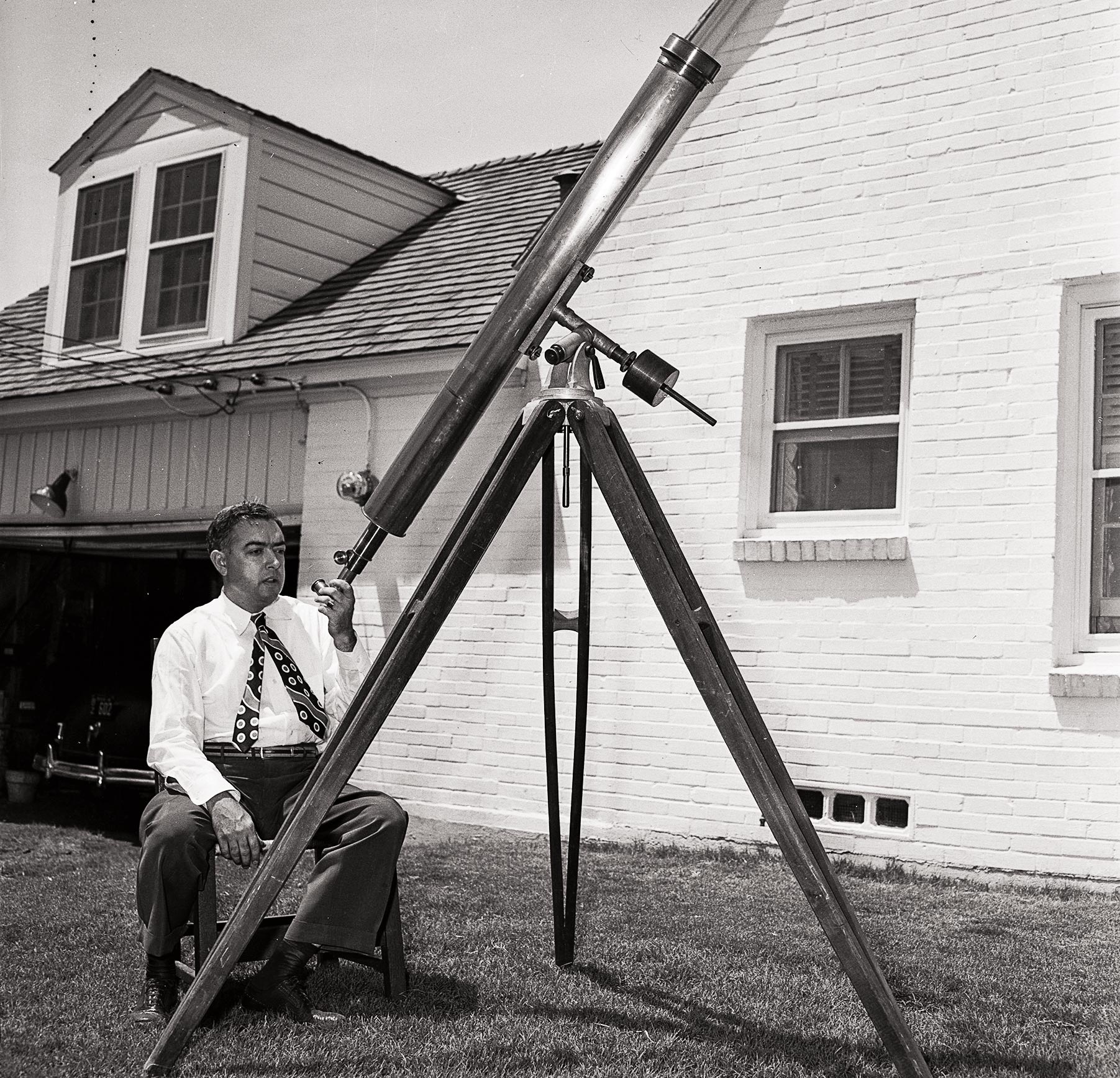
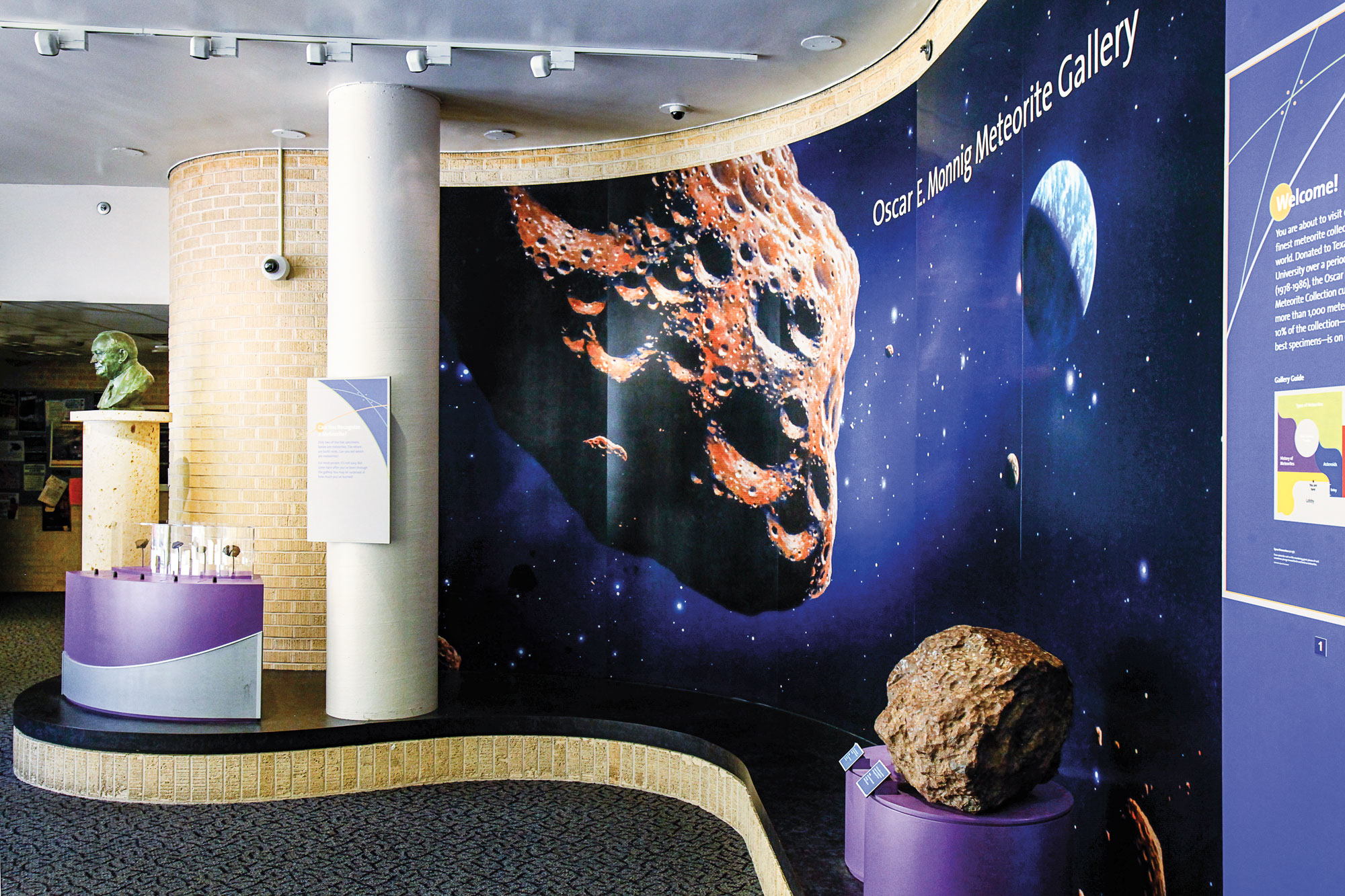
Although Monnig was primarily a businessman and had no formal training in planetary science, between the 1930-70s he assembled one of the country’s most significant collections of meteorites. He was one of three major collectors in the Southwest and regularly traded specimens with curators at the Smithsonian, one of whom wrote to suggest that the museum wanted to acquire his collection. Instead, Monnig left all his meteorites to Texas Christian University, which today boasts one of the largest collections at a university anywhere.
“He was definitely one of the most important meteorite collectors of the 20th century,” says Rhiannon Mayne, the curator of the Oscar Monnig Meteorite Collection and Gallery at TCU. She adds that, although he was not a scientist, his gift enables ongoing research in meteoritics. “Decades from now, people all over the world will get to request samples to study because of him.”
More than 99% of meteorites are from asteroids—rocks that orbit the sun. The remainder are fragments of the moon or Mars. Occasionally, they make headlines for crashing through roofs or into cars—in 1954 a rock plummeted into a house in Alabama, ricocheted off the radio, and hit a woman napping on the couch (she survived). But most that are recovered are found by dedicated searchers and collectors.
No geologic record of Earth’s earliest days exists, but because asteroidal meteorites formed contemporaneously with Earth 4.5 billion years ago, they offer valuable clues about our own planet’s history. “If you want to understand the very beginnings of our solar system, meteorites and samples from other bodies are the only things that are going to tell you about that time,” Mayne says.
Space exploration missions return similar samples, but at a hefty price. “Nature’s bringing us these for free,” Mayne says. “It’s an astonishing resource to understand the formation of our solar system.”
Born in 1902, Monnig began acquiring meteorites in the 1930s after visiting collections held at the Smithsonian and other museums. It was an unusual hobby that necessitated both the acumen to distinguish meteorites from other rocks and the ability to travel, purchase, and transport his finds, which sometimes weighed several hundred pounds. Itinerant salesmen for his family’s stores carried brochures with his contact information and instructions for identifying meteorites. He placed ads in Texas and Oklahoma newspapers: Meteorites wanted. Generous prices. Often found by farmers plowing. Generally black-crusted or brown-crusted rocks heavy for their size. Readers wrote him about unusually heavy rocks they’d been using as paperweights and doorstops, inquiring what he’d pay. Throughout the ’30s, Monnig offered $1 per pound for verified meteorites, a significant sum during the Great Depression.
When the papers reported a fireball streaking through the sky, Monnig would travel to where it had been spotted, up to 300 miles from Fort Worth. Armed with a highway map, on which he’d draw a dot representing each farmhouse he visited, he interviewed eyewitnesses: In what direction did you first see the meteor? What angle did the meteor’s path make with the horizon? He logged their responses in voluminous reports: “J.W. Richmond, Borger … was 4 mi. south of town. Had just got up and stepped into kitchen to light stove; was attracted by ‘real white-bluish flash’ outside … 5:56 a.m. CST. Duration of flight 3 or 4 sec.”
When Monnig identified a likely fall site, he contacted the landowner, asking permission to search or requesting that the farmer write him about any finds.
With modern technology, finding fallen meteorites is much faster. Around 5 p.m. on Feb. 15, 2023, residents of McAllen in the Valley heard a loud boom and saw a bright light in the sky. Some called the police to report an explosion. A thousand-pound meteor had entered the atmosphere over Texas, much of it burning up as it streaked toward the ground.
That night, Fort Worth-based attorney, geologist, and meteorite collector Phil Mani was contacted by a colleague at NASA who had used Doppler radar data to determine that the remnants of the meteor had landed in Starr County near the community of El Sauz. Mani checked county records and realized that, by sheer luck, he knew the landowner. Soon, Mani and a small team from NASA and Rice University were on the ground, combing the mesquite-covered terrain. Within hours, they had found the first pieces, the stones’ blackened crust vivid against the light-colored soil.
Meteorite hunts are urgent business. Rain, dew, and even fog can cause the iron in meteorites to oxidize, making it more difficult for researchers to glean data about their composition. The specimen from La Villa that Monnig identified had oxidized significantly during the years it had spent buried in the field and then exposed to the elements.
Mani and the team sent a sample of the El Sauz meteorite to the TCU collection, which has expanded significantly from the 400 specimens Monnig donated to the university in his later years. Today, the collection comprises around 2,500 specimens, and the gallery showcases a revealing segment of the cosmos. “I feel like every day I’m living out his wishes for what he left us,” Mayne says.