
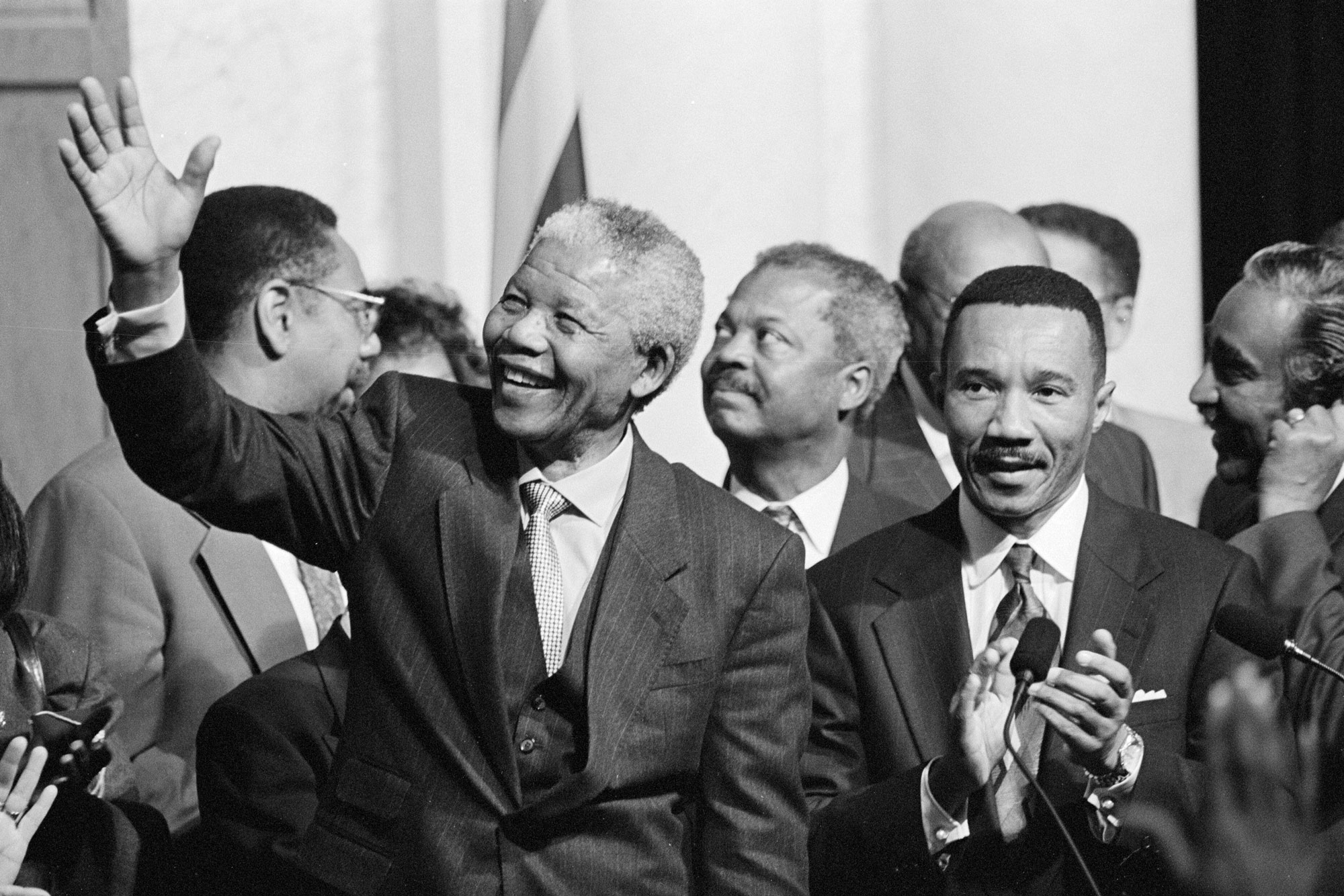
Nelson Mandela loomed large as a heroic figure during his life, first as an anti-apartheid activist, then as a political prisoner, and finally as South Africa’s first democratically elected president. However, in 2018, on what would have been his 100th birthday, his family grew concerned that people were forgetting his legacy. Thus, an exhibition was born.
Appearing first in London, England’s Leake Street Gallery in 2019, Mandela: The Official Exhibition then traversed sites in the United States including New Mexico, Indiana, Minnesota, and Oregon. It went on display in Texas in 2022 at the Bush Presidential Library; to celebrate, former President George W. Bush declassified letters between himself and Mandela to feature in the galleries.
The exhibition completes its seven-year run by returning to Texas, this time at the African American Museum of Dallas in Fair Park. This final stop is the exhibition’s first in an African American history-focused museum. Displayed in four interactive galleries, Mandela’s remarkable life story is told through private artifacts from his childhood, his fight for justice, his time in prison, and his presidency. The exhibition also lands just in time for FIFA World Cup crowds.
Though Mandela may not conjure up images of soccer, Margie J. Reese, chief program officer at the museum, points out, “Mandela leaned on sports in his quest to bring the country together.” As people gather in Dallas from across the globe to take in FIFA matches, many will head to Fair Park for the city’s FIFA Fan Festival, and while doing so, they can rediscover Mandela as both a person and a historic figure.

Sarah Hougan, the exhibition’s curator, culled from official documents and private family collections to bring Mandela’s story to the next generation. The items in the show, which is on display through Nov. 1, remind visitors of Mandela’s humanity.
“Personally, my favorite gallery is the one with the objects from [his youth in] Mqhekezweni,” Hougan says. “They’re the objects that he used to do his chores when he was a kid.”
In Gallery 2, titled “Early Years,” adults and kids can see items Mandela used when he was shepherding the community’s sheep or ironing his elder’s robes. Artifacts like a Thembu beaded pipe and the jacket shared by Mandela and his cousin Justice while they attended school at Fort Hare humanize the historic figure and remind visitors of the factors that shaped Mandela’s belief in justice and unity.
For W. Marvin Dulaney, historian and scholar-in-residence at the African American Museum of Dallas, there’s a strong personal connection to the exhibition. “I was intimately involved with fighting apartheid on this side of the ocean when I was in graduate school and throughout my life,” he says. “Mandela was really special.”
Dulaney remembers learning about the future Nobel Peace Prize winner when Mandela was serving a 27-year prison sentence for his anti-apartheid efforts in South Africa. For him, Mandela represented hope. Despite being jailed and persecuted, Mandela survived and went on to change South Africa forever. Dulaney wants children to learn that Mandela’s life “shows that if you take a stand, you can survive and you can make a difference.”
On my visit, Dulaney, Hougan, and Reese talk about the exhibition while the museum’s young interns have their own history lesson. With gloved hands, high schoolers and college students hold and examine relics of America’s history of segregation. Similar items from South Africa are featured in the exhibition’s third gallery, titled “The Struggle is My Life,” including a sign reading “Non-White Shop” and a photo of another sign warning “Beware of Natives.”
As I head out past the student interns, past the exhibition, and toward the museum’s doors, Dulaney says, “Mandela believed South Africa was big enough for everyone to live in it. And we want to model that our country is big enough for all of us to fit.” He hopes all visitors, young and old, leave feeling the impact of history and the power of unity.
Admission is free to the exhibition, and FIFA fans can find it just across from Fair Park’s Music Hall. Dulaney encourages visitors to keep an eye on the website for panels, symposiums, and other educational events throughout the run of the exhibition. He adds to give yourself ideally 90 minutes to fully experience the story being told.