
During my college years, my father harvested raw honey on our Brenham family farm. Infused with an unmistakable wildflower symphony, and thicker and sweeter than the store-bought kind, the honey from those Hill Country hives taught me to appreciate homegrown liquid gold.
Since that 100-acre farm was sold years ago, along with the bee boxes my father built and cultivated for years, I’ve been on the hunt for a comparable nectar. I think I found it, or at least something close to it, at a honey stand off of Lutheran Church Road in Tomball.
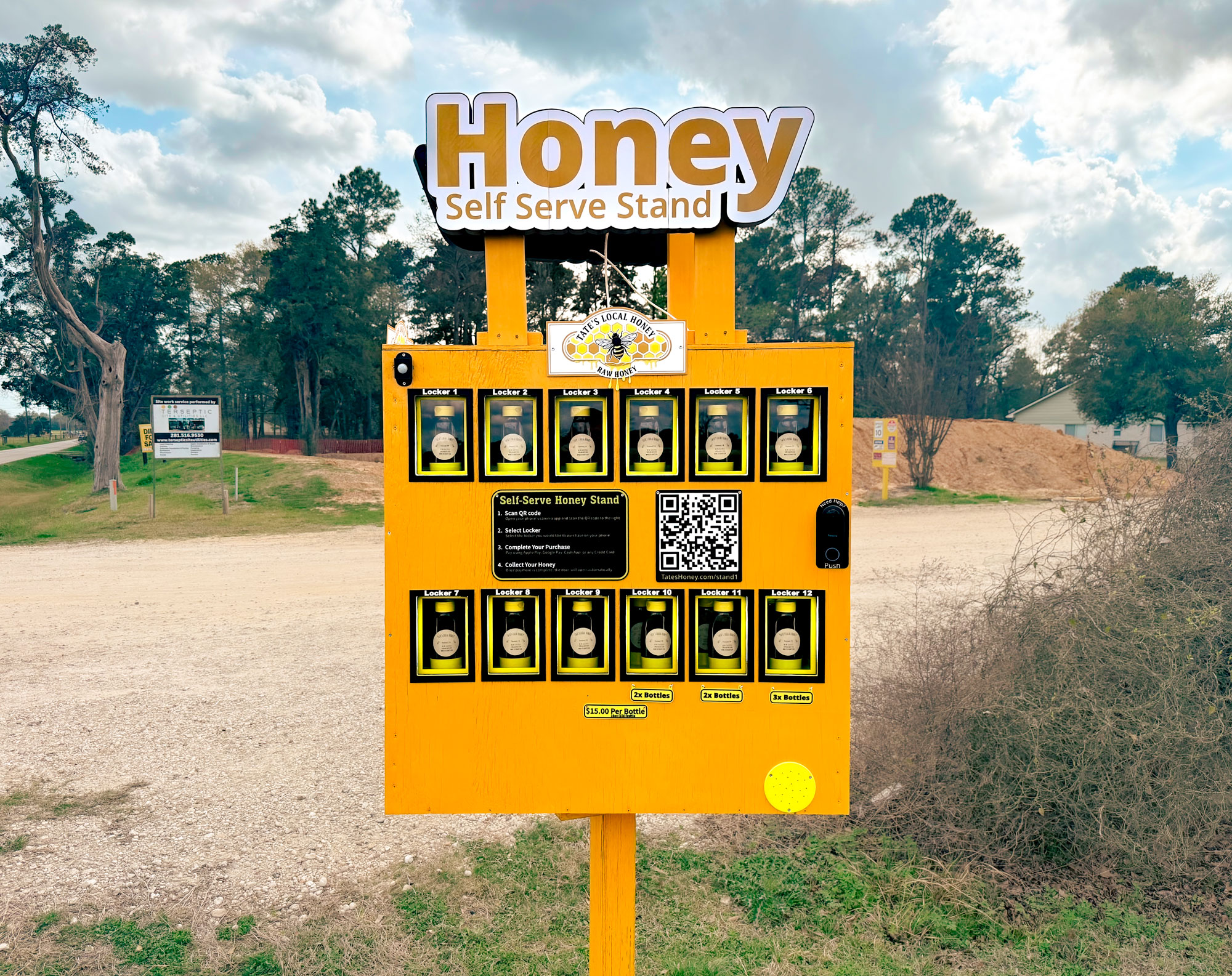
Nestled among sprawling hay fields and cow pastures, Tate’s Local Honey Stand is a self-serve honey dispenser that brings the old school farm stand into modern times. Drive too fast down this surprisingly busy road and you might miss this solar-powered golden wood structure that houses up to 16 plastic bottles of Tomball- and Hempstead-produced pure, raw honey at a time.

Roadside farm and honey stands are hardly a new trend. They’re a mainstay in rural and semirural spots throughout the South; in fact, I discovered my first honey stand outside of Nashville, Tennessee. Around Texas, you can find them at Bees and Blooms Flower Farm in Kountze and Prime Bees in College Station, to name a few. But since I’ve been on the lookout for them in and around the Houston area, where I live, Tate’s is the first I’ve come across that takes self-service to the next level.
While some classic roadside stands use the honor system, allowing buyers to drop cash in a wooden box for payment, Tate’s Local Honey Stand employs an efficient electronic system. You scan a QR code, select from one of 12 honey lockers, and complete your $15-a-bottle purchase in under a few minutes. Don’t be alarmed, like I was, by the AI-generated system that talks to you when you walk up, saying cute, albeit syrupy, bee puns. On my visit, it told a joke: “Who is a bee’s favorite singer? Bee-yoncé.” It’s all part of the roadside shopping experience.
For Zachary Tate, owner and resident beekeeper of Tate’s Local Honey, this independent stand was born out of necessity. His main line of work is manufacturing and selling basketball equipment at his family business, Pro Dunk. Beekeeping is a busy side hustle, though. When customers started stopping by so often to buy honey from him during the workday, he decided to launch the DIY setup to keep the honey flowing without interrupting his day job.
“I always had people text me after 5 o’clock when I left for the day, saying, ‘Hey, can I pick up honey?’ It never really worked out well for my schedule,” Tate says. “I’ve always tried to keep it small, but it’s hard to stay small with bees. They tend to like to propagate, and so you end up getting bigger and bigger. I’m just growing and outgrowing everything.”
The 10-year beekeeper’s side gig has become a buzzing enterprise, the kind of word‑of‑mouth operation that supplies locals from Tomball and beyond. Tate maintains 18 hives, housed on 70 acres in Hempstead and on a 16-acre Tomball property. The bees’ feeding area is absent of commercial agriculture, meaning there are no herbicides or pesticides, but plenty of wildflowers and local trees to feast upon.
Before the honey stand, Tate was selling a couple of bottles a day. Now, on weekends, he and his father often have to refill the roadside system.
“We really had no idea how much it would take off,” Tate says.
The busy bee he is, Tate engineered and constructed the kiosk with help from his brother, using 3D printing, AutoCAD, a Raspberry Pi (a tiny computer), and some old‑fashion woodworking to turn a small structure into a tech‑forward vending machine.
But instead of receiving ultra-processed sweets, snacks, and sodas, shoppers are in for a special kind of homegrown treat: the pure flavor of dark-hued honey infused with the richness of the Southeast Texas terroir.