It’s tough to complete a long Texas drive only listening to the radio. Past one city’s last broadcast tower and short of the next, the FM band offers little but crackling oldies and syndicated talk. The phone plugged into the dash might tempt you to cycle through a well-trod playlist.
Scan a little longer, though, and you may receive a low signal from a nearby campus, where the DJ is playing exactly what they please: perhaps Peruvian psychedelic cumbia, spiritual jazz, or a local punk band’s debut. In most Texas college towns, a student-run radio station airs music you likely wouldn’t have discovered anywhere else.

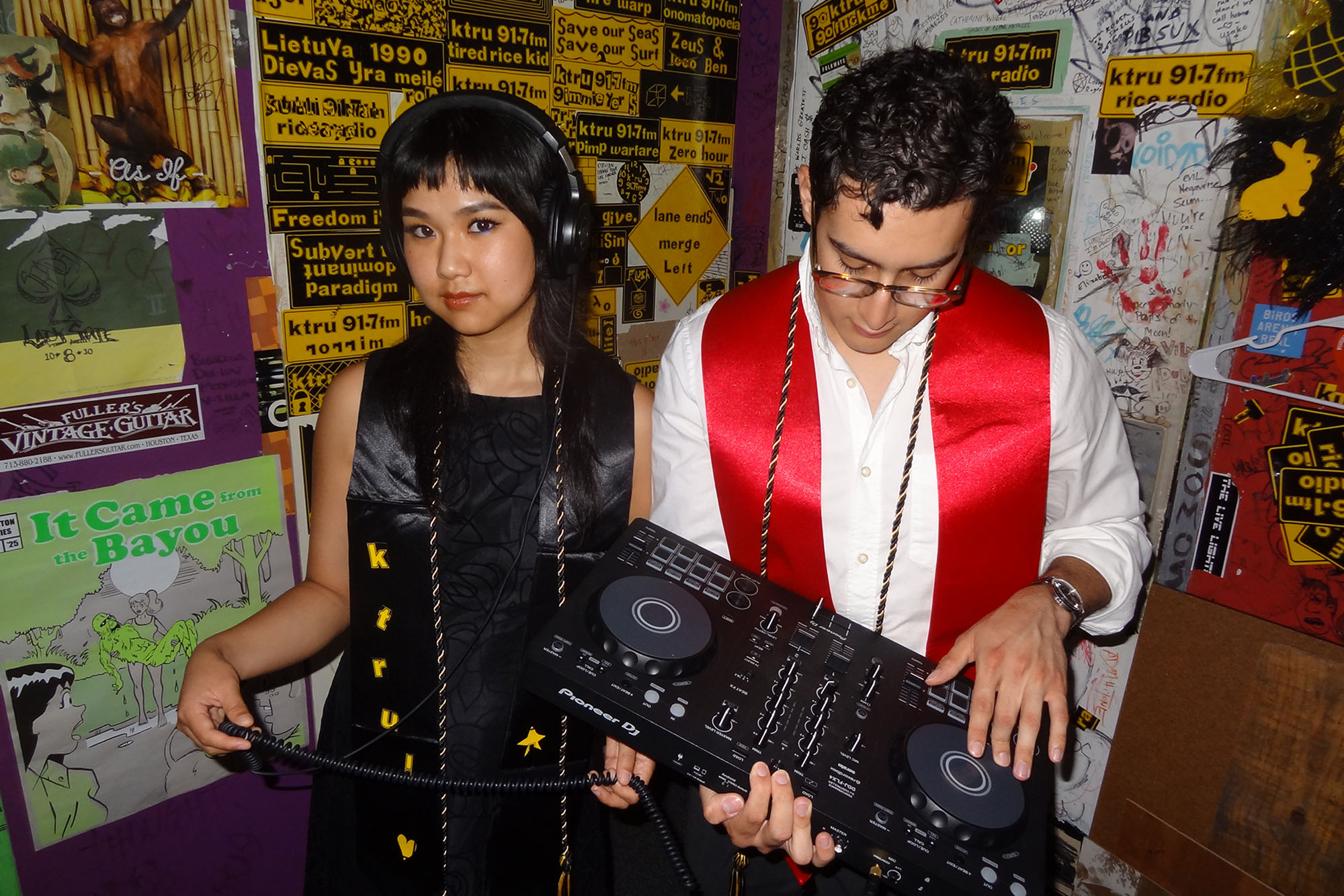
Start in Houston with KTRU 96.1 FM, which began in 1967 as a two-watt signal Rice University students wired through steam tunnels to a single dormitory. The station has been freeform from the start—meaning the DJ on duty decides what airs—but by the 1980s, its hosts leaned hard into the underground and experimental.
In 1985, its schedule included chickenskin, devoted to blues, folk, and bluegrass, and Mutant Hardcore, spinning punk and indie vinyl. Both are still on the air today. “I always cringe when someone says KTRU has a certain vibe,” says Chloe Diehl, a Rice undergraduate and the station’s manager. Diehl hosts Global Grooves, spotlighting a different international subgenre each show, like Italian nu-disco and Mexican experimental rock. Rather than cater to a taste, she says, the station is a “musical catalyst” for DJs and listeners to “experience sound journeys they wouldn’t typically encounter.”
The station’s independent programming nearly ended in 2010, when Rice announced it would sell its 50,000-watt tower and license to the University of Houston for $9.5 million. A “Save KTRU” campaign petitioned the Federal Communications Commission, but the sale went through, and the old 91.7 FM frequency went dark in April 2011. Four years later, the station returned with a 41-watt antenna atop Rice Stadium, now reaching about five miles. Drivers farther out stream online.
KTRU’s physical music library, though, remains intact. The collection reaches deep into the Texas underground, its shelves stocked with the likes of Red Krayola and Butthole Surfers. For its 50th anniversary in 2017, KTRU even coaxed the reclusive Houston musician Jandek onstage for a rare public show.
An hour-and-a-half drive northwest, College Station’s KANM 106.7 FM still crafts its rotation by hand. DJs at Texas A&M University bring records to weekly meetings, argue their merits, and democratically elect which tracks go to air. Outside the studio, KANM books regional independent acts for its concerts in downtown Bryan.
The station, founded in 1973, survived for decades on campus cable and web streams. As station manager from 2024 to 2026, recent A&M graduate Nayab Warach helped secure an FM license and return programming to the airwaves, protecting what he calls the “authentic human experience” of college radio.
“KANM leans heavily alternative, but we play every genre,” Warach says. “We have no algorithm, no hidden agenda, and no paid music industry marketing behind us. We’re just 110-plus DJs and 400-plus A&M students who love music and love sharing it.”
The University of North Texas transmits KNTU 88.1 FM at 100,000 watts from a former Nike missile base in Denton, covering much of the northern metroplex. The station debuted on Halloween 1969, airing Orson Welles’ War of the Worlds. It was then managed by Bill Mercer, who became a longtime radio voice of the Dallas Cowboys.
In 1981, KNTU adopted a jazz format to complement UNT’s eminent jazz program. It switched to alternative on July 29, 2022, opening the era with the White Stripes’ “Icky Thump.”
The last stop is Austin. With the city’s FM band full, student DJs at the University of Texas spent the 1980s trying to get on the air at all. But in 1994, KVRX 91.7 FM arranged to share the last open noncommercial frequency in town with community station KOOP, which takes the daylight hours.
KVRX gets the night, fitting for its after-dark identity. The station’s tagline—“None of the Hits, All of the Time”—dares listeners to always opt for obscurity. DJs may only play artists whose monthly listeners on Spotify fall below a ceiling of 250,000.
Since 1988, the station’s studio has hosted up-and-coming acts every Sunday for a show called Local Live. Spoon, Explosions in the Sky, The Black Keys, and Death Cab for Cutie all recorded early sessions at KVRX.
Layla Williams, a UT undergraduate who spins as DJ Smiles, hosts a show called SPELLBOUND! Each Tuesday, Williams defines a word and selects an hour of songs around it, one for each letter. She has little patience for automation.
“The more streaming services integrate AI and try to improve the algorithm, the worse they make it,” Williams says. “Sharing songs has been a love language for a long time. It’s 10 times better to get your music recommendation from someone else with ears rather than a computer.”