
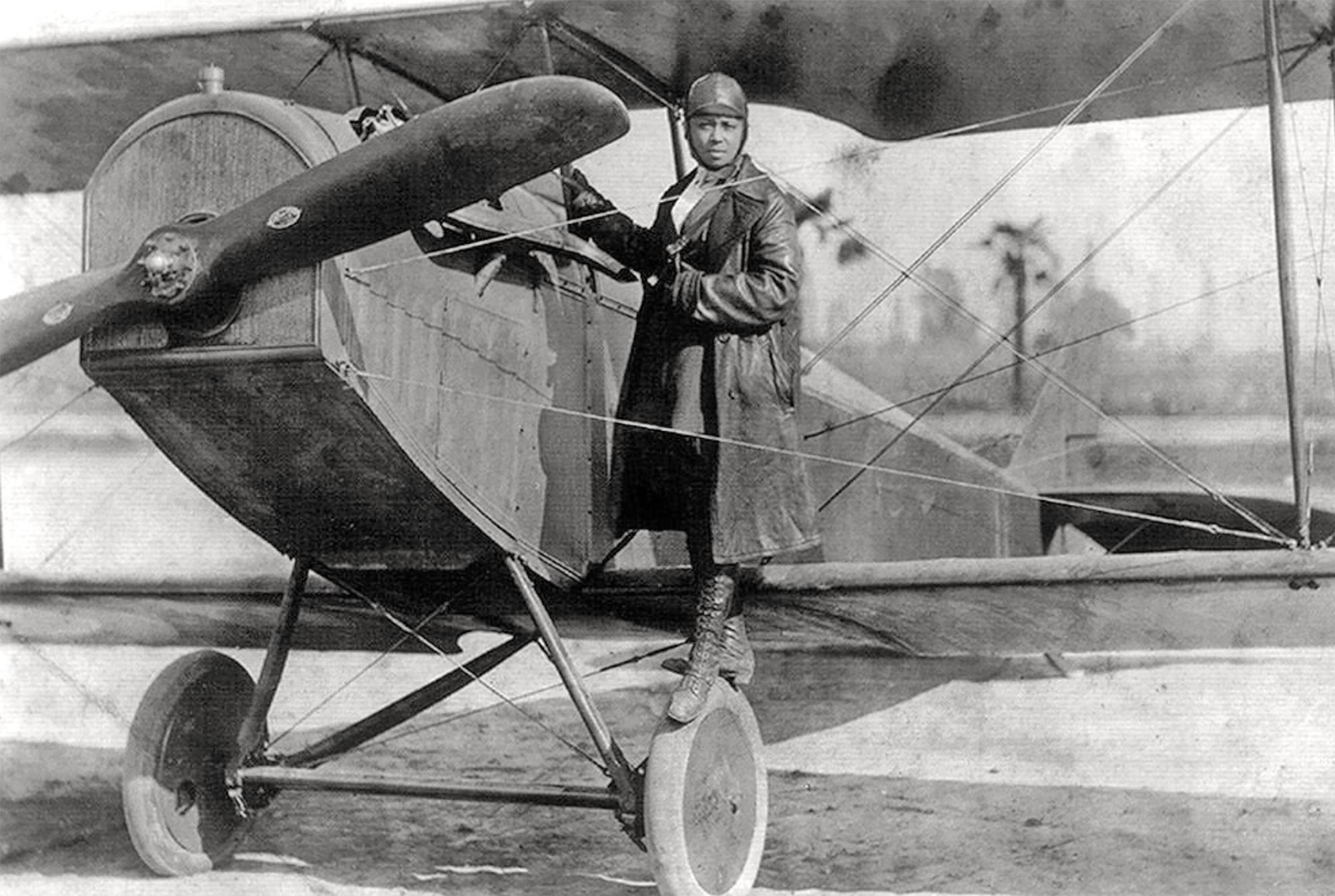
A crowd of Texans gazed upward as a World War I Curtiss JN-4D “Jenny” plane flew through the sky in loops, dives, and barrel rolls. The performance, held in Houston on Juneteenth 1925, resembled European exhibition flights that took off after the war as a result of the increased supply of aircraft and trained pilots. Europe is where the plane’s aviator, 33-year-old Bessie Coleman, learned the ropes of aerial performance and earned a reputation as “one of the world’s greatest fliers,” according to a 1922 article in the Chicago Whip.
She was the first Black woman in the world to become a licensed pilot. And her home state of Texas was getting a glimpse of her skills up close.
“I can’t think of one female pilot around the globe who hasn’t been influenced by Bessie,” says Abigail Erickson-Torres, president and CEO of Frontiers of Flight Museum in Dallas. “She was the one who started it all.”

One hundred years after Coleman’s tragic death, the museum is honoring her with an exhibit, on display all year, about her legacy as a stunt pilot who defied odds and broke barriers for women of color.
“She was tenacious. She had style. She brought that personality and the beautiful culture of the story of America and all its diversity to the fray,” Erickson-Torres says. “She brought America to the world.”
Born in the East Texas town of Atlanta in 1892, Coleman grew up on a small plot of land in Waxahachie, 30 miles south of Dallas. Her father abandoned the family in 1900, leaving Coleman’s mother, Susan, to raise their 13 children. Though she couldn’t read, Susan would gather books from a traveling library that came to town a few times a year, always ensuring she brought home volumes about Black history. To help her family financially, Coleman and her siblings picked cotton in local fields.
After graduating high school in 1910, Coleman moved to Langston, Oklahoma, to attend the Colored Agricultural and Normal University but dropped out after only one semester because of the cost. She moved to Chicago instead to live with two of her brothers and enrolled in beauty school, eventually working as a manicurist.
After hearing stories of women pilots in France from her brother John, who traveled there while serving in the military, a new dream started to blossom. Coleman, then age 27, decided that could be her, too. She applied to nearly every flight school in the U.S., but none would accept African Americans. So, she reached out to her friend Robert S. Abbott, the editor and publisher of Chicago Weekly Defender, an African American newspaper. He helped her apply to schools abroad, which were far less restrictive.
“Despite facing racial and gender bias, she still wouldn’t let anyone tell her no,” Erickson-Torres says. “When she said, ‘I want to learn to fly,’ she took it all the way.”
In November 1920, Coleman set sail for France; she had been accepted into the country’s most famous flight school, the Ecole d’Aviation des Frères Caudron at Le Crotoy. Coleman spent 10 months there learning the intricacies of flying. After passing the final qualifying test from the Federation Aeronautique Internationale, she officially became a licensed pilot.
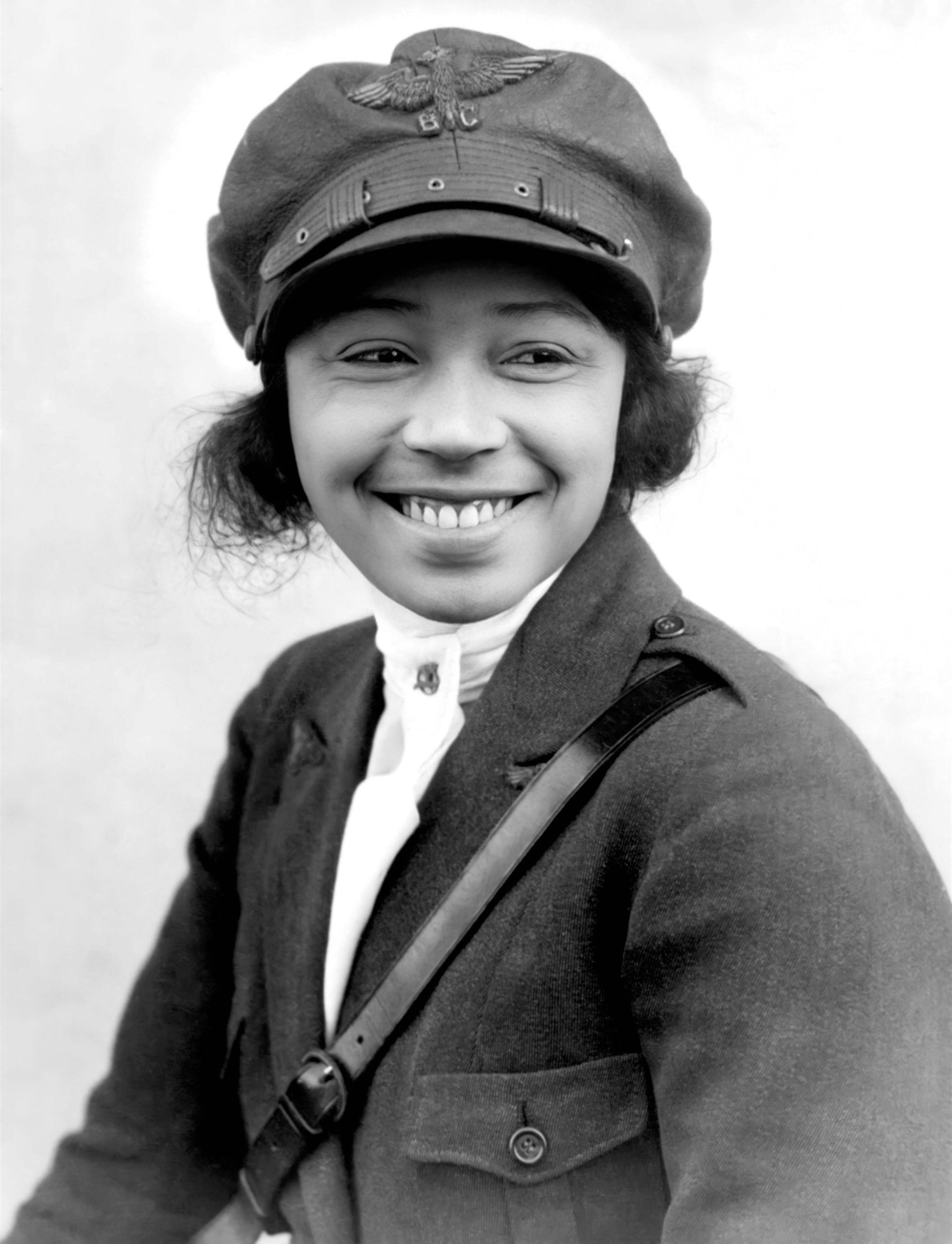
When Coleman returned to the U.S. the following year, she was welcomed by reporters from across the country, a rush of publicity that accelerated her flying career. She performed “barnstorming” air shows, characterized by daring aerial tricks, across America and Europe, forming figure eights and loop the loops thousands of feet in the sky. She also spoke in schools and showed films of her performances to teach students they could have a career as a pilot.
Though she was “besieged by promoters and moving picture magnates,” according to the 1922 Chicago Whip article, Coleman remained discerning in what she chose to work on. When she was supposed to star in Shadow and Sunshine, a full-length feature film, she reportedly walked off set when she saw the movie would portray African Americans in a derogatory way. “No Uncle Tom stuff for me,” she declared. Instead, she worked to raise funds to buy her own plane and fulfill her real dream: starting a flight school for African Americans.
She purchased a surplus JN-4 “Jenny” with an OX-5 engine, a style of plane used during World War I. But when she flew her new plane for the first time during a 1923 air show in California, tragedy struck. Shortly after the plane took off, the motor stalled at 300 feet and the plane nosedived. Coleman made it out of the crash alive but had a broken leg, a few cracked ribs, and cuts on her face. Accidents like these were common; that year, the U.S. had 179 barnstorming accidents, resulting in nearly 100 deaths.
Still, her faith wasn’t shaken. She sent a telegram to her friends from her hospital bed, which read “Tell them all that as soon as I can walk, I’m going to fly!”
She lived up to her words, and in 1925 returned to Texas to perform a series of flights. On Juneteenth, she performed the unforgettable show in Houston. In Wharton, she decided to parachute from her plane after the original parachute jumper got sick, leaping at 3,000 feet and landing in the center of an enthusiastic crowd.
Only a year later, though, tragedy struck again. On April 30, 1926, while conducting a test flight for a show in Jacksonville, Florida, Coleman’s plane malfunctioned, causing it to spin and crash from 2,000 feet. She died in the accident, along with her mechanic and publicity agent William Wills, who was flying the plane. She was 34. Her death stunned the nation, and more than 10,000 people attended her funeral in Chicago.
Years after Coleman paved the way for women pilots, the share of women in the industry remains small. Only 9% of pilots are women, and fewer than 150 Black women across the country hold a pilot license, according to Sisters of the Skies, a Pearland nonprofit.
There are aviation organizations trying to shift that narrative. Coleman’s great-niece, Gigi Coleman, serves as president and CEO of Bessie Coleman Aviation All-Stars, a Chicago program that introduces youth to aviation.
Ruth Calix joined the program as a high school student and went on to attend St. Louis University, earning her master’s degree in aviation. She now works as a safety programs analyst for Endeavor Air, where she keeps a Barbie doll of Coleman in her office cubicle to remind her of the aviator’s legacy.
“There’s a place anywhere that you make it,” Calix says. “There’s going to be people who try to tell you to pick something more attainable. Don’t listen to that. Whatever it is that you want to do, you can achieve it.”