

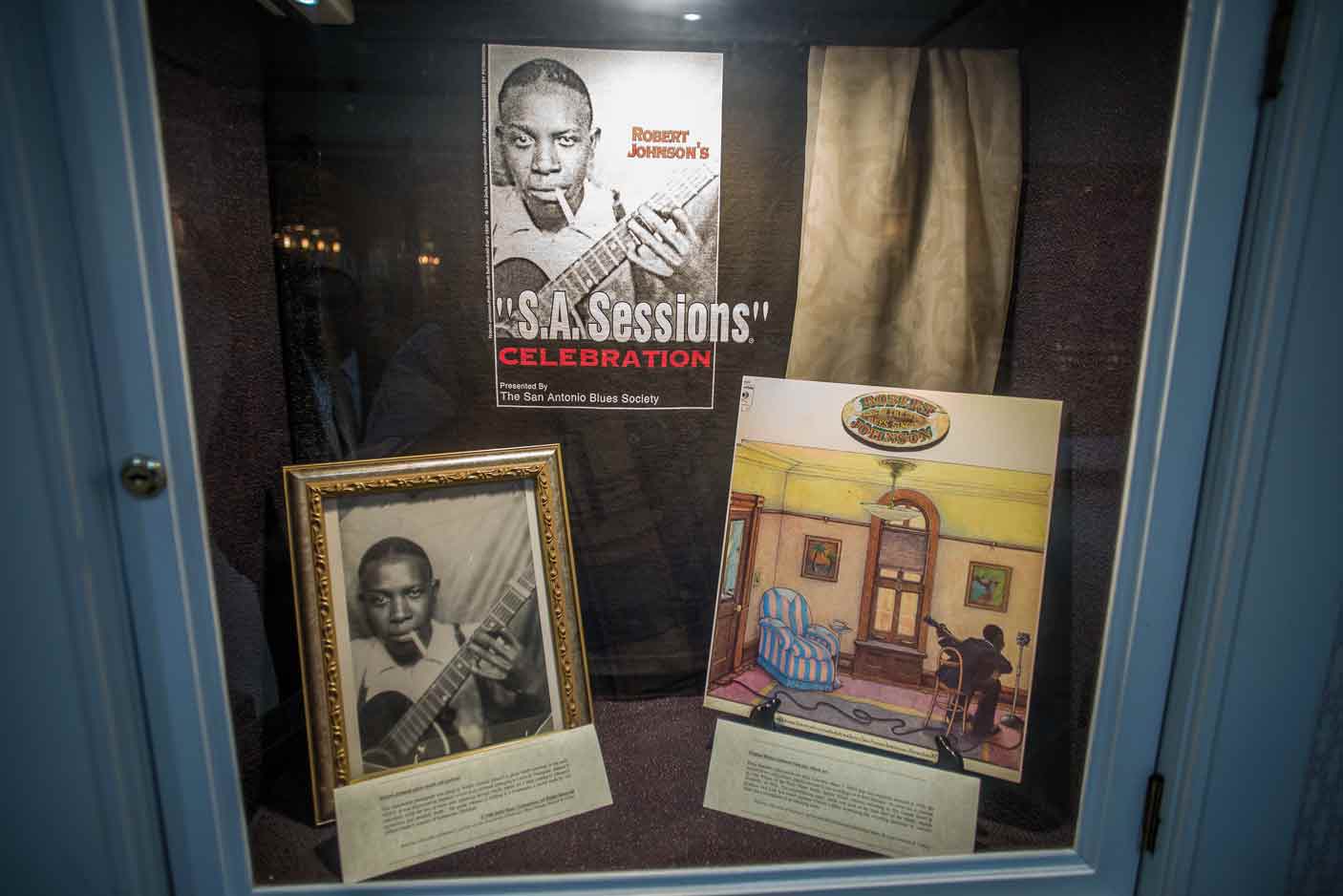
Texas music recording history changed forever on the fourth floor of a hotel on San Antonio’s River Walk. For three November days in 1936, Room 414 of the Gunter Hotel, now owned by Marriott, was a studio for future Delta blues legend Robert Johnson. On a mobile recording unit operated by music executive Don Law, Johnson performed 16 songs that became the most enduring documentation of the early history of popular music.
Bob Dylan and Keith Richards are just two musicians among thousands who count these songs, like “Sweet Home Chicago” and “Cross Roads Blues,” as direct influences on their life’s work. Heartland rocker John Mellencamp and English folk singer Billy Bragg even followed in Johnson’s footsteps, recording in Room 414 in an effort to inject their music with some of the bluesman’s magic.
Fast forward 90 years, and Texas retains an underdog status among the behemoths of the recording industry. This is despite producing some of the most influential recording artists in history—from Willie Nelson and Scott Joplin to Selena and Beyoncé—and multiple genres bearing the state’s name, like Tejano and Texas country. Still, the state that once shipped its stars elsewhere to record will probably never be Nashville. But in refusing to conform to the industry, it has become a destination for artists from all over the world.

The earliest music recordings in Texas were nomadic. Dubbed “field recordings,” they were popularized by John Lomax in the early 1900s. The folklorist and musicologist traversed the state, recording “cowboy songs” at homes, ranches, and prisons.
After World War I, the mechanisms to record the music of Texas—blues and “hillbilly” music, as it was deemed then—still didn’t exist here. Labels like RCA and Decca started planting talent scouts throughout the South, looking for musicians to pluck from obscurity and ship to recording powerhouses like Chicago and New York. Fiddler Eck Robertson traveled to New York in 1922 and pleaded with RCA to cut six tracks, the first major country records. In the mid-’20s, Blind Lemon Jefferson was brought to Chicago to make his first recordings.
“Those major record labels came south once they realized there’s talent here,” says Jason Mellard, a professor of music and Texas history at Texas State University.
The Great Depression caused the record industry to falter despite isolated recording sessions like Johnson’s. Shellac, the material used to make most records, was rationed during World War II, which further slowed record production. The American Federation of Musicians’ strike, spanning from 1942-44, also didn’t help matters.
“The majors pulled back after World War II,” Mellard says. “That’s when all of these smaller recording studios and record labels started to flourish.”
One such story is of SugarHill Recording Studios, opened in 1941 as Quinn Recording. The Houston institution bills itself as the “oldest continuously operating recording facility in the U.S.” The studio first made waves in 1946 with Port Arthur-based Cajun fiddler Harry Choates’ song “Jole Blon.” In 1958, the Big Bopper cut breakthrough hit “Chantilly Lace” at the studio, then named Gold Star. His stardom was cut short less than a year later when he died in a plane crash with fellow Texan Buddy Holly and teen sensation Richie Valens.
That same year, a clean-cut country singer waltzed into Gold Star and made some of his first recordings. Putting down an early version of “Night Life,” Willie Nelson was still very much in the Nashville system, worlds away from the Texas outlaw country he would eventually help develop. Outside of scattered singles and live recordings, popular country music had been made in Nashville, New York, and Los Angeles.
Mellard points to Nelson’s 1975 album Red Headed Stranger, recorded at Autumn Sound in Garland, as an example of Texas’ growing influence on the industry. “I think he chose to make that album in Texas because he had a specific vision for how he wanted it to go,” Mellard says.
At the time, Texas country was two things at once. It was a new way to market Waylon Jennings and Jerry Jeff Walker, but it also let artists like Nelson make records their way: edgier, rawer, and with their own backing bands.
As Nelson was finding his Texas sound in DFW, Hector Saldaña was honing a type of Tex-Mex, Beatles-influenced rock at his house in San Antonio. One day in 1977, his father suggested he and his band, the Krayolas, record some songs at Zaz, a little studio near his office on the west side of the city.
“I didn’t really even realize the historic implications of that studio,” he says of Zaz, which closed in 2015. “If you were making conjunto music, if you were doing anything like the early Tejano music, you were recording it there.”
Now the Texas music curator at the Wittliff Collections and a longtime music writer for the San Antonio Express-News, Saldaña says the ’70s were a transitional moment. Texas had superstar artists like accordionist Flaco Jiménez but not the in-state recording infrastructure to help big-time acts break through.
“They might have called themselves producers,” Saldaña says of the personnel working in Texas then. “But they never produced a hit.”
Some Texas musicians didn’t even bother with so-called producers, figuring they could do it themselves. Houston rap, which came of age in the 1990s, further exemplifies Texas’ otherness. Rap-A-Lot Records, home of the Geto Boys, Devin the Dude, and Bun B, formed because coastal record labels passed over Southern hip-hop. The group Screwed Up Click was particularly DIY, choosing leader DJ Screw’s home in the South Park neighborhood of Houston as its base. Screw would record freestyles and produce and sell tapes, all from his house, without the help of a major label. He invented an entire genre—chopped and screwed—in the process.
“DJ Screw was not about creating a recording empire,” Mellard says. “You went to his house, and you made a recording in the back room. They weren’t trying to set up a new empire in the way that some of the Atlanta guys were.”
When producer John Painter started the Kitchen Studios in Dallas during the mid-’90s, recording artists like Erykah Badu, Andre 3000, and Charlie Sexton had labels paying for extensive sessions. But over the past 10 years, physical media sales have been supplanted by streaming, which does not pay artists nearly what they made in the past with records and CDs. This has all changed how studios are used.
“People don’t come in with the attitude that we’re going to block out some days and do an album,” Painter says. “It’s more like, we’re going to come in for a couple of hours and do a song at a time. It’s a little more piecemeal.”
Lisa Fletcher, who co-owns Arlyn Studios with her husband, Freddy, confirms the trend. But, she says, there are still artists who want to use the studio, which Freddy opened in the old Austin Opera House in 1984, like Nelson did. Blues guitarist Gary Clark Jr. likes to spend weeks at a time working out songs. He’ll record a few tracks, play some shows, and come back to finish things up. Fletcher says he might spend a cumulative four months at Arlyn working on an album. “He loves to be in the studio and be writing,” she says.
Clark recorded a cover of Johnson’s “Cross Road Blues” with Guns N’ Roses guitarist Slash last year, and he’s cited Johnson’s songs recorded at the Gunter Hotel as an influence.
“The recording studio business is still alive and well,” Fletcher says. “It’s different, but it’s doing well.”