

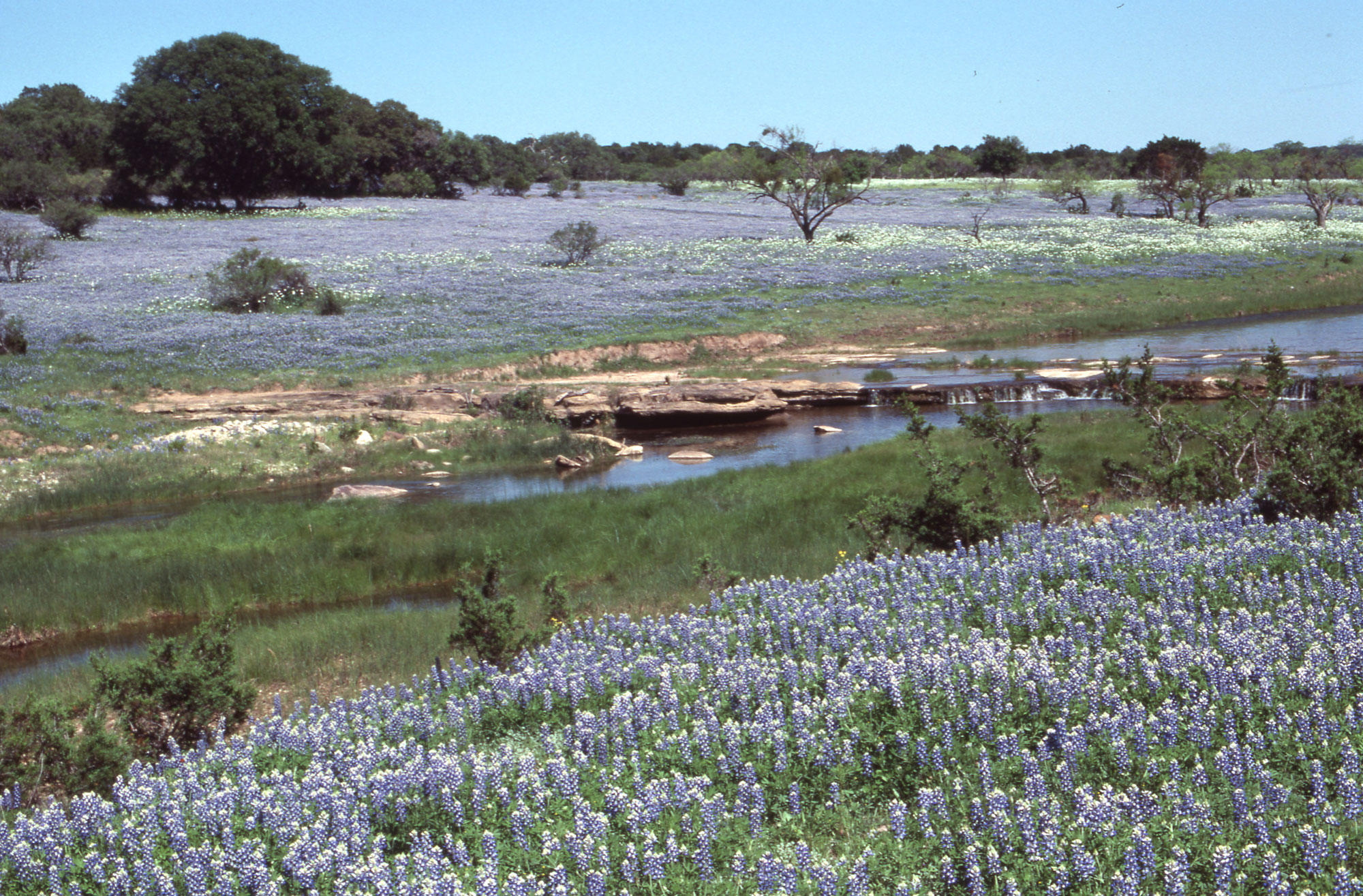
Springtime in Texas is marked by deep shades of indigo peppering the roadside. Patches of bluebonnets paint the pale brown grass that the fleeting cool of winter and now-lingering sun has washed out. Rainfall determines just how bountiful each season will be.
In the Hill Country, the blooms are usually dense, attracting swaths of tourists to swerve to the shoulder and bask in the state flower. And in San Marcos, where many Coahuiltecan descendants reside, the bluebonnet’s distinct hue is a reminder of their ancestors’ path to find water in a time of drought as they discovered an everlasting spring. Members of the Indigenous Cultures Institute, a nonprofit dedicated to the preservation and revitalization of Coahuiltecan heritage, honors this story today and the commitment toward the lands that cared for its people so long ago.
“When the ancestors first arrived here, they already knew the instructions to survive and thrive as humans,” says Maria Rocha, secretary of the Indigenous Cultures Institute. “We are working hard to restore that relationship.”

The Coahuiltecans are descendants of one of Texas’ first Indigenous groups that originally lived between modern-day Mexico and San Antonio. Originally comprising multiple Indigenous groups, it is likely that in the days of post-contact with settlers, populations were merged under one language umbrella as “Coahuilteco.” Lineages and records were further lost following the formation of the Texas republic and missionization. Today, Rocha and ICI share knowledge of the Coahuiltecans, their ancestral lands, and the bluebonnet through educational programming, an annual powwow in San Marcos, and theatre.
In 2017, the Dallas Children’s Commission approached Rocha and her adopted daughter Roxanne Schroeder-Arce to develop a play depicting the Indigenous origins of the bluebonnet. Other narratives at the time tended to revolve around Comanche accounts, but Rocha and Arce considered this an opportunity to tell a story about Coahuiltecan culture and the enduring connection between their people and the land.
Their play, Yana Wana and the Legend of the Bluebonnet, details the journey of a young girl named Maria connecting with her Indigenous heritage after spending a few weeks with her grandmother in Laredo. On a stage composed of branches, Maria learns of Yana Wana, a Coahuiltecan child who followed a deer to the sacred waters of the San Marcos springs to save her people from a dry season and saw the very first bluebonnets in Texas.
Yana and Maria’s tale echoes the Coahuiltecan creation story, known as Napako, that says their ancestors came from the Earth through the waters of four springs in Texas: Barton Springs, Comal Springs, San Pedro Springs and the river in San Marcos. In November 2023, San Marcos unveiled a mural titled Coahuiltecan Guardian Spirits of the River and Medicine by artists Ernesto Hernandez and Cindy Tobar. It is a visual depiction of this creation story.
Rocha developed the play to echo the messages of restoring the environment and caring for one another that the Indigenous Cultures Institute models for future generations. “Here in Western culture, we’re orienting them to a very, very different way of receiving the world,” Rocha says. “We can help our children adjust and see that they walk in two worlds, and they have to be able to see the differences and navigate colonial influences on us all the time.”
This message of the institute and play ring especially loud this spring, as members of the ICI gathered in March to bless the waters of the San Marcos River following a city-wide veto of a proposed AI data center in the city. In the stories passed down to Rocha, and those that she shares now as a community elder, water has proven to be a lifeway to the Coahuiltecan people, in both survival and culture. In a fictional Laredo, Yana Wana’s protagonist was guided by the lessons of her elders to bring water to her family and friends and honor her heritage. This same message remains in San Marcos as the community bands together for the springs.
After conducting a series of live shows, the play is now available for digital streaming with accompanying discussion guides for educators. Inquiries for access and booking can be forwarded to ICI. The Indigenous Cultures Institute also provides opportunities to learn more about Indigenous culture through the annual Sacred Springs Powwow at the Meadows Center for the Environment in San Marcos each fall. In the summer, the institute also hosts a youth summer camp where attendees can take part in Indigenous art and ceremony.
Like Yana Wana, who once found her way to the water by following the path set forth by wildflowers and deer, Rocha believes a return to knowledge of the past is key to maintaining a relationship with the Earth today.
“Everybody here in Texas has ancestors, and those ancestors, whether they were from this land or from Europe, Africa, or Asia, those ancestors lived in the natural way and had a grasp of what balance from Mother Earth was about. They wanted to survive,” Rocha says. “We should all be looking back to our ancestors and asking, ‘How can we help ourselves today?’”